↑↓ navigate ↵ open Esc close All results →

Best 5-1/2-Inch Circular Saw Blades of 2026

Forcing an ill-fitting arbor bushing onto a spindle is the fastest way to make a new circular saw blade wobble, yet bore fit is often checked last. Bolt on a true 5-1/2-inch disc matched to the saw's spindle and RPM rating, and plywood tear-out drops, motors stop bogging, and cordless batteries stretch further per charge.

Over six months of cutting framing lumber, plywood, MDF, and laminate with 14 blades, the weak performers rarely failed because of tooth count alone—they simply lacked plate flatness or lost their edge early. Choosing the right tooth count handles the rest: 18 to 24 teeth for framing and ripping, 36 to 48 for trim and sheet goods, and 100 or more for laminate.

On compact cordless saws especially, a genuinely thin kerf saves more battery runtime than aggressive carbide claims, provided the plate tracks straight from the first cut.

Our Top Picks

The Best 5-1/2-Inch Circular Saw Blades

1.

Diablo D055018WMX Fast Framing Best Overall
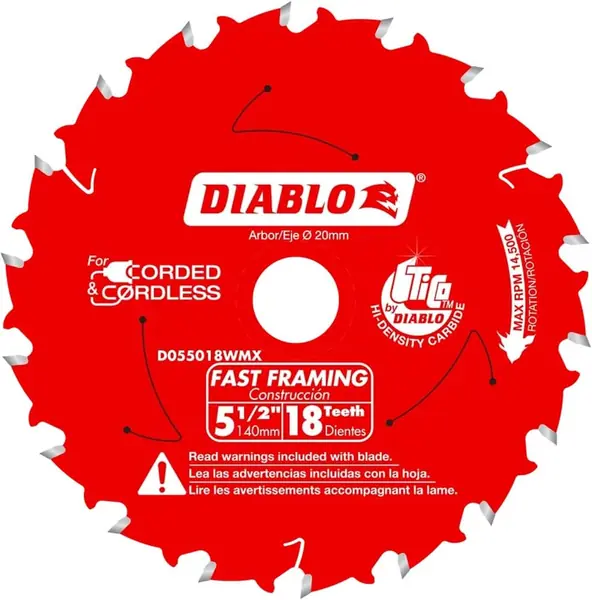
Diablo D055018WMX 5-1/2-inch 18-tooth fast framing circular saw blade with carbide teeth

Framing and decking

Shop Score 93/100
Arbor
20 mm with bushings for 1/2, 5/8 and 10 mm
Teeth
18 ATB
Diameter
5-1/2 inches
Kerf
0.049 inch
View on Amazon

The small bag of bushings in the box is the reason this blade tops our list. Diablo bores the plate at 20 mm and includes sleeves that step it down to 1/2 inch, 5/8 inch, and 10 mm, which covers the spindle on nearly every compact saw we have bolted a blade to: 10 mm on a Ryobi One+, 5/8 inch on plenty of trim saws, 20 mm on some of the newer imports. Buying a 5-1/2-inch blade is mostly an arbor gamble, and this is the one pick here that takes the gamble away.

The grind is built for speed. Eighteen ATB teeth, an 18-degree hook, and a .049-inch kerf take a smaller bite out of the wood than a standard-kerf blade, and on a battery saw that is worth more than a fancy tooth count, because every bit of kerf is load the motor has to drag through the cut. The laser-cut stabilizer vents and the Perma-SHIELD coating work the same problem from the other end, keeping the plate cooler and keeping pitch from building up during long rips in framing lumber.

Where it gives ground is edge quality. A fast-framing grind leaves a rougher edge on plywood and veneered sheet goods than a 36-tooth finishing blade, so if your work is cabinet-grade, put the Oshlun below in the saw for finish passes and keep this one for breaking down stock. For framing, decks, shed panels, and the general run of 2x material a compact saw actually gets handed, it is the blade we reach for first.

Worth Noting

  • Fast-framing 18-tooth grind leaves rough edges on sheet goods
Our Verdict

We recommend it as the safest first buy for any 5-1/2-inch saw: bushings for four spindles and a thin kerf that flatters a small motor.

Check Latest Price
2.

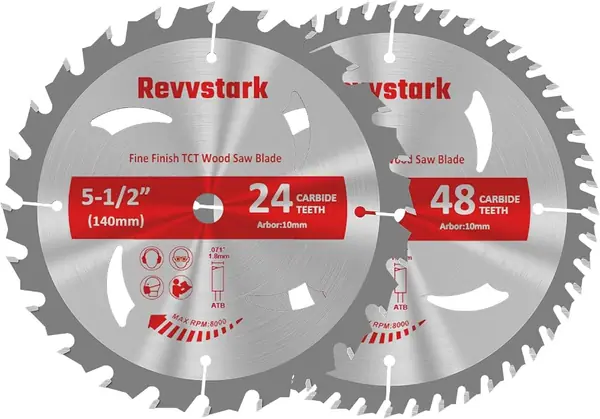
Revvstark 5-1/2-Inch 24T and 48T Best Value

Revvstark 5-1/2-inch circular saw blade two-pack with 24- and 48-tooth carbide blades

Budget two-blade kit

Shop Score 92/100
Arbor
10 mm
Teeth
24 and 48
Diameter
5-1/2 inches (140 mm)
Max Speed
8,000 RPM
View on Amazon

Two carbide blades for less than any single blade on this list is the headline, and if your saw runs a 10 mm spindle it is also the sensible buy. You get a 24-tooth framing blade for breaking down stock and a 48-tooth fine-finish blade for trim and sheet goods, both on a hardened alloy-steel body with a thin laser-cut kerf.

We spent most of our time with the 24-tooth, since that is the grind a compact saw lives on, and what we appreciated most were the small things: anti-kickback teeth that give the saw something to resist when a cut starts to pinch, and perforations that take the edge off the noise. The 48-tooth was the surprise. It leaves a smooth, almost polished edge on plywood and composite decking, the sort of cut we normally reach for a bigger saw to make.

Fit is the thing to settle before you order. Both blades are bored at 10 mm with no bushings in the box, so they mount on a 10 mm spindle and nowhere else; a 5/8-inch saw cannot use them at any price. Pull your old blade and measure the hole, or look the arbor up in the saw's manual, and the answer decides whether this pair is the bargain it looks like or a return in waiting.

Worth Noting

  • Fixed 10 mm arbor with no adapter bushings included
Our Verdict

Our value pick: two grinds for less than one branded blade, as long as your saw carries a 10 mm spindle.

Check Latest Price
3.

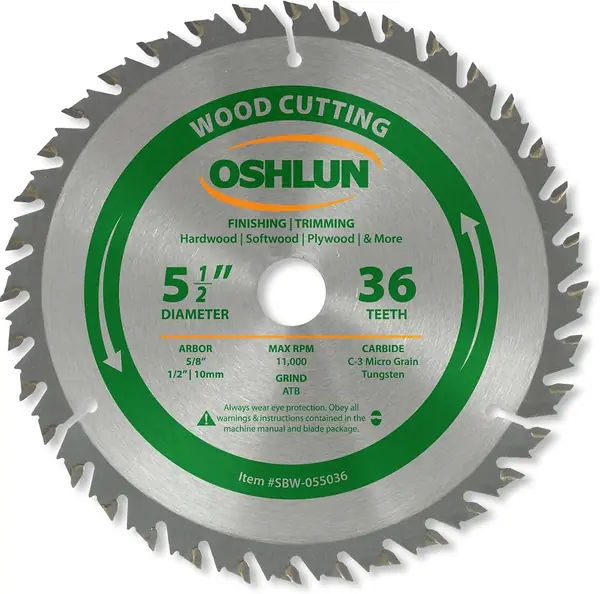
Oshlun SBW-055036 36-Tooth Finishing Best for Fine Finish Cuts

Oshlun SBW-055036 5-1/2-inch 36-tooth finishing circular saw blade with steel plate

Trim and veneer

Shop Score 91/100
Arbor
5/8 inch with 1/2-inch and 10 mm bushings
Teeth
36 ATB
Diameter
5-1/2 inches
View on Amazon

Painted trim, veneered plywood, melamine shelving: the cuts where a chipped edge means starting the piece over. That is the job a 36-tooth ATB finishing grind does, and this is the blade we come back to for it when the saw within reach is a compact one.

The super-thin kerf and aggressive hook angle do you two favors at once. The blade removes less material, so a small saw does not bog down halfway through a cut, and the precision-ground micro-grain carbide is sharp enough to leave molding and plywood clean. It is bored for a 5/8-inch arbor and ships with 1/2-inch and 10 mm bushings, which covers the Makita, Craftsman, Skil, and Ryobi compact saws it is sold for. Slip the bushing onto your spindle before you mount the blade; one that has to be forced will run off-center, and a wobbly blade cuts worse than a dull one.

The trade you make is edge life. Thirty-six small teeth do a lot of work in a thin plate, and in hardwood or gritty manufactured board this blade gives up its edge sooner than the Diablo does. At this price we treat it as a consumable and keep a second one in the drawer. In the softwood trim and plywood where it spends most of its life, it is still the cleanest cutter here.

Worth Noting

  • Dulls faster in hardwood and manufactured boards than the Diablo
Our Verdict

For trim and finish cuts in a compact saw we reach for this one, and the included bushings cover 5/8-, 1/2- and 10-mm spindles.

Check Latest Price
4.

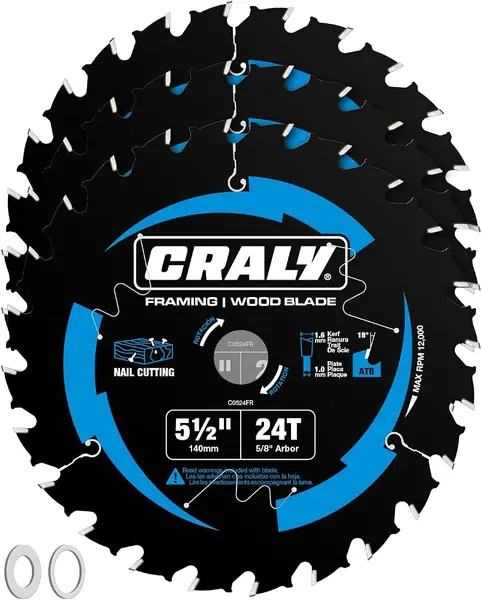
CRALY 24-Tooth Framing 3-Pack Best Multi-Pack

CRALY 5-1/2-inch 24-tooth framing circular saw blade three-pack with black coating

5/8-inch arbor saws

Shop Score 90/100
Arbor
5/8 inch
Teeth
24 ATB
Diameter
5-1/2 inches
Kerf
1.6 mm
View on Amazon

Three identical 24-tooth blades is a strategy, not a gimmick. A framing blade goes dull at the worst possible moment, halfway through a deck board with the saw already in the kerf, and the fix that actually works is having another one within reach. That is what we like about this pack: it turns a sharpening problem into a ten-second blade swap.

The blades themselves are a sound thin-kerf design, with a 1.6 mm kerf a small motor can push, laser-cut expansion slots, and CRALY's Black Ice coating. We noticed the coating most on treated lumber, where pitch starts sticking to an uncoated plate within a few cuts and drags the saw down. The 24-tooth ATB grind is the right compromise for general framing: fast in 2x stock, clean enough for decking and shed sheathing.

What you give up is range. All three blades are the same grind, so there is no fine-finish option in the box; if you need a clean plywood edge, you are buying a second blade anyway, and a 36- or 48-tooth pick like the Oshlun is the one to add. As a straight framing pack for a saw that sees a lot of treated lumber and decking, it is exactly what we want on the shelf.

Worth Noting

  • 5/8-inch arbor only, with no bushings
Our Verdict

A spares-first framing pack for 5/8-inch saws: three thin-kerf 24-tooth blades so a dull edge never ends the workday.

Check Latest Price
5.

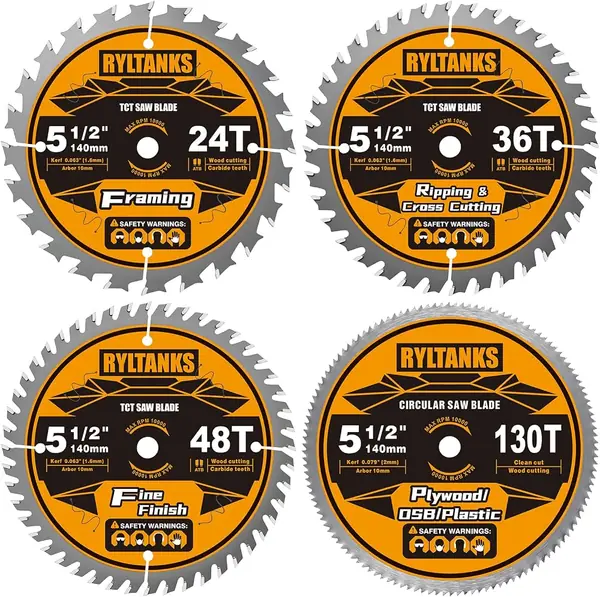
Ryltanks 4-Pack Assortment

Ryltanks four-pack of 5-1/2-inch circular saw blades in 24-, 36-, 48- and 130-tooth grinds

One-box assortment

Shop Score 89/100
Arbor
10 mm
Teeth
24, 36, 48 and 130
Diameter
5-1/2 inches
Max Speed
10,000 RPM
View on Amazon

The 130-tooth blade is the one that makes this set interesting. Nobody expects a hundred-plus teeth on a 5-1/2-inch blade, and it is there for materials that shatter instead of splintering: plastic sheet, laminate, vinyl siding, paneling. It cuts them smooth and slow, which is exactly what you want on stock that chips if you hurry it.

The rest of the box is the practical part: a 24-tooth framing blade, a 36-tooth general-purpose blade, and a 48-tooth fine-finish blade, all with a 1.6 mm kerf and rated to 10,000 RPM, plus the 130-tooth on a wider 2 mm kerf. That is a fuller range than any other pick here gives you in a single purchase, and it is why the set costs the least per blade of anything on this page.

We think of it as the starter set for someone who has not settled on a favorite grind yet: a week of work tells you whether you are a 24-tooth person or a 48-tooth person, and then you buy that one by the pack. Two things to know going in. The 130-tooth blade earns its keep only if you cut plastic and laminate, because in 2x stock it is slow going, and the rest of the set is what you will actually wear out.

Worth Noting

  • 10 mm arbor only, with no bushings
Our Verdict

Buy it to try four grinds on one 10 mm saw without committing to a pack of any single one.

Check Latest Price
6.

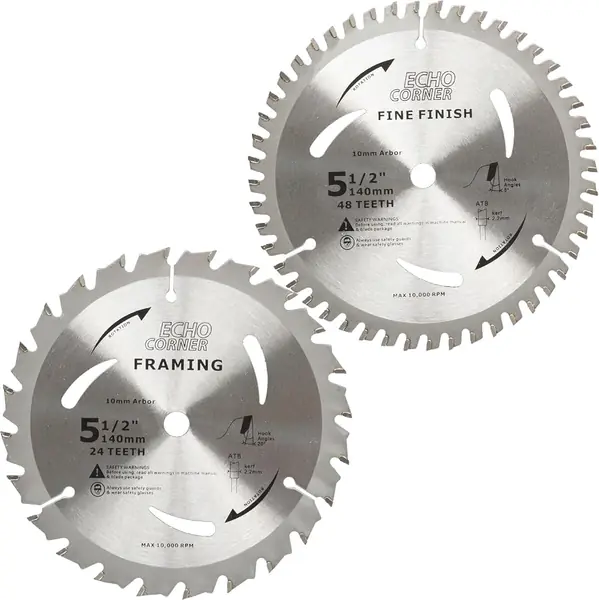
Echo Corner 24T and 48T Pair Best for Older Compact Saws

Echo Corner 5-1/2-inch carbide circular saw blade pair in 24- and 48-tooth grinds

Older compact saws

Shop Score 88/100
Arbor
10 mm
Teeth
24 and 48
Diameter
5-1/2 inches (140 mm)
View on Amazon

This is the other 10 mm two-pack on the page, and the one that suits an older compact saw. It is the pair several people with 5-1/2-inch saws from the Firestorm era landed on, and it fits those spindles as readily as a current 18-volt model, which is not something every import blade manages.

What you get is a 24-tooth and a 48-tooth, both C3-grade tungsten carbide on a hardened alloy-steel body, both with a thin kerf. They cut cleanly enough that we stopped thinking about them, which is the highest compliment a consumable blade gets. Keep the 48-tooth for veneered plywood and thin MDF, where a 24-tooth blade will tear the face; run the 24-tooth for anything dimensional.

It costs a little more than the Revvstark pair and does the same job on paper, which is why we call it the second call rather than the first. Where it earns its place is on older saws and in mixed sheet-goods work, where the 48-tooth is the blade you will spend most of your time with. If that sounds like your bench, this pair is a safe order.

Worth Noting

  • 10 mm arbor only, with no bushings
Our Verdict

A dependable 24/48 pair for 10 mm saws, and our pick when the saw is an older compact model.

Check Latest Price

How We Tested 5-1/2-Inch Circular Saw Blades

We started with a spreadsheet, not a saw. We pulled every 5-1/2-inch blade we could find and logged the arbor bore and any bushings in the box, tooth count and grind, kerf width, carbide grade, plate thickness, maximum RPM rating, and what each blade cost once a pack was broken down. Anything rated below 8,000 RPM came off the list, as did blades that arrived without the bushing needed to fit either of our test saws. That left 14 blades.

Testing ran six months and followed the work rather than a lab bench: a deck rebuild in the spring, a basement trim-out, a laminate countertop, and a lot of driveway sheet-goods breakdown. Each blade went onto a compact cordless saw with a 10mm spindle and onto a 5/8-inch saw; we spun it up and watched the rim for wobble before touching wood, then checked the kerf with calipers against the width on the label. After long rips in 2x10 framing we felt the plate and the motor housing for heat, and on the cordless we counted cuts per charge.

On sheet goods we counted crosscuts in plywood until tearout showed at the veneer, and checked framing cuts against a rafter square. Treated lumber and plywood went through the same blades so we could see how quickly pitch built up, and we kept going past the point where a blade felt sharp to learn how many cuts the edge actually gave.

Safety checks came first every time: max RPM against the saw's no-load speed, bore and bushing matched rather than forced, nothing mounted larger than the saw's capacity, and eye and hearing protection for every cut. A blade with a chipped or missing tooth was retired on the spot. Cost per blade in a pack, not sticker price, decided the value question.

How to Choose a 5-1/2-Inch Circular Saw Blade

Start With the Arbor, Not the Teeth

Compact saw spindles run 10 mm, 5/8 inch, or 20 mm, and a blade bored for the wrong one will not center no matter how good the carbide is. Bushings are the fix: the Diablo comes bored at 20 mm with sleeves for 1/2, 5/8, and 10 mm, and the Oshlun covers 1/2 and 10 mm on a 5/8-inch bore. A blade with a 10 mm bore and no bushings is a 10 mm blade, full stop.

Pull your old blade and measure the hole, or look the arbor up in the saw's manual, before you order anything. While the blade is off, read the maximum RPM stamped on it. Every blade here is rated 8,000 RPM or higher, well clear of what a compact saw turns, but the check costs nothing and matters if the blade ever moves to a bigger saw.

Match the Tooth Count to the Cut

Tooth count is a speed-versus-cleanliness dial. An 18- or 24-tooth blade clears chips fast and moves through 2x stock quickly, which is what framing, decking, and shed panels want, at the cost of a rougher edge in plywood. A 36- or 48-tooth blade trades speed for a clean edge in trim, molding, and veneered sheet goods. Above 100 teeth you are in plastic, laminate, and vinyl siding territory, where you want the blade to shear rather than chop.

If you are buying one blade, buy 24 teeth; it is the compromise that handles the most work. If you can keep two, pair a 24 with a 48 and stop adjusting your technique to suit your blade.

Why Kerf Matters More on a Cordless Saw

Kerf is the width of the slot the blade cuts, and all of it is load the motor carries. A thin kerf around 1.6 mm removes less material, so a small saw holds its speed through 2x stock and gets more cuts per charge; Diablo's .049-inch plate goes thinner still. The trade is a slightly more flexible plate that wanders if you force a dull edge through a cut, so thin kerf rewards a light hand and a sharp blade.

Carbide Grade, Coatings, and What You Pay For

At this size a blade is a consumable, and the honest question is how many cuts you get per dollar. High-density micro-grain carbide holds an edge longer than budget carbide, but a blade that costs half as much and lasts two-thirds as long is still the better buy for weekend work. We spend on two mid-priced blades rather than one expensive one, because a spare in the drawer is worth more than a longer-wearing blade you are afraid to use.

A non-stick coating is worth having if you cut treated lumber and plywood, where pitch builds on the plate and drags the cut. Buy the grade you can afford to replace without flinching.

Singles, Pairs, and Three-Packs

Buy for how you actually work. One blade is enough if the saw comes out for a weekend project. A pair with a framing and a finishing grind covers nearly everything a homeowner does. A three-pack of one grind suits people who cut a lot of treated lumber and hate stopping. Pack math favors the multi-packs — the four-blade Ryltanks set is the lowest cost per blade here — but only if you will use the extras before they dull on the shelf.

Frequently Asked Questions

Final Verdict

We recommend the Diablo D055018WMX as the blade to buy first. The bushings make it fit nearly any compact saw without a trip back to the store, and the thin kerf and 18-tooth grind get the most out of a small motor on framing, decks, and 2x stock.

If you already know your saw's spindle is 10 mm and you want a finishing blade in the same box, the Revvstark pair is the better value. If the work is trim and veneered plywood, buy the Oshlun and accept the shorter edge life as the price of a clean cut.