↑↓ navigate ↵ open Esc close All results →

Best Table Saw Blades for Plywood of 2026

Veneered plywood hides no blade flaws: a dull tooth or the wrong grind splinters the paper-thin face veneer along the exit edge, leaving tear-out that sanding cannot erase. More teeth alone will not fix it if gullets pack with resin or heat up along a long cabinet rip.

Eight months of cutting veneered plywood, melamine, and shop-grade sheet goods with 12 blades revealed clear differences in exit-edge crispness, rip-cut scorching, and how much drag a thin kerf saved on smaller saws. Dedicated high-tooth veneer blades slice finished cabinet panels cleanly, though pushing them through rough framing or jig stock dulls expensive carbide quickly.

For woodworkers who hate swapping blades between casework and shop fixtures, multi-purpose combination blades or two-blade packs bridge both jobs without sacrificing finished faces.

Our Top Picks

The Best Table Saw Blades for Plywood

1.

Diablo D1090X Ultimate Polished Finish Blade Best Overall
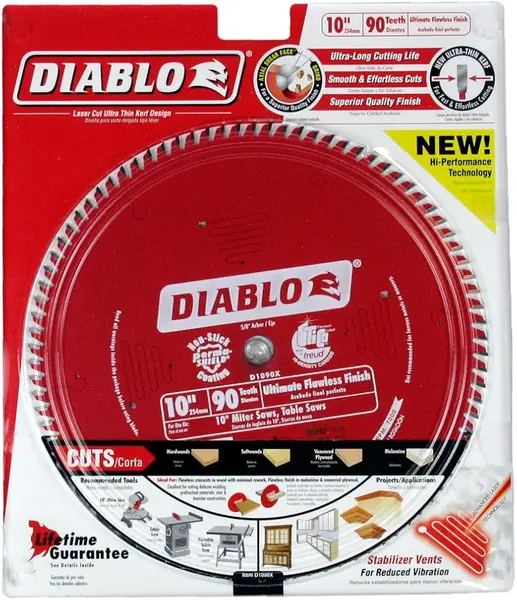
Diablo D1090X 10-inch 90-tooth circular saw blade with carbide teeth

Cabinet-grade plywood

Shop Score 98/100
Arbor
5/8 in
Teeth
90 ASFG
Diameter
10 in
Kerf
.087 in
View on Amazon

The D1090X is the blade we put at the top for plywood because its 90-tooth double-side grind is built to shear through veneer rather than lift the fibers. The .087-inch kerf keeps the cut light, and the edge comes off the saw looking closer to sanded than sawn. That is the finish we want on cabinet-grade sheet goods.

What we appreciate most is how little the blade asks of the saw. The thin kerf reduces drag, so it works on a contractor saw without feeling like the motor is straining, and the polished-finish grind leaves less sanding on veneered faces. We also like that it handles melamine and fine molding, not just plywood.

The trade-off is feed rate. Ninety teeth are not made for ripping thick stock quickly, and on long cuts in 3/4-inch plywood we slow down and let the blade do the work. For a shop that breaks down sheets all day, the CMT 256.050.10 is the more practical one-blade choice.

We keep the Diablo for face veneer and swap to a coarser blade for the rest. It is not the blade we reach for when we are framing a shed, but it is the one we want when the plywood is going to be seen.

Worth Noting

  • Slower on thick stock and long rips
Our Verdict

We recommend the Diablo D1090X as the default for clean plywood because its 90-tooth ASFG grind leaves veneer edges ready for finish, though it is slower on thick stock.

Check Latest Price
2.

Freud LU79R010 Ultimate Plywood & Melamine Blade Best for Veneered Plywood

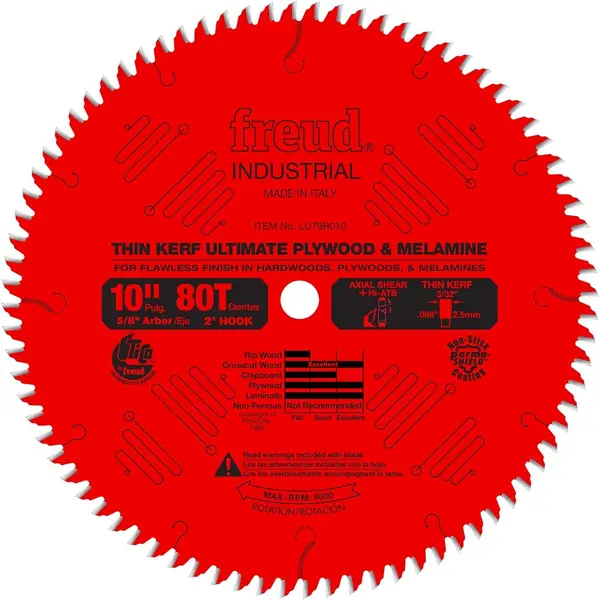
Freud LU79R010 10-inch 80-tooth thin-kerf plywood blade with carbide teeth

Veneered plywood

Shop Score 97/100
Arbor
5/8 in
Teeth
80 Hi-ATB
Diameter
10 in
Kerf
Thin kerf
View on Amazon

The LU79R010 is the most purpose-built plywood blade in this group. Freud labels it for veneered plywood and melamine, and the 80-tooth Hi-ATB grind is designed to leave a chip-free edge on both sides of the cut. The thin kerf and anti-vibration slots make it feel smoother than a general-purpose blade.

This is the blade we choose when the plywood is Baltic birch and the edge is going to be finished. In our cuts, the top and bottom edges were clean enough to go straight to assembly, with no scoring blade and no tearout line to sand out. The 80-tooth count is slow enough to need a steady feed, but it is not fussy on a contractor saw.

It is not the blade for heavy rips in thick solid stock. If your work is mostly veneered sheet goods, though, that trade-off buys you a finish that needs very little cleanup. We keep it for the plywood that will be seen.

Worth Noting

  • Premium price for a single blade
Our Verdict

Choose the Freud LU79R010 for veneered plywood and melamine because its 80-tooth Hi-ATB grind is purpose-built for chip-free edges.

Check Latest Price
3.

CMT 256.050.10 Combination Blade Best Combination Blade

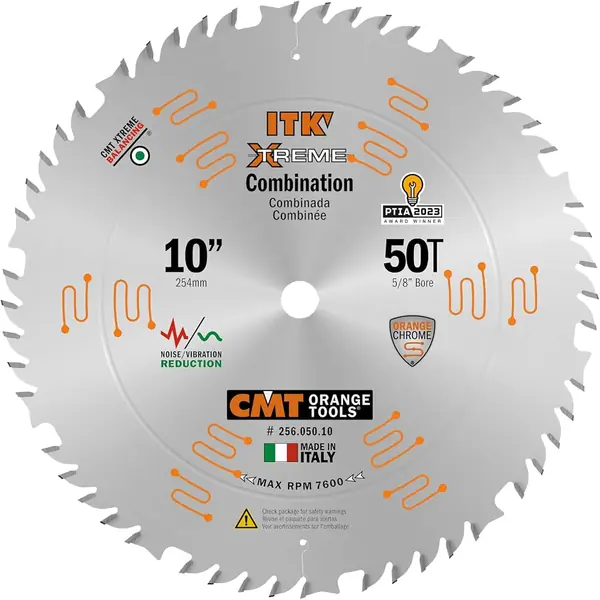
CMT Orange Tools 256.050.10 10-inch 50-tooth combination saw blade

One-blade shops

Shop Score 96/100
Arbor
5/8 in
Teeth
50
Diameter
10 in
Kerf
.102 in
View on Amazon

The CMT 256.050.10 is the middle path: a 50-tooth combination blade with four ATB teeth and one flat tooth per group, aimed at shops that want one blade for both rips and crosscuts. The .102-inch kerf is thin enough to ease the load on a mid-power saw, but not so thin that the plate feels fragile.

On plywood, the combination grind leaves a clean edge for painted cabinets and utility shelving. We noticed the blade runs quietly and with very little vibration, which makes long rips less tiring. The chrome coating also helps keep pitch from building up, so it stays smooth between cleanings.

If you need one blade to do most of your plywood work, this is the one we recommend. If every cut is a show cut, step up to the Diablo D1090X. We keep the CMT on the saw for mixed days.

Worth Noting

  • Leaves more tearout than a dedicated plywood blade
Our Verdict

Pick the CMT 256.050.10 as the one-blade choice for a shop that rips and crosscuts plywood without buying a dedicated finish blade.

Check Latest Price
4.

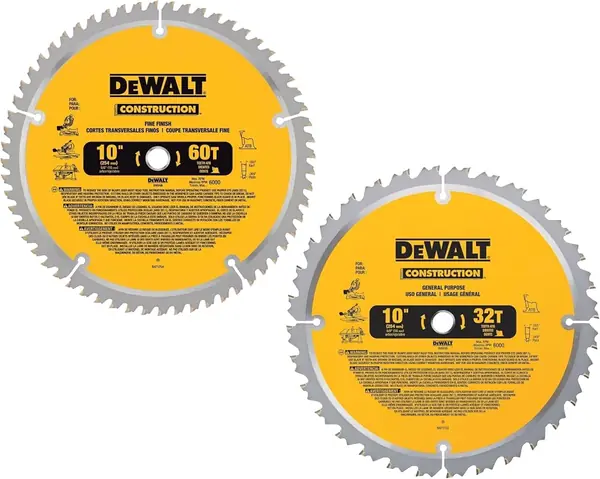
DEWALT DW3106P5 60/32-Tooth Combo Pack Best Two-Blade Value

DEWALT DW3106P5 two-blade pack with 60-tooth and 32-tooth circular saw blades

Two-blade starter set

Shop Score 95/100
Arbor
5/8 in
Teeth
60 and 32
Diameter
10 in
Kerf
Thin kerf
View on Amazon

The DW3106P5 is a two-blade set that pairs a 60-tooth fine-finish blade with a 32-tooth general-purpose blade. Both are 10-inch with a 5/8-inch arbor and a thin kerf, so they fit the same saw and keep the cut light.

The 60-tooth blade is the one we keep on the saw for sheet goods. It leaves clean edges on plywood and cuts without much resistance, especially on a contractor saw. The computer-balanced plate keeps vibration down, and the cut feels steadier than we expected from a two-blade pack.

The 32-tooth half is the ripper. It clears chips and handles thicker stock, and it is the blade we put on when we are breaking down framing plywood or ripping construction lumber.

For a first table saw blade set, we think this is the smart buy. You get a clean plywood blade and a ripper in one box, and the 60-tooth blade is good enough for most painted cabinets. We keep the pair together because the swap covers almost everything.

Worth Noting

  • 32-tooth blade leaves rougher plywood edges
Our Verdict

Small shops looking for a clean 60-tooth plywood blade and a 32-tooth ripper in one purchase should grab the DEWALT DW3106P5.

Check Latest Price
5.

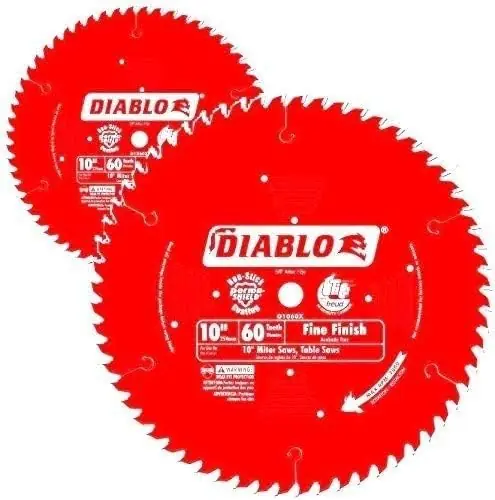
Diablo D1060X 60-Tooth 2-Pack Best 60-Tooth Two-Pack

Diablo D1060X two-pack of 10-inch 60-tooth Hi-ATB saw blades

Daily plywood cutting

Shop Score 94/100
Arbor
5/8 in
Teeth
60 Hi-ATB
Diameter
10 in
Kerf
.098 in
View on Amazon

The D1060X is the 60-tooth blade we recommend when you want a cleaner plywood cut than a general-purpose blade but don't need the mirror finish of a 90-tooth blade. Its Hi-ATB teeth and .098-inch kerf are aimed at veneered plywood, and the two-pack means you can keep a fresh blade on the saw instead of nursing a dull one.

We like the 60-tooth count for everyday sheet goods. It feeds faster than the 90-tooth Diablo and still leaves a clean edge on painted plywood and utility cabinets. The thin kerf is easy on a mid-power saw, and the Perma-SHIELD coating keeps pitch from building up.

For a shop that cuts a mix of plywood and solid stock, this is a more forgiving blade to live with than the 90-tooth. We keep one on the saw and one on the shelf for when the first gets dull. It is the blade we grab when we want clean cuts without slowing to a crawl.

Worth Noting

  • Less polished than an 80- or 90-tooth blade
Our Verdict

We recommend the Diablo D1060X two-pack for daily plywood work because the 60-tooth Hi-ATB grind balances clean edges with a faster feed.

Check Latest Price
6.

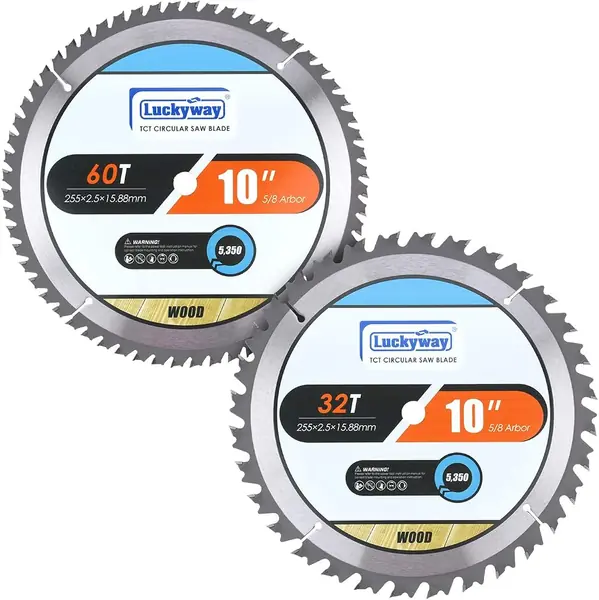
Luckyway 32T/60T 2-Pack Best Budget Two-Pack

Luckyway two-pack of 10-inch 32-tooth and 60-tooth saw blades

Occasional plywood work

Shop Score 93/100
Arbor
5/8 in
Teeth
32 and 60
Diameter
10 in
Pack
2 blades
View on Amazon

The Luckyway set is the lowest-cost way here to get both a 60-tooth plywood blade and a 32-tooth ripper. The 60-tooth half is the one for veneered plywood, while the 32-tooth blade handles rough rips and construction-grade sheet goods. For occasional weekend work, the pairing covers a lot of ground.

We were impressed that the arbor hole is exact, so the blade seats tightly on a 5/8-inch spindle without wobble. The 60-tooth blade cuts plywood cleanly for a budget blade, and the thin body doesn't bog a smaller saw. It is better than the dull general-purpose blade that came with many jobsite saws.

If you cut plywood every day, step up to the Diablo or Freud. If you cut a few sheets a month, the Luckyway set is a sensible place to start. We keep it as a backup set for quick jobs.

Worth Noting

  • Durability is mixed over repeated use
  • Not a finish-grade blade for show veneer
Our Verdict

For occasional plywood work, the Luckyway 32T/60T set pairs a clean-cutting 60-tooth blade with a ripper at the lowest cost here.

Check Latest Price
7.

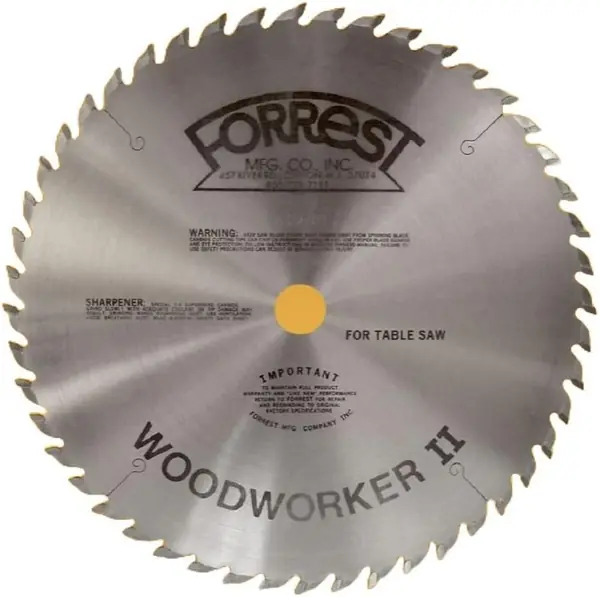
Forrest Woodworker II 40-Tooth Best for Mixed Hardwood Shops

Forrest Woodworker II 10-inch 40-tooth ATB saw blade with carbide teeth

Mixed hardwood shops

Shop Score 92/100
Arbor
5/8 in
Teeth
40 ATB
Diameter
10 in
Kerf
.125 in
View on Amazon

The Woodworker II is the premium general-purpose blade in this group, and it is built like it: a hand-tensioned plate, hand-brazed C-4 carbide teeth, and a .125-inch kerf. The 40-tooth ATB grind is meant to handle rips and crosscuts in hardwood and plywood, and the blade runs quietly for a 40-tooth model.

What we like most is the flexibility. It handles hardwoods and plywood with very little tearout, and the heavier plate feels stable in thick cuts. For someone who wants one very good blade rather than a rack of specialized ones, that is a real advantage.

For a plywood-first shop, a dedicated 80- or 90-tooth blade is the more direct route. We see the Forrest as the one-blade upgrade for a serious hobbyist, not the first blade for a plywood project. It is the blade we choose for a mixed hardwood and sheet-goods shop.

Worth Noting

  • Premium price is hard to justify for plywood alone
  • Can burn on thick stock with slow feed
Our Verdict

Serious hobbyists who want one premium 40-tooth blade for plywood and hardwoods will get their money's worth from the Forrest Woodworker II.

Check Latest Price
8.

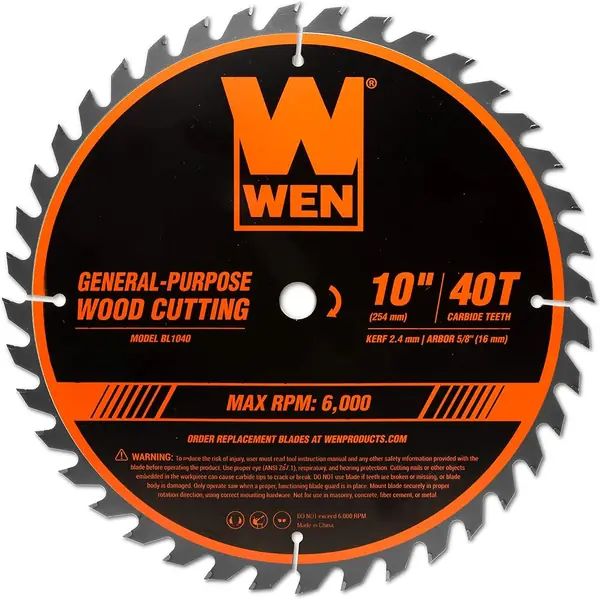
WEN BL1040 40-Tooth Best for Rough Plywood Cuts

WEN BL1040 10-inch 40-tooth carbide-tipped woodworking saw blade

Rough plywood cuts

Shop Score 91/100
Arbor
5/8 in
Teeth
40
Diameter
10 in
Kerf
1/10 in (2.4 mm)
View on Amazon

The WEN BL1040 is the cheapest single blade in this group. Its 40-tooth carbide grind and 1/10-inch kerf cut quickly through construction-grade sheet goods, and the 5/8-inch arbor fits most 10-inch table saws.

Out of the box, it is sharp and cuts without binding, which is more than we can say for a lot of budget blades. We noticed the thin kerf makes it easy on a small saw, and the 40-tooth grind is forgiving on framing plywood and quick rips.

The blade is light and simple to mount, and the thin kerf leaves less sawdust to clean up. The 40-tooth pattern also clears chips well, so it doesn't bog in thicker construction stock.

For rough plywood, jobsite cuts, and a spare in the toolbox, we recommend it. We keep one as a backup for the cuts where a chipped edge will be painted or hidden.

Worth Noting

  • 40-tooth grind leaves more tearout on veneer
  • Durability is mixed with steady use
Our Verdict

Keep the WEN BL1040 on hand for rough plywood and jobsite cuts where a clean finish matters less than a low-cost spare.

Check Latest Price

How We Tested Table Saw Blades for Plywood

We started with the blades that come up again and again in reader reviews and on shop forums, sorted them by grind, tooth count, kerf, and price, and narrowed the field to 12 that covered the range: fine-finish crosscut blades, thin-kerf veneer specialists, combination blades, and three two-packs. Every blade was bought at retail. Before mounting one, we unplugged the saw, checked the arbor size against the spindle, and inspected the plate for flatness or shipping damage, then matched the blade's maximum RPM rating to the saw. The guard and riving knife stayed on for every cut.

Testing ran eight months. We broke down sheet after sheet of veneered plywood, sanded plywood, and melamine into cabinet sides, drawer bottoms, and shop shelving, ripping and crosscutting on both a 1.75-horsepower contractor saw and a heavier cabinet saw. We counted the fibers standing up along the exit edge of each cut, looked for burnishing after rip cuts, and ran a fingernail along melamine edges to feel for chips. We also wrote down how hard we had to push: a thin-kerf blade that sails through on the big saw can bog down on a smaller one, and a blade that forces a slow feed is a blade that burns.

Durability got its own log. We tracked board feet per blade and noted the first cut that needed extra pressure or left scorch marks — that was our cue to pull it and send it out for sharpening. To judge value, we ran the two-blade packs against a single high-tooth blade through a week of ordinary work and counted how often we actually stopped to change blades.

How to Choose a Table Saw Blade for Plywood

Start With the Saw, Not the Tooth Count

A 10-inch blade with a 5/8-inch arbor is the common table saw setup, but it is not universal. Before you buy, check the saw's arbor size and maximum RPM, and make sure the blade's diameter clears the insert and guard. A 10-inch circular saw blade that fits one saw may not fit another if the arbor is bushed differently. The blade's RPM rating should meet or exceed the saw's no-load speed.

Match the Grind to the Face You Need to Protect

Tooth count is only half the story. A high alternate top bevel grind, usually 80 to 90 teeth, shears the veneer and leaves the cleanest edge on cabinet-grade plywood. A 50- or 60-tooth combination blade is the better compromise if you rip and crosscut the same sheet, while a 40-tooth general-purpose blade is for construction plywood where a little tearout will be painted or hidden. More teeth can slow the feed and burn thick stock, so don't buy 90 teeth for ripping 1-inch plywood all day.

Decide How Much Kerf You Can Afford

Thin-kerf blades remove less material and pull less power, which makes them a good match for contractor saws and jobsite saws. The trade-off is a slightly less rigid plate, so deep cuts in dense stock can deflect if you feed too hard. A full-kerf blade is more stable in a cabinet saw with plenty of horsepower, but it wastes more wood and asks more of the motor. For most plywood work on a 1.75- to 3-horsepower saw, we prioritize a thin kerf.

Choose One Blade or a Two-Blade Strategy

If you cut plywood only occasionally, a single 50- or 60-tooth combination blade is the simplest answer. If you break down a lot of sheets, a two-blade plan is easier on the saw and the finish: a 60- or 80-tooth blade for crosscuts and face veneer, plus a 32- or 40-tooth ripper for thick stock. The DEWALT DW3106P5 and Luckyway sets here show the appeal of that approach; the Diablo D1090X and Freud LU79R010 are for the cuts where finish is the whole point.

Frequently Asked Questions

Final Verdict

For most plywood projects, we recommend the Diablo D1090X. Its 90-tooth ASFG grind and .087-inch kerf give the cleanest veneer edges in this group, and it is the blade we leave on the saw for cabinet-grade sheet goods. If you need one blade for both rips and crosscuts, choose the CMT 256.050.10; if you cut veneered Baltic birch and melamine all day, the Freud LU79R010 is the dedicated 80-tooth alternative.