↑↓ navigate ↵ open Esc close All results →

Best Circular Saw Blades for Plywood of 2026

A sheet of cabinet-grade plywood costs more than the blade that cuts it, so tearout hurts twice: both the material and the afternoon are lost. Preventing chipped veneer takes more than extra teeth. It takes a grind that shears the surface fibers cleanly before they lift, paired with a plate stiff enough to track a long rip.

Across four months of cutting veneered plywood, melamine, and thick stock with 14 blades, tooth grind proved more decisive than tooth count—a high-alternate-top-bevel profile prevents face chipping better than five additional teeth. Arbor fit comes next: a round or diamond knockout has to match the saw's 5/8-inch arbor, and choosing the wrong diameter creates a safety hazard rather than a minor inconvenience.

Several top-performing blades use a thin kerf, which keeps cordless saws from bogging down in 3/4-inch stock. Because a thinner plate flexes more during a deep rip, steady feed pressure matters more than speed to keep both faces clean and burn-free.

Our Top Picks

The Best Circular Saw Blades for Plywood

1.

Freud LU79R007 Ultimate Plywood Blade Best Overall
Freud LU79R007 7-1/4-inch 60-tooth thin kerf plywood and melamine blade

Veneered plywood

Shop Score 95/100
Arbor
5/8 inch
Teeth
60, Hi-ATB grind
Diameter
7-1/4 inches
Kerf
0.079 inch
View on Amazon

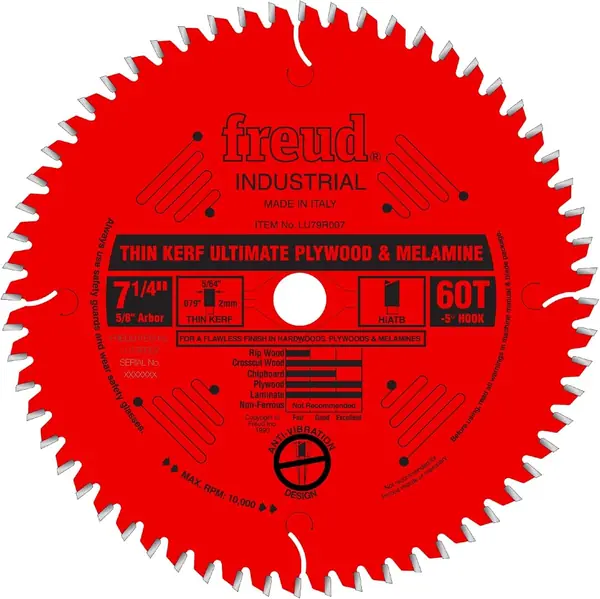
Tooth geometry is what separates a plywood blade from everything else, and this Freud is ground unlike any other blade here. Its teeth carry a high alternate top bevel, so each one slices the veneer fibers before they can lift, and the negative hook angle keeps the blade from grabbing. It was designed for veneered plywood and melamine rather than adapted to them.

That design is why it's our top pick. On 3/4-inch birch plywood and melamine-faced shelving, the edges came off the saw clean on both faces of the kerf, and we went straight to assembly without touching them with sandpaper. If a torn face means a scrapped panel, the blade pays for itself on the first sheet you don't have to remake.

The cost is speed. Sixty Hi-ATB teeth on a negative hook angle want a steady, unhurried feed, and ripping thick stock with it feels like work rather than a pass. That's the trade for an edge that needs no cleanup, and it's why we keep the 40-tooth Diablo mounted for rough breakdowns and save this blade for cuts that show.

One more thing we've come to appreciate is the Perma-SHIELD coating. Pitch from pine and MDF is what quietly dulls a fine blade, and this surface resists it instead of letting it bake onto the teeth.

Worth Noting

  • Slow feed through thick stock
Our Verdict

We put this blade on the saw whenever a plywood edge will show; its Hi-ATB teeth leave veneered faces that need no sanding before glue-up.

Check Latest Price
2.

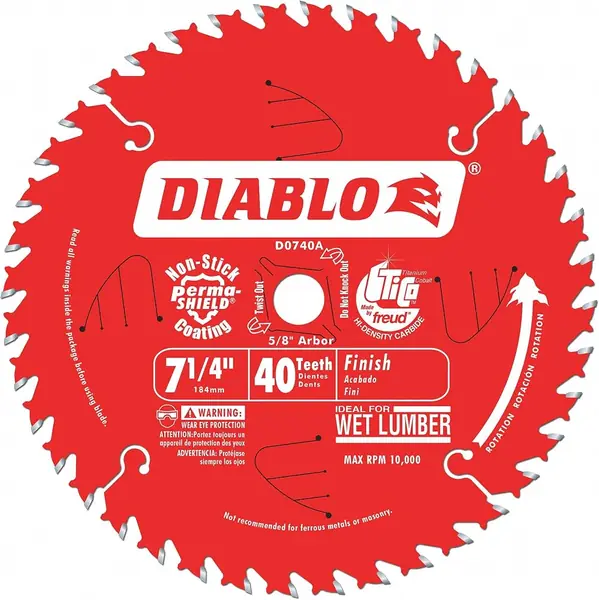
Freud Diablo D0740A 40-Tooth Finishing Blade Best Everyday Blade

Freud Diablo D0740A 7-1/4-inch 40-tooth finishing blade with red coating

Mixed shop work

Shop Score 94/100
Arbor
5/8 inch, diamond knockout
Teeth
40, ATB grind
Diameter
7-1/4 inches
View on Amazon

Not every plywood cut is a cabinet cut. For jigs, shop shelves, and the sheet that becomes a workbench top, a 40-tooth blade is the more useful tool, and the Diablo is the one we leave mounted: quick through construction lumber, clean enough that you don't have to change blades to crosscut a cabinet side.

What keeps us coming back is how much it does for so little. Thin kerf, TiCo carbide, the same non-stick coating as the premium Freud, minus the specialist grind. Sheet goods come off it smooth, the saw doesn't labor, and you aren't protecting an expensive edge every time you pick up the tool.

Durability is where it surprised us. Budget carbide can give up quickly on sheet goods, but ours has gone through plywood, OSB, and pressure-treated 2x with the edge still cutting clean, and the coating keeps pitch from building up the way it does on an uncoated blade.

The 5/8-inch arbor with its diamond knockout fits nearly every 7-1/4-inch saw in the U.S., including older models that won't take a plain round-hole blade. That's the kind of detail that decides whether a blade actually stays on the saw.

Worth Noting

  • More tearout on raw veneer than 60-tooth blades
Our Verdict

Our recommendation for a saw that does as much framing and shelving as finish work: clean plywood edges, fast cuts, and a low price.

Check Latest Price
3.

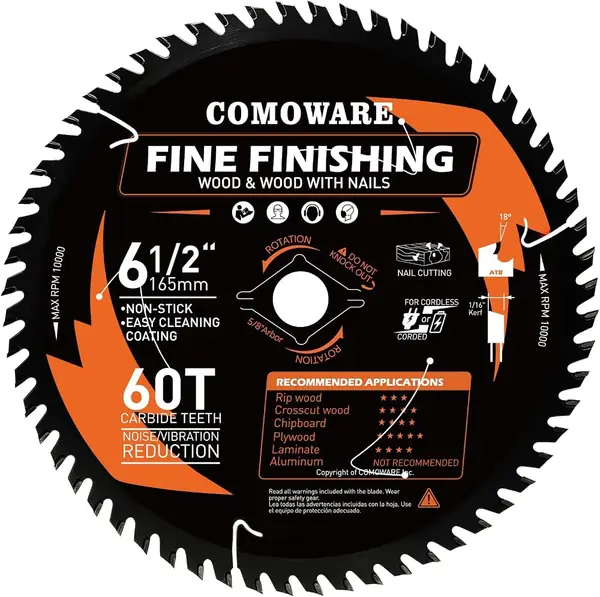
COMOWARE 6-1/2-Inch 60-Tooth Circular Saw Blade Best Budget

COMOWARE 6-1/2-inch 60-tooth carbide-tipped circular saw blade in black

Budget compact saws

Shop Score 93/100
Arbor
5/8 inch, diamond knockout
Teeth
60, ATB grind
Diameter
6-1/2 inches
View on Amazon

Sixty teeth, a 5/8-inch arbor with a diamond knockout, and the lowest price on this page add up to the obvious budget answer for a 6-1/2-inch saw. We didn't expect much when we first mounted it; by the second sheet of half-inch birch plywood we had stopped being skeptical. It cuts square, clears chips, and leaves an edge that needs only a light pass with a sanding block.

The grind is a standard ATB rather than the high alternate bevel on the Freud picks, and you can feel that at the very edge of a veneer face, where a strip of painter's tape on the cut line closes most of the gap. What you're buying is most of the finish for a small fraction of the money, and for a hobbyist cutting a few sheets a year that's the right trade.

Edge life is the honest question with any budget carbide. Ours is still cutting cleanly, but the sensible way to buy this blade is as a consumable: keep one on the saw, keep a spare in the drawer, and don't expect it to outlast the blade it's imitating.

Worth Noting

  • Only fits 6-1/2-inch saws
Our Verdict

We think it's the least expensive honest way to get clean plywood edges from a 6-1/2-inch saw, and a smart spare to keep in the case.

Check Latest Price
4.

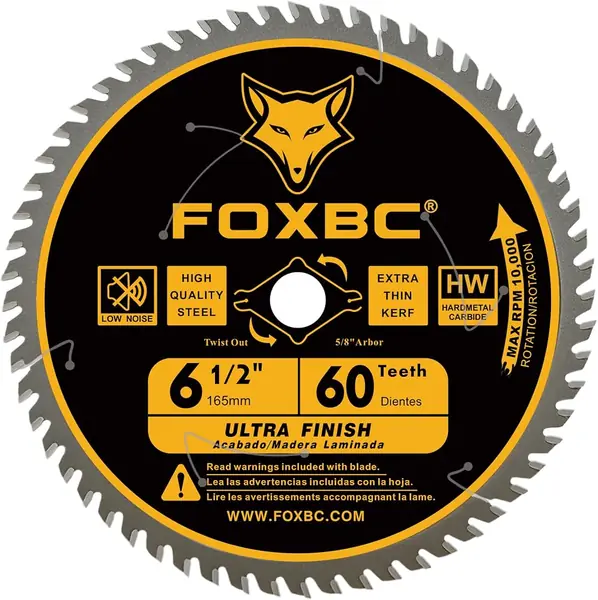
FOXBC 6-1/2-Inch 60-Tooth Thin-Kerf Blade Best for Cordless Saws

FOXBC 6-1/2-inch 60-tooth ultra-thin kerf circular saw blade in yellow

Cordless saws

Shop Score 92/100
Arbor
5/8 inch, diamond knockout
Teeth
60
Diameter
6-1/2 inches
Kerf
0.059 inch
View on Amazon

At 0.059 inch, the kerf on this FOXBC is the narrowest of any blade here, roughly a quarter less than the 0.079-inch Freud LU79. A thinner kerf removes less material, and that shows up twice: more of the sheet stays a sheet, and the saw has less wood to push the blade through.

Laser-cut stabilizer vents and a hardened plate are supposed to keep that thin body tracking true, and in our cuts through half-inch plywood the blade ran straight with no burning along the edges. It also fits a long list of compact saws, including DeWalt's DCS391B and DCS565B, Milwaukee's M18 models, and Ryobi, which is not something every 6-1/2-inch blade bothers to confirm.

Where we liked it most was on battery saws. If your cordless saw bogs down in 3/4-inch plywood with a heavier blade, a thin kerf is the least expensive fix there is, and this one delivered it without wandering.

The trade is rigidity. A 0.059-inch plate will deflect if you force it or let the cut bind, and a deflected thin-kerf blade leaves a wavy edge you can't sand out. Let the saw do the work and keep the baseplate flat, and that never comes up.

Worth Noting

  • Thin plate can deflect if the cut binds
Our Verdict

Our pick for battery saws: the 0.059-inch kerf keeps a cordless motor from bogging down and tracks straight in sheet goods.

Check Latest Price
5.

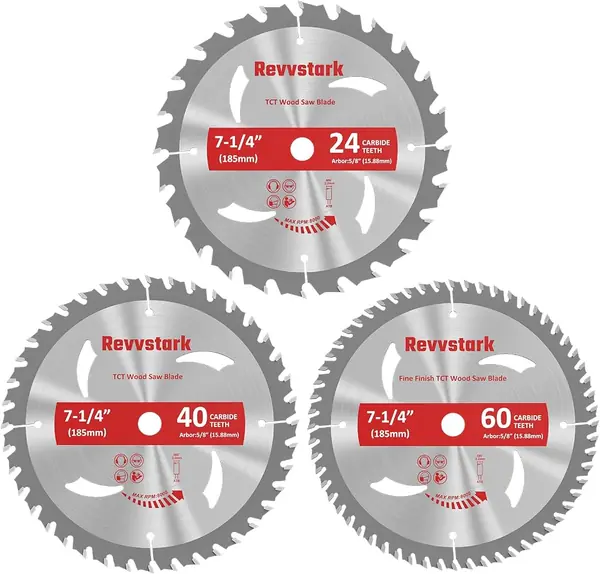
Revvstark 3-Pack 7-1/4-Inch Saw Blade Set Best for One-Saw Shops

Revvstark three-pack of 7-1/4-inch circular saw blades in 24, 40 and 60 tooth

One-saw shops

Shop Score 91/100
Arbor
5/8 inch
Teeth
24, 40, and 60
Diameter
7-1/4 inches
View on Amazon

Three blades for about the price of one of the premium picks is the pitch, and the combination is smart: 24 teeth for framing, 40 for general crosscutting, 60 for finish work. For a one-saw shop, a small crew, or a truck box where everybody wants a sharp blade, that covers a lot of ground for very little money.

The 60-tooth is the one that matters for this job, and it holds up its end. In 3/4-inch oak plywood it cut without splintering, and the 40-tooth makes a serviceable stand-in when you don't want to swap blades between a crosscut of 2x stock and a cut in sheet goods.

We treat the set as a value package rather than a finish blade. Edges that really matter still get tape, but what you gain is two extra blades and the freedom to keep one on the saw and one in the truck. If you already own a dedicated plywood blade, most of the appeal disappears.

The 24-tooth is a framing blade, fast and rough, at home in treated lumber and demolition rather than on the veneered sheet goods you bought the set for.

Worth Noting

  • Finish grind is standard ATB, not Hi-ATB
Our Verdict

We like it as the one-saw shop's set: the 60-tooth blade handles plywood and the extras cover framing and rough cuts.

Check Latest Price
6.

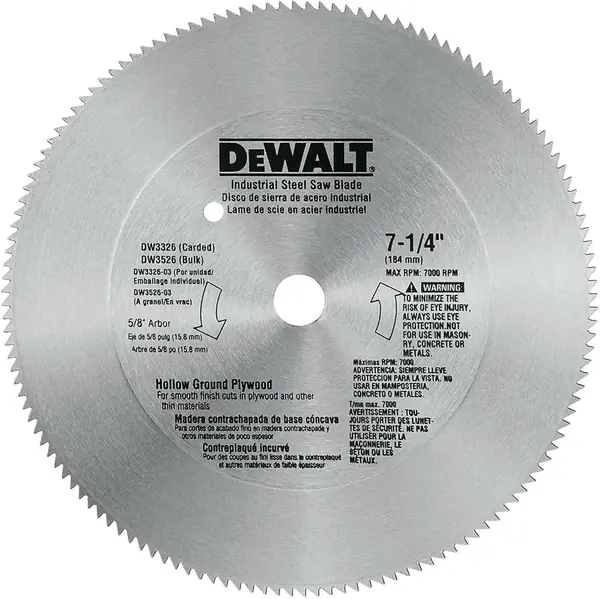
DEWALT DW3326 140-Tooth Plywood Blade

DEWALT DW3326 7-1/4-inch 140-tooth hollow ground plywood cutting blade

Thin veneer

Shop Score 88/100
Arbor
5/8 inch, diamond knockout
Teeth
140, hollow ground
Diameter
7-1/4 inches
Kerf
0.065 inch
View on Amazon

One hundred forty teeth, hollow ground, in a 7-1/4-inch blade: the highest count here by a wide margin, and it exists for one job, thin and brittle sheet goods that chip if you look at them sideways. In quarter-inch plywood, door skins, and laminate it leaves a genuinely fine edge.

The geometry explains why. A 140-tooth hollow-ground blade takes a very small bite per tooth, which is exactly why the finish is so good, and it also makes the blade a specialist rather than a substitute for a general-purpose one. Run it against a straightedge in material a quarter inch or thinner and it does what no 60-tooth blade can.

Thin panels are its territory. We keep a 40- or 60-tooth blade for anything structural, and at the bottom of this group's price range this one is the least expensive route to a chip-free edge on delicate material.

Worth Noting

  • Binds and burns in stock over 1/4 inch
Our Verdict

We recommend it for veneer, laminate, and quarter-inch panels, where 140 teeth leave an edge nothing else here matches.

Check Latest Price

How We Tested Circular Saw Blades on Plywood

We built the shortlist by fit first: a blade had to come in a 5/8-inch arbor, round or diamond knockout, and mount on either a 6-1/2- or 7-1/4-inch saw, or it never got ordered. That left 14 blades spanning the tooth counts and grinds sold for sheet goods, from 24 teeth up to a 140-tooth hollow ground, in thin and full kerf, with the price of each written on the box.

For four months those blades lived in a garage shop. We broke down 3/4-inch birch and oak veneer plywood on sawhorses against a straightedge, cut melamine for shop cabinets, and moved the same blades onto a cordless saw for the driveway breakdowns most people actually do. Every blade went on a saw whose arbor and RPM rating matched it, with the lower guard working and both halves of the sheet supported.

Each cut started with tape on the line and the good face down. We then looked at both faces of the kerf under a shop light and counted chips, noting whether the veneer tore or lifted cleanly. Feed rate got recorded too, because a 140-tooth blade punishes a fast push differently than a 40-tooth one, and forcing either showed up as burning or a cut that wandered off the line.

Thin kerf blades got their own note on how hard they loaded the cordless motor and whether they tracked straight in a deep rip. Last, we kept cutting plywood until a blade needed real pressure to get through, and checked where pitch collected on the plate and coating — that, weighed against the price, settled value.

What separated the keepers was simple: clean edges on both faces, an edge that survived a stack of sheet goods, and a feed rate you can hold with a straightedge and two sawhorses.

How to Choose a Circular Saw Blade for Plywood

Fit the Blade to the Saw First

Diameter is not a preference. A 7-1/4-inch blade doesn't belong on a 6-1/2-inch saw, because the guard and motor housing won't clear it, and the size is stamped on the lower guard if the manual is long gone. Arbor comes next: nearly every handheld saw takes a 5/8-inch arbor, and the blades here have either a round hole or a diamond knockout that seats on both styles of spindle.

We check the arbor and the saw's no-load speed before mounting anything. A blade rated below the speed your saw spins is a real risk, not a technicality.

Tooth Count and Grind Decide the Finish

Forty teeth cut fast and leave a serviceable edge; sixty teeth slice the veneer before it can lift and give you a glue-ready face. Count isn't the whole story, though, because the grind matters as much. A standard ATB blade does fine work, while the high-ATB grind on the Freud LU79 exists specifically for veneered plywood and melamine.

Very high counts push the finish further but only in thin stock. Match teeth to thickness: the thicker the panel, the more chip clearance the blade needs. What most shops call a plywood blade is simply the highest-tooth blade they own, kept for sheet goods and nothing else.

Thin Kerf Buys Speed and Costs Stiffness

Kerf is the width of the slot, and the blades here run from 0.059 inch on the FOXBC to 0.079 inch on the Freud LU79. A narrow kerf removes less material, so a battery saw works less and your panel dimensions shift less. The trade is rigidity: a thin plate deflects under a forced cut, and a deflected blade leaves a wavy edge.

On an 18V saw, thin kerf is worth having. On a corded saw with power to spare and a straightedge clamped down, a slightly thicker blade tracks truer.

Tape and Which Face Goes Down

Two habits make more difference than the blade. Run painter's tape over the cut line and mark on the tape, since the tape holds the surface fibers down while the teeth pass through. On a handheld saw the teeth exit at the top of the panel, so set the good face down when both sides will show.

Clamp a straightedge rather than following a pencil line. A wandering cut is the other reason plywood edges come out ragged, and no blade grind rescues one.

What the Extra Money Buys

Budget carbide gets you the tooth count; the premium buys the carbide grade, the tooth geometry, and edge life. The Freud LU79 is the clearest example in this group, the only blade engineered from the start for veneered plywood and melamine, and the most expensive of the set.

If sheet goods go through your saw weekly, that's money well spent. If plywood shows up twice a year, a midrange 60-tooth blade and a roll of tape will get you edges you can live with.

Frequently Asked Questions

Final Verdict

If clean edges are the whole reason you're shopping, the Freud LU79R007 is the blade we put on the saw. It costs more than anything else here and it feeds slower, and neither matters the first time a veneered panel comes off ready for glue-up.

If your saw also frames walls and breaks down treated lumber, the 40-tooth Diablo is the smarter single blade to own, and for a compact 6-1/2-inch saw the FOXBC's 0.059-inch kerf is the one we reach for.