↑↓ navigate ↵ open Esc close All results →

Best Miter Saw Blades for Aluminum of 2026

Lower a general-purpose wood blade into aluminum extrusion, and the teeth grab, shriek, and smear hot metal across the cut instead of slicing cleanly. Non-ferrous blades prevent that buildup by pairing a triple-chip grind with tooth counts tuned to clear chips from the kerf, keep heat down, and leave an edge that rarely needs a file pass.

Six months of cutting extrusion, tube, sheet, and plastic with 12 ten-inch, 5/8-inch-arbor blades evaluated edge quality, heat buildup, durability, noise, and cost per clean cut. One critical safety spec sits near the bottom of most spec sheets: a blade's maximum RPM rating must meet or exceed the miter saw's no-load speed.

Because higher tooth counts trade feed speed and cooler running for a finer finish, the six blades ranked here span heavy structural extrusions down to visible architectural trim.

Our Top Picks

The Best Miter Saw Blades for Aluminum

1.

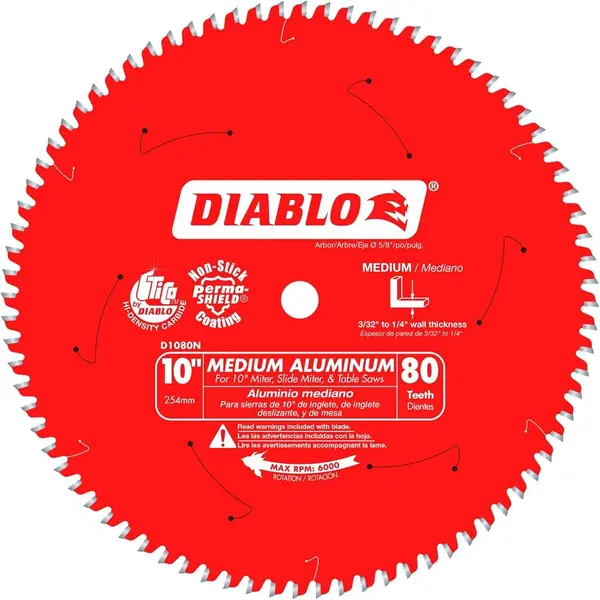
Diablo D1080N 10-Inch 80T TCG Best Overall
Diablo D1080N 10-inch circular saw blade with 80 carbide TCG teeth

Aluminum extrusion cuts

Shop Score 94/100
Arbor
5/8 inch
Teeth
80 TCG
Diameter
10 inches
Kerf
0.094 inch
View on Amazon

Eighty teeth in a triple-chip grind, a negative hook angle, and a thin kerf: put those three together and you have a blade that shaves aluminum instead of grabbing it. The teeth are ground to shear a chip on both sides of the kerf, which is why the edge that comes off the saw is usually flat and bright rather than torn and furry. On a 10-inch miter saw with a 5/8-inch arbor it mounts like any other blade.

We ran it through 1/8-inch wall extrusion and heavier bar stock, and what stuck with us was how little drama there was: no screech, no heat haze, no aluminum welded to the teeth afterward. The laser-cut stabilizer vents do real work at full miter swing, where a lesser plate starts to sing, and the Perma-SHIELD coating keeps chips from building up between cuts.

Six thousand RPM is the ceiling Diablo publishes, which is more headroom than a 10-inch miter saw will ask for, and the carbide came through our cuts without chipping at the tips. Compare it with the 100-tooth blades here and the difference is feed rate: 80 teeth want a slightly faster, more confident push, and they leave an edge a hair coarser on thin-wall extrusion — close enough that we stopped noticing after a few cuts.

If the cut edge is going to be painted or anodized, that last hair matters and one of the 100-tooth options is the better call. For brackets, jigs, railing, and framing stock, this is the blade that stays on the saw.

Worth Noting

  • Too fine for wood; it makes powder not chips
Our Verdict

We mount this one for aluminum extrusion and trim: the 80-tooth TCG grind leaves edges that need little or no filing, and it holds up cut after cut.

Check Latest Price
2.

MASTEC 10-Inch 100T TCG Best for Fine Finishes

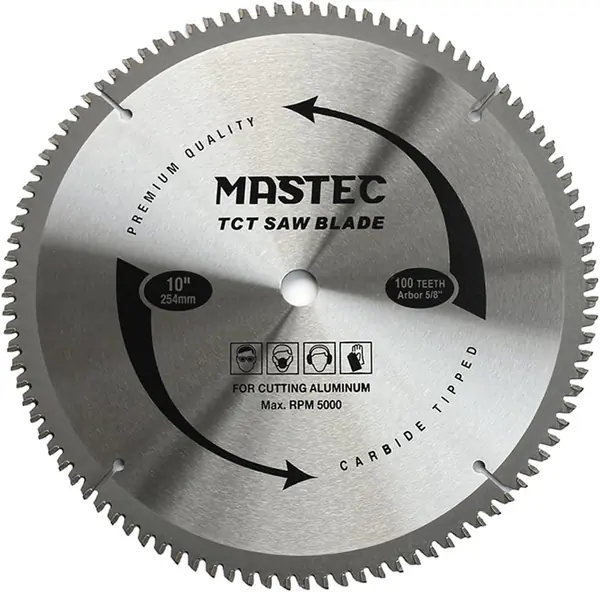
MASTEC 10-inch circular saw blade with 100 triple-chip carbide teeth

Visible trim cuts

Shop Score 93/100
Arbor
5/8 inch
Teeth
100 TCG
Diameter
10 inches
Max Speed
5,000 RPM
View on Amazon

Of the two 100-tooth blades in this group, the MASTEC is the one we hand to someone cutting thin-wall extrusion that will stay visible: railing, cabinet trim, picture-frame stock, the pieces nobody paints. The extra teeth over an 80-tooth blade take a lighter bite, and on square tube with a 1/8-inch wall that shows up as a smoother edge and less snagging as the blade leaves the cut.

The thin-kerf plate is the other half of the appeal. On a 15-amp miter saw it feeds fast without bogging, and it stayed cool through a run of cuts in tube rather than taking on that hot-metal smell that tells you a blade is working too hard. The finish is the real point, though: edges come off clean enough that a file pass is optional rather than mandatory.

Where it gives ground to the Diablo is pace. A hundred teeth want a slower, steadier push, and an afternoon in 1/4-inch plate will show up in your arm before the blade complains. For trim and tube work that is a trade we make without hesitation, and the 100-tooth grind is the whole reason the cut looks the way it does.

Worth Noting

  • 5,000 RPM cap; some 10-inch saws spin faster
Our Verdict

When the cut edge is going to show, we reach for this 100-tooth blade: the extra teeth leave thin-wall extrusion smooth enough to skip the file.

Check Latest Price
3.

FOXBC 10-Inch 80T TCG Best for Mixed Materials

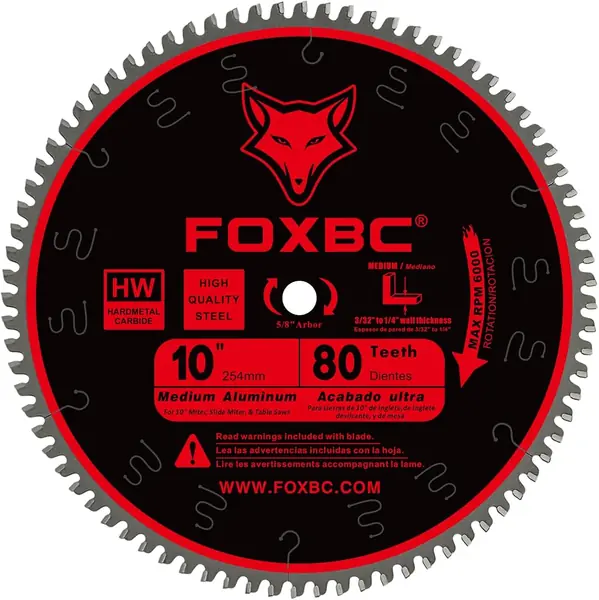
FOXBC 10-inch 80-tooth TCG blade with red coating and 5/8-inch arbor

Metal and plastic

Shop Score 92/100
Arbor
5/8 inch
Teeth
80 TCG
Diameter
10 inches
Kerf
0.094 inch
View on Amazon

Aluminum is only half of what most small shops cut on a miter saw. Acrylic, PVC trim, composite decking, and fiberglass all end up on the same table, and this blade is aimed at exactly that mix: 80 TCG teeth, a 0.094-inch kerf, and a body with laser-cut stabilizer vents.

We paid attention to the exit edge on acrylic and polycarbonate, where a wrong blade announces itself immediately as crazing or a crack running off the cut. This one came through clean, with no melting, no chipping, and no welded swarf on the teeth. On aluminum it behaves the way a proper non-ferrous blade should: steady feed, cool cut, an edge that needs light dressing at most.

What we appreciate is that it never feels like a compromise. The plate is stiff, the tungsten carbide is fine-grained, and the 80-tooth grind is coarse enough to feed at a normal rate through 1/8-inch extrusion while still finishing clean. Set against the Diablo, the cut quality is close enough that we pick on availability rather than on the cut.

Worth Noting

  • Aluminum cuts can still need light edge dressing
Our Verdict

For a shop that cuts aluminum one minute and acrylic the next, this is the blade we keep mounted: 80 TCG teeth handle all of it without chipping.

Check Latest Price
4.

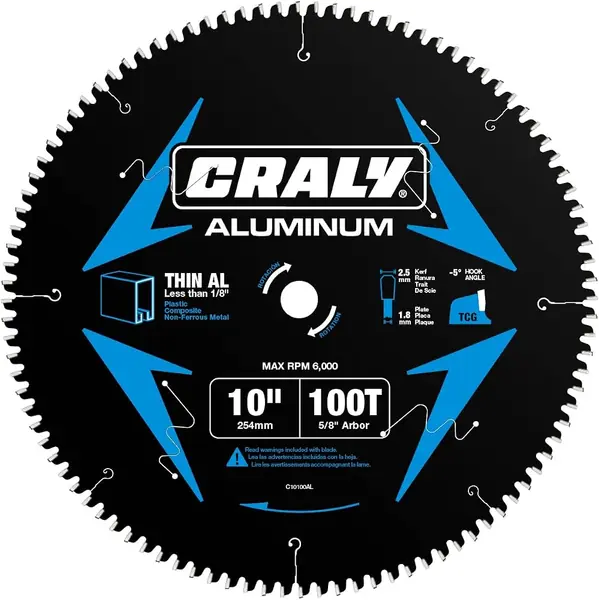
CRALY C10100AL 10-Inch 100T Best for Long Production Runs

CRALY 10-inch 100-tooth carbide blade with black anti-stick coating

Repeated railing cuts

Shop Score 91/100
Arbor
5/8 inch
Teeth
100 TCG
Diameter
10 inches
Kerf
2.5 mm
View on Amazon

At 2.5 mm, the kerf on this CRALY is among the thinnest plates in this group, and on a 10-inch miter saw that has consequences you can feel. Less aluminum comes off per cut, so the blade feeds faster and runs cooler, which matters most when you are making a hundred closet-rod cuts in an afternoon rather than three.

The coating is what we noticed first, though. Aluminum has a habit of galling onto carbide: one smear of metal on a tooth and the cut starts to wander. The Black Ice shield keeps chips sliding clear, and after a long run of railing and rod cuts the teeth still looked clean, with nothing packed into the gullets.

The 100-tooth grind gives you the smooth, square edge you want in thin-wall extrusion, and the plate stayed stiff enough that we did not see wander at the end of a cut. Against the MASTEC, which also runs 100 teeth, we prefer the CRALY for volume work because of the coating, a difference you notice on the tenth cut rather than the first.

Worth Noting

  • No published maximum RPM rating to check
Our Verdict

We like this one for long production runs: the thin 2.5 mm kerf and slick black coating keep aluminum from welding itself to the teeth.

Check Latest Price
5.

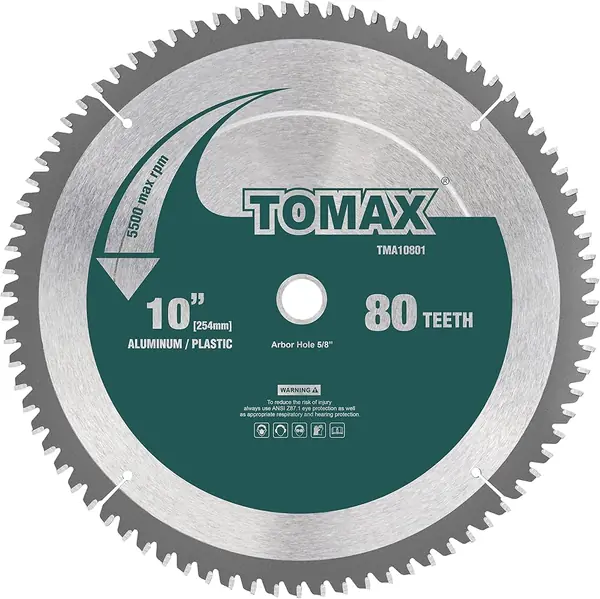
TOMAX 10-Inch 80T TCG Best Budget

TOMAX 10-inch 80-tooth TCG saw blade for aluminum and non-ferrous metal

Budget aluminum cutting

Shop Score 90/100
Arbor
5/8 inch
Teeth
80 TCG
Diameter
10 inches
Kerf
2.6 mm
View on Amazon

This is the budget pick, and we think it earns the spot honestly: an 80-tooth TCG grind, a 5/8-inch arbor, a 2.6 mm kerf, and a laser-cut body with anti-vibration slots, all at the lowest price in this group. What you are not giving up is the geometry. The teeth are ground for non-ferrous metal, not borrowed from a general-purpose wood blade.

We put it through the same cuts as the blades that cost more and came away impressed by the exit edge on 1/8-inch wall tube. The TCG teeth shear rather than tear, the plate stays flat under load, and the electrophoretic coating means it will not rust on a pegboard in a damp garage. It is also genuinely quick in thin-wall tube, where 80 teeth clear the chip fast enough that you are not waiting on the blade.

Where it sits against the Diablo is refinement. The finish is a touch coarser, and on thin-wall extrusion the edge wants a light dressing more often. For shop jigs, brackets, one-off repairs, and anything headed for paint, none of that changes the math. It is the blade we reach for when we do not want to think about what the cut costs.

Worth Noting

  • Carbide teeth can chip in thick or hardened stock
Our Verdict

The cheapest blade in this group, and it still leaves clean, near-burr-free edges on extrusion; we keep one around for rough and dirty jobs.

Check Latest Price
6.

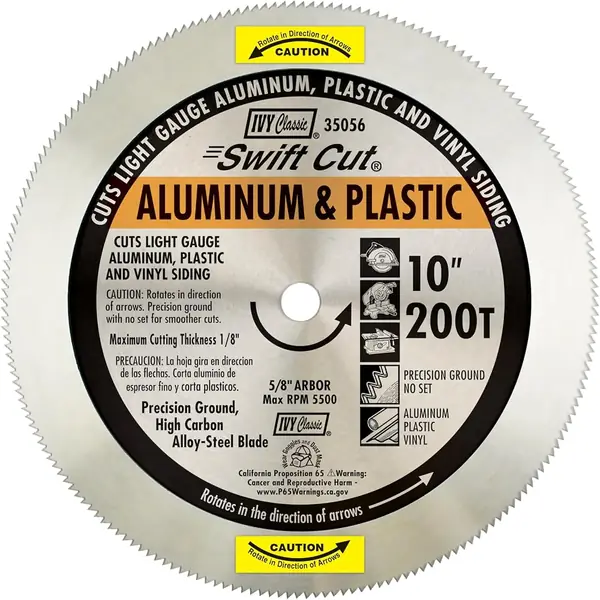
IVY Classic 35056 Swift Cut 10-Inch 200T

IVY Classic Swift Cut 10-inch 200-tooth steel blade for aluminum and plastic

Light gauge sheet

Shop Score 89/100
Arbor
5/8 inch
Teeth
200
Diameter
10 inches
Max Material Thickness
1/8 inch
View on Amazon

Two hundred teeth on a 10-inch plate is a different animal from the carbide blades here, and we are glad there is room for it in this group. It is a high-carbon steel blade with precision-ground, unset teeth, built for light gauge sheet, vinyl siding, and plastic rather than structural extrusion.

Where it shines is exactly where a coarse blade ruins the work. On window screen frames, thin trim, and sheet aluminum that would deform or tear under a big TCG bite, the unset teeth shear a narrow path and leave an edge that needs almost no dressing. On vinyl siding it leaves a clean, unsplintered cut instead of the ragged line a wood blade produces.

High tooth counts and a steel plate build heat, so keep the feed steady and let the blade work rather than leaning on it. Treated that way, it gives the cleanest edge in this group on thin sheet and screen stock, the kind of edge you would otherwise get from a file and a lot of patience.

Worth Noting

  • Limited to aluminum and plastic up to 1/8 inch
Our Verdict

We keep this one for light gauge work: 200 ground teeth leave a glassy edge on thin aluminum sheet, screen frames, and vinyl siding.

Check Latest Price

How We Tested Aluminum-Cutting Miter Saw Blades

We narrowed the field on paper first. Every blade had to be a 10-inch, 5/8-inch-arbor model with a triple-chip grind, since that pairing is what fits the miter saws most people already own and what actually slices aluminum rather than rubbing it. We compared published tooth counts, kerf widths, and maximum RPM ratings, and set aside anything whose RPM ceiling sat below the no-load speed of our test saw. That left 12 blades, which we ran for six months.

Testing happened where this work actually happens: a shop bench on weekend afternoons, working through a railing project and a run of window trim. Every length of stock went into a vise or under a clamp before the saw came down, and we wore eye and hearing protection for every cut. Before mounting each blade, we checked its max RPM rating against the saw's no-load figure.

We cut 1-inch angle, thin-wall channel, sheet, and plastic, timing a set number of cuts through the same length of extrusion to see how hard we had to push. We measured kerf with calipers, then dragged a cotton rag along the fresh edge to see what it snagged and whether a file pass was still needed.

After ten consecutive cuts we read the offcut and blade plate with an infrared thermometer and looked for smeared aluminum on the teeth and packed chips in the kerf. A sound meter at arm's length logged noise, and over the months we kept feeding thick stock through to catch chipped or missing teeth. Price went into the final call, weighed against how many clean cuts each blade delivered before its edge gave out.

How to Choose Miter Saw Blades for Aluminum

Start With the Grind, Then the Tooth Count

Aluminum wants a triple-chip grind: each tooth carries a flat, trapezoidal tip that takes a shallow bite, with a raker behind it to clear the chip, so the blade shears the metal instead of hooking into it. An ATB wood grind will get through aluminum, but it grabs, heats up, and leaves a torn edge. We look for TCG first and treat everything else as a compromise.

Tooth count then sets the finish and the feed rate. Eighty teeth is the sweet spot for a 10-inch blade in extrusion and tube — fast enough to feed at a normal pace, clean enough that the edge needs little dressing. Step up to 100 teeth when the cut is going to be visible: thin-wall railing, cabinet trim, anything headed for anodizing or paint. Expect a slower, steadier push in exchange.

Match the Diameter, Arbor, and Speed Rating

Diameter is fixed by the saw. A 10-inch miter saw takes a 10-inch blade, and a 12-inch blade will not fit under the guard no matter what the arbor looks like. Arbor size is the second gate: most 10-inch miter saws run a 5/8-inch arbor, while many 12-inch saws use a 1-inch arbor, so check the spec plate before you order. Reducing bushings exist for the in-between sizes, but a bushing is a shim, not a fix for the wrong blade.

The rating people skip is maximum RPM. Every blade carries one, and it has to be at or above your saw's no-load speed; a blade rated below the saw's speed can come apart. Check both numbers before the first cut — the saw's is on the motor plate, the blade's is etched into the plate itself.

Thin Kerf Cuts Faster; Know What You Are Trading

Kerf is how wide a slot the teeth cut, and a thin kerf asks less of the motor. On a 15-amp miter saw that means a faster feed and less heat, which is exactly what you want across a long run of extrusion. The blades here range from about 0.094 inch up to 2.6 mm, and the differences are small but real by the fiftieth cut.

The trade is stiffness. A thin plate can deflect in a deep or heavy cut, and deflection shows up as a wall that is not square or a cut that wanders at the bottom. If your work is thick plate, or you tend to push, a heavier plate is the safer choice; for trim and tube, take the thin kerf and the speed that comes with it.

Match the Blade to the Stock, Not Just the Saw

Thin-wall extrusion and a piece of 1/4-inch plate are different jobs. Tube and trim cut beautifully with 80 to 100 TCG teeth and a light feed. Plate wants a slower feed and more patience, and no 10-inch blade will make it feel easy. Sheet aluminum and plastic — screen frames, siding, thin panels — are the one place a high-count steel blade earns a spot, because those teeth are ground for a narrow shear rather than a heavy chip.

Whatever you bolt on, clamp the work. Aluminum is slick, and a piece that climbs on the blade will chip teeth or worse. Set the stock tight against the fence, bring the blade down to the line before you start the motor on the first cut, and let the blade reach full speed before the teeth touch metal.

Frequently Asked Questions

Final Verdict

The Diablo D1080N is the blade we put on the saw by default: 80 TCG teeth, a thin kerf, and a speed rating with plenty of headroom, and it leaves extrusion edges that need little more than a wipe.

When the cut edge is going to show on thin-wall trim, the MASTEC's 100 teeth give you a smoother finish in exchange for a slower feed. And if your aluminum arrives as sheet or siding rather than extrusion, the 200-tooth IVY Classic is the right tool for that job — a different blade for a different day.