Diablo PergoBlade D1012LF Best Overall
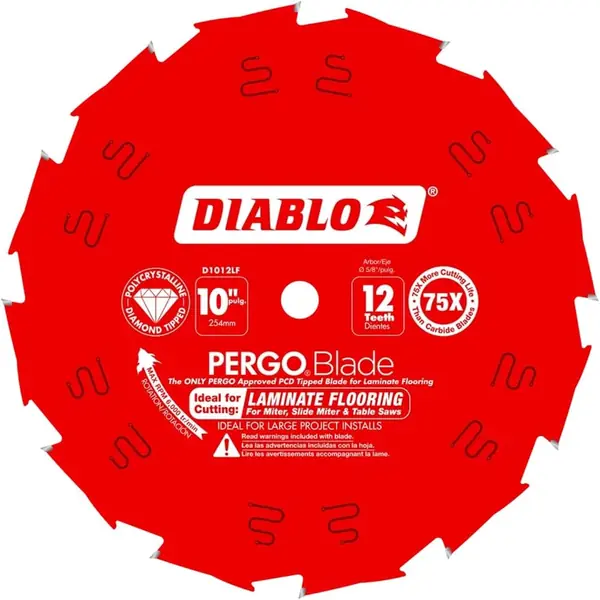
- Teeth
- 12 PCD
- Diameter
- 10 in
- Arbor
- 5/8 in
- Kerf
- 0.087 in
Laminate is mostly paper and glue pressed into a board, and the wear layer on top is aluminum oxide, the same family of grit as sandpaper. It grinds carbide teeth down fast. The PergoBlade answers that with twelve polycrystalline diamond teeth instead of eighty carbide ones, and diamond is not much impressed by aluminum oxide.
On the saw, that shows up as a blade that behaves the same from the first box to the last. Edges come off clean, with none of the white fuzz along the cut that appears once a carbide blade starts to go, and the narrow 0.087-inch kerf takes less out of the plank and less out of the motor. This is the blade we hand someone who is flooring a whole house.
Twelve teeth feed fast and leave a slightly coarser edge than an 80-tooth carbide on solid wood, so treat it as a flooring tool rather than a trim blade. Diablo rates the cutting life at up to 75 times a standard carbide blade; we read that multiplier as marketing, but the direction is right, because it is the only blade here that stays sharp through thousands of square feet.
It is also the most expensive blade in this roundup by a wide margin. For one room, or for a saw that has to cut casing between flooring jobs, two 80-tooth carbide blades for a fraction of the price make more sense. For a full install, nothing else here comes close on cost per cut.
What We Like
- Diamond teeth ignore the abrasive wear layer
- Clean edges without chipping on the wear layer
- Narrow 0.087-inch kerf is easy on the saw
Worth Noting
- Most expensive blade in the roundup
- 12-tooth design leaves coarser cuts on solid wood
For a whole-house laminate install, this is the blade we hand you: diamond teeth hold their edge through abrasive flooring that eats carbide, and the cuts stay clean.
Check Latest Price