↑↓ navigate ↵ open Esc close All results →

Best Miter Saw Blades for Trim of 2026

Running the 24-tooth framing blade that ships on most miter saws through painted pine casing chews up the cut line, tears out grain, and leaves mitered joints ragged enough to demand heavy caulking. Because finish trim sits at eye level, blade choice affects joint quality more than almost any spec on the saw itself.

Eight months of cutting baseboard, window casing, MDF, and prefinished molding with 12 blades showed that tooth count tells only half the story. Tooth grind matters equally—a high-ATB geometry leaves a glassy edge on melamine, whereas a poorly balanced or dragging blade scorches prefinished stock beyond repair—while diameter, arbor size, kerf, and maximum RPM decide whether a disc safely matches the saw.

Spanning 10-inch sliders, 12-inch chop saws, lighter motors, and full 15-amp machines, these eight single blades and combo packs pair clean finish cuts with the saw power on hand.

Our Top Picks

The Best Miter Saw Blades for Trim

1.

Makita A-93681 10-Inch 80-Tooth Miter Saw Blade Best Overall

Makita A-93681 10-inch 80-tooth carbide miter saw blade with silver steel plate

Paint-grade trim

Shop Score 97/100
Arbor
5/8 in
Teeth
80
Diameter
10 in
Tooth Grind
ATAF
View on Amazon

Alternate top, alternate face — ATAF — is the grind Makita uses on this 10-inch blade, and it explains why edges come off the saw looking sheared rather than torn. Each tooth scores the fibers ahead of the cut and lifts the waste clear, so primed pine and oak casing do not come away fuzzy along the shoulder. The plate is hardened and hand-tensioned, and the micro-grain carbide is honed to a polish that shows in the first cut.

We keep this one on the arbor once a job turns from framing to casing. On baseboard, crown, and door trim it is the blade we reach for first, and the difference shows most on the cut that stays visible: crosscuts in 3/4-inch hardwood come away clean enough that sanding is optional. It also resists pitch, which is where cheaper blades start smearing through resinous pine after a dozen cuts.

The ultra-thin kerf is a working detail you feel on a mid-size saw — less steel in the wood means less drag, so the motor holds speed through a wide casing and throws less dust. The trade is feed rate. Eighty teeth and a thin plate want an unhurried stroke, and on a compact battery saw you feel the blade asking for more than the motor has.

It costs more than the WEN and the FOXBC here, and that is the only real argument against it. Set that against a blade that lets you skip sanding on paint-grade trim, and we make the trade without much debate.

Worth Noting

  • Needs an unhurried stroke and taxes compact battery saws
  • Costs more than budget options like WEN and FOXBC
Our Verdict

We fit this 80-tooth Makita when a cut has to come off the saw ready for paint; it is the cleanest-cutting 10-inch blade in this group for casing, baseboard, and crown.

Check Latest Price
2.

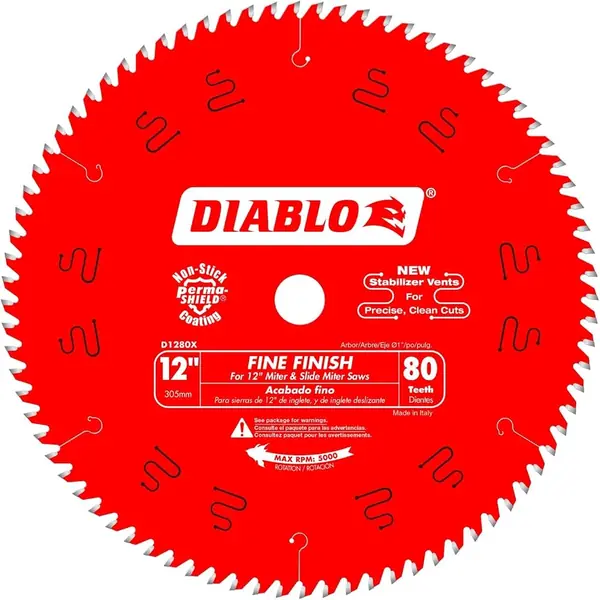
Diablo D1280X 12-Inch 80-Tooth Blade Best for 12-Inch Saws

Diablo D1280X 12-inch 80-tooth Hi-ATB carbide saw blade with hardened steel body

12-inch miter saws

Shop Score 96/100
Arbor
1 in
Teeth
80
Diameter
12 in
Tooth Grind
Hi-ATB
View on Amazon

A 12-inch miter saw wants a 1-inch arbor, which leaves every 10-inch blade here on the sideline. This Diablo is the pick for those saws: 80 Hi-ATB teeth on a hardened steel body, with the company's TiCo carbide, and the cleanest-cutting geometry of the 12-inch options in this group.

Hi-ATB sharpens the teeth at a steeper top angle than an ordinary alternate-bevel grind, so they slice brittle material rather than lifting it. On MDF baseboard and finger-jointed casing that is the difference between a crisp edge and a frayed one, and it is why this blade goes straight to primer without a sanding pass.

The Perma-SHIELD coating is functional rather than decorative: sap and adhesive do not bake onto the plate, so the blade keeps running cool through a long run of trim. The laser-cut thin kerf helps a 12-inch saw hold speed in wide stock. What the grind does not do is rip, and it is not meant to — this is a crosscut and miter blade, and your framing cuts belong on something else.

Worth Noting

  • Crosscut grind, so not the blade for ripping
Our Verdict

For a 12-inch miter saw with a 1-inch arbor, this is the blade we recommend for trim: 80 Hi-ATB teeth and a coated plate that stays clean.

Check Latest Price
3.

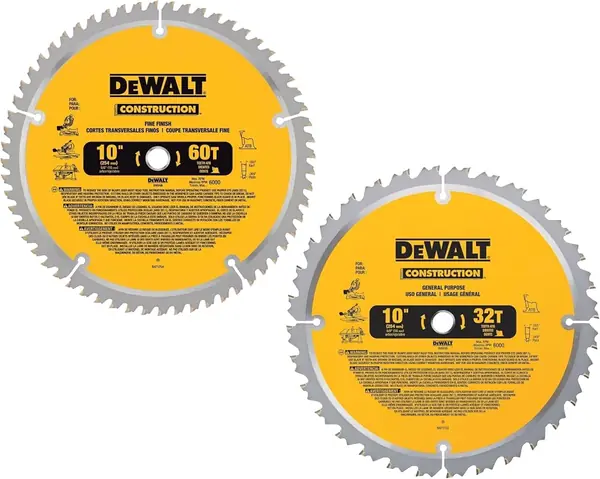
DEWALT DW3106P5 10-Inch 2-Blade Combo Best Two-Blade Value

DEWALT DW3106P5 combo pack with 10-inch 60-tooth and 32-tooth carbide saw blades

Trim plus framing

Shop Score 95/100
Arbor
5/8 in
Teeth
60 and 32 (two blades)
Diameter
10 in
Kerf
Thin kerf
View on Amazon

Two blades arrive in this pack, and the pairing is the point: a 60-tooth fine-finish blade for the trim, and a 32-tooth blade for the 2x material and blocking that come before it. Both are thin-kerf, both are computer-balanced to cut vibration, and both use the 5/8-inch arbor found on most 10-inch miter and table saws.

DEWALT puts a wedge of steel behind each tip rather than relying on the braze alone, which is why these hold up to the occasional nail-riddled board better than the flimsiest blades here. The 60-tooth is the one that matters for trim: it leaves a smooth shoulder on casing and baseboard, and it stays sharp long enough to get through a room's worth of molding.

We recommend the pair to anyone whose miter saw is also their only saw. Swapping the 32-tooth on for framing and back to the 60-tooth for trim takes a minute, and it beats dulling a fine blade on pressure-treated 2x8s. If you already own a decent ripper, spend the money on a single 80-tooth blade instead.

Worth Noting

  • 60 teeth leave more tearout than an 80-tooth blade
Our Verdict

We hand this pair to anyone building out a 10-inch saw: the 60-tooth blade handles trim while the 32-tooth takes the framing cuts that come first.

Check Latest Price
4.

WEN BL1280 12-Inch 80-Tooth Blade Best Budget 12-Inch

WEN BL1280 12-inch 80-tooth carbide woodworking blade with heat expansion slots

Budget 12-inch work

Shop Score 94/100
Arbor
1 in
Teeth
80
Diameter
12 in
Kerf
1/10 in (2.6 mm)
View on Amazon

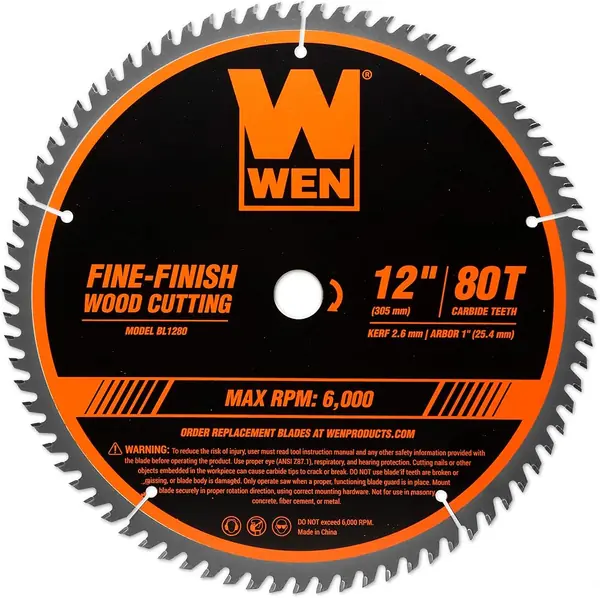
Twelve-inch capacity, 80 teeth, a 1-inch arbor, and a 1/10-inch kerf (2.6 mm) — the WEN's numbers read like the premium 12-inch blade's, which is exactly why it is here. The plate carries heat expansion slots and a protective coating, and the tooth count is right for casing, baseboard, and crown.

We like it for the job most people actually have: a weekend of trim in one or two rooms. It cuts baseboard and casing cleanly, miters close up tight, and the thin kerf wastes little on expensive prefinished stock. Set beside the 10-inch blades here, it is the same tooth count doing the same work on a bigger saw.

The 6,000 RPM rating clears every 12-inch miter saw we know of, and the heat slots do their job in long runs of baseboard, where a plate that stays flat is what keeps miters closing tight. Matched with a fine-tooth finish and a slow chop, the cut comes off ready for caulk and paint.

Worth Noting

  • Not built for daily jobsite use
Our Verdict

For a 12-inch saw on a budget, this WEN leaves baseboard and casing clean enough for paint at a fraction of what the premium blades cost.

Check Latest Price
5.

FOXBC 10-Inch 60-Tooth Thin Kerf Blade Best Thin Kerf

FOXBC 10-inch 60-tooth ATB thin-kerf carbide blade with black coated plate

Low-power 10-inch saws

Shop Score 93/100
Arbor
5/8 in
Teeth
60
Diameter
10 in
Kerf
0.087 in
View on Amazon

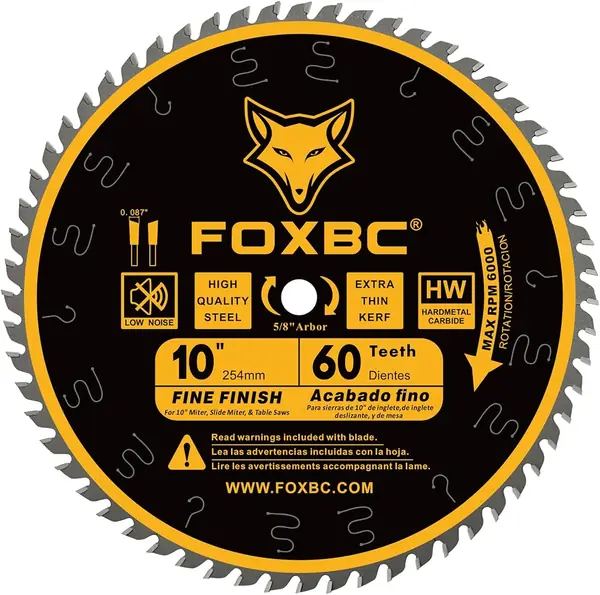
At 0.087 inch, this FOXBC has the thinnest kerf in this group — well under the CMT's 0.110 — and on a saw that bogs in wide casing, that number is the whole argument. Less carbide width in the wood means less drag, so an older 10-inch saw keeps its speed and the motor runs cooler through a run of baseboard.

The 60-tooth ATB grind cuts painted and coated stock without chipping the surface, which matters when you are trimming out a room that is already finished. Sixty teeth is a middle setting: clean enough for casing, shelving, and door trim, a step behind the 80-tooth blades for glass-smooth work on brittle material. At this price it is the blade we suggest for a second saw or a jobsite beater.

Worth Noting

  • Only offered in a single 60-tooth count
Our Verdict

The blade we put on a small or older 10-inch saw when we want clean trim cuts without asking much of the motor.

Check Latest Price
6.

CMT 255.080.10 10-Inch 80-Tooth Ultra-Fine Blade Best for Finest Finish Cuts

CMT Orange Tools 10-inch 80-tooth Hi-ATB blade with chrome-plated body

Finest finish cuts

Shop Score 92/100
Arbor
5/8 in
Teeth
80
Diameter
10 in
Kerf
0.110 in
View on Amazon

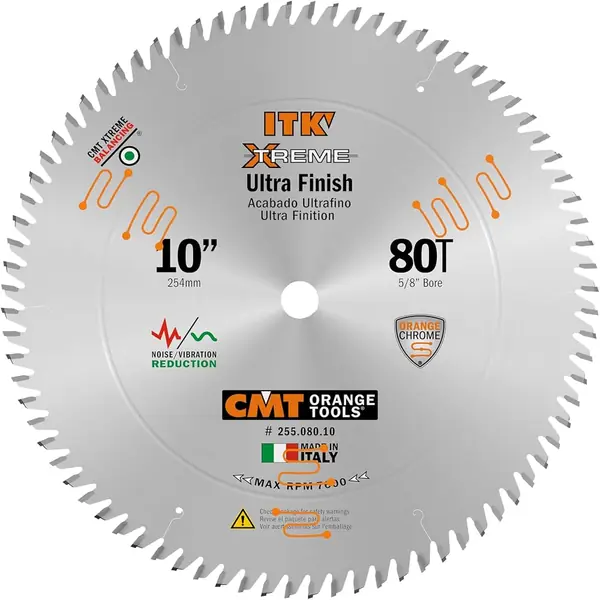
Hi-ATB at a 30-degree top angle with a 5-degree hook is a finishing grind, and CMT builds the rest of the blade to match: German harmonic steel hardened to 46-48 Rockwell, a 0.071-inch plate, and a 0.110-inch kerf that is the widest of the 10-inch blades here.

The chrome plating is the detail we appreciate most — resin and adhesive wipe off instead of baking on, and the body slides through the cut with less friction than an uncoated plate. Laser-cut expansion slots filled with sound-dampening material take the ring out of the cut, and the visible tensioning ring is what keeps a plate this thin from wandering.

Where it separates itself is on material that punishes a lesser blade: melamine shelving, laminate, plastic sheet, and prefinished molding. Crosscuts come off glue-ready, and edges on coated stock stay intact rather than chipping at the corners.

It is the most expensive blade here, and for painted pine casing the Makita does the same job for less money. What persuades us is cabinet work: when a melamine edge is going to be seen, this is the blade on the arbor. Spin it once before the first cut to be sure the plate runs true.

Worth Noting

  • Most expensive 10-inch blade in the roundup
  • Wide 0.110-inch kerf removes more stock per cut
Our Verdict

For the fussiest finish work — melamine, laminate, brittle trim — this CMT leaves the sharpest edges of any 10-inch blade here, at a price to match.

Check Latest Price
7.

Luckyway 10-Inch 32- and 60-Tooth 2-Pack Best for First Trim Projects

Luckyway two-pack of 10-inch carbide blades, 32-tooth and 60-tooth, silver finish

First trim projects

Shop Score 91/100
Arbor
5/8 in
Teeth
32 and 60 (two blades)
Diameter
10 in
Blade Count
2
View on Amazon

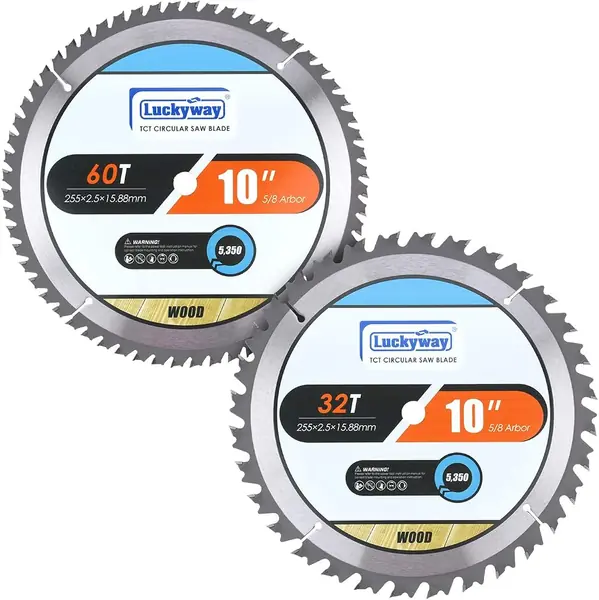
A 32-tooth and a 60-tooth blade, both 10-inch with a 5/8-inch arbor, both on fully hardened steel bodies with ATB teeth. Two blades for one job is the pitch, and it holds up: the 60-tooth handles trim and the 32-tooth does the ripping a trim project always ends up needing.

Out of the package the 60-tooth cuts molding cleanly, and the arbor hole is machined to an exact fit, so there is no play on the spindle. It held its edge through a run of baseboard and casing without needing a second pass, and the 32-tooth chewed through 2x blocking without complaint.

Our take is that this pair makes sense for a first trim project, a second saw, or a borrowed miter saw that came with a dull blade. Two blades at the lowest cost per blade here means you can keep one for finish work and let the other take the abuse.

Worth Noting

  • 32-tooth blade is only for rough work
Our Verdict

A cheap pair that gets a beginner through a trim project: the 60-tooth cuts molding and the 32-tooth handles the framing lumber.

Check Latest Price
8.

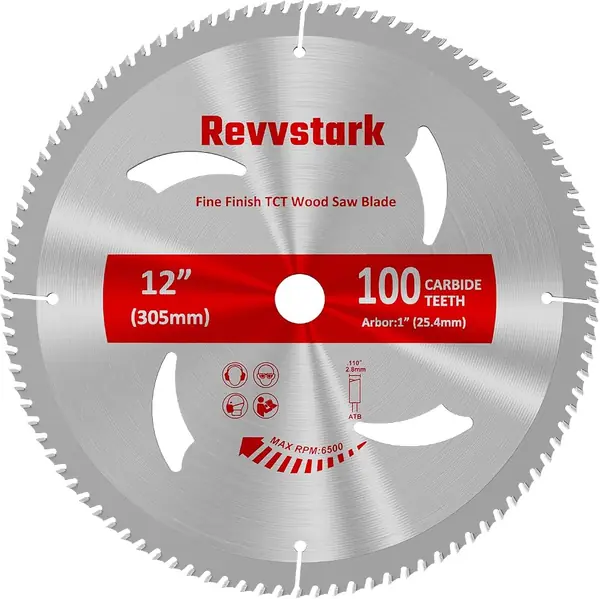
Revvstark 12-Inch 100-Tooth Blade

Revvstark 12-inch 100-tooth carbide blade with 1-inch arbor and noise-reducing perforations

12-inch fine trim

Shop Score 90/100
Arbor
1 in
Teeth
100
Diameter
12 in
Max Speed
6,500 RPM
View on Amazon

A hundred teeth on a 12-inch plate is the finest count in this group, and that is the entire case for this blade. The 1-inch arbor fits standard 12-inch miter saws, the plate carries noise-reducing perforations and anti-kickback teeth, and it costs less than the premium blades here.

What 100 teeth buy you is surface finish: on prefinished molding, veneered plywood, and plastic trim, the finer pitch leaves fewer marks and less fuzz at the exit side. What they cost you is feed rate. Fine teeth take a smaller bite per revolution, so thick hardwood needs a slower pass and lets the blade dwell long enough to warm up.

The perforations break up the ring a 12-inch plate can set up, and the anti-kickback teeth are shaped to keep the stock from climbing. The 6,500 RPM rating covers every 12-inch miter saw we know of, and at 2.49 pounds the blade is light enough that the saw's motor barely notices it on start-up.

We see this as the blade for the last cuts of a job: the prefinished baseboard, the visible shelf edge, the plastic trim nobody wants to touch up. If the day's work is framing or wet pressure-treated lumber, a 60-tooth blade is faster and cheaper to replace.

Worth Noting

  • Fine teeth cut slowly through thick hardwood
Our Verdict

The finest tooth count here and the least expensive route to a polished edge on a 12-inch saw, though 100 teeth ask for a steady hand.

Check Latest Price

How We Tested Miter Saw Blades for Trim

We began with a list of more than 30 blades sold for miter and table saws and narrowed it by the things that rule a blade out before it cuts anything: arbor size and diameter that matched the saws on hand, a maximum RPM rating at or above each saw's no-load speed, and a price spread that made sense for trim work. Twelve blades made it onto the saws — 10-inch and 12-inch, 60- and 80-tooth, thin kerf and standard — and we used them for eight months.

They went to work on a hallway of painted pine baseboard and window casing, on MDF and prefinished casings, on PVC and melamine. We mounted each blade on the arbor it was built for, with the guard and kerf plate in place, and kept wood blades out of aluminum. After every run of cuts we checked the cut face under a raking light, ran a thumbnail across the edge for tearout, and looked for scorch marks on prefinished stock after a dozen cuts in a row.

We also watched how each blade behaved with no wood under it — whether it spun flat against the collar or shivered at full speed — and noted the kerf width, then cut with the lower-powered saw to see whether a thin kerf kept the motor from bogging down. Each blade went into a log with a running tally of linear feet cut and how it held up in abrasive MDF before the edge went from sharp to smeared. Value got the last word: we weighed a single blade's price against a combo pack only when the second blade did work we'd actually have on the schedule.

How to Choose a Miter Saw Blade for Trim

Fit the arbor and diameter first

Most 10-inch miter saws take a 5/8-inch arbor; most 12-inch saws take 1 inch. Get that wrong and nothing else on this page matters — a 12-inch blade will not fit a 10-inch saw, and an 80-tooth blade with the wrong bore sits in the drawer. Check your saw's manual for both numbers before you shop.

Then compare the blade's maximum RPM rating with the saw's no-load speed, which is printed on the motor plate. A blade rated below your saw's speed is the wrong blade, however good the teeth look.

Pick a tooth count for the material

Sixty teeth is the working baseline for painted trim: smooth, fast, and forgiving of a saw that is not perfectly tuned. Eighty teeth is where casing, crown, and stain-grade work get their clean edges, in exchange for a slower feed. A hundred teeth belongs on veneered plywood, melamine, and plastic trim, where the surface matters more than speed.

More teeth also means more heat and more drag, so a small saw handles an 80-tooth blade better than a 100-tooth one. The grind matters as much as the count: an aggressive high-angle tooth slices brittle stock, while a plain alternate-bevel tooth is the generalist.

Treat thin kerf as a motor decision

Kerf is the width of the cut, and the blades here run from 0.087 inch to 0.110 inch. A thin kerf removes less material per tooth, so an older or lower-powered saw holds speed in wide stock, and you waste less on expensive prefinished trim. That is why we feed a 0.087-inch blade more slowly than a 0.110-inch one.

The trade is rigidity. A very thin plate can deflect if you force the cut, while a heavier plate is steadier on a big saw working thick hardwood. Match the kerf to the saw, not to the brochure.

Half of a clean cut is setup

Any blade here will tear out if the saw is set up badly. A zero-clearance insert or a sacrificial backer board supports the fibers at the exit side, and letting the blade reach full speed before the teeth touch wood stops the chatter that shows up later as a ragged edge.

On prefinished or brittle stock, a strip of painter's tape over the cut line is cheap insurance, and a slow, steady chop beats a fast one every time. A sharp blade in a sloppy saw still leaves a torn edge.

One blade or a set

A combo pack makes sense when the miter saw is your only saw: a 60-tooth blade for the trim and a 32-tooth for the framing covers a whole remodel without a second trip. The pair usually costs less than the two blades bought separately, though the coarser blade tends to sit on the shelf until you need it.

If you already own a decent ripper, put the money into one good trim blade instead. Carbide can be resharpened, and on the premium blades here that math works; on a budget blade, replacement is usually the better call.

Frequently Asked Questions

Final Verdict

The Makita A-93681 is the blade we put on a 10-inch miter saw when the work is trim: 80 ATAF teeth, a thin kerf, and an edge that comes off the saw ready for primer. It costs more than the budget picks, and it earns that back on the first room of paint-grade casing.

If your saw is a 12-inch model with a 1-inch arbor, the Diablo D1280X is the equivalent choice. And when one saw has to frame and finish the same room, the DEWALT 60/32 combo is the practical buy — one blade for the framing, one for the trim.