↑↓ navigate ↵ open Esc close All results →

Best Pinless Scroll Saw Blades of 2026

Teeth snapping mid-curve or leaving a fuzzy underside that demands hours of hand sanding usually trace straight to the blade, not the scroll saw itself. Because the machine only supplies the up-and-down stroke, tooth geometry, blade width, and set govern how tightly you can turn, while ultra-fine blades that trace intricate fretwork are often the first to break—turning bargain packs into poor value once failures are counted.

Putting 16 packs of pinless reverse-tooth, spiral, skip-tooth, and double-tooth assortments into four months of workshop rotation across pine, plywood, and hardwood clarified which blades hold up under tension. Measuring cut quality alongside lifespan and true cost per surviving blade separated smooth cutters from brittle stock.

Matching tooth style to the curve and material keeps thin kerfs tracking true without fighting the pattern.

Our Top Picks

The Best Pinless Scroll Saw Blades

1.

Flying Dutchman Ultra Reverse Variety Pack Best Overall
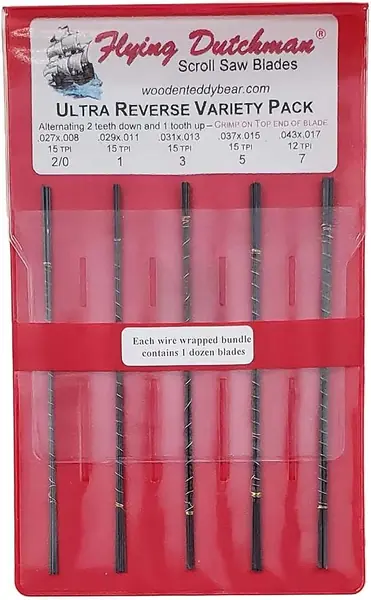
Flying Dutchman pinless scroll saw blade variety pack with five sizes of milled steel blades

Clean-edged detail work

Shop Score 93/100
Blade Type
Reverse tooth, pinless
Pack Count
60 blades, 12 per size
Blade Length
5 inches
Sizes Included
#2/0, #1, #3, #5, #7
View on Amazon

Every third tooth on these blades points the other way, and that single detail is why we start here. A flat skip-tooth blade tears the wood as the teeth exit the bottom of a cut; reversed teeth shave that exit edge on the upstroke, so the face you see when you flip the piece over comes off the saw clean instead of fuzzy. In 1-inch hardwood the difference is obvious enough that we stopped planning a sanding pass for the underside.

What we like best is the spread: a dozen blades each in #2/0, #1, #3, #5, and #7, which carries you from a hairline interior cutout up to an inch of hardwood without ordering a second assortment. They are milled rather than stamped, made in Germany from hardened steel, and they hold tension at the clamp, which is where cheaper blades give up. The reusable envelope is labeled by size, so you are not sorting five piles of identical silver blades by eye.

The coarsest blade in the box is a #7, which is plenty for an inch of stock but not what you want for thick puzzle blanks or laminated turning blanks; if heavy stock is most of your cutting, a heavy-duty assortment serves you better. For everything else — fretwork, inlays, portrait panels, toy parts — the extra money buys fewer sanding marks, which is the whole currency of scroll work.

Worth Noting

  • Highest-priced pack in this group
Our Verdict

We recommend this as the pack to buy first: five sizes of reverse-tooth blades that leave the underside of a cut clean, so the detail work needs less sanding.

Check Latest Price
2.

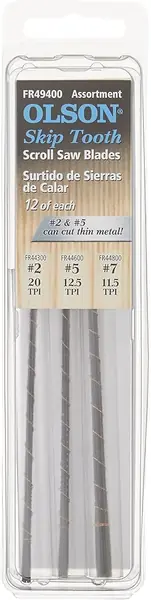
Olson Skip Tooth 36-Piece Assortment Best for Fast Cutting

Olson skip tooth plain-end scroll saw blades in a 36-piece assortment pack

Fast general cutting

Shop Score 92/100
Blade Type
Skip tooth, plain end
Pack Count
36 blades
#2 Blade
0.029 in. wide, 20 TPI
#5 Blade
0.038 in. wide, 12.5 TPI
View on Amazon

Where the Flying Dutchman pack chases a clean exit edge, this one chases feed rate. Skip-tooth geometry leaves a wide gap after every tooth, and that gullet throws chips clear instead of letting them pack into the kerf and drag on the blade. Through 1/2-inch oak and through pine, we found it the quickest of the flat blades here in straight runs and easy curves.

Three dozen high-carbon steel blades for noticeably less than the five-size packs make this the value pick of the group, and the #2 and #5 universal sizes cover most flat cutting in stock from 1/8 inch to about 3/4 inch. They stay sharp through a session and turn a tight radius in thick wood without fighting you, which is more than we expect from a blade at this price.

The real luxury of buying them by the dozen is that you change one the moment it slows. Most bad scroll saw cuts come from a dull blade being pushed through a curve, and a box of 36 makes putting in a fresh blade the cheaper decision every time.

Worth Noting

  • Only two universal sizes in the pack
Our Verdict

Buy this one when feed rate matters more than a glass-smooth exit edge: three dozen fast skip-tooth blades for noticeably less than the premium assortments.

Check Latest Price
3.

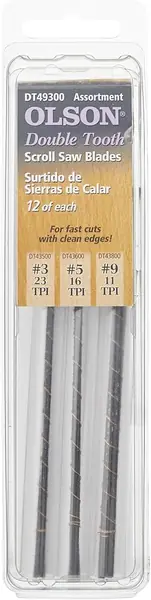
Olson Double Tooth 36-Piece Assortment Best Budget Assortment

Olson double tooth plain-end scroll saw blades, 36 pieces in three sizes

Mixed stock thicknesses

Shop Score 90/100
Blade Type
Double tooth, plain end
Pack Count
36 blades
Sizes Included
12 each of #3, #5, #9
#9 Blade
0.053 in. wide, 11 TPI
View on Amazon

Three sizes, one box, and a working range that runs from 3/32-inch veneer up to 2-inch stock: the #3 takes tight radius work in thin material at 23 TPI, the #5 is the everyday middle at 16 TPI, and the #9 puts an 11 TPI blade into thick hardwood. Nothing else in this group covers that spread for the money.

Double-tooth geometry sets two teeth together and then leaves a flat space for chips to clear. In hard stock that reads as a blade that cuts fast without chattering, and the sizes are packed a dozen each, so you can save the coarse blade for thick work and let the #5 take the wear. Made in Germany from high-speed steel, they hold up through a run of brackets or toy parts without going dull halfway.

We think of this as the box to buy when you don't yet know what you cut most. The finish off a double-tooth blade is not as fine as what a reverse-tooth blade leaves, and that is the honest trade at this price; what you get instead is enough range to finish a whole project without a second order.

Worth Noting

  • No blade finer than a #3 for hairline detail
Our Verdict

We think it's the best-value box here for a shop that cuts a bit of everything, with three double-tooth sizes covering veneer through thick stock.

Check Latest Price
4.

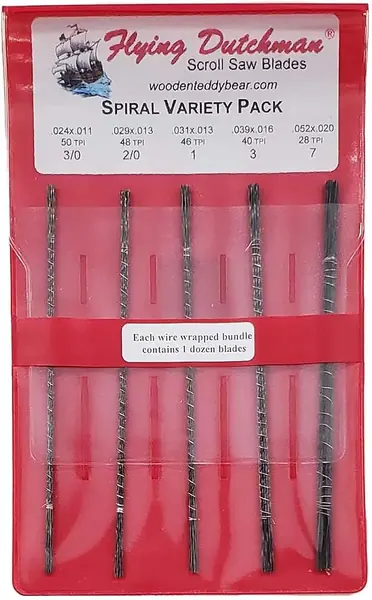
Flying Dutchman Spiral Variety Pack Best for Cutting in Any Direction

Flying Dutchman spiral pinless scroll saw blades, five sizes with a reusable pouch

Curved interior cuts

Shop Score 89/100
Blade Type
Spiral, pinless
Pack Count
60 blades, 12 per size
Blade Length
5 inches
Sizes Included
#3/0, #2/0, #1, #3, #7
View on Amazon

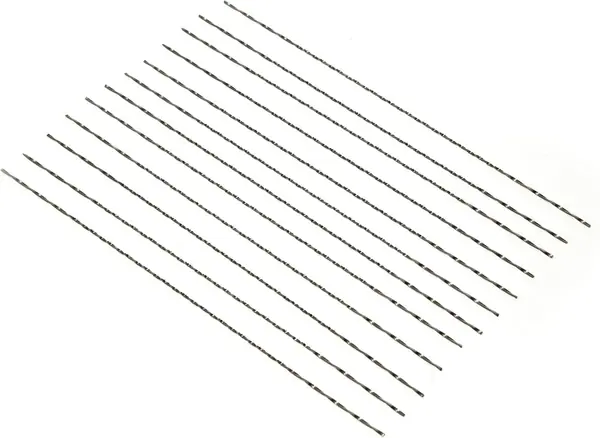
The trick with a spiral is that you never rotate the workpiece. Teeth run around every face of the twist, so the blade cuts in whatever direction you steer it — an interior cutout in the middle of a panel, or a long board whose far end would otherwise hit the back of the saw.

Five sizes, a dozen each, from #3/0 up to #7, all milled from hardened steel in Germany. The small end is where these earn their place: a #3/0 follows a fine line through 1/4-inch plywood and craft foam without grabbing, and even the coarse sizes go through thick material without the burning you get from a fine flat blade pushed too slowly.

Control is the trade. A spiral cuts on all sides, so it wanders in a long straight run and leaves a fuzzier edge than a flat blade, and the wide kerf of the coarse sizes is not what you want on a visible glue line. For pierced panels, inlays, and portrait work you steer like a pencil, none of that matters, and we keep a spiral pack on the shelf beside the flat assortments.

Worth Noting

  • Costs as much as the flat assortments
Our Verdict

For pierced panels and interior shapes, we reach for this five-size spiral pack: it steers in any direction and never needs the workpiece turned.

Check Latest Price
5.

FOXBC 5-Inch Plain End 36-Pack

FOXBC plain-end scroll saw blade set with three tooth counts, 36 blades

Budget starter set

Shop Score 87/100
Blade Type
Plain end, precision sharpened
Pack Count
36 blades, 12 per count
Blade Length
5 inches
Tooth Counts
28, 12, and 10 TPI
View on Amazon

The least expensive way here to put three dozen flat blades in a drawer. FOXBC splits the pack by tooth count rather than by number — 12 blades at 28 TPI, 12 at 12 TPI, 12 at 10 TPI — which reads like a job list: fine work in thin stock, everyday cutting, and a coarse blade for fast work in thicker material.

They are precision sharpened, and we like that the three counts map onto jobs instead of numbers you have to look up. In softwood, plywood, and plastic they cut clean and tracked straight, and the 28 TPI blade left a good edge on 1/4-inch stock without the burning a duller blade leaves behind.

Treat it as a beginner's first box, a spare set for a second saw, or the blades you keep for stock that might have a hidden nail in it. At this price, ruining one on a bad cut costs nothing worth mourning, and three dozen means there is always another in the bag.

Worth Noting

  • No blade fine enough for hairline interior cuts
Our Verdict

A sensible first box: three tooth counts and three dozen blades for the lowest 36-pack outlay here, which makes it an easy place to start.

Check Latest Price
6.

WEN BLX241 Spiral 12-Pack

WEN BLX241 spiral pinless scroll saw blades, size 2, 12-blade pack

Fine spiral detail

Shop Score 84/100
Blade Type
Spiral, pinless
Pack Count
12 blades
Size
#2, 0.035 in. diameter
Teeth
41 TPI
View on Amazon

One size, one dozen, one job. The BLX241 is a #2 spiral, 0.035 inch in diameter with 41 teeth per inch, and it makes no attempt to be a starter assortment. That narrowness is the point: 41 TPI in a spiral leaves a very fine edge in thin stock, and every blade in the pack behaves the same, so you learn one blade instead of five.

Twelve blades is enough pierced work to know whether spiral cutting suits you, which is why we keep a pack around as the low-cost way to answer the question before spending on a five-dozen spiral assortment. High-carbon steel, and the universal 5-inch length fits most saws that take plain-end blades, WEN's own line included.

What it earns is a place on pierced ornaments, model work, and thin ply — the jobs where you steer the blade around a drawn line instead of feeding stock into a curve. If most of your cutting is 3/4-inch and thicker, put the money into a flat assortment instead.

Worth Noting

  • One fine size, no blade for thick stock
Our Verdict

Worth it as a low-cost trial of spiral cutting: a dozen fine #2 blades for pierced work in thin stock, from a pack that fits most saws.

Check Latest Price

How We Tested Pinless Scroll Saw Blades

We started by building a shortlist from the pinless blades sold in variety packs, sorting by tooth geometry, the sizes included, clamp style, and cost per blade. We ruled out blades that needed pinned clamps or adapters, then bought 16 packs and put them into rotation for four months in a home workshop. That meant weeknight craft and toy projects, weekend sign projects, and plenty of practice curves in pine, plywood, and hardwood. We inspected each blade out of the pack for straightness, tooth set, and rough edges before it went on the saw.

Every blade got used for the jobs it was sold for: reverse-tooth and double-tooth blades for clean-edged detail, skip-tooth for fast straight cutting, and spirals for interior cuts and tight turns. We noted whether each blade started cleanly or wandered off the line, how much fuzz or burn it left, and how tight a radius it could follow before the kerf closed in. We compared narrow, high-tooth blades against wider, coarser ones and recorded where each paid off—tight curves versus fast waste removal. We ran blades until they dulled or snapped under tension, tracking which sizes failed first and how many usable blades were left in each pack, then divided the pack cost by that number.

We also checked how easily the sizes could be told apart after the pack was opened and whether the storage sleeve kept them sorted. Clamp fit got checked before any cutting: each blade had to seat squarely in standard pinless clamps without wobble or slack. We did not cut ferrous metal; any non-ferrous test stock was sandwiched between waste boards and cut with the saw running slowly. We unplugged the saw and wore eye protection every time we changed a blade, since a tensioned blade can snap.

How to Choose Pinless Scroll Saw Blades

Start With Tooth Geometry

Four shapes cover nearly everything. Skip tooth and double tooth are the fast generalists, clearing chips and cutting quickly through stock up to about an inch. Reverse tooth puts some teeth pointing backward to clean the exit edge, which is what separates a finished-looking cut from a fuzzy one. Spiral blades cut on every face and steer in any direction, at the cost of a rougher edge and less control in a straight line.

Decide which of those four describes most of your work and buy a pack built around it. Our default for detail work is reverse tooth, with a spiral box kept for pierced shapes.

Sizes, TPI, and the Radius a Blade Will Turn

Width and tooth count set what a blade can do. A narrow, high-TPI blade turns inside a curve the width of a pencil; a wide 11 TPI blade powers through two inches of hardwood and refuses tight corners. More teeth is not automatically better — a very fine blade dragged slowly through thick stock burns the wood and clogs its gullets.

Most scroll work needs two or three sizes, which is why an assortment beats a single-size pack. Check the range against your stock before ordering: a box that stops at #7 covers an inch of hardwood, not two.

Buy by the Dozen, Because Blades Break

Scroll saw blades are consumables and they snap — usually at the clamp after too much tension, or mid-curve when the stock is fed faster than the teeth can clear. Budget for it. Thirty-six blades sounds excessive until you are three hours into a project and the last fine blade gives up; the cost per blade on a 36-count box is a fraction of buying singles.

Our rule is to change the blade at the first sign of drag. A dull blade costs more in sanding than a fresh one costs to buy.

Check Your Clamps Before You Order

Plain-end blades need a clamp that grips a flat shank. Plenty of entry-level saws ship with pin-type holders, and a 5-inch pinless blade will not stay put in them without a conversion kit or a set of pinless clamps. Check the saw before you check the blade.

Length matters too: 5 inches is the standard for this category, and every pack here is that length, so a blade that will not fit is almost always a clamp problem rather than a size problem.

Keep the Sizes Apart

Five nearly identical silver blades in a drawer is how a good assortment turns into guesswork. Packs that arrive in a labeled, resealable envelope are worth a small premium; if yours come loose in a bag, sort them into a compartmented parts box by size the day they arrive.

Labeling saves you from cutting a 2/0 where the job wanted a #5, and it tells you which size you actually burn through so you can reorder that one on its own.

Frequently Asked Questions

Final Verdict

The Flying Dutchman Ultra Reverse pack is the one we point a scroll saw owner to first: five sizes, milled steel, and a reverse tooth that fixes the exit edge on the cuts that show. It costs the most here, and the spread of sizes is what you are paying for.

If speed and budget matter more than finish, the Olson skip tooth box is the better buy. If your work is pierced panels and interior shapes, add a spiral pack — the five-size Flying Dutchman set covers the widest range of them, and the WEN twelve-pack is the cheap way to find out whether you like the technique at all.