↑↓ navigate ↵ open Esc close All results →

Best Scroll Saw Blades of 2026

Before tooth count ever enters the picture, a scroll saw blade has to fit the clamps on the machine. Pin-end blades drop straight into saws built for pins, while plain-end blades require clamps that pinch bare steel — and shorter vintage hobby saws will not take standard 5-inch lengths at all. Buying a bulk pack before matching both end style and length turns a cheap consumable into drawer clutter.

Over four months on a 16-inch saw and a smaller pin-end hobby saw, we ran 16 packs of blades through pine, maple, plywood, plastic, and thin brass sandwiched between waste boards. Feeding a fine blade through thick maple quickly shows why tooth geometry dictates feed speed: dull steel burns around curves instead of slicing, and most snapped blades give way to side pressure long before the teeth wear out.

Covering both mount styles, both common lengths, and tooth patterns from rough-out skip teeth to clean-cutting reverse teeth ensures the right blade is on hand for the stock on the table.

Our Top Picks

The Best Scroll Saw Blades

1.

Olson Precision Ground Scroll Saw Blade Best Overall
Olson Precision Ground scroll saw blade, 5-inch plain-end carbon steel blade with fine teeth

Finish cuts in hardwood

Shop Score 94/100
Blade Length
5 in
Blade Ends
Plain end (pinless)
Teeth
18 TPI, double tooth
Tooth Geometry
Precision ground
View on Amazon

A scroll saw cut has two edges: the one you planned and the one underneath. The top one is where the Olson Precision Ground earns its place on our saw. The teeth are ground rather than punched, and they sit in pairs with a flat gap behind them that carries chips out of the kerf instead of packing them in. On maple and white oak the edge came off the table smooth enough that sanding felt like a formality.

That edge also lasted. We kept waiting for the push-back that tells you a blade is dull, and it took far longer to arrive than we expected from something this thin. That is what puts it ahead of the budget boxes for us: fewer blade changes, fewer half-finished cuts, less time chasing a line that has started to wander.

The shanks are plain, so this one needs a saw with pinless clamps; a WEN 3921 or an older pinned Craftsman cannot run it at all. On a modern 16- or 21-inch saw it drops in, tensions up, and tracks where you point it, which is the reason it stays loaded between projects.

Worth Noting

  • Fine 18 TPI tooth cuts slowly in thick stock
Our Verdict

The blade we load when the cut has to look good coming off the saw: ground teeth leave a smooth edge in hardwood and keep it. Buy it for a pinless saw and finish-quality work.

Check Latest Price
2.

FOXBC 5-Inch Pin End Scroll Saw Blades Best Value

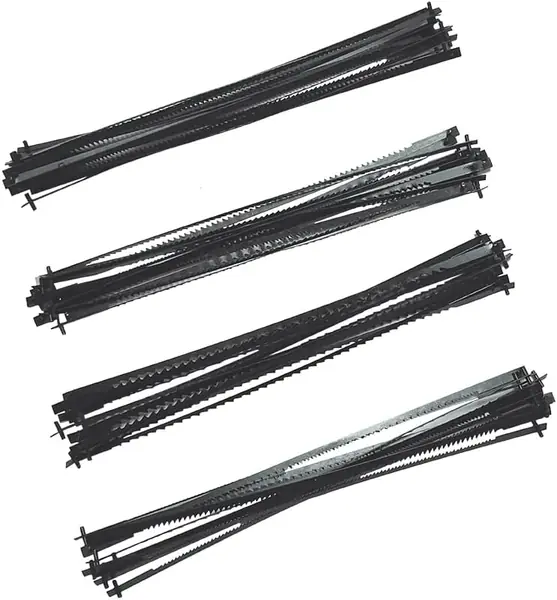
FOXBC 5-inch pin-end scroll saw blades in four tooth counts, 48-blade pack

Pin-end saw owners

Shop Score 93/100
Blade Length
5 in
Blade Ends
Pin end
Blades Per Pack
48 (12 of each tooth count)
Tooth Counts
10, 15, 18, and 24 TPI
View on Amazon

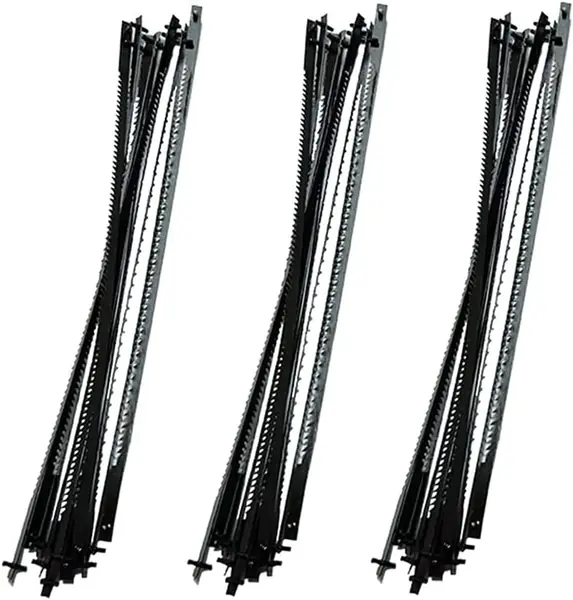
Pinned-blade saws are where a lot of people start — the WEN 3921 and 3922, most Craftsman and Ryobi 15- and 16-inch machines — and the blades in the box are usually the first thing to disappoint. This pack is our usual answer: 48 blades, twelve each at 10, 15, 18, and 24 teeth per inch, in corrosion-resistant SK5 carbon steel.

Having four counts in one box is the whole point. We keep the 18 loaded for general work in 3/4-inch stock, drop to the 10 for fast straight cuts and thicker blanks, and switch to the 24 for tight turns in 1/4-inch plywood where tear-out would show. The bands are spaced widely enough that one box covers roughing out and finishing, instead of forcing you to buy two.

Fit is settled by the pins at five inches overall, which is what those saws expect, and they seated in the listed machines without shimming. We treat them as consumables and swap a dull one without thinking about it, which is exactly what a 48-blade box is for.

Worth Noting

  • Blades can snap early under heavy feed
Our Verdict

If your saw takes pinned blades, this is the box we point people to: four tooth counts, 48 blades, and enough of each to actually finish a project.

Check Latest Price
3.

Flying Dutchman Ultra Reverse Scroll Saw Blades Best for Splinter-Free Finishes

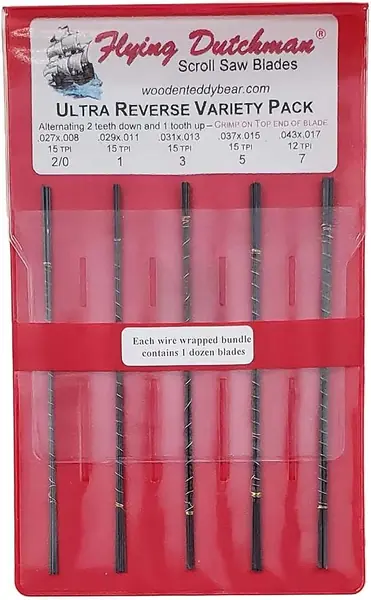
Flying Dutchman Ultra Reverse pinless scroll saw blades in five sizes, 60-piece pack

Tear-out-free finish cuts

Shop Score 92/100
Blade Length
5 in
Blade Ends
Plain end (pinless)
Blades Per Pack
60 (12 of each size)
Sizes Included
2/0, 1, 3, 5, and 7
View on Amazon

Tear-out lives on the underside of a scroll cut. You finish a curve, lift the piece, and find a fringe of splinters along the back edge that no amount of care on the top face prevented.

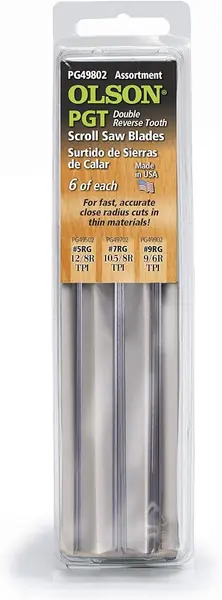
Ultra Reverse attacks that directly: every third tooth points backward, so the blade shears the fibers on the exit side instead of lifting them. On 3/4- and 1-inch hardwood we came off the saw with edges that needed a light pass with a sanding stick rather than a session with one. That result is the most convincing argument for a premium blade anywhere on this page.

Five sizes — 2/0, 1, 3, 5, and 7 — a dozen of each, which spans hairline fretwork up to stock around an inch, and the hardened German steel stays sharp through it. What the pack does not give you is a coarse blade for hogging out waste, so we keep a cheap box beside it for rough work and save these for anything whose cut edge will show.

Worth Noting

  • No coarse blade in the pack for roughing out
Our Verdict

The cleanest underside we got from any pack in this group. Worth the premium if you are tired of sanding fuzz off the back of every cut.

Check Latest Price
4.

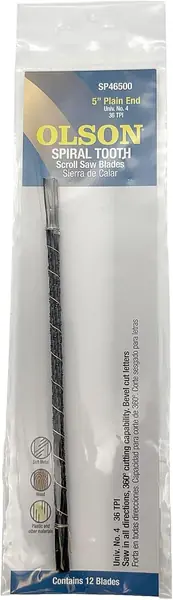
Olson Spiral Scroll Saw Blade Best for Cutting in Any Direction

Olson spiral scroll saw blades, 5-inch carbon steel blades with twisted teeth

Shapes without turning

Shop Score 91/100
Blade Length
5 in
Blades Per Pack
12
Teeth
36 TPI spiral
Kerf
.041 in
View on Amazon

Sooner or later a piece is longer than the space between the blade and the back of the saw, and turning it becomes the entire job. A spiral blade removes that problem: the teeth wrap the blank in a helix, so the blade cuts in any direction and the workpiece never has to rotate.

We used it for lettering and for long shallow curves where a standard blade would have forced us to stop and pivot mid-cut. At 36 TPI it is a fine tooth, and the high carbon steel is hardened and tempered, so it does not fade in a single session the way a stamped blade does.

The trade is the surface. Olson calls it a medium-rough finish and we agree with the label: this is a shaping blade, not a finishing one, and you should plan on sanding what comes off it. It also rewards a light hand, because pushed hard it wanders off the line. Anyone cutting small flat pieces gets a better edge from a standard blade; anyone fighting the throat has no other solution here.

Worth Noting

  • Leaves a medium-rough edge that needs sanding
Our Verdict

The blade for long boards and lettering, where turning the workpiece is the whole problem. Expect a rougher edge and slower going than a standard tooth.

Check Latest Price
5.

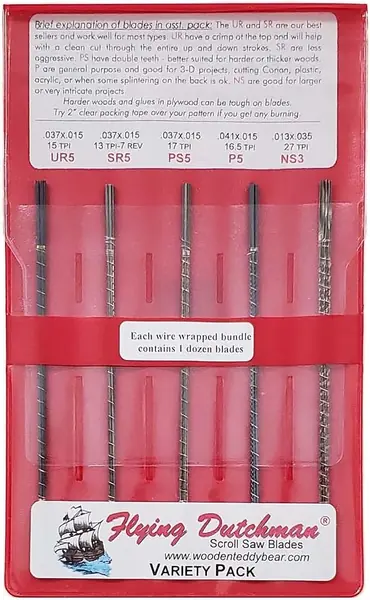
Flying Dutchman Five-Dozen Pinless Variety Pack Best Blade Sampler

Flying Dutchman pinless scroll saw blade variety pack with a labeled reusable pouch

Blade style sampling

Shop Score 90/100
Blade Length
5 in
Blade Ends
Plain end (pinless)
Blades Per Pack
60 (12 of each style)
Styles Included
UR5, SR5, PS5, P5, and NS3
View on Amazon

What sold us is the pouch. Five styles sit in their own labeled compartments with a short note on what each one is for, which is more guidance than most blade packs offer. For someone standing at a saw holding an unmarked blade, that is the difference between learning and guessing.

The lineup includes the ultra reverse tooth Flying Dutchman sells on its own, alongside four other configurations, a dozen of each in 5-inch pinless blades of hardened German steel. Cutting the same pattern with three of them back to back is the fastest way we know to feel what tooth geometry does: one style feeds fast and leaves fuzz, another cuts slower and comes off clean.

Treat it as a sampler rather than a supply. Twelve of each style goes quickly once you settle on a favorite, so plan the first few projects as a test and then buy a full box of the blade that won. If you already know you want ultra reverse across a range of sizes, the Ultra Reverse pack is the smarter purchase.

Worth Noting

  • Only a dozen of each style, so you will reorder
Our Verdict

Buy it to find out which blade you actually like. Five styles, labeled, in one pouch, and then you reorder the one that suits your work.

Check Latest Price
6.

FOXBC 3-Inch Hobby Scroll Saw Blades Best for Vintage Hobby Saws

FOXBC 3-inch pin-end hobby scroll saw blades, 36-pack with three tooth counts

Vintage hobby saws

Shop Score 89/100
Blade Length
3 in (2-3/4 in between pins)
Blade Ends
Pin end
Blades Per Pack
36
Tooth Counts
15, 18, and 24 TPI
View on Amazon

Vintage hobby saws — Dremel Moto-Shop and Moto-Jig models, old Craftsman 3-inch machines — take a 3-inch blade with 2-3/4 inches between pins, and almost nobody stocks them anymore.

We were glad to find 36 of them in three tooth counts. The SK5 carbon steel holds up, they seat properly in the original clamps, and they cut 1/4-inch plywood and pine cleanly enough for the work those saws are good at. For someone who inherited a relative's Moto-Shop and wants to actually use it, that covers the whole need.

The blades are short by design, so keep your expectations to small parts: model work, craft shapes, pine blanks, and 1/4-inch plywood rather than 3/4-inch furniture stock. Measure the old blade end to end and between the pins before you order, because a 5-inch blade cannot be made to fit one of these machines.

Worth Noting

  • Will not fit standard 15-inch scroll saws
  • Short 3-inch length limits cuts to thin stock
Our Verdict

The practical way to keep a vintage 3-inch pin-end hobby saw cutting. It will not fit a standard 15-inch scroll saw, so check your pins before ordering.

Check Latest Price

How We Tested Scroll Saw Blades

We started by narrowing to blades our saws could actually mount, which meant separating pin-end from plain-end and matching blade length to the saw: standard 5-inch blades for the 15- and 16-inch saws, short pin-end blades for a vintage hobby saw. From there we compared tooth counts and geometries — skip, double, reverse, spiral — and looked hard at what came in each pack, favoring sets that let us try several tooth counts instead of committing to 60 of one kind. Price per blade was the last filter, not the first.

Sixteen packs went into rotation over four months. Every blade got mounted, checked for slop in the clamps or a loose pin, then run through the same cuts: a long straight line in 3/4-inch pine, a tight radius in maple, a plywood cutout that started with a drilled entry hole, plastic, and thin brass sandwiched between waste boards. We timed a fixed length of cut with each one and noted whether it pulled to a side or wandered off the line.

The underside got the closest look, since fuzz and tear-out show up there first; we ranked blades by how much sanding their edges would need afterward. Thinner blades turned tighter but deflected more under side pressure, and we noted that tradeoff for each. Every blade stayed on the saw until it dulled or broke, and we recorded where it failed — at the clamp, at a pin, or mid-blade — plus any twist that showed up before the break. Blade changes happened with the saw unplugged and safety glasses on.

How to Choose Scroll Saw Blades

Match the Ends to Your Saw First

The two families are not interchangeable. Pin-end blades have small pins through each end and fit saws whose clamps grip those pins, which covers most 15- and 16-inch imported machines, WEN's 3921 and 3922 among them, and plenty of older Craftsman saws. Plain-end, or pinless, blades have bare shanks that go into a pair of thumbscrews.

Check your saw before you look at anything else. A pinless shank will not hold in a pinned clamp, and pins will not pass through a small drilled hole, which is exactly why pinless blades are the ones you thread through a workpiece for inside cuts. If your saw accepts both, favor pinless; if it is pinned, shop by pin spacing and overall length.

Treat Tooth Count as a Speed-and-Finish Dial

Teeth per inch is the biggest single lever on how a blade behaves. A 10 TPI blade clears chips fast and cuts quickly, leaving a rougher edge; an 18 or 24 TPI blade cuts slowly and leaves something you sand in a couple of passes. Geometry matters as much as the number: skip-tooth blades leave a gap between teeth for fast chip removal, double-tooth blades put two teeth together for hardwoods, and reverse-tooth blades turn every third tooth backward.

We keep at least two counts on hand — something coarse for 3/4-inch stock and a fine blade for detail — because forcing a fine blade through thick stock dulls it and burns the edge.

When Reverse Teeth and Spiral Blades Are Worth It

Two specialty designs solve specific problems. Reverse-tooth blades also cut on the down stroke, which reduces splintering on the underside of the work; that is worth paying for when the back of the piece will be seen. Spiral blades have teeth wrapped around the blank so they cut in any direction, letting you follow a pattern without rotating the workpiece and saw a board longer than the saw's throat.

Both cost you something. Reverse blades feed slower than a skip tooth, and spiral blades leave a medium-rough surface that needs sanding. Buy either for the job that needs it, not as your only pack.

Blade Length and the Vintage Saw Exception

Almost every scroll saw sold in recent decades runs a 5-inch blade, measured either overall or between pins. The exception is the small hobby saw — Dremel Moto-Shop and Moto-Jig models, some Craftsman 3-inch machines — which takes a 3-inch blade with roughly 2-3/4 inches between pins.

Those saws are still sitting in workshops, and blades for them come from only a couple of makers. Measure the blade you are replacing before you order, because a 5-inch blade cannot be shortened and a 3-inch blade cannot be stretched.

Buying Quantity Without Wasting It

A big box is only a bargain if you will use most of it. Forty-eight blades sound better than twelve until you notice three dozen of them are a tooth count you never reach for. Read the mix as carefully as the count: four counts spread from coarse to fine serve a general woodworker better than sixty blades in one fine size.

Premium packs cost more per blade up front and earn some of it back in fewer changes and less sanding. We spend on the blade that shapes the visible edge and economize on the ones that hog out waste.

Frequently Asked Questions

Final Verdict

Start with the Olson Precision Ground. It left the cleanest edge of anything we cut in hardwood, held that edge through a long project, and drops into any pinless saw without fuss. If your machine takes pinned blades, the FOXBC 48-pack is the better buy: four tooth counts and enough blades to finish the work in front of you.

And if the back of your work will be seen, the Ultra Reverse pack earns its place — it turns sanding you would otherwise do into a couple of light passes.