↑↓ navigate ↵ open Esc close All results →

Best Miter Saw Blades of 2026

Blaming a miter saw for fuzzy oak trim or stalled cuts is an easy mistake when a coarse factory blade is still on the arbor—or when an 80-tooth finish disc gets bolted onto a modest motor that cannot pull it cleanly. Matching tooth count and kerf to both the material and the saw's horsepower yields glue-ready joints without straining the motor.

Fourteen blades and two-blade sets—covering 10-inch discs with 5/8-inch arbors and 12-inch discs with 1-inch arbors from 32 to 80 teeth—cut trim, plywood, and hardwood end grain across nine months to track how long each stayed sharp before scorching. In dense oak, a balanced combination blade often left a cleaner face on lower-powered saws than an ultra-high-tooth disc that bogged down mid-pass.

Every disc was verified for diameter, arbor fit, and a printed max RPM above the saw's no-load speed before testing, resulting in eight options divided across finish trim, framing, and single-blade shop setups.

Our Top Picks

The Best Miter Saw Blades

1.

Diablo D1060X 10-Inch 60-Tooth Fine Finish Best Overall
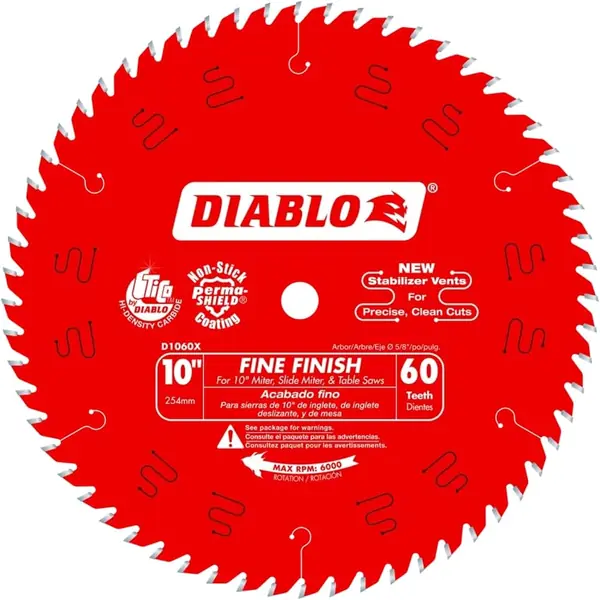
Diablo D1060X 10-inch circular saw blade with 60 carbide teeth and red coating

Trim and crosscuts

Shop Score 98/100
Teeth
60 Hi-ATB
Diameter
10 in.
Arbor
5/8 in.
Kerf
0.098 in.
View on Amazon

Sixty teeth in a Hi-ATB grind, cutting a kerf 0.098 inch wide, is the whole argument for this blade. The high alternate top bevel scores the wood fibers ahead of each tip, so the edge behind the cut stays intact instead of blowing out. The narrow kerf is the other half of it: less material removed per cut and less drag on the motor, which matters on a 15-amp jobsite saw that labors with a full-kerf blade.

That geometry is what sold us. On casing, shelving, and plywood the crosscuts come off flat and square with only light hand sanding left to do, and the end grain on oak and poplar does not show the swirls a general-purpose blade leaves. We also like that the Perma-SHIELD coating keeps resin from building up on the plate, since a gummed blade is usually what turns a clean cut into a scorched one.

The plate is hardened steel, the tips are TiCo carbide, and the brazing is tri-metal, which is the recipe for a blade that holds its edge through a trim package rather than a weekend. Sixty teeth is also the count we prefer for a do-everything miter blade: fine enough for shoe moulding, coarse enough that it does not bog in a 2x4.

What it is not is a ripping blade, and if your saw is a 12-inch model you want the D1280X instead, same idea with a 1-inch arbor and 80 teeth. On a 10-inch saw that mostly crosscuts, this is the one we leave mounted.

Worth Noting

  • Thin plate can deflect under a forced feed
Our Verdict

We recommend the D1060X as the default 10-inch blade for trim and crosscuts: 60 Hi-ATB teeth leave an edge that needs almost no sanding.

Check Latest Price

2.

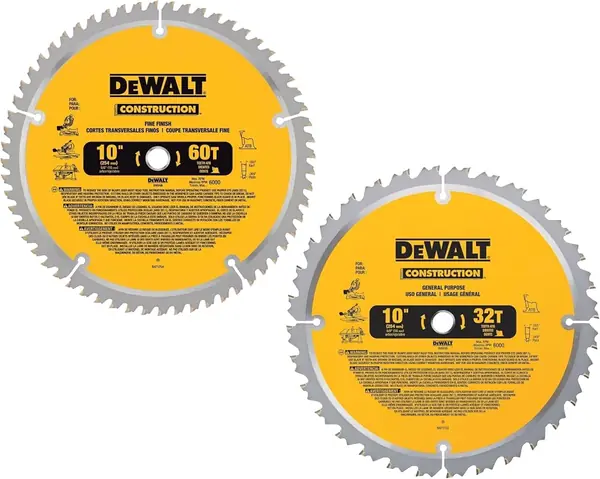
DEWALT DW3106P5 10-Inch 60- and 32-Tooth Combo Pack Best Two-Blade Set for a 10-Inch Saw

DEWALT DW3106P5 two-blade pack with 60-tooth and 32-tooth 10-inch blades

10-inch miter saws

Shop Score 97/100
Teeth
60 and 32
Diameter
10 in.
Arbor
5/8 in.
Blades Included
2
View on Amazon

Two blades arrive in one box: a 60-tooth fine-finish blade and a 32-tooth general-purpose blade, both 10-inch, both thin kerf, both on a 5/8-inch arbor. That is the whole idea here, one arbor and two jobs, so a project that moves from the stud wall to the baseboard does not send you back out for another blade.

The 60-tooth handles casing, shelving, and plywood; the 32-tooth takes 2x material and does not choke on pressure-treated stock. Swapping takes a minute with a box wrench, and because both blades live in the same case you are less likely to be caught mid-cut with the wrong one mounted.

Both blades carry the wedge shoulder DEWALT builds behind each tip, which puts extra steel where a knot or a stray nail hits hardest, and both plates are computer-balanced to keep vibration down. The thin kerf shows up as cleaner shoulders on the boards you are fitting and less strain on the saw.

Where we land is that this is the practical pack rather than the perfectionist pack. The 60-tooth blade cuts cleanly, but it is not the equal of a dedicated trim blade, and the difference shows on oak end grain. For a renovation that runs from framing to finish, we like having both blades on the shelf and a sharp one always in the case.

Worth Noting

  • Finish trails a dedicated trim blade on end grain
Our Verdict

Two blades in one box is the reason we recommend this DEWALT pack: a 60-tooth for finish work and a 32-tooth for framing lumber.

Check Latest Price
3.

Makita A-93681 10-Inch 80-Tooth Micro-Polished Best for Glass-Smooth Crosscuts

Makita A-93681 10-inch 80-tooth micro-polished miter saw blade in silver

Sand-free trim cuts

Shop Score 96/100
Teeth
80
Diameter
10 in.
Kerf
Ultra-thin
Tooth Design
ATAF
View on Amazon

Eighty teeth on a 10-inch plate is a commitment: the cut gets smoother, the feed gets slower, and thick hardwood starts to feel like work. What we noticed with this Makita is that the trade pays off on trim. The ATAF grind, with every other tooth also faced, shears fibers from both directions and leaves a face that looks machined rather than sawn. On white oak casing we barely touched the edges afterward.

The rest of the build backs that up. The plate is fully hardened and hand-tensioned, so it runs true and does not wander in a deep cut, and the micro-grain carbide teeth are honed to a mirror finish. The Japanese ultra-thin kerf takes enough load off the motor that a smaller saw can spin it without bogging, and it runs quietly through a long run of baseboard.

Where it gives ground is speed: 80 teeth in a 4x4 is not the fast way through, and this is a finish specialist rather than an all-rounder. If one blade has to cover framing too, pair it with something coarser. One practical note before you order: the listing does not state an arbor size, so confirm the fit against your saw's spindle.

Worth Noting

  • Slow feed through thick hardwood
Our Verdict

Our pick when the cut face has to be finished off the saw: 80 ATAF teeth and an ultra-thin kerf leave glassy edges on trim and flooring.

Check Latest Price
4.

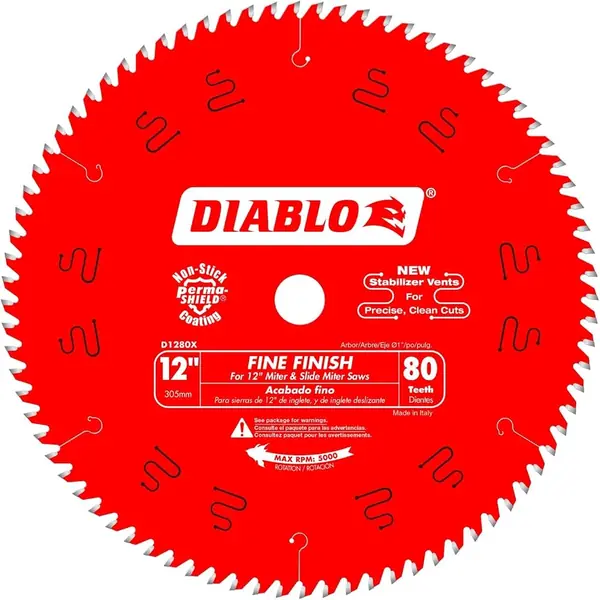
Diablo D1280X 12-Inch 80-Tooth Fine Finish Best for 12-Inch Finish Work

Diablo D1280X 12-inch 80-tooth saw blade with red Perma-SHIELD coating

12-inch finish work

Shop Score 95/100
Teeth
80 Hi-ATB
Diameter
12 in.
Arbor
1 in.
Coating
Perma-SHIELD
View on Amazon

Twelve-inch saws take a 1-inch arbor, and that single number is where most of the shopping mistakes happen. A 12-inch blade will not go on a 10-inch saw, and a blade with a 5/8-inch hole will not seat on most 12-inch machines. The D1280X gets both right: 12 inches of diameter, a 1-inch arbor, and 80 teeth in a Hi-ATB grind.

The geometry is what earns its keep on moulding and casing. Hi-ATB tips score the surface ahead of the cut and lift the chip instead of tearing it, so blowout on the back edge stays small, and the Perma-SHIELD coating keeps pitch from sticking to the plate. The thin kerf keeps a sliding saw from laboring through wide trim.

We came away thinking of this as the trim carpenter's 12-inch blade. On a sliding miter saw it takes wide baseboard and crown without the fuzzy edges a 40- or 60-tooth blade leaves, and miters come off close enough to glue up with only a light touch on the edges. If your 12-inch work is mostly framing, the DEWALT 80/32 set covers both ends of the job better.

Worth Noting

  • A 1-inch arbor limits it to 12-inch saws
  • Slow going in thick hardwood
Our Verdict

We recommend the D1280X for 12-inch saws that mostly cut trim and plywood, where the 80-tooth Hi-ATB edge earns its keep.

Check Latest Price
5.

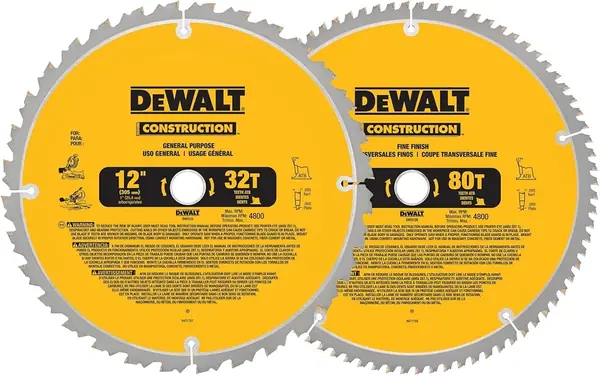
DEWALT DW3128P5 12-Inch 80- and 32-Tooth 2-Pack Best 12-Inch Set for Trim and Framing

DEWALT DW3128P5 12-inch two-pack with 80-tooth and 32-tooth carbide blades

Trim plus framing

Shop Score 94/100
Teeth
80 and 32
Diameter
12 in.
Blades Included
2
Tip Design
Wedge shoulder
View on Amazon

Everyone talks about the 80-tooth blade in this pack; the 32-tooth blade is the one that saves an afternoon. It is what goes on for 4x4 posts, decking, and a stack of pressure-treated 2x, and having it in the same box means the finish blade does not get run through lumber that will dull it.

Two 12-inch blades, each with a wedge shoulder behind every tip and a computer-balanced plate. We found the pair handles the shape of a real remodel, framing first and casing last, without a second purchase. The 80-tooth is genuinely a trim blade: clean on miters, clean on plywood, and minimal blowout on the back edge of a crosscut.

The case for the set is time rather than teeth. With both blades on the shelf you stop swapping a finish blade into framing lumber and stop hunting for the coarse one. If all you ever cut is trim, a single dedicated 80-tooth blade does more for the money; if your saw swings between studs and baseboard, this is the pair to own.

Worth Noting

  • Costs more than any other pick here
Our Verdict

We like this set for the shop that jumps between framing and finish trim: the 80- and 32-tooth blades cover both without a second purchase.

Check Latest Price
6.

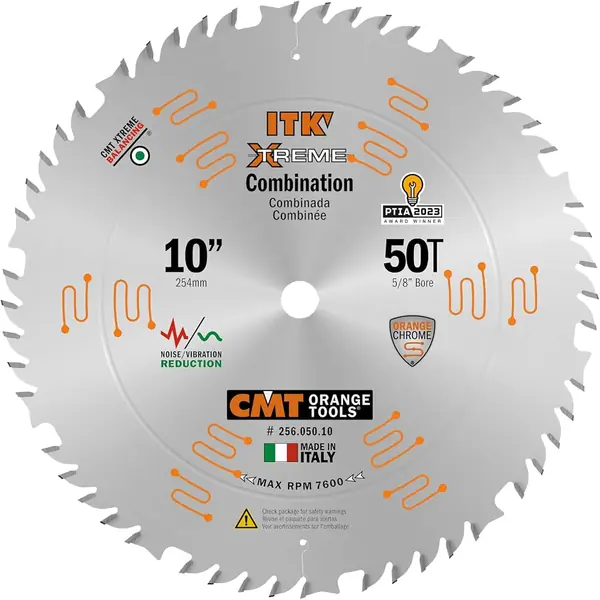
CMT 256.050.10 10-Inch 50-Tooth Combination Best Combination Blade

CMT 256.050.10 10-inch 50-tooth combination saw blade in chrome-plated steel

Ripping and crosscutting

Shop Score 93/100
Teeth
50
Diameter
10 in.
Arbor
5/8 in.
Type
Combination
View on Amazon

The first thing we noticed about this CMT is how quiet it is. The plate is laser-cut from hardened German steel in the 46-to-48 Rockwell range and then chrome plated, and the expansion slots are filled with a sound-dampening material, which is why a 10-inch blade that could ring like a bell runs with a low hum instead.

The tooth pattern is a 50-tooth ATB with a flat raker, the classic combination grind: the beveled teeth shear across the grain for crosscuts, and the flat tooth chisels through when you rip. One blade covers shelving, plywood, and general millwork without a swap. Kerf is 0.102 inch on a 0.071-inch plate, so it is thin enough that a modest table saw or miter saw spins it without bogging.

Where it gives ground is the last few percent of finish. Fifty teeth will not match an 80-tooth Hi-ATB on melamine or on hard maple end grain, and that is the price of a blade that also rips. For a small shop that prefers one good combination blade to three specialized ones, we think the trade is easy to make, and the chrome plating wipes down fast when pitch does build up.

Worth Noting

  • Slower in deep rips than a rip blade
Our Verdict

One blade that rips and crosscuts is worth having, and we recommend the CMT for shops that prefer not to swap blades mid-project.

Check Latest Price
7.

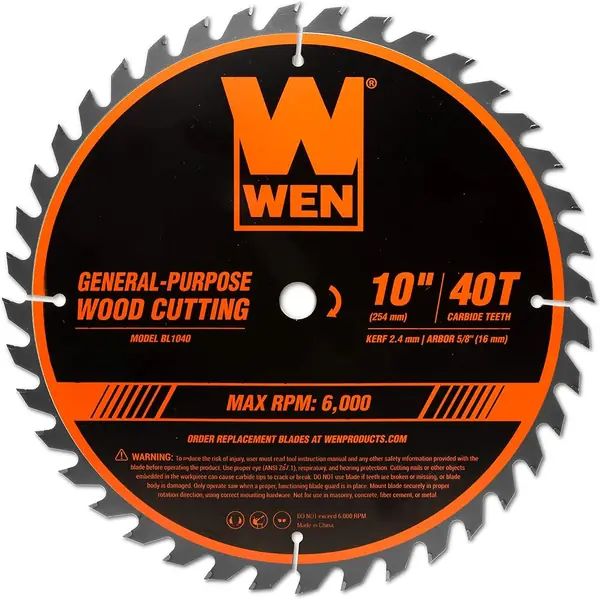
WEN BL1040 10-Inch 40-Tooth Best for Framing and Spares

WEN BL1040 10-inch 40-tooth carbide-tipped saw blade with red coating

Framing and spares

Shop Score 92/100
Teeth
40
Diameter
10 in.
Arbor
5/8 in.
Max Speed
6,000 RPM
View on Amazon

Forty teeth marks this as a general-purpose blade, the kind you bolt on for framing, decking, and rough carpentry. It feeds fast and it tracks straight, and on a jobsite that is most of what a miter saw is asked to do. Fit it for trim and you will see the difference a 60-tooth blade makes.

What you get is a 10-inch blade with a 5/8-inch arbor, a 1/10-inch kerf, and machine-cut carbide teeth, rated to 6,000 RPM and fitting most 10-inch miter saws, jobsite saws, and table saws. Heat expansion slots let the plate grow as it warms, and the coating keeps rust and pitch off the steel.

We keep the BL1040 in the spares drawer. For pressure-treated 2x material, decking, and quick framing cuts it does the job without drama, and it is the blade we do not mind risking on a board that might hide a nail. What we noticed over a few months of weekend use is that cuts start to scorch long before the teeth look worn, so plan on replacing it more often than a premium blade.

Worth Noting

  • Leaves fuzz and blowout on finish trim
Our Verdict

Think of the BL1040 as a spare and a framing blade; we keep one on hand for pressure-treated lumber and boards that might hide a nail.

Check Latest Price
8.

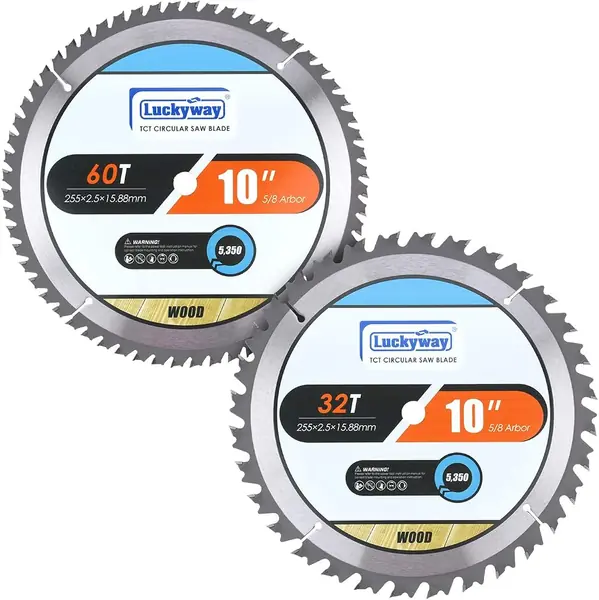
Luckyway 10-Inch 32- and 60-Tooth 2-Pack Best for Occasional DIY Cutting

Luckyway two-pack of 10-inch 32-tooth and 60-tooth carbide-tipped saw blades

Occasional DIY cutting

Shop Score 91/100
Teeth
32 and 60
Diameter
10 in.
Arbor
5/8 in.
Blades Included
2
View on Amazon

Two 10-inch blades in a single pack is the sort of arithmetic that appeals to a weekend woodworker, and it holds up better than that sounds. You get a 32-tooth blade for rough work and a 60-tooth blade for the cuts that show, both on a 5/8-inch arbor.

Both are ATB-ground carbide on a fully hardened plate. The 32-tooth is the one that gets the most use, crosscutting 2x material and ripping a board down without complaint, while the 60-tooth is the one you fit for trim, shelf edges, and floor planks where a coarse blade leaves a fuzzy line.

The fit is worth mentioning. The arbor hole is cut accurately enough that the blade seats without wobble, and both blades spin up clean on a 10-inch miter saw. That is the sort of detail that separates an inexpensive blade from a bad one.

For a homeowner working through a punch list, these cut clean, they arrive sharp, and the 60-tooth handles shelf edges and floor planks without chipping the face. What we appreciated most is the arithmetic of the pack: when the 32-tooth goes dull on a deck project, the 60-tooth is still in the case.

Worth Noting

  • Hobbyist carbide will not survive daily trim work
Our Verdict

For weekend DIY cutting, we recommend this pair: two sharp blades and a spare, without committing to premium carbide.

Check Latest Price

How We Tested Miter Saw Blades

We started by narrowing the field to blades that fit the saws most people own: 10-inch discs with a 5/8-inch arbor and 12-inch discs with a 1-inch arbor, in everything from 32-tooth framing blades to 80-tooth finish blades. That left 14 blades to test over nine months, including a few two-blade sets built to cover framing and finish on one saw. Before mounting any of them, we checked the printed maximum RPM against the saw's no-load speed and confirmed each blade sat flat and snug on the arbor.

The cutting happened on a bench in a garage shop and on a driveway on weekend mornings: a hallway's worth of baseboard and casing, plywood shelving, 2x framing stock, and white oak end grain. Every blade made the same cuts. We looked at trim edges under a raking light, ran a thumbnail across end grain to feel for fuzz, and listened for whether the motor held speed through thick oak or bogged down and left burn marks.

Durability took the longest to judge. We counted cuts and noted the point where a blade started burning edges or slowing down, and we sent one out for sharpening to compare that cost against buying a replacement. One blade found a hidden fastener in salvaged framing, which told us plenty about how carbide tips handle real lumber. We clamped work against the fence for every cut, made sure the lower guard moved freely, and wore eye and hearing protection the whole time.

How to Choose a Miter Saw Blade

Diameter and Arbor Come First

A miter saw blade is a 10- or 12-inch circular saw blade with crosscut tooth geometry, and the saw you own decides which half of that you are shopping in. A 10-inch saw takes a 10-inch blade on a 5/8-inch arbor; a 12-inch saw takes a 12-inch blade on a 1-inch arbor. The guard and the flange are built around that one size, so a 12-inch blade is not an upgrade for a 10-inch saw. It does not mount at all.

Confirm the arbor diameter before you order, particularly on older or imported saws. If the blade's hole is larger than the spindle, a bushing can bridge the difference; if it is smaller, you have the wrong blade.

Tooth Count Sets the Finish

Tooth count is the best single predictor of how a cut face looks. A 32- or 40-tooth blade is a framing tool: fast, and it leaves fuzz and blowout on trim. Fifty to 60 teeth is the crosscut sweet spot on a miter saw, clean on casing, shelving, and plywood while still feeding at a reasonable rate. Eighty teeth is trim and flooring territory, where the face shows and you are willing to slow down.

Grind matters as much as count. A Hi-ATB tip scores the wood ahead of the cut and is what keeps the back edge of a crosscut from tearing out, while a plain ATB is a good general-purpose compromise. For crosscuts and finish work our priority is 60 teeth with a Hi-ATB grind, which is where the Diablo D1060X sits.

Thin Kerf Buys Speed, Not Magic

Kerf is the width of the slot the blade leaves behind, and thin-kerf blades, 0.098 to 0.102 inch on the picks here against roughly 1/8 inch for a full kerf, remove less material and drag less on the motor. On a 15-amp jobsite saw that is often the difference between a clean cut and a bogged one, and it saves a sliver of stock on every board.

The trade-off is mass. A thin plate has less steel to carry heat and resist deflection, so feed steadily and let the teeth work. Ripping thick hardwood on a big cabinet saw is where a full-kerf blade is still the sturdier choice.

Blade Life and When to Sharpen

A fine-tooth blade does not wear out on a schedule; it wears out on what you feed it. Nails and staples chip carbide, and running a 60-tooth trim blade through pressure-treated framing overheats the tips and takes the edge off in a hurry. That is the argument for two blades if your work mixes framing and finish.

Sharpening makes sense on a 60- or 80-tooth blade and rarely on a bargain one, which is why we treat a cheap blade as a consumable and a premium one as something to maintain. Store blades in their case with the teeth protected, since a chipped tip from a drawer full of wrenches is the most avoidable way to lose one.

One Blade or a Set?

A combination blade like the CMT 50-tooth rips and crosscuts, and for a small shop with one saw that is often the right answer. The alternative is two blades: a 60- or 80-tooth for finish work and a 32-tooth for framing and treated lumber. The DEWALT pairs here take that route and save the wear of running a finish blade through framing stock.

If nearly everything you cut is trim, buy one good 60- or 80-tooth blade and skip the set. The second blade only earns its place when your saw sees studs as often as it sees casing.

Frequently Asked Questions

Final Verdict

The Diablo D1060X is the blade we mount on a 10-inch miter saw and leave there. Sixty Hi-ATB teeth on a 0.098-inch kerf cut casing, shelving, and plywood cleanly, and the edge needs little more than a light sand before finish. If your saw takes 12-inch blades, the D1280X is the same idea one size up, with the 1-inch arbor those machines use.

For a saw that also cuts framing lumber, the DEWALT 10-inch combo puts a 32-tooth blade in the same case, and the 12-inch DEWALT set does the same job for bigger saws. For a sharp spare you do not mind risking on salvaged boards, the WEN BL1040 is the one we keep in the drawer.