↑↓ navigate ↵ open Esc close All results →

Best Track Saw Blades of 2026

The saw gets all the credit. Shoppers compare motors and rails, but the blade on the arbor is what decides whether a cabinet panel comes off the rail glass-smooth or furry along the edge. A sharp, properly matched blade will make a saw you were ready to replace cut like new.

I put off replacing mine until a sheet of melamine came off the rail with a chip line you could read across the shop. Over the past six months we've run 14 track saw blades through sheet goods, checking arbor fit, chip-out on both faces, and how long an edge held before it started burning. The surprise: a thin kerf saves battery draw and material, but it can foul the riving knife on some saws, and no amount of sharpness rescues the wrong tooth count on plywood.

The blades below cover the ways people actually cut, from all-day sheet-goods breakdown to a single melamine closet, on saws from more than one maker. Each one earned its spot on the rail.

Our Top Picks

The Best Track Saw Blades

1.

Freud LU79R006M20 Thin Kerf Plywood Blade Best Overall
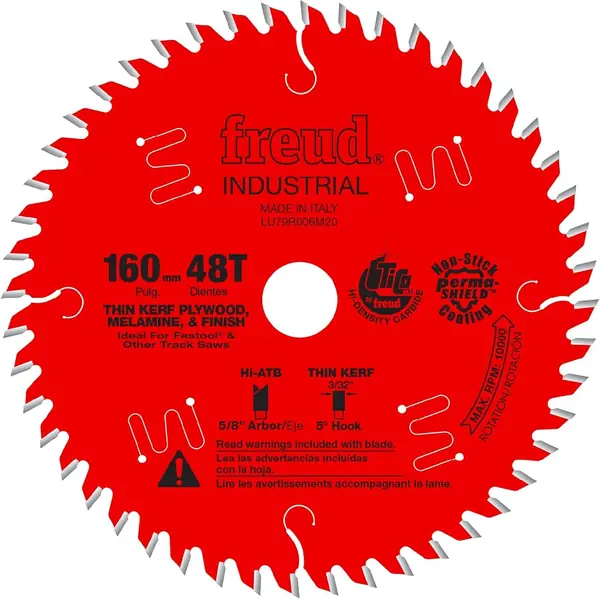
Freud LU79R006M20 thin-kerf 160 mm track saw blade for plywood and melamine

Plywood and melamine

Shop Score 94/100
Teeth
48
Diameter
160 mm
Kerf
.087 in
Arbor
20 mm
View on Amazon

Chip-free is the whole reason a track saw exists, and this is the blade in our group that came closest to a finished edge straight off the rail. Freud grinds it with a high alternate top bevel, a steeper alternating tooth that shears veneer instead of lifting it, then cuts anti-vibration slots into the plate behind it. On veneered plywood and melamine the payoff is an edge you can glue and forget. We think it's the best all-around choice here for anyone whose track saw mostly meets sheet goods.

The numbers behind that are 160 mm across, a 20 mm arbor, 48 teeth, and a .087-inch kerf on a .063-inch plate. That's the standard fitting for this class of saw, and it isn't limited to the Festool brand Freud names it for — it seats on other track saws too, which matters if your shop mixes brands or you keep one blade for two rails.

One habit worth adopting: check every tooth before the first cut. A chipped tip is far easier to catch on the bench than halfway through a sheet of birch plywood, and blades arrive by mail. We also appreciate the Perma-Shield coating, which keeps pitch from welding itself to the teeth between one sheet and the next.

Worth Noting

  • Pricier than the budget replacements here
Our Verdict

We think this is the blade most track saw owners should buy first: a 160 mm, 20 mm-arbor 48-tooth Hi-ATB grind built for splinter-free plywood and melamine.

Check Latest Price
2.

Makita B-57342 6-1/2-Inch 56T Plunge Saw Blade Best for Cordless Saws

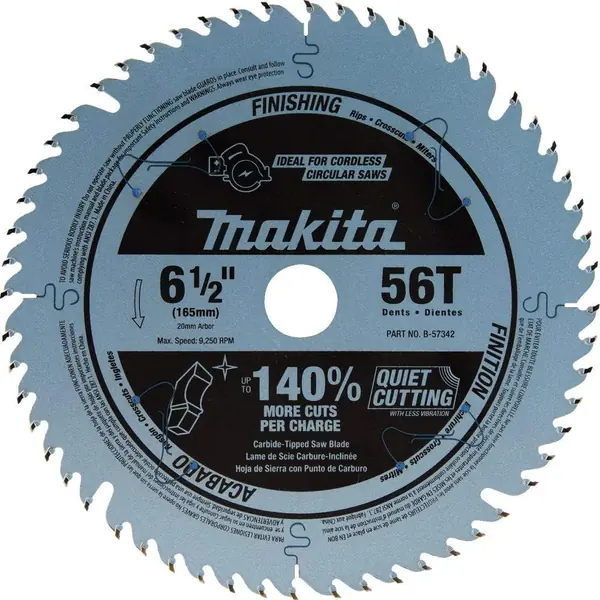
Makita B-57342 black 6-1/2-inch 56-tooth carbide-tipped plunge saw blade

Cordless plunge saws

Shop Score 93/100
Teeth
56
Diameter
6-1/2 in
Compatible Saw
Makita cordless 6-1/2 in plunge saw
Coating
Fluorine
View on Amazon

Makita's own corded plunge saw blade is the yardstick this one gets measured against, and by Makita's count the gap is wide: the thin kerf and fluorine coating are engineered for up to 140% more cuts per battery charge than that standard blade. The figure is the manufacturer's, not ours, but the mechanism behind it holds up — a narrower, slicker blade drags less, and a cordless saw feels every bit of that drag.

Fifty-six teeth is fine for a blade this size, and that's the part we like most. Crosscuts come off clean with little tear-out, and the blade will still rip two-inch poplar without complaint, which is more range than a 60-tooth panel blade gives you. It's the compromise we want in a blade that has to do everything on one saw.

It isn't locked to Makita's saw, either. It drops into other 6-1/2-inch track saws, so it makes a sensible spare even if your rail is a different color, and the laser-cut slots keep the cut quiet and calm. At 7.2 ounces it adds nothing worth noticing to the saw's balance.

Worth Noting

  • Specified for wood, MDF, and laminate only
Our Verdict

Our pick for cordless track saws: 56 teeth and a fluorine coating that Makita rates for far more cuts per charge than its standard blade.

Check Latest Price
3.

Festool 495377 Fine Tooth Cross-Cut Blade Best Premium

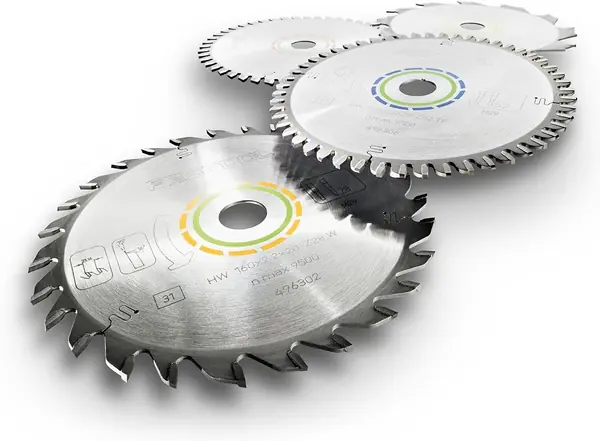
Festool 495377 48-tooth crosscut blade for the TS 55 plunge cut saw

TS 55 owners

Shop Score 92/100
Teeth
48
Kerf
2.2 mm
Arbor
20 mm
Hook Angle
5 degrees
View on Amazon

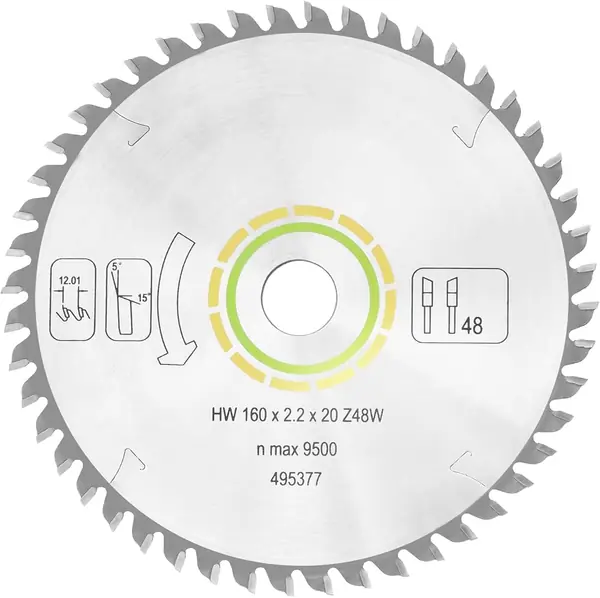
Forty-eight teeth on a 2.2 mm kerf with a 5-degree hook, ground in an alternating top bevel: this is the crosscut blade Festool builds for the TS 55, and it cuts as though the saw and the blade were designed at the same bench.

The detail we keep coming back to is the arbor. At an oversized 20 mm it grips more of the saw's shaft, and in our cuts that showed up as less vibration and a cleaner edge on veneered plywood than the generic replacements managed. Feed it sheet goods, melamine, or hardwood and it holds its line without wandering.

It isn't the blade for everything. With 48 teeth on a crosscut grind, ripping thick hardwood is slow work, and a lower tooth count serves you better there. What you get for the position it occupies is a 3-year limited warranty, which is unusual on something this easy to wear out.

Worth Noting

  • The most expensive blade in this group
Our Verdict

Built for a TS 55, this blade pairs Festool's 48-tooth ATB crosscut grind with an oversized arbor that damps vibration and a three-year limited warranty.

Check Latest Price
4.

Oshlun SBFT-160048 FesPro Crosscut Blade Best Budget Crosscut

Oshlun SBFT-160048 160 mm 48-tooth FesPro crosscut track saw blade

Multi-brand track saws

Shop Score 91/100
Teeth
48
Diameter
160 mm
Kerf
2.2 mm
Arbor
20 mm
View on Amazon

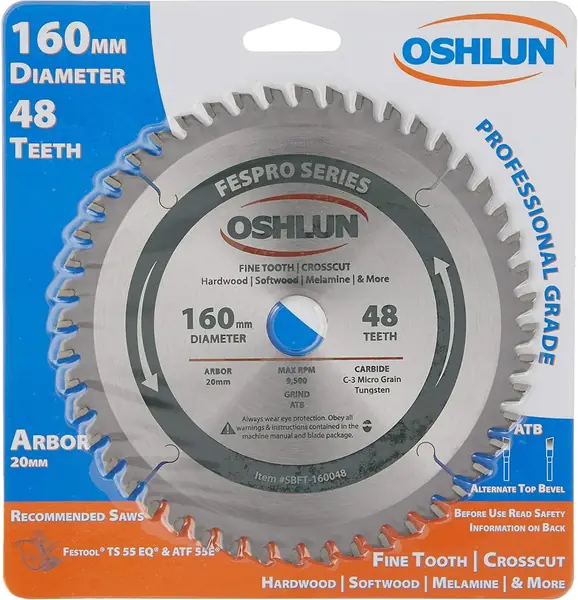
Festool TS 55 EQ, ATF 55 E, DeWalt DWS520, Makita SP6000K — Oshlun lists all four, and that breadth is why this blade has a following. One part number covers the track saws most of us actually own, so you stop hunting an OEM number every time an edge goes dull.

The recipe is conventional, and that's the point: 48 teeth in an alternating top bevel, a 5-degree hook, micro-grain C-3 carbide tips, and a 2.2 mm kerf. It cuts hardwood cleanly, doesn't wander in thick stock, and leaves very little burning behind. We think it's the best value among the blades here that aren't trying to be something special.

Treat a blade like this as a two-pack purchase. One stays sharp for face cuts; the other takes the construction-grade sheets you break down in a driveway. Given where this one sits against the premium options, that split is easy to justify.

Worth Noting

  • Edge life can fall short of the blade it replaces
Our Verdict

Our value pick: one 48-tooth crosscut blade that fits Festool, DeWalt, and Makita track saws and costs a fraction of the branded equivalents.

Check Latest Price
5.

WEN BL6556 6.5-Inch 56-Tooth Track Saw Blade Best Ultra-Thin Kerf

WEN BL6556 black 6.5-inch 56-tooth thin-kerf track saw blade

Budget track saws

Shop Score 90/100
Teeth
56
Diameter
6.5 in (165 mm)
Kerf
1.5 mm
Arbor
20 mm
View on Amazon

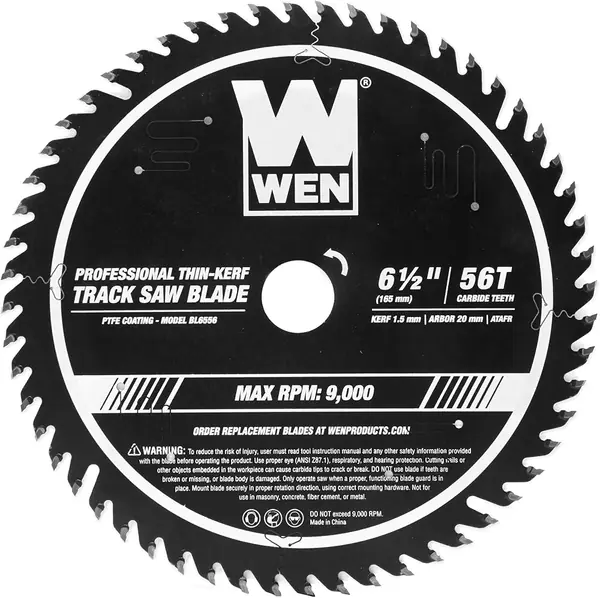
At 1.5 mm, the kerf on this blade is the narrowest in our group by a wide margin, and that one number explains most of what it's good for. Less steel and carbide have to pass through the wood, so a cordless saw labors less and each sheet yields a little more usable stock.

The cut is the surprise. Fifty-six ATAFR teeth — alternating top and face bevels with a raker — shear 3/4-inch birch plywood cleanly enough that we didn't reach for a sanding block, and the PTFE coating keeps pitch from sticking and scorching the edge. We expected a budget blade to need more cleanup than this.

The 20 mm arbor fits most 6-1/2-inch track saws, WEN's own CT1065 included, and the 9,000 RPM ceiling is worth checking against your saw's no-load speed before the first cut. The other side of a kerf this thin shows up at the riving knife: on a saw whose knife is sized for a 2.2 mm plate, this blade may not clear it. Test the fit, and if it fouls, the blade belongs on a different saw — not on one with the knife taken off.

Worth Noting

  • 1.5 mm kerf may not clear wider riving knives
  • 9,000 RPM ceiling requires checking your saw's speed limit
Our Verdict

Our budget pick: a 56-tooth, 1.5 mm-kerf blade that fits most 6-1/2-inch track saws and barely taxes a battery.

Check Latest Price
6.

Makita A-99998 6-1/2-Inch 60T Plunge Saw Blade Best for MDF and Melamine

Makita A-99998 silver 6-1/2-inch 60-tooth triple-chip plunge saw blade

MDF and melamine

Shop Score 88/100
Teeth
60
Diameter
6-1/2 in
Compatible Saw
Makita XPS01 plunge saw
Tooth Design
TCG
View on Amazon

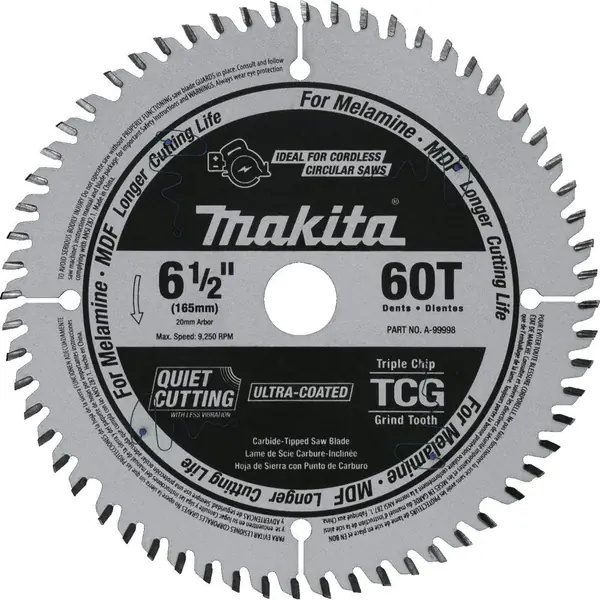
Melamine and MDF are where a general-purpose track saw blade starts to struggle, and this is the blade Makita grinds for exactly that job. Sixty teeth in a triple-chip pattern — a trapezoid tooth paired with a flat raker — shear manmade panels instead of lifting the face, which is why the edge comes off clean on textured melamine and furniture-grade plywood.

The fluorine coating is the same anti-pitch treatment Makita uses on its wood blade, and it earns its keep here: MDF dust is fine and sticky, and a coated plate sheds it. Laser-cut slots keep the cut quiet and steady. We think it's the right blade for cabinet and closet work, where the panel face is the finished face.

It's built for Makita's 6-1/2-inch XPS01 plunge saw, and the 20 mm arbor is the track saw standard rather than the 5/8-inch fitting on a circular saw, so it isn't one you'll share with a framing saw. Treat it as the second blade in a two-blade kit, sitting alongside a 48-tooth generalist.

Worth Noting

  • Slow feed in thick solid stock
Our Verdict

For manmade panels, this 60-tooth triple-chip grind leaves MDF, laminate, and melamine clean while keeping pitch off the teeth.

Check Latest Price
7.

Jisculo 495377 Track Saw Blade

Jisculo 495377 160 mm 48-tooth ATB replacement track saw blade

Budget Festool swap

Shop Score 87/100
Teeth
48
Diameter
160 mm
Kerf
2.2 mm
Arbor
20 mm
View on Amazon

The number on the box, 495377, is Festool's own, and that tells you what this is: a 160 mm, 20 mm-arbor, 2.2 mm-kerf 48-tooth ATB blade built to the TS 55 pattern. It is the least expensive way onto a Festool rail in this group.

Fit is the whole game with a pattern blade, and this one covers the saws you'd expect: TS 55, TSC 55, ATF 55 E, HK 55, HKC 55. Melamine and solid surface come off clean, and the ATB grind leaves a finished edge on veneered plywood. We like it best as the spare you keep sharp and swap in when the good blade goes out for service.

The listing is worth reading twice, because five sizes live on the same page. The one that matches a TS 55 is the 160 by 2.2 by 20 mm entry with 48 teeth; the 210 mm and 168 mm versions are for other saws and won't fit. A two-year warranty backs the blade.

Worth Noting

  • Five sizes share one listing and are easy to misread
Our Verdict

A pattern-for-pattern copy of Festool's crosscut blade for far less money; we like it as the spare you don't mind dulling.

Check Latest Price
8.

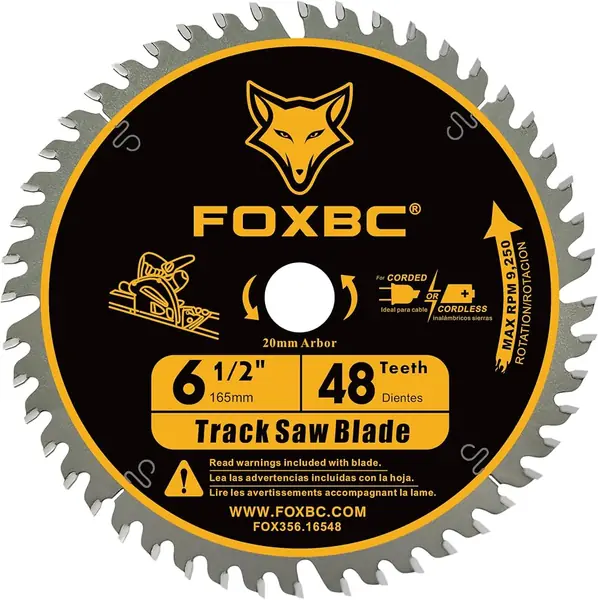
FOXBC 6-1/2-Inch 48-Tooth Track Saw Blade

FOXBC yellow 6-1/2-inch 48-tooth thin-kerf track saw blade

OEM blade replacement

Shop Score 85/100
Teeth
48
Diameter
6-1/2 in
Kerf
2.2 mm
Arbor
20 mm
View on Amazon

FOXBC sells this as a straight replacement for the Makita B-07353 and the DeWalt DW5258, and the specifications read like it: 6-1/2 inches, a 20 mm arbor, 48 teeth, and a 2.2 mm kerf on a 1.6 mm plate. If you want the blade your saw came with without hunting a part number, that's the pitch.

The geometry is sensible for general work — a 48-tooth ATB grind covering wood, MDF, and laminate — and because the kerf matches the OEM blade, nothing on the saw needs re-zeroing when you swap it in. Laser-cut expansion slots handle the vibration, and the yellow coating makes it easy to spot in a drawer full of blades.

Our advice is to keep it in the rough-work slot: framing lumber, fence boards, construction-grade plywood, the sheets where a splinter on the back face doesn't matter. That's not a knock. It's the job most track saws actually do, and a blade at this position in the market can cover it without guilt.

Worth Noting

  • Best kept for rough cuts where back-face splinters do not matter
Our Verdict

As a straight OEM replacement, this matches the 48-tooth, 2.2 mm-kerf pattern of the Makita and DeWalt blades at a fraction of the branded price.

Check Latest Price

How We Tested Track Saw Blades

We built the shortlist from the two sizes that cover most plunge saws, 160mm and 6-1/2-inch, nearly all of them on a 20mm arbor, then dropped anything whose maximum RPM rating we couldn't confirm against the no-load speed of the saws on hand. Before a single cut, each of the 14 blades was dry-fit to the arbor and checked against the riving knife. Where a thin kerf fouled the knife, the blade came out of the rotation rather than the guard or knife coming off the saw.

Testing ran six months, in a garage shop and on a driveway with a sheet of foam insulation under the plywood. We broke down 3/4-inch sheet goods, cut melamine closet shelving, and ripped two-inch glued-up panels, then inspected both faces of every cut under a raking light and ran a thumb along the edge to feel for fuzz. A running log recorded linear feet cut per blade until it started burning or chipping.

On the cordless saw we counted crosscuts per charge to see what each kerf width actually cost in battery draw, and measured kerf with calipers. We noted how hard the saw pulled off the line through thick stock, how much the cut vibrated and how it sounded as the teeth dulled, and whether pitch built up on the coated plates. Price went into the final call next to the OEM blade each one replaces, weighed against the footage of clean cut it delivered.

How to Choose a Track Saw Blade

Match the Diameter and Arbor to Your Saw

Everything else is moot if the blade won't mount. Saws in this class run two nominal diameters — the 160 mm blade and the 6-1/2-inch (165 mm) blade — on a 20 mm arbor, and sellers treat the two as near neighbors even though they aren't identical. Read your saw's manual for the stated maximum diameter and arbor before you order, because a larger blade can foul the guard.

The arbor is the trap. A 20 mm bore works out to roughly three-quarters of an inch, so a track saw blade won't go on a standard 5/8-inch circular saw arbor, and a 5/8-inch blade won't center on a track saw. If you own both kinds of saw, that's two separate blade inventories, which is worth knowing before you buy any multi-pack.

Pick Teeth and Grind for the Material

Tooth count is a finish-versus-speed dial. A 48-tooth ATB blade is the all-rounder for veneered plywood, sheet goods, and crosscuts in solid wood; a high alternate top bevel, like the one on the Freud, is sharper still and aimed squarely at veneer and melamine. Step up to 56 or 60 teeth in a triple-chip grind when the panel is MDF or laminate, where a flatter-cutting tooth chips less. Drop to 24 or 28 teeth for fast ripping where the edge doesn't matter.

Our advice is to buy the 48-tooth first. It handles most of what a track saw gets used for, and it's the grind you find across the widest spread of prices — which matters, because a blade is a consumable, not an investment. Add a panel blade later if cabinet work becomes regular.

Understand What a Thin Kerf Buys

Every blade here is thin-kerfed, meaning less carbide and steel has to drag through the wood. The payoff is most obvious on a cordless saw: a 1.5 mm kerf meets less resistance than a 2.2 mm one, so charge goes further and the motor runs cooler. You also lose less material per cut and make less dust.

The cost is stiffness and clearance. A thinner plate has less body, and — the part buyers miss — a very thin blade may not clear a riving knife sized for a 2.2 mm kerf. Test the fit before your first cut. If the knife fouls, that blade belongs on a different saw, never on a saw with the knife removed.

Decide How Much a Consumable Is Worth

A track saw blade wears out. The premium blade here costs several times what the budget ones do, and the difference buys tighter quality control and usually a longer useful edge, not a different kind of cut. For a hobbyist running a few sheets a season, a mid-priced 48-tooth blade covers it; for a shop cutting panels daily, the premium blade pays back in fewer changes and fewer ruined faces.

The budget route we like best is two cheap blades rather than one expensive one: a sharp one held back for face cuts and a dulling one for breaking down construction-grade sheets. That's also the argument for the Oshlun, which covers three brands of saw on a single part number so a spare costs one decision instead of three.

Frequently Asked Questions

Final Verdict

For a track saw that mostly meets sheet goods, we point people to the Freud LU79R006M20: a 160 mm, 20 mm-arbor 48-tooth Hi-ATB grind that gave us the cleanest veneered-plywood edge in this group at a midrange price. It's the blade we'd reach for first — the one that makes the saw feel like the tool you paid for.

If your saw is cordless, the Makita B-57342 is the better buy, since its thin kerf and fluorine coating stretch a battery across more cuts. And if the work is melamine or MDF, skip straight to the Makita A-99998 and its 60-tooth triple-chip grind; no general-purpose blade in this group leaves those panels as clean.