↑↓ navigate ↵ open Esc close All results →

Best Spiral Scroll Saw Blades of 2026

Fretwork gets slow until the day you clamp in a spiral blade. Instead of steering the stock around a flat blade, you cut in whatever direction the line goes — no spinning the workpiece, no backing out of a corner — and suddenly the pattern, not the saw, is what's slowing you down. The catch is that spiral blades are thin, they wander, and they snap, so a bad pack can cost you a Saturday.

We tested 14 packs over four months, clamping them into five-inch pinless saws and cutting fretwork, puzzles, plastic, and brass. The first surprise was how little the size numbers mean from one maker to the next; tooth count is the more honest guide, with 40-odd teeth per inch for detail work and closer to 16 for fast cuts in plastic and mixed stock.

The picks below span that range, from a big mixed variety pack to single-size packs for thick stock, and every one of them cut in any direction. The difference was how straight they held a line while doing it.

Our Top Picks

The Best Spiral Scroll Saw Blades

1.

Flying Dutchman Spiral 60-Piece Variety Pack Best Overall
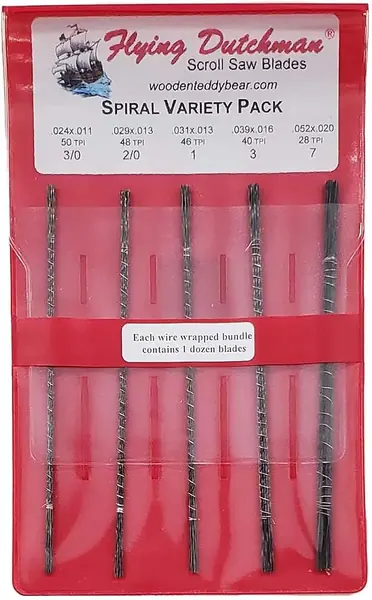
Flying Dutchman spiral pinless scroll saw blades in five sizes, 60-piece variety pack

Intricate mixed-material work

Shop Score 92/100
Blade Length
5 inches
Pack Quantity
60 blades (12 per size)
Pin Style
Pinless
Blade Sizes
Five sizes: #3/0, #2/0, #1, #3, and #7
View on Amazon

Five sizes in one box is why this is the set we recommend first. The Flying Dutchman pack gives you a dozen blades each of 3/0, 2/0, 1, 3, and 7, all 5-inch pinless, so you can move from fine interior cutouts to roughing without ordering five separate packs. That range matters with spiral blades because tooth count changes both the turning radius and the surface you have to sand.

The blades are milled from hardened steel, and the spiral grind cuts on all sides so you can steer without spinning the workpiece. We like that for lettering, inlays, and any cut where the workpiece is too large or awkward to rotate. The 60-blade count also means you can afford to experiment with a size instead of hoarding the one you already know.

The five-size spread is the reason we reach for this one when we do not yet know which tooth count a project wants. Once a project is dialed in, a single-size pack makes more sense, but that is a choice for later, not a reason to skip the variety now. For a beginner or a hobbyist who moves between delicate and coarse work, this is the most useful box to keep near the saw.

Worth Noting

  • Premium price for a 60-blade set
Our Verdict

We recommend this as the first spiral blade set for most scroll-saw users because five sizes let you learn what your saw and projects need.

Check Latest Price
2.

Olson Saw SP46500 Spiral Scroll Saw Blades Best Everyday Value

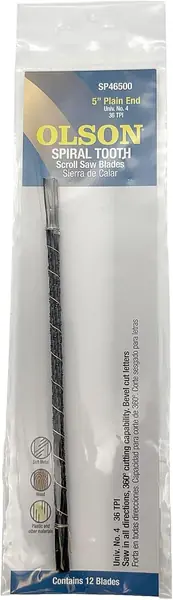
Olson Saw SP46500 silver spiral scroll saw blades, 12-pack of #4 36 TPI blades

All-around scroll-saw work

Shop Score 91/100
Blade Length
5 inches
Blade Size
#4
Teeth Per Inch
36 TPI
Kerf
0.041 inch
View on Amazon

The #4 is the low-drama choice in this group. It is a 5-inch blade with 36 teeth per inch and a 0.041-inch kerf, a middle-of-the-road spiral that suits general fretwork, lettering, and curved cuts in wood and plastic. If you do not want to think about blade sizes yet, this is the one to load.

We recommend it for the shop that wants a dependable refill rather than a sampler. The high-carbon steel is hardened and tempered, and the blades are listed for power scroll saws as well as hand-held fret and jewelers frames. The 36-TPI tooth count is fine enough for controlled curves and general fretwork in wood and plastic; if you are cutting a visible face, test the kerf on scrap first.

The value case is straightforward: this is one of the more affordable 12-packs here, and it has the broadest everyday use of the single-size sets. What you give up is range. If you want a 3/0 for delicate inlays or a #7 for faster stock removal, the Flying Dutchman variety pack is the better buy. For the scroll-saw user who mostly cuts 3/4-inch stock and wants one blade to keep on hand, the #4 is the safer default.

Worth Noting

  • Wide 0.041-inch kerf leaves a rougher edge
Our Verdict

We keep this #4 in the everyday slot: it is a dependable 36-TPI spiral for general fretwork and a sensible refill when you know your size.

Check Latest Price
3.

Proxxon 28747 Spiral Scroll Saw Blades Best for Plastic and Mixed Materials

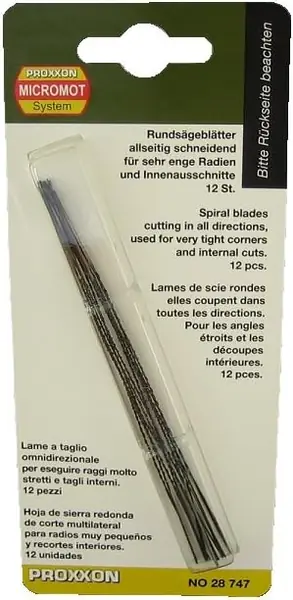
Proxxon 28747 spiral pinless scroll saw blades, 12 blades for plastic and wood

Mixed-material cutting

Shop Score 88/100
Blade Length
5.1 inches (130 mm)
Pack Quantity
12 blades
Tooth Count
16
Starter Hole
1/16 inch
View on Amazon

The 1/16-inch starter hole is the detail that tells you what this blade is for. Proxxon lists the 28747 as a 5.1-inch pinless spiral for plastic, hard and soft woods, with a 16-tooth count. That coarse grind is built for clearing material, not for the finest hairline turns.

The set is 12 blades, and the listing points to Proxxon's DS115/E and DSH/E scroll saws. Check clamp travel before ordering: 5.1 inches is a touch longer than the standard 5-inch blade, and your clamps need room to take up the difference. The 1/16-inch starter hole is also the size you need for interior cuts, so keep that bit with the saw.

Where this blade earns its place is in plastic and mixed-material cutouts where a fine-tooth spiral loads up. We like the coarser grind for that work, and the 12-blade pack is a low-cost way to keep a dedicated set with the plastic-cutting saw. If your work is mostly sheet plastic, softwood, or utility templates, the Proxxon is the specialist in this group.

Worth Noting

  • Coarse grind leaves a rough finish
Our Verdict

We reach for the Proxxon set for plastic and softwood utility cuts, where its coarse spiral clears material faster than fine-tooth blades.

Check Latest Price
4.

WEN BLX241 Spiral Scroll Saw Blades Best for Fine Detail

WEN BLX241 #2 spiral pinless scroll saw blades, 12-pack of 41 TPI blades

Fine detail cuts

Shop Score 86/100
Blade Length
5 inches
Blade Size
#2
Teeth Per Inch
41 TPI
Blade Diameter
0.035 inch
View on Amazon

A #2 blade with 41 teeth per inch is the fine-detail end of this group, and that is exactly where we like the WEN BLX241. The 0.035-inch diameter and 41-TPI spiral are aimed at tight curves and small interior cutouts in wood, plastic, and non-ferrous metal. It is a slow, controlled cutter rather than a stock-removal blade.

The 5-inch pinless length is the common size for most scroll saws, and WEN lists it for its own saws as well as the majority of others. We appreciate that the 12 blades come in one sealed pack, so you can keep a fresh one for a delicate piece instead of running a dull blade through a visible face. The high-carbon steel is the same broad material family used by most blades here.

The obvious boundary is that every blade in the pack is the same #2 size. If you want to compare a 3/0 against a #7, this is not the sampler; the Flying Dutchman pack does that job. But when you already know your work lives in fine fretwork, the WEN is the straightforward refill, and the 41-TPI tooth count gives you the fine control this kind of work wants.

Worth Noting

  • All 12 blades are one #2 size
  • Cuts slowly compared to coarser stock-removal blades
Our Verdict

We choose the WEN pack for fine fretwork, where its #2 41-TPI spiral gives you controlled cuts in a simple 12-blade refill.

Check Latest Price
5.

Murtenze #6 Spiral Scroll Saw Blades Best for Low-Cost Wood Cutting

Murtenze #6 spiral scroll saw blades, 12 plain-end high-carbon steel blades

Low-cost wood cutting

Shop Score 85/100
Blade Length
5 inches
Blade Size
#6
Pack Quantity
12 blades
Material
High carbon steel
View on Amazon

The least expensive 12-pack here is also the simplest: 12 five-inch plain-end spiral blades in a single #6 size, made from high carbon steel. Murtenze sells this listing as the #6 option in a range that also includes #1, #2, #3, #5, and #7, so the number on the box tells you this is a wood-cutting blade, not a mixed-size sampler. The plain end is the right format for pinless clamps, and the 5-inch length is the common scroll-saw size.

We see it as a stock-up pack for a beginner who has already settled on a mid-coarse wood blade, or for someone who wants a spare set without paying for sizes they will not use. The blades are thin enough to follow curves, and the high-carbon steel is the same broad material used across this group. If you are still learning what spiral blades do, the Flying Dutchman variety pack is the more useful first purchase; if you know #6 is your size, this is the low-cost way to keep 12 on the pegboard.

The trade-off is not hidden: a single size means the pack cannot move from fine inlay work to thick stock. For a beginner who wants to practice one blade until the motion feels natural, that focus is useful. For anyone buying a first spiral assortment, the five-size Flying Dutchman box is the better teacher.

Worth Noting

  • Single #6 size cannot cover fine inlay work
Our Verdict

We recommend the Murtenze pack when you already know a #6 wood blade is what you want and you just need a low-cost refill.

Check Latest Price
6.

Semme #7 Spiral Scroll Saw Blades Best for Thick-Stock Rough Cuts

Semme #7 spiral scroll saw blades, 12-piece high-carbon steel set

Thick-stock rough cuts

Shop Score 83/100
Blade Length
5.12 inches
Blade Size
#7
Pack Quantity
12 blades
Material
High carbon steel
View on Amazon

The #7 is the coarsest size in this group, and Semme pairs it with a 5.12-inch length and high-carbon steel. That is a roughing combination: a large blade clears waste quickly, but it leaves a rougher edge than the 36- and 41-TPI blades here. If your work is mostly thick stock, templates, or shop fixtures, that trade can make sense.

The set is 12 blades, made from high carbon steel and listed for wood, metal, and plastic. The 5.12-inch length is slightly longer than the common 5-inch blade, so check the clamp travel on your saw before you count on it. We also like that the coarse #7 size is distinct from the fine-detail packs here; it gives the group a true roughing option instead of another #2 or #4.

This is not our pick for inlay work or fine lettering; the coarse #7 grind is built to move material, not to leave a finish-ready edge. For that job, choose a finer blade and plan to slow down. The Semme earns its place as the coarse blade for the jobs where speed matters more than surface quality.

Worth Noting

  • Leaves a rougher edge unsuitable for fine lettering
  • Slightly longer 5.12-inch length requires checking clamp travel
Our Verdict

We keep the Semme around for roughing thick stock, not for fine fretwork, because its coarse #7 spiral trades surface quality for speed.

Check Latest Price

How We Tested Spiral Scroll Saw Blades

We built the shortlist from the specs that decide whether a blade works at all: length and clamp style first, so nothing pinned or oversized made the cut, then tooth count, pack quantity, and whether a pack mixed sizes or stuck to one. From about 40 candidate packs we bought 14 to test, deliberately blending variety packs with single-size packs, and testing ran across four months.

Every blade went into the same two saws in a garage workshop, on weekend project sessions. We unplugged the saw before each change and put eye protection on first, since thin spiral blades throw chips and break without much warning. We timed each change and noted whether the clamp bit down on the plain end without slipping or needing a second try, then tensioned the blade and watched for bowing or twist before the saw was even switched on.

On the saw, we cut Baltic birch fretwork, pine, acrylic, and thin brass, following pencil lines through tight curves and long straight runs. We noted which blades led off the line and by how much, measured kerf at the cut with calipers, and ran a thumb over the edge to feel for fuzz or chatter. Starter holes were drilled at 1/16 inch to see which blades threaded through them, and blades stayed in the saw until they dulled, snapped, or twisted past saving, with the number of cuts logged for each.

Value got the same scrutiny as performance: we compared cost per blade across every pack and counted how many a typical project would burn through, because a cheap blade that quits on the third cut isn't inexpensive at all.

How to Choose Spiral Scroll Saw Blades

Start with Length and Clamp Style

Most 5-inch scroll saws use pinless blades, but 5-inch is a nominal size, not a promise that every blade drops in. Check the clamp style and the actual length: the Proxxon set runs 5.1 inches, which is close enough for many saws but can run out of clamp travel on others. We also look at blade thickness and how the clamp grips a thin spiral; a blade that slips or cannot be tensioned will cut poorly no matter how sharp it is.

Match Tooth Count to Detail or Speed

The tooth count is the clearest guide to how a spiral blade behaves. A 41-TPI #2 like the WEN is a fine-detail blade; a 36-TPI #4 like the Olson is the all-around middle; a coarse #7 or 16-tooth blade is for fast, rough shaping. More teeth mean a slower feed and a smoother edge, while fewer teeth clear waste quickly and leave more sanding. Spiral blades cut in any direction, but that freedom does not make a coarse blade suitable for inlay.

Choose a Variety Pack or a Single Size

A variety pack is the better first purchase if you have not settled on a size. The Flying Dutchman set gives you 12 blades each in five sizes, so you can compare a 3/0 for fine interior work against a #7 for roughing without buying five packs. Once you know your saw and projects prefer one size, a 12-pack of that blade is simpler and cheaper to restock. Buy the sampler for learning, the single size for repeating.

Plan for Kerf, Control, and Material

Spiral blades cut on all sides, so they can turn in place and follow intricate patterns, but the same geometry can leave a wider, rougher kerf than a standard scroll blade. The Olson #4 lists a 0.041-inch kerf, which is a good reminder to test on scrap before cutting a visible face. Thin blades also reward light tension and a steady feed; forcing a tight turn can twist or snap one. For plastic and softwood, a coarse blade like the Proxxon clears chips well.

Frequently Asked Questions

Final Verdict

Most scroll-saw users should start with the Flying Dutchman 60-piece variety pack. The five sizes let you match blade to project instead of guessing, and the hardened steel and 5-inch pinless fit cover the broad middle of scroll-saw work. If you already know your saw likes a #4, the Olson SP46500 is the everyday refill we recommend; it costs less and cuts general fretwork without fuss. For plastic and mixed materials, the Proxxon set's coarse spiral is the specialist alternative.