↑↓ navigate ↵ open Esc close All results →

Best Scroll Saw Blades for Hardwood of 2026

Oak and maple push back against every tooth of a scroll saw blade. Heat builds quickly in dense grain, and a blade that glides through pine will scorch across cherry while leaving a fuzzy underside that demands heavy sanding. Matching the blade to the wood keeps the kerf cool, holds the pencil line, and leaves an edge ready for light cleanup.

Across four months of weekend cutting with 16 blade packs in both pinned and pinless 5-inch mounts, tooth geometry mattered far more than sheer tooth count. Grabbing a dense tooth pattern meant for thin softwood clogs quickly in thick hardwood, since package numbers rarely explain what each profile does best. Skip teeth clear sawdust before it burns, and reverse teeth clean up the bottom face on exit.

Because blades are consumables that snap under side load, buying multipacks in both 5-inch mount styles keeps 15- and 16-inch saws stocked from fine scroll work through 3/4-inch stock.

Our Top Picks

The Best Scroll Saw Blades for Hardwood

1.

Flying Dutchman Ultra Reverse 60-Piece Variety Pack Best Overall
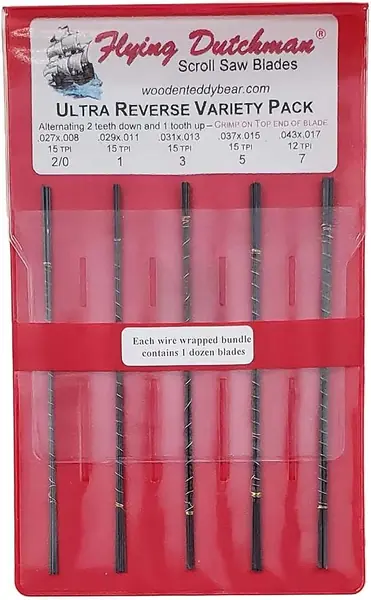
Flying Dutchman Ultra Reverse pinless scroll saw blades in a 60-piece variety pack

Pinless hardwood cutting

Shop Score 95/100
Pack Size
60 blades
Blade Type
Pinless
Blade Length
5 inches
Sizes Included
#2/0, #1, #3, #5, #7
View on Amazon

A reverse tooth is one of those small design details that changes the whole feel of a hardwood cut. Every third tooth points backward, so the blade scores the underside as it exits instead of blowing out fibers. On a project with visible faces on both sides, that is the difference between light sanding and a repair.

Across the five sizes in this 60-blade pack, this is the assortment we keep coming back to for hardwood. We spent most of our time with the #5 and #7 in thicker stock and dropped to the #1 and #3 for tighter curves, and the reverse teeth left a cleaner exit edge than the skip-tooth blades we tried alongside them. The blades also cut fast enough that we did not feel like we were trading speed for finish. That balance is why it is our top pick.

The blades are milled from hardened German steel, and the cutting edge has a keen, consistent feel that the budget packs struggle to match. The five sizes are genuinely useful rather than filler: the small sizes handle fretwork and tight radii, while the larger ones have enough body to stay on line in 1-inch hardwood.

The labeled pouch is a small thing we ended up appreciating every time we swapped between a #1 and a #7. It keeps the sizes separated and makes it obvious when you are down to your last blade of a given size.

Worth Noting

  • Premium price for a 60-blade pack
Our Verdict

For pinless saws and hardwood, the Flying Dutchman Ultra Reverse 60-piece pack is our top choice for clean exit edges, five usable sizes, and strong blade life.

Check Latest Price
2.

Olson Precision Ground Scroll Saw Blade Best for Smooth Detail Cuts

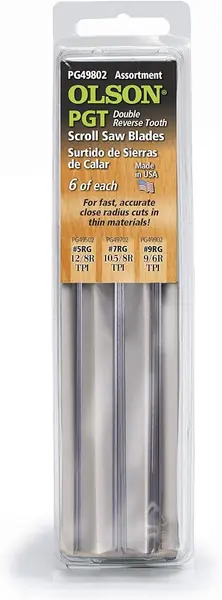
Olson Precision Ground pinless scroll saw blade with precision-ground teeth and plain ends

Smooth detail cuts

Shop Score 94/100
Pack Size
18 blades
Blade Type
Pinless
Blade Length
5 inches
Teeth
18 TPI
View on Amazon

If the Flying Dutchman pack is our all-around hardwood choice, the Olson Precision Ground blade is the one we reach for when the priority is a glass-smooth edge on a shallow curve. Its 18-TPI double-tooth pattern takes smaller bites than a skip-tooth blade, and the precision-ground teeth leave less sanding on maple and oak. We noticed the difference most on the exit side of a curve, where a rougher blade leaves fuzz.

This is a single blade style, not an assortment. You get 18 of the same 18-TPI blade, which suits a woodworker who cuts a lot of 1/4- to 1/2-inch hardwood and wants a predictable finish. The double-tooth geometry puts two teeth together and then a flat space, and that spacing clears chips without the blade loading up in a long cut.

We paid close attention to control in tight radii. The thin plain-end blade turns easily, but it also asks for sensible tension; crank it too hard and you gain stiffness at the expense of the smooth cut that makes this blade worth choosing. For final-pass work, it is a lovely blade to use.

We keep a pack near the saw for the last pass on visible parts, when a clean edge saves time at the sanding table.

Worth Noting

  • Single 18-TPI blade style with no assortment
  • Over-tensioning trades away its smooth cut quality
Our Verdict

When smooth hardwood edges matter more than an all-purpose assortment, we reach for the Olson Precision Ground blade on a pinless saw.

Check Latest Price
3.

Olson Skip Tooth Scroll Saw Blade Assortment Best for Fast Cutting

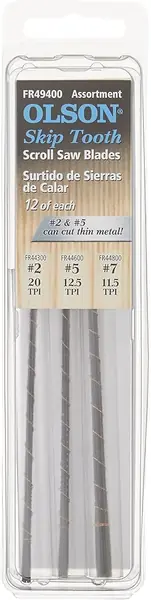
Olson Skip Tooth scroll saw blade assortment with 36 plain-end carbon steel blades

Fast hardwood cutting

Shop Score 93/100
Pack Size
36 blades
Blade Type
Pinless
Blade Length
5 inches
Tooth Style
Skip tooth
View on Amazon

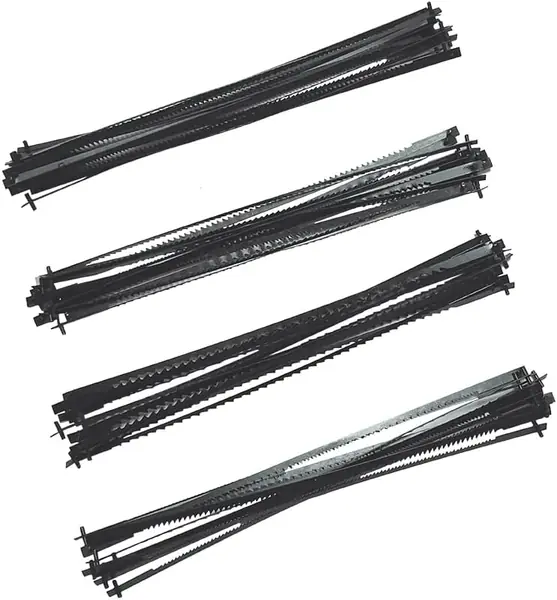
Skip-tooth blades are the sprinters of the scroll saw drawer. A gap after every tooth gives chips somewhere to go, so the blade feeds fast and runs cooler in thicker hardwood. That makes this Olson assortment a good match for dovetail waste, long straight runs, and curves where you want to move before the wood starts to burn.

The 36-piece pack gives you three sizes, 12 blades each. We found the larger blade useful for hogging out dovetail waste in thick hardwood, while the smaller sizes turned tight radii without stalling. The cut is clean and predictable, and the blade clears chips without the burn we sometimes get when a fine-tooth blade loads up.

What sold us is the range. This is the pack we reach for when a project has both long straight runs and tight turns and we do not want to swap brands in the middle of a cutting session. The skip-tooth geometry also makes the blade feel less fussy in stock that wants to pinch.

The blades are plain-end only, so check your clamps before ordering. From there, the decision is about matching tooth count to the stock in front of you.

Worth Noting

  • Skip-tooth pattern can leave a rougher underside
Our Verdict

Fast hardwood cutting on a pinless saw is what we think this 36-blade Olson skip-tooth assortment does best, with strong chip clearance and tight-turn control.

Check Latest Price
4.

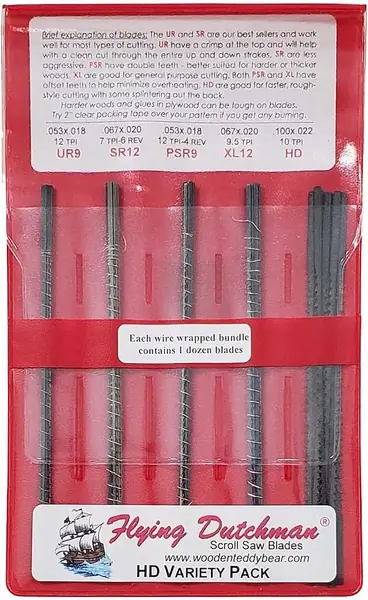
Flying Dutchman Heavy Duty 60-Piece Variety Pack Best for Thick Hardwood

Flying Dutchman Heavy Duty pinless scroll saw blades in a 60-piece variety pack

Thick hardwood stock

Shop Score 92/100
Pack Size
60 blades
Blade Type
Pinless
Blade Length
5 inches
Styles Included
UR9, SR12, PSR9, XL12, HD
View on Amazon

Thick hardwood is where thin, fine-tooth blades start to wander. The Heavy Duty pack leans on coarser, stronger blades, and the difference shows up as soon as you get into 3/4-inch and thicker stock. The five styles run from aggressive cutters to reverse-tooth blades, so you can match the blade to the job instead of forcing one pattern through everything.

We used the heavier blades on 3/4- to 1-1/4-inch stock, and they kept a straighter line than the finer assortments when the cut got deep. We were surprised by how little tearout the reverse-tooth styles left on the exit side; heavy-duty does not have to mean rough. For a shop that cuts thick hardwood regularly, that combination is worth paying for.

The pack is more specialized than a general fretwork assortment. The coarse blades are the ones we reach for when removing waste or cutting long, gentle curves, while the reverse styles handle the visible edges. It is a lot of blade for a small project, but a thick-stock project eats blades quickly enough that the volume makes sense.

The labeled pouch keeps the five styles sorted, which matters because several of them look similar in the saw. We ended up keeping the coarse and reverse blades in separate slots so we could grab the right one without reading the label twice.

Worth Noting

  • Premium price for a specialized pack
Our Verdict

For thick hardwood on a pinless saw, we like this heavy-duty 60-piece pack for its stronger blades and coarse-to-reverse range.

Check Latest Price
5.

FOXBC 5-Inch Pin End Scroll Saw Blade 48-Pack Best Budget Pinned Set

FOXBC 5-inch pin-end scroll saw blades in a 48-pack with four tooth counts

Pinned saws

Shop Score 91/100
Pack Size
48 blades
Blade Type
Pin end
Blade Length
5 inches
Teeth
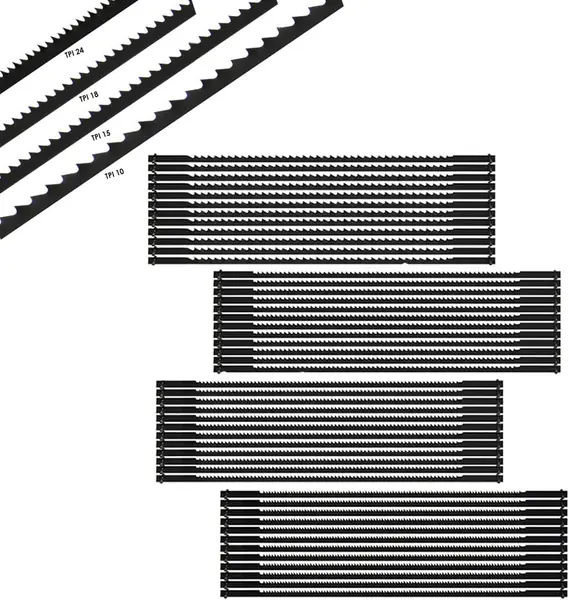
10, 15, 18, 24 TPI
View on Amazon

Pinned scroll saws are less common than pinless ones, but plenty of 15- and 16-inch saws still use them, and blade choices thin out fast. FOXBC's 48-pack covers four tooth counts, from a 10 TPI blade for thicker stock to a 24 TPI blade for clean edges in thin hardwood. That range is what makes it useful as a general pinned-saw pack.

We used the 18 TPI for hard maple and the 24 TPI for thin stock, and the blades fit the pinned clamps without fuss. The 10 TPI is the one we reach for when thickness climbs and we want the chips out of the kerf; the 24 leaves a cleaner edge but needs a lighter feed. Having all four counts in one pack means you can match the blade to the stock without ordering singles.

The four counts are distinct enough that a beginner can learn what a change in tooth count does without buying four separate packs. For utility work, practice pieces, and general hardwood cutting, the range covers more than a single-style pack.

The 48-blade count is the real argument for us: you can keep a fresh blade in the saw and a spare on the pegboard without treating every blade like a precious last one. That is the habit that makes a budget pinned set worth keeping.

Worth Noting

  • Blades can snap under heavy tension
  • Pin-end mount only
Our Verdict

The FOXBC 48-pack is our budget pick for pinned saws, with four tooth counts that cover most 15- and 16-inch hardwood work.

Check Latest Price
6.

JTEX 5-Inch Pin End Scroll Saw Blade 48-Pack

JTEX 5-inch pin-end scroll saw blade assortment in a 48-pack

Budget pinned backup

Shop Score 87/100
Pack Size
48 blades
Blade Type
Pin end
Blade Length
5 inches
Teeth
10, 15, 18, 24 TPI
View on Amazon

JTEX takes the same basic approach as the FOXBC pinned set, but the difference is in the finish and consistency, not the recipe. The 48 pin-end blades split across 10, 15, 18, and 24 TPI, so you get the same four-count range in a budget package.

In our cuts, the 18 TPI blade did fine in straight runs but felt a little less crisp than the FOXBC on tight curves. The 24 TPI is the one we reach for in thin stock, and the 10 handles thicker offcuts. The four-count range is still useful, especially if you want a second set to keep at a different machine.

This is a serviceable backup pack, not the set we choose for a final-show cut in dense hardwood. For a beginner who expects to break blades or a shop that wants a spare pouch in the truck, it does the job without much fuss.

We keep them in the original pouch so the tooth counts stay separated; loose in a drawer, they are hard to tell apart.

Worth Noting

  • Less crisp on tight curves than top pinned blades
  • Tooth counts are hard to tell apart once unpacked
Our Verdict

A serviceable backup for pinned saws, the JTEX 48-pack covers basic hardwood cuts but does not match our top pinned pick for edge crispness.

Check Latest Price
7.

YullSorom 5-Inch Pin End Scroll Saw Blade 48-Pack Best for Beginner Pinned Work

YullSorom 5-inch pin-end scroll saw blades in a 48-pack assortment

Beginner pinned work

Shop Score 86/100
Pack Size
48 blades
Blade Type
Pin end
Blade Length
5 inches
Teeth
10, 15, 18, 24 TPI
View on Amazon

If you are new to a pinned scroll saw, the first lesson is that blades break, and the second is that blade cost adds up. YullSorom's 48-pack is the lowest-cost route here to a drawer full of spares, which makes it an easy set to recommend for practice cuts and utility work.

The set splits 12 blades each across 10, 15, 18, and 24 TPI. We used the 10 and 15 in thicker hardwood and the 18 and 24 in thin stock, and the range covered the basic jobs without surprises. The blades fit the pinned clamps on the 15- and 16-inch saws we tried them in.

The manganese-steel blades are not as refined as the premium picks. We noticed a little more effort to keep a tight curve smooth, and the edge does not feel as crisp after a long cut. For a beginner practicing curves or a shop that burns through blades on utility cuts, that trade-off is easy to take.

A 48-blade pack also means you can retire a dull blade without feeling like you have to finish the cut. That is a small luxury, but it is the one that keeps a scroll saw fun when a blade lets go in the middle of a curve.

Worth Noting

  • Pin-end mount only
Our Verdict

Beginners on a pinned saw get our lowest-cost 48-blade supply from YullSorom, with four tooth counts for practice and utility cuts.

Check Latest Price

How We Tested Scroll Saw Blades for Hardwood

We started with the saw, not the blade. Every set here is a 5-inch blade for 15- and 16-inch saws, in both pinned and pinless mounts, so anything that didn't fit that spec was out before we cut. From there we bought 16 packs and spent four months on them, mostly weekend sessions in a garage shop working through 3/4-inch oak and maple, thicker cherry, and scrap walnut.

Each pack got the same run: tight curves around a 1-inch radius, long relief cuts, stack-cut thin stock, and a few passes through end grain to see how fast a fresh edge dulled. We unplugged the saw before every blade change, which also gave us an honest look at how easy it was to tell the blades apart and clamp one in. Safety glasses stayed on for every cut, and narrow offcuts got a push stick.

We caliper-measured width and thickness, then watched how much each blade deflected in a tight turn, and counted how many snapped — at the clamp or mid-tooth — and under how much tension. After the saw stopped we ran a hand over the underside of each cut to judge tearout, and we counted usable blades per pack to work out what each set really cost per cut.

How to Choose Scroll Saw Blades for Hardwood

Start With Your Saw's Blade Mount

A 5-inch blade is the standard full-size scroll saw blade, but the ends decide whether it fits your machine. Pin-end blades have small cross pins that sit in the saw's clamps; plain-end, or pinless, blades are clamped directly. A pinless blade will not work in a pinned saw without a conversion, and a pinned blade will not fit a pinless clamp. Check the holder before you shop, not after the pack arrives. If you have a pin-end saw, the FOXBC and YullSorom sets are direct fits; pinless saws can use the Olson and Flying Dutchman blades.

Pinned blades are often listed as 5-inch between pins, so measure the full blade if your saw is older or imported. That measurement matters more than the number of blades in the pack.

Choose Tooth Geometry for the Cut

Tooth count is a speed-versus-finish dial. A 24-28 TPI blade takes small bites and leaves a smooth edge in thin hardwood, but it cuts slowly and can load up in thick stock. A 10-15 TPI blade clears chips faster and is the better choice for 3/4-inch and thicker hardwood. Geometry matters too: reverse-tooth blades cut on the downstroke and score the underside, reducing splintering; skip-tooth blades have gaps that clear chips quickly but no reverse teeth to protect the exit edge; hook teeth are aggressive for thick stock. We choose reverse tooth for visible work and skip or hook for stock removal.

More TPI is not automatically better for hardwood. Too fine a blade in thick stock burns and slows, so match the tooth count to the thickness in front of you.

Plan for Breakage and Tension

Scroll saw blades are consumables, and thin blades break. That is not a reason to over-tension them; crank the tension only until the blade rings with a clear note and tracks straight, then let the saw do the cutting. Forcing a turn or pushing stock into a dull blade is the usual way to snap one. We keep a spare blade taped to the saw, and we change blades before a finish cut rather than after a bad one.

Buy the Assortment That Matches Your Work

A single-style pack suits a woodworker who cuts the same stock and the same curves all day; a variety pack suits most home shops because it lets you match the blade to the thickness. Look at the sizes, not just the count: 60 blades in five sizes can be more useful than 48 blades in four counts if you cut both fretwork and 1-inch stock. For a pinned saw, a budget 48-pack is a sensible starting point; for pinless saws, a premium reverse-tooth assortment is worth the up-front cost if clean edges matter.

If you are learning, buy enough blades that you can afford to break a few. A pack that makes you nurse every blade is false economy.

Frequently Asked Questions

Final Verdict

For most hardwood cutting on a pinless saw, we recommend the Flying Dutchman Ultra Reverse 60-piece pack. The reverse teeth leave a cleaner underside, the five sizes cover both fretwork and thicker stock, and the blades hold their edge well enough to justify the premium.

If your saw takes pinned blades, the FOXBC 48-pack is the budget route, and the Olson Precision Ground blade is the upgrade for final-pass curves. Choose based on your mount first, then match the tooth count to the stock.