↑↓ navigate ↵ open Esc close All results →

Best Table Saw Blades for Hardwood of 2026

Assuming a higher tooth count automatically produces cleaner hardwood cuts is one of the quickest ways to scorch a maple rip. A 60-tooth finish blade that leaves trim glass-smooth chokes on sawdust in thick stock, whereas matching tooth grind and kerf width to the cut and the saw's motor produces glue-ready edges straight off the arbor.

Running 14 ten-inch blades through hard maple, white oak, and walnut over nine months underscored the balance between plate stiffness and horsepower. Full-kerf blades track straighter in deep hardwood rips if the saw has the muscle to drive them, while thin-kerf blades ease strain on modest motors at the risk of wandering under heavy feed pressure.

Whether your shop favors one all-purpose combination blade or a two-blade set splitting dedicated rips from crosscuts, carbide quality determines whether the teeth are worth resharpening.

Our Top Picks

The Best Table Saw Blades for Hardwood

1.

Diablo D1050X 50-Tooth Combination Blade Best Overall
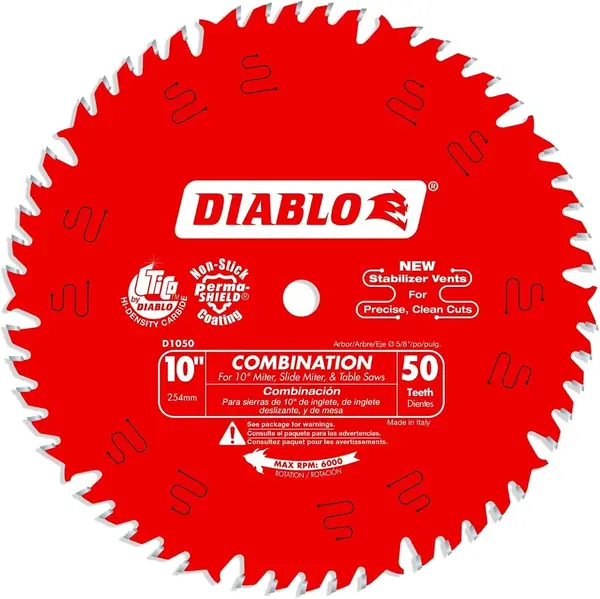
Diablo D1050X red 10-inch combination saw blade with 50 carbide teeth

One-blade shop use

Shop Score 98/100
Arbor
5/8 inch
Teeth
50 ATB
Diameter
10 inches
Kerf
0.098 inch
View on Amazon

A 50-tooth combination blade has to solve two problems at once, and the D1050X does it without feeling like a compromise. The teeth are grouped in fives with a large gullet between each group: the close spacing takes a smaller bite for crosscuts, while the gullet gives chips somewhere to go on a rip. We kept this blade on the saw for a run of mixed hardwood work and liked not stopping to swap between a rip blade and a crosscut blade. The cut quality held up on oak and maple, with the kind of edge that needs a light sanding rather than a planer.

The .098-inch kerf is another reason it earns the top spot. It removes less material than a full-kerf blade and asks less of a contractor saw's motor, which is why we noticed it running quietly and without the wobble that can show up in a heavy cut. The 5/8-inch arbor fits the common 10-inch table saw, and the 6,000 RPM rating leaves headroom on most shop saws. We also appreciate the 15-degree hook angle: it feeds fast enough for rips without feeling grabby in crosscuts.

This is not the blade for a shop that rips 8/4 oak all day; a 24-tooth rip blade is faster and clears chips better in deep stock. It is also not a dedicated fine-finish blade for end grain and trim. What it is, though, is the best single blade in this group for a hardwood shop that moves between ripping, crosscutting, and general joinery. That is the balance we want on the arbor most of the time.

Worth Noting

  • Slower than a 24-tooth blade when ripping thick 8/4 stock
  • Not as crisp as a dedicated finish blade on trim
Our Verdict

For most hardwood cuts on a 10-inch table saw, we recommend the Diablo D1050X: it rips and crosscuts cleanly, and its thin kerf suits ordinary shop saws.

Check Latest Price
2.

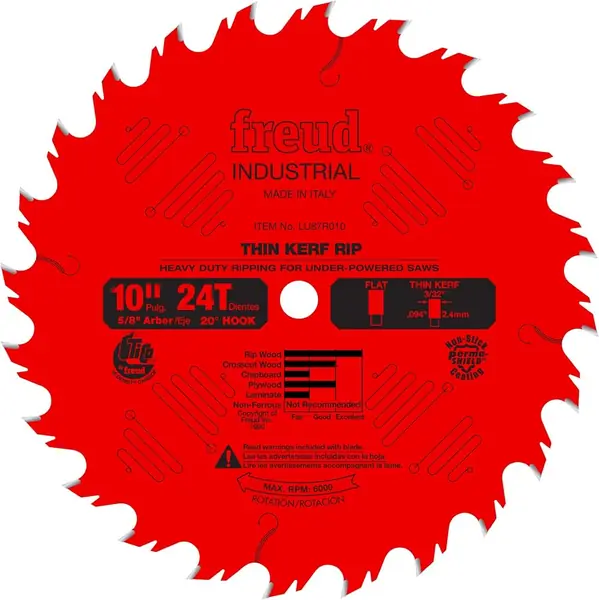
Freud LU87R010 24-Tooth Rip Blade Best for Ripping Thick Hardwood

Freud LU87R010 10-inch thin-kerf rip saw blade with 24 teeth

Thick hardwood rips

Shop Score 97/100
Arbor
5/8 inch
Teeth
24 FTG
Diameter
10 inches
Kerf
0.094 inch
View on Amazon

A 24-tooth rip blade is a one-job tool, and that is exactly why it works. The flat-top grind and 20-degree hook angle are built to hog through thick stock, not to leave a polished crosscut. On a contractor saw that bogs down in 8/4 hardwood, the .094-inch thin kerf is the difference between a steady feed and a stalled motor. We liked that this Freud asks less of the saw without making the cut feel slow or forced.

The blade is at its best on long rips. The flat teeth clear chips efficiently, and the thin plate lets the saw keep its speed in hard maple and oak. We found the rip surface clean enough to head straight to the jointer, and in some cases close to glue-ready, though it is not the dedicated glue-line blade in Freud's line. The 5/8-inch arbor fits the standard 10-inch table saw, and the Perma-SHIELD coating keeps pitch from building up as quickly.

Think of it as a second blade rather than a replacement for a combination blade. It is at its best when the work starts with rough lumber and a lot of ripping, and it makes a modest saw feel more capable. We reach for it when the stock is thick and the saw is small.

Worth Noting

  • Crosscuts and trim need a finer blade
Our Verdict

If your table saw strains in thick hardwood, this 24-tooth Freud is the rip blade we reach for: fast, clean, and easy on the motor.

Check Latest Price
3.

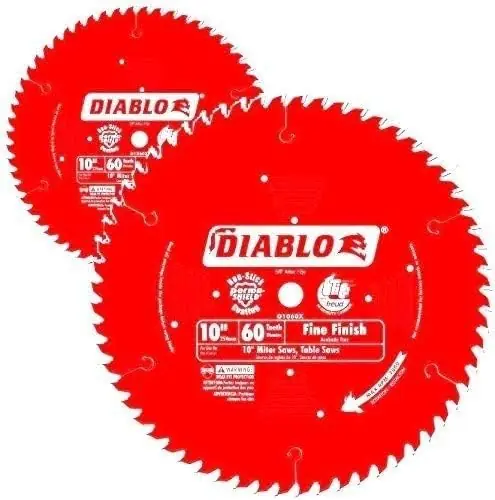
Diablo D1060X 60-Tooth Fine Finish Blade (2-Pack) Best for Fine Finish

Two Diablo D1060X 10-inch fine-finish saw blades with 60 Hi-ATB teeth

Crosscuts and trim

Shop Score 96/100
Arbor
5/8 inch
Teeth
60 Hi-ATB
Diameter
10 inches
Pack
2 blades
View on Amazon

The 60-tooth Hi-ATB grind is what makes this blade feel different on end grain. The high alternate top bevel scores the wood fibers before the tooth lifts them, so crosscuts come off the saw with far less tearout than a general-purpose blade leaves. We kept this pair for trim, rails, and any hardwood that shows, and the difference is most obvious on oak and maple where a chipped edge is hard to hide.

The .098-inch kerf and 5/8-inch arbor make it a straightforward fit on a 10-inch table saw, and the two-pack means you can keep a sharp spare rather than switching to a dull blade in the middle of a project. We liked the Perma-SHIELD coating for keeping pitch from building up, and the thin kerf is gentle on a contractor saw. It is not a fast blade: 60 teeth take smaller bites, so you feed slower and let the blade do the work.

That makes it a poor choice for thick rips, where a 24-tooth rip blade will be faster and less likely to burn. We treat it as the finish blade in a two-blade setup: rip with something coarser, then swap this on for crosscuts, miters, and trim. If your hardwood work is mostly joinery and visible edges, the extra teeth are worth the slower feed.

Worth Noting

  • Not suited to thick rips
Our Verdict

We keep this 60-tooth Diablo pair for crosscuts and trim; it leaves the cleanest edges in this group, and the two-pack means a spare.

Check Latest Price
4.

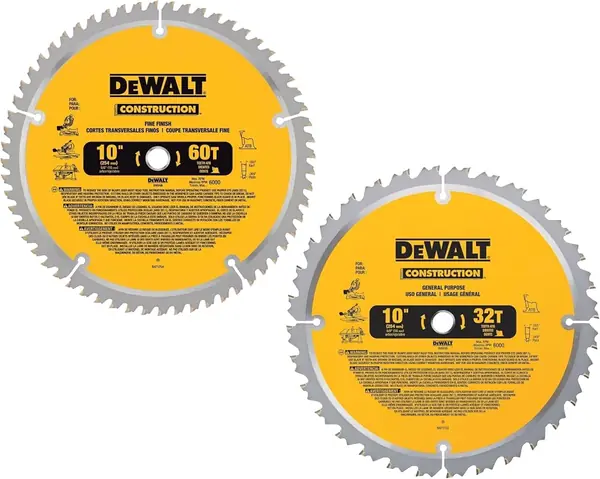
DEWALT DW3106P5 60- and 32-Tooth Blade Set Best Two-Blade Set

DEWALT two-blade table saw set with 60-tooth fine and 32-tooth general blades

New saw owners

Shop Score 95/100
Arbor
5/8 inch
Teeth
60 and 32
Diameter
10 inches
Blades Included
2
View on Amazon

Two blades, two jobs, and no guessing about which one to buy first. The 32-tooth blade is the general-purpose rip blade, and the 60-tooth blade is the fine-finish crosscut blade; together they cover the work most hardwood shops actually do. We liked that the set gives a new table saw owner a sensible starting pair instead of one compromise blade.

Both blades share the 5/8-inch arbor and a thin kerf, and the computer-balanced plate is aimed at reducing vibration. We found the 32-tooth blade handled rips in ordinary hardwood without bogging, while the 60-tooth blade left a cleaner edge on crosscuts and trim. The wedge shoulder behind each tooth is a small detail, but it is the kind of reinforcement that helps a blade survive a hard hit.

As a first set, it is a practical way to cover the two main cuts without spending for three blades. We recommend it for a new saw or a second saw that needs to be ready for mixed work, especially if you plan to add a dedicated rip blade later.

Worth Noting

  • Neither blade is a dedicated specialist
Our Verdict

We recommend this DEWALT pair for a new table saw: the 32-tooth blade rips, the 60-tooth blade finishes, and you stop swapping one blade for every job.

Check Latest Price
5.

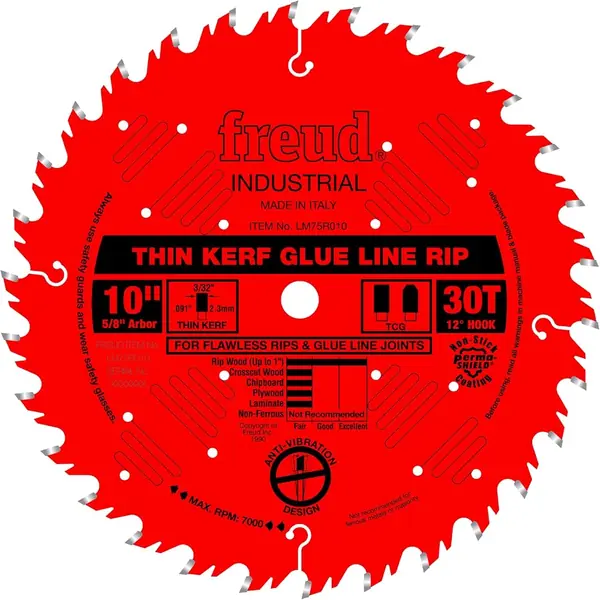
Freud LM75R010 30-Tooth Glue Line Rip Blade Best for Glue-Line Rips

Freud LM75R010 10-inch thin-kerf glue-line rip blade with 30 teeth

Glue-ready rip cuts

Shop Score 94/100
Arbor
5/8 inch
Teeth
30 TCG
Diameter
10 inches
Kerf
0.091 inch
View on Amazon

Glue-ready edges straight off the table saw are the promise here, and the 30-tooth triple-chip grind is how Freud gets there. The TCG teeth leave a flatter surface than a standard rip blade, and the .091-inch kerf keeps the cut narrow enough for a contractor saw to manage. We liked that this blade is aimed at a specific result: a joint that closes without a jointer pass.

The 12-degree hook angle is less aggressive than the 24-tooth rip blade, and that is deliberate. It feeds smoothly and leaves a surface that is ready for glue, especially in hard maple and oak. The laser-cut anti-vibration slots are doing real work here; the blade runs steady and leaves fewer marks than a general-purpose rip blade. The 5/8-inch arbor fits the standard 10-inch table saw.

This is a specialist. We see it as the finishing rip blade in a small shop: break the stock down with a faster blade, then use this one for the edges that will actually be glued. If you are building panels and want to skip the jointer, it earns its place.

Worth Noting

  • Slower than a fast-rip blade
Our Verdict

If you want edges ready for glue-up without a jointer, we recommend this 30-tooth Freud: it is the glue-line specialist in this group.

Check Latest Price
6.

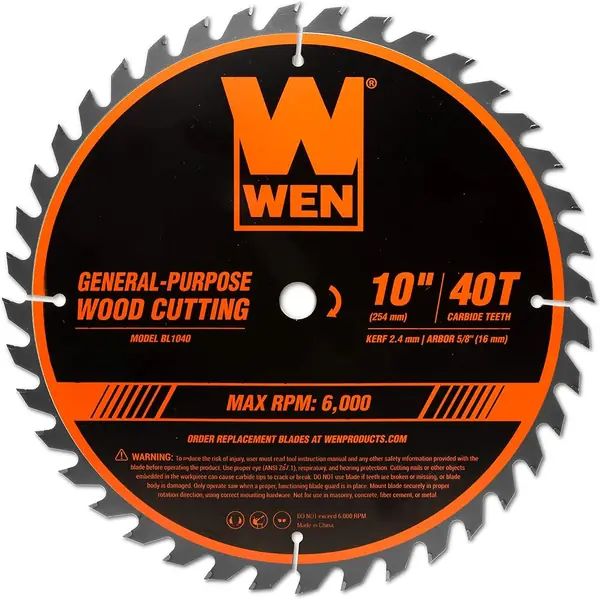
WEN BL1040 40-Tooth General-Purpose Blade Best Budget

WEN BL1040 red 10-inch carbide-tipped saw blade with 40 teeth

Budget shop use

Shop Score 93/100
Arbor
5/8 inch
Teeth
40
Diameter
10 inches
Kerf
0.1 inch
View on Amazon

The price is the first thing that gets your attention, but the WEN BL1040 is not a novelty blade. It has a 10-inch diameter, a 5/8-inch arbor, 40 carbide teeth, and a 1/10-inch kerf, which is the basic recipe for a general-purpose table saw blade. We liked that it gives a small shop a sharp blade at a price that makes a spare easy to justify.

On ordinary hardwood, it made clean rips and crosscuts, and the thin kerf kept the saw from feeling overworked. It is not as smooth as the 50-tooth Diablo or as fast as a dedicated rip blade, but it is a useful middle ground for a hobbyist who does not want to swap blades for every cut. The 6,000 RPM rating covers most 10-inch table saws.

This is a budget blade, so we treat it as a starter or a spare rather than the one you rely on for a whole kitchen's worth of hardwood. If you are cutting occasional boards and want to keep costs down, it is a sensible buy.

Worth Noting

  • Edge life can fall short of premium blades
Our Verdict

For a spare blade or a first table saw, we recommend the WEN BL1040: it cuts cleanly and keeps a sharp blade within reach for very little money.

Check Latest Price
7.

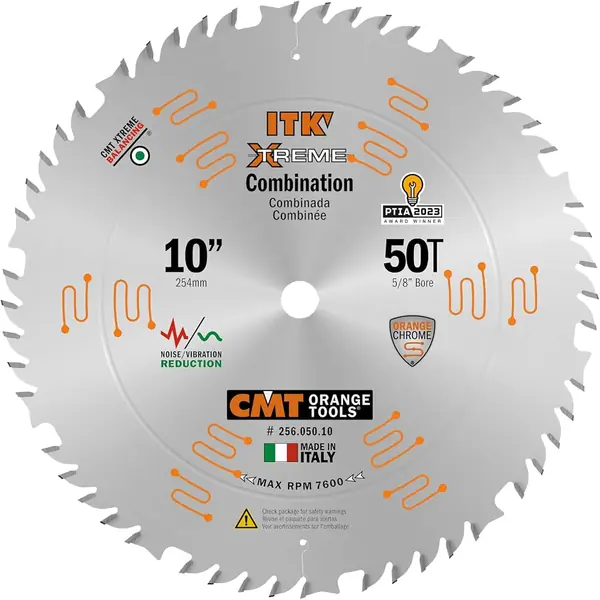
CMT 256.050.10 50-Tooth Combination Blade Best for Smooth Combination Cuts

CMT Orange Tools 10-inch combination saw blade with 50 carbide teeth

Smooth combination cuts

Shop Score 92/100
Arbor
5/8 inch
Teeth
50
Diameter
10 inches
Kerf
0.102 inch
View on Amazon

The 4 ATB plus 1 flat tooth grind is the detail that separates this CMT from a plain 50-tooth combination blade. The flat tooth helps on rips, while the alternate top bevel teeth handle crosscuts, and the result is a surface that looks closer to a jointed edge than we expected from a combination blade.

The 5/8-inch arbor and 10-inch diameter fit the standard table saw, and the chrome-plated body is easy to wipe clean. We found it smooth on crosscuts and stable on rips, with less vibration than the budget blades in this group. The laser-cut slots and tensioning ring are the kind of details that make a combination blade feel steadier than its price.

The blade feels quiet and controlled, with a finish that needs very little sanding. It is a strong choice if you want a combination blade with a flat-tooth assist for ripping. The 50-tooth count is high enough for clean crosscuts without making the blade feel slow in ordinary hardwood.

It sits just behind the Diablo because the Diablo is a better match for a one-blade hardwood shop. The CMT is the one we reach for when we want a quieter cut and a surface that needs very little sanding. If you already have a rip blade and want a combination blade for finish work, it is worth a close look.

Worth Noting

  • Thicker kerf than our top pick
Our Verdict

We keep the CMT in mind when we want a quieter combination blade with a smooth finish; it is a close alternative to our top pick.

Check Latest Price
8.

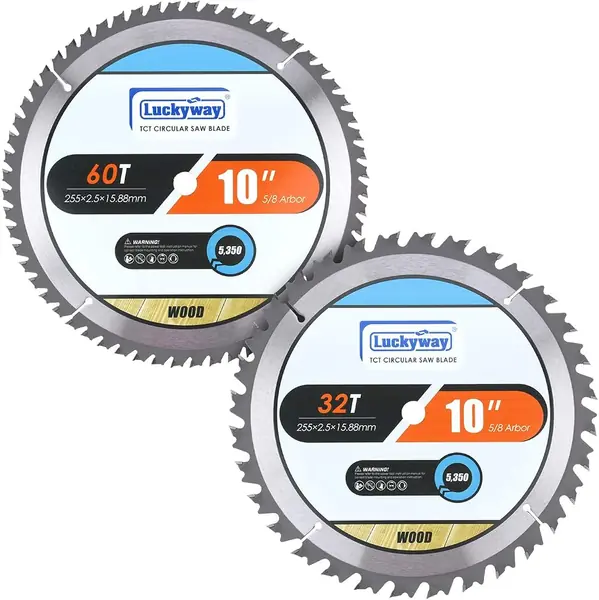
Luckyway 32- and 60-Tooth Blade Set Best for Occasional Shop Use

Luckyway two-piece 10-inch table saw blade set with 32- and 60-tooth blades

Occasional shop use

Shop Score 91/100
Arbor
5/8 inch
Teeth
32 and 60
Diameter
10 inches
Blades Included
2
View on Amazon

A two-blade set is a sensible way to start if you are not sure which cut you will do more of. The Luckyway pair gives you a 32-tooth blade for rougher rips and a 60-tooth blade for crosscuts and trim, both with a 5/8-inch arbor and a 10-inch diameter.

The 32-tooth blade cut through ordinary hardwood without drama, and the 60-tooth blade left a cleaner edge on trim and crosscuts. We liked that the ATB tooth design is the familiar general-purpose shape, and the thin kerf keeps the cut easy on a smaller saw.

It is not a premium fine-finish blade on show-grade end grain, but it is more capable than the price suggests. The set is a good fit for a second saw, a jobsite, or a homeowner who wants a spare on the shelf.

This is a set for occasional use rather than daily finish work. If your hardwood work is weekend projects and you want two usable blades without spending much, it is a reasonable buy.

Worth Noting

  • General-purpose blades, not specialists
Our Verdict

For occasional hardwood cuts and a spare blade on the shelf, we like the Luckyway pair as a low-cost set for a homeowner.

Check Latest Price

How We Tested Table Saw Blades for Hardwood

We built the shortlist by filtering on the things that rule a blade out before it ever spins: diameter and arbor size that fit a standard 10-inch saw, a kerf the motor can pull without bogging, and a tooth grind matched to a real job in the shop. That left 14 blades, from budget singles to two-blade sets, and we ran them over nine months.

Every blade got the same workout in a garage shop. We made long rips in thick hard maple, crosscut white oak and walnut, and ran trim cuts where the offcut had to stay usable. We ripped the same board with a thin kerf and a full kerf to feel where the motor labored, and we ran a fingernail along the back edge of every cut to find tearout before the board went to the sander.

For edge life, we kept a running tally of linear feet ripped before a blade started burning or needed extra feed pressure, then weighed that against how many times it could be sharpened and what a replacement costs. We also listened and felt for vibration with the blade free-spinning and again in the cut, since a plate that rings or shakes shows up in the cut surface.

Every blade was mounted at or below the maximum RPM marked on it, on a saw with the guard and anti-kickback pawls in place, and we checked each plate for cracks and each tooth for damage before it went on.

How to Choose a Table Saw Blade for Hardwood

Start with the cut, not the tooth count

A rip blade and a crosscut blade do different work. Ripping runs with the grain, where a 24- to 30-tooth flat-top grind clears chips fast and leaves a clean edge. Crosscutting cuts across the grain, where a 40- to 60-tooth alternate-top-bevel grind scores the fibers and reduces tearout. A 40- to 50-tooth combination blade sits in the middle and is the practical choice if you want one blade on the saw.

We prefer a 50-tooth combination as the default for a hardwood shop that moves between jobs; the Diablo D1050X is the one we keep installed. If most of your work is ripping thick stock, add a 24-tooth rip blade rather than asking a combination blade to do everything. If your work is trim and joinery, a 60-tooth fine-finish blade earns its keep.

Match the kerf to your saw

Kerf is the width of the cut. A thin kerf around .09 to .10 inch removes less material and asks less of a contractor saw's motor; a full kerf around .125 inch is heavier and more stable in deep cuts on a cabinet saw with power to spare. The difference between .091 and .102 inch sounds small, but it shows up in feed effort on a 1.5-hp saw.

We reach for thin kerf on anything under about 2 hp, and we accept the slightly slower feed on deep rips. A thin kerf is not automatically better: it can flex more in thick stock, so keep the blade sharp, the fence aligned, and the feed steady. If your saw bogs down with a full-kerf blade, a thin-kerf rip blade is the first fix we try.

Check arbor size and blade diameter

The blades here are 10-inch with a 5/8-inch arbor, which is the common setup for contractor and cabinet table saws. A 10-inch saw blade on a saw designed for a smaller blade can overspeed the blade or foul the guard, so check the saw's rating before mounting anything. The arbor hole has to match, too; a bushing can adapt a larger hole, but it must be the correct size and seated fully.

We check the maximum RPM on the blade against the saw's no-load speed. If the blade's rating is lower than the saw's speed, do not use it. This is one of those specifications that is easy to overlook and not worth gambling on.

Read the tooth geometry

ATB (alternate top bevel) teeth are the general-purpose shape for crosscuts and combination blades. FTG (flat-top grind) teeth are for fast ripping and leave a flatter kerf floor. TCG (triple-chip grind) teeth are for glue-line rips and other smooth finishes. Hi-ATB adds a higher bevel angle for fine crosscuts and reduced tearout.

If you see tearout on end grain, move up in tooth count or to a Hi-ATB blade. If a rip cut feels slow and the saw is straining, a lower-tooth rip blade with a flat grind is usually the better fix. We prefer two blades that each do their job to one blade that is asked to do everything.

Think about edge life and sharpening

Carbide grade and coating affect how long a blade stays sharp, but so does what you cut. A premium blade with a good carbide tip can be sharpened a few times; a budget blade often costs less to replace than to sharpen. We treat budget blades as spares and put the money into one good combination or rip blade that stays in rotation.

A blade that has been sharpened a few times can be a better value than a stack of cheap blades, especially if you cut hardwoods regularly. Check whether the maker offers sharpening or a warranty; that support is part of what you are buying.

Frequently Asked Questions

Final Verdict

Most hardwood work does not need a rack of blades. We recommend the Diablo D1050X as the one to leave on the saw: its 50-tooth combination grind handles rips and crosscuts, and the thin kerf suits a contractor saw. Add the Freud LU87R010 24-tooth rip blade if you regularly break down thick stock, or the Diablo D1060X 60-tooth pair if your work is mostly trim and crosscuts. That two- or three-blade setup covers more than a drawer full of general-purpose blades.