↑↓ navigate ↵ open Esc close All results →

Best Table Saw Blades for MDF of 2026

MDF is sawdust and glue pressed into a board, and it punishes a blade two ways at once: the resin dulls teeth fast, and the edges chip out unless each tooth shears instead of scraping. We ran 12 blades — all 10-inch, all 5/8-inch arbor, from 32 teeth up to 90 — through eight months of shop work to see which ones held their edge.

I burned a shelf's worth of 3/4-inch MDF once by rushing the rip with a low-tooth framing blade, and the scorch marks are still there. Tooth count gets you most of the way, but grind and hook angle decide whether a cut shears clean or smears.

The picks below cover different shop situations: a single blade for occasional weekend work, pairs that split ripping and crosscutting, and fine-finish blades for faced panels. What they share is a clean exit on the underside, which is where MDF gives itself away.

Our Top Picks

The Best Table Saw Blades for MDF

1.

Diablo D1090X Ultimate Polished Finish Best Overall
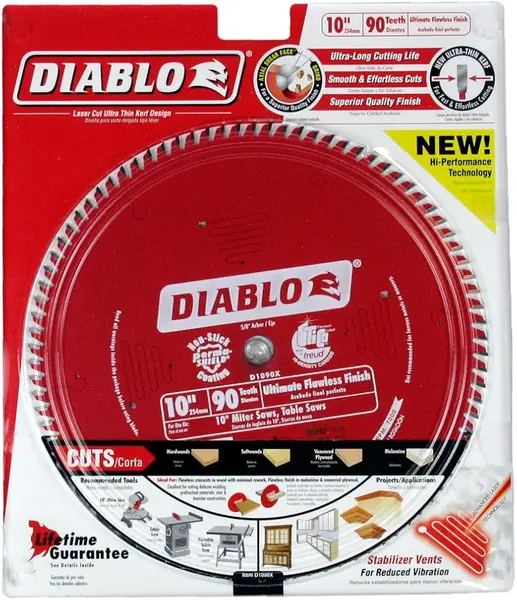
Diablo Ultimate Polished Finish 90-tooth 10-inch circular saw blade

Polished MDF crosscuts

Shop Score 97/100
Arbor Size
5/8 in
Blade Diameter
10 in
Tooth Count
90
Kerf
0.087 in
View on Amazon

A 90-tooth rim is a lot of carbide to spin, but that density is exactly why the Diablo D1090X earns the top spot for MDF. The teeth are packed close enough to take small bites, and the polished-finish grind is aimed at the crosscuts where MDF shows every fuzzy fiber. We like that the thin .087-inch kerf keeps the load reasonable on a contractor saw, while the 5/8-inch arbor fits the common table-saw spindle.

What sold us is the edge quality. On sheet goods, the blade's job is to shear cleanly rather than tear, and the D1090X's high tooth count and 10-degree hook angle support that. We reach for it when the cut will be visible, whether that is cabinet sides, shelf edges, or MDF panels headed for paint or veneer. It is not the blade we choose for deep rips in thick stock; that is a job for a lower tooth count.

The trade-off is speed. A 90-tooth blade wants a steady feed and a saw that is not struggling, so it suits a table saw with reasonable power and a user who is not in a race. We also appreciate the thin .063-inch plate, which keeps the blade from feeling heavy in the cut, and the 6000 RPM rating gives it headroom on common 10-inch saws. If you want one blade for the cleanest MDF crosscuts, this is the one we hand you first.

Worth Noting

  • Premium price compared with budget blades
Our Verdict

We recommend the Diablo D1090X when clean MDF crosscuts matter most; its 90-tooth grind leaves the smoothest edges here, as long as you feed it steadily.

Check Latest Price
2.

Freud LU79R010 Thin Kerf Best for Faced Sheet Goods

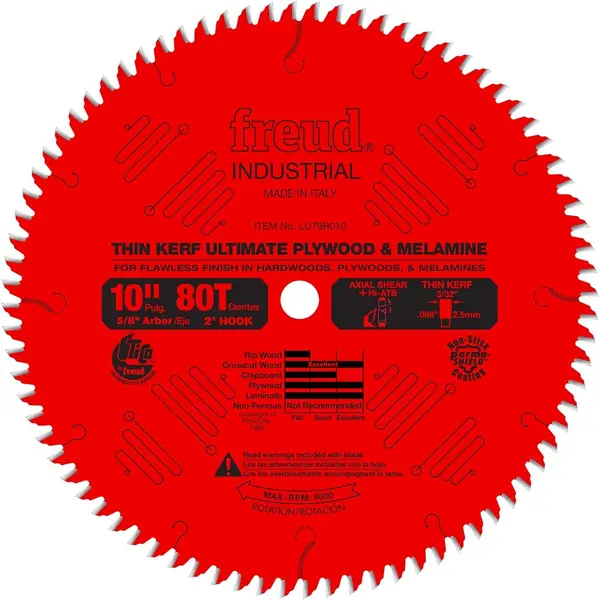
Freud LU79R010 80-tooth thin-kerf 10-inch saw blade with Perma-Shield coating

Faced sheet goods

Shop Score 96/100
Arbor Size
5/8 in
Blade Diameter
10 in
Tooth Count
80
Tooth Geometry
Hi-ATB
View on Amazon

The Hi-ATB tooth shape is the first thing we notice on the Freud LU79R010, and it is the reason this blade belongs in a conversation about MDF. High alternate top bevel teeth shear the top and bottom edges of the cut, which is what you want when the panel has a veneer or a melamine face that will chip. The 80-tooth count is high enough for finish work without going all the way to a 90-tooth rim.

This is a thin-kerf blade, and that matters on a 10-inch table saw that is not overflowing with power. It takes less effort to feed, wastes less material, and leaves a clean edge on plywood and melamine. We like it for cabinet carcasses and built-ins where the cut edge may stay exposed. The 5/8-inch arbor is standard, and the Perma-Shield coating helps with pitch.

For the buyer whose MDF is faced with melamine or veneer, this is the pick that protects the surface. It is the one we reach for when a chip-out would ruin a painted panel, and the thin kerf makes the finish cut feel easier on the saw. The blade is built for veneered plywood, melamine, and laminate, and the same geometry makes sense for MDF with a decorative face.

If you mostly cut raw MDF and sand the edges, the Diablo D1090X is the more direct buy. For faced sheet goods, we prefer the LU79R010's chip-free approach. That distinction is the whole reason it earns a place beside the top pick rather than replacing it.

Worth Noting

  • Not a general-purpose ripping blade
Our Verdict

We reach for the Freud LU79R010 when MDF has a melamine or veneer face that cannot chip; its Hi-ATB grind protects the surface better than a general combination blade.

Check Latest Price
3.

Diablo D1050X Combination Best All-Around Combination

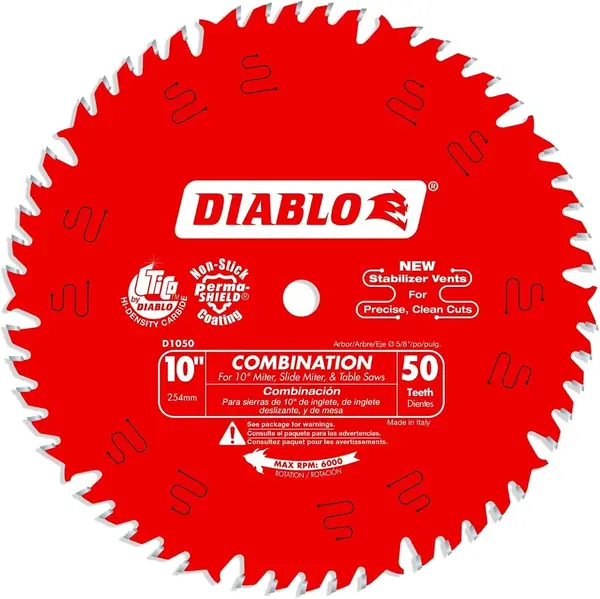
Diablo D1050X 50-tooth combination 10-inch saw blade with red Perma-Shield coating

Mixed shop work

Shop Score 95/100
Arbor Size
5/8 in
Blade Diameter
10 in
Tooth Count
50
Kerf
0.098 in
View on Amazon

The Diablo D1050X is the blade we leave on the saw when the day mixes ripping and crosscutting. Its 50-tooth pattern is a compromise, but a smart one: five teeth are grouped between large gullets, so the blade can clear chips during a rip and still take a small enough bite for crosscuts. For a one-blade shop, that flexibility is worth more than a single-purpose finish rim.

The 15-degree hook angle and .098-inch kerf give it a fairly aggressive feed, and the thin kerf helps a contractor saw keep up. We like the Perma-Shield coating for the same reason we like it on other Diablo blades: less pitch buildup means fewer cleaning breaks. The 5/8-inch arbor is standard for 10-inch table saws.

The D1050X is the practical all-rounder in this group. We like it for framing, shop jigs, and mixed sheet-goods work, where swapping blades for every rip would slow the job. It earns its place by doing two jobs well enough to avoid a swap.

Worth Noting

  • Less refined edge than finish blades
Our Verdict

We keep the Diablo D1050X on the saw when one blade has to rip and crosscut MDF; it is the best all-around compromise in this group.

Check Latest Price
4.

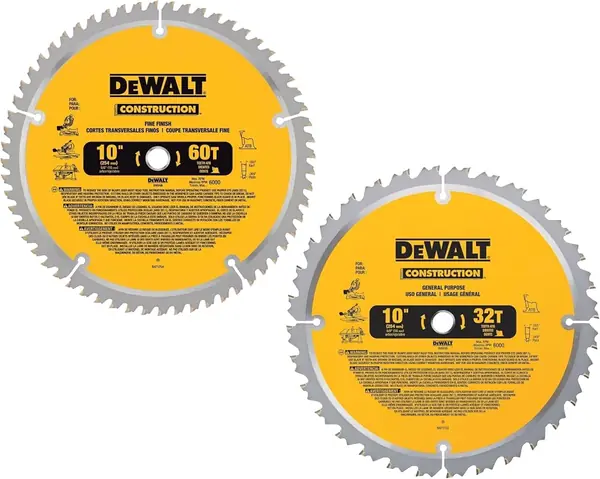
DEWALT DW3106P5 Combo Pack Best Two-Blade Set

DEWALT DW3106P5 two-blade combo with 60-tooth and 32-tooth 10-inch blades

Two-blade starter set

Shop Score 94/100
Arbor Size
5/8 in
Blade Diameter
10 in
Blade Count
2
Tooth Counts
60 and 32
View on Amazon

The DEWALT DW3106P5 solves a common shop problem: you need a clean 60-tooth blade for MDF and a coarser blade for rips, but you do not want to buy both separately. The set includes a 10-inch 60-tooth fine-finish blade and a 32-tooth general-purpose blade, both with a 5/8-inch arbor.

The 60-tooth blade is the one we put on for MDF sheet goods. It has a thin kerf and a computer-balanced plate, and the tooth count is high enough to leave a respectable edge without the slow feed of an 80-tooth rim. The 32-tooth blade is the one we keep for ripping and general carpentry, where speed matters more than a polished edge.

The set is a value play, not a boutique finish set. We like having both blades within reach, and the 5/8-inch arbor means they fit the same saw. If you are building your blade collection from scratch, this is a sensible first set, and it leaves budget for the project itself.

Worth Noting

  • No 80-tooth blade in the set
Our Verdict

We think the DEWALT DW3106P5 is the smart buy for a small shop that wants a 60-tooth MDF blade and a 32-tooth ripper without buying two separate premium blades.

Check Latest Price
5.

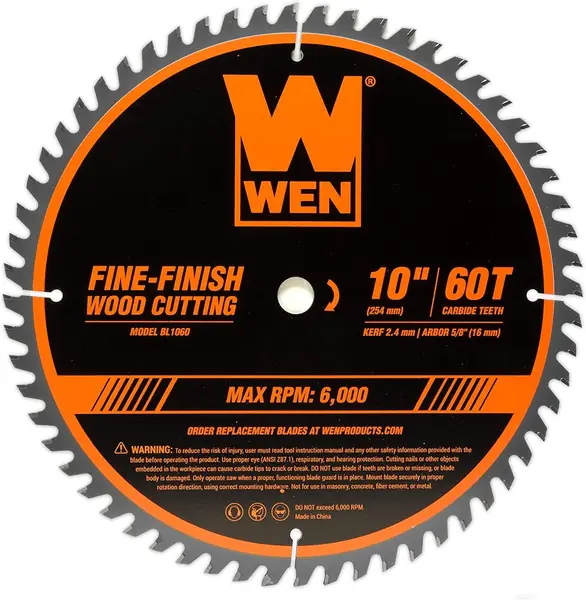
WEN BL1060 Fine-Finish Best Budget Fine-Finish

WEN BL1060 60-tooth 10-inch fine-finish saw blade in silver

Budget MDF cuts

Shop Score 93/100
Arbor Size
5/8 in
Blade Diameter
10 in
Tooth Count
60
Kerf
1/10 in
View on Amazon

A 60-tooth fine-finish blade does not have to cost premium money, and the WEN BL1060 is the proof in this group. It has the basics we look for in an MDF blade: a 10-inch diameter, a 5/8-inch arbor, 60 carbide-tipped teeth, and a thin 1/10-inch kerf. The 6000 RPM rating covers the common table saws and miter saws this blade is built for.

We like it as the blade you keep for occasional sheet-goods work, especially if your saw is a contractor model that does not need a heavy full-kerf blade. The thin kerf asks less of the motor, and 60 teeth are enough to improve on a general-purpose rip blade without the slow feed of an 80-tooth rim. For MDF shelving, shop cabinets, and utility panels, that is a useful balance.

We recommend it for the budget buyer who wants a clear step up from a stock blade. It cuts cleanly for the money and does not demand a premium saw, and the 60-tooth count is the right compromise for occasional MDF work. It is the blade we keep for weekend projects where good enough is the goal.

Worth Noting

  • 60 teeth leave more tear-out than 80-tooth blades
Our Verdict

We recommend the WEN BL1060 for occasional MDF work on a budget; its 60-tooth thin kerf cuts cleanly without demanding a premium blade budget.

Check Latest Price
6.

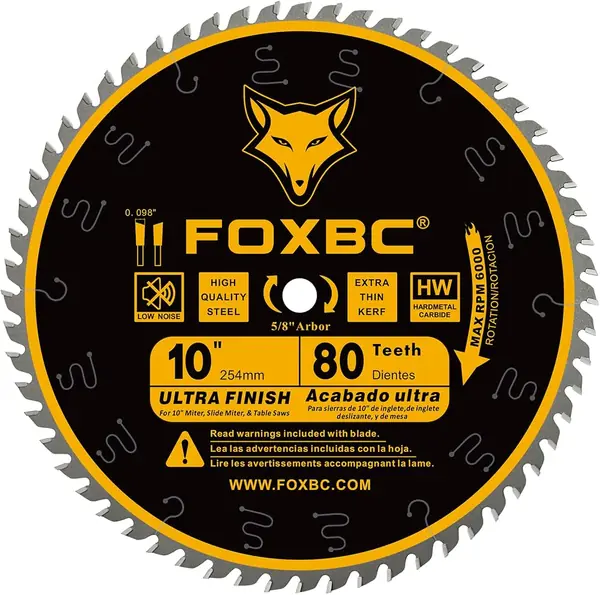
FOXBC 80-Tooth Ultra Finish Best Value High-Tooth

FOXBC 80-tooth ultra-finish 10-inch table saw blade with carbide teeth

Budget fine finish

Shop Score 92/100
Arbor Size
5/8 in
Blade Diameter
10 in
Tooth Count
80
Kerf
0.098 in
View on Amazon

The FOXBC 80-tooth blade is the budget route to the tooth count MDF wants. It is a 10-inch, 5/8-inch-arbor blade with an ATB tooth pattern and a .098-inch kerf, and it is aimed at crosscutting oak, pine, melamine, plywood, and molding. For a blade at this price, the 80-tooth count is the headline.

We like it for a shop that cuts MDF occasionally and cannot justify a premium finish blade. The high tooth count takes smaller bites than a 60-tooth general-purpose blade, and the thin kerf keeps the feed light on a contractor saw. The 80-tooth count is also the reason we reach for it on MDF trim and panel cuts where a stock blade would leave fuzz.

For the money, it gives a high tooth count that most budget blades skip, and it handles the crosscuts that matter most in MDF. It leaves enough budget for a zero-clearance insert, which is where a lot of MDF edge quality actually comes from. That combination makes it a useful second blade for a home shop.

We recommend it to the woodworker who wants an 80-tooth blade for MDF without paying premium prices. It is not the blade we choose for a production shop, but it earns a place in a small shop where one good finish blade has to justify its cost.

Worth Noting

  • ATB grind is less specialized than Hi-ATB
Our Verdict

We like the FOXBC 80-tooth blade for budget-minded woodworkers who want a high tooth count for MDF, as long as they accept the consistency risk.

Check Latest Price
7.

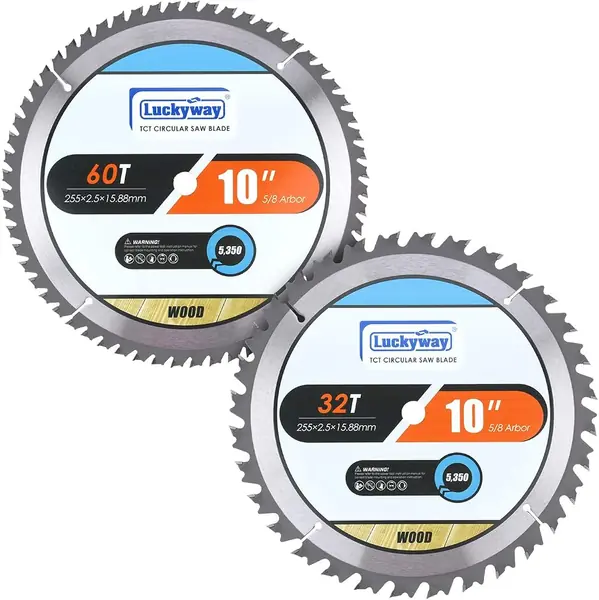
Luckyway 32T/60T Two-Pack Best for Occasional MDF Work

Luckyway 10-inch two-pack with 32-tooth and 60-tooth carbide blades

Occasional MDF work

Shop Score 91/100
Arbor Size
5/8 in
Blade Diameter
10 in
Blade Count
2
Tooth Counts
32 and 60
View on Amazon

The Luckyway two-pack is the budget answer for a shop that wants a 60-tooth finish blade and a 32-tooth ripper without spending much. Both blades are 10 inches with a 5/8-inch arbor, and the set includes one of each tooth count. For occasional MDF work, the 60-tooth blade is the one that matters.

We like the 60-tooth blade for trim, shelving, and light panel work. It has the tooth count to leave a cleaner edge than a 32-tooth rip blade, and the ATB tooth design scores the surface before the cut. The 32-tooth blade is the one for fast rips and rough work. Having both in one pack is the appeal.

The set is not for a production shop. The low price means you should treat these as consumables rather than blades you send out for repeated sharpening. But for a DIY shop that cuts MDF occasionally and wants a clear step up from a stock blade, the pair covers the basics, and having two tooth counts on hand means fewer interruptions.

Worth Noting

  • Not a dedicated MDF finish blade
Our Verdict

We suggest the Luckyway two-pack for occasional MDF and general trim work, where a 60-tooth finish blade and a 32-tooth ripper cover more jobs than one premium blade.

Check Latest Price

How We Tested Table Saw Blades for MDF

We started with the listings, sorting through specs and owner reviews and keeping only 10-inch blades with a 5/8-inch arbor and a maximum RPM rating we could check against the no-load speed of the saws in our shop. That left 12 blades across a spread of prices, which we ran for eight months. Before mounting anything, we counted the teeth by hand and measured the kerf with calipers to confirm the numbers matched the box.

Most of the testing happened in a Saturday-morning rhythm of cabinet parts and shop shelving: crosscuts in 3/4-inch MDF, rips in faced panels, and the occasional changeover to a different blade mid-project. Dust collection ran the entire time, we wore respirators, and every through cut was made with the guard and riving knife in place.

After each cut we checked the exit side under a raking light for chip-out, then wiped the edge with a cloth to feel for fuzz the eye misses. For vibration, we made four-foot rips and watched the offcut and the fence line for chatter. Thin-kerf blades went onto a lower-horsepower contractor saw to see whether they bogged down or sailed through, and we kept a running tally of linear feet cut before the edges started burning or the feed needed a harder push.

Blade life got its own notes. We tracked which blades needed sharpening first, whether a resharpening made sense against replacing one, and what each purchase actually covers — a single blade or a pair that splits ripping and crosscutting. High-tooth blades buzzed more out of the box, and we recorded which ones settled down after a few cuts.

How to Choose a Table Saw Blade for MDF

Start With Tooth Count

For MDF, tooth count is the first filter. An 80- or 90-tooth blade takes smaller bites and leaves a smoother edge, which is why the Diablo D1090X and Freud LU79R010 sit at the top of this list. A 60-tooth blade is the practical compromise for a shop that cuts MDF occasionally and does not want to swap blades for every job; the WEN BL1060 and the 60-tooth half of the DEWALT set fit that role. A 50-tooth combination blade is the choice when ripping matters as much as crosscutting.

Match the Grind to the Edge You Need

Tooth count gets you close; the grind decides what happens at the surface. A high alternate top bevel, or Hi-ATB, blade like the Freud LU79R010 shears the edges of veneered and melamine-faced MDF and is the safer choice when chip-out would ruin a panel. A standard ATB blade is the more general finish grind and works well on raw MDF. Flat-top teeth are for ripping, not for a polished edge. We look for a positive hook angle and sharp, clean teeth over a fancy coating.

Choose Kerf and Saw Power Together

Thin kerf is not automatically better; it is a match to your saw. A thin-kerf blade such as the Diablo D1090X at .087 inch or the D1050X at .098 inch takes less power to pull, which helps a contractor saw cut MDF without bogging. On a heavier cabinet saw, a full-kerf blade can add stability. The trap is assuming a thin kerf fixes a tired motor: if the saw still strains, the blade may flex and leave a worse edge. Match the kerf to the saw you actually run.

Check the Arbor and the Saw

A table saw blade is still a circular saw blade, so the arbor and RPM ratings have to match the machine. The 10-inch blades here use a 5/8-inch arbor, the common size for U.S. table saws. Check the blade's maximum RPM against your saw's no-load speed and confirm that the blade diameter clears the insert and guard. If you also plan to use the blade on a miter saw, verify that saw's arbor and speed separately. The wrong arbor is not a tune-up problem; it is the wrong blade.

Plan for Abrasive Dust and Blade Life

MDF is abrasive, and it dulls carbide faster than pine or poplar. A sharp high-tooth blade gives you clean cuts; a dull one fuzzes and makes the saw work harder. We keep a clean brush and pitch remover on the bench and inspect teeth before a visible cut. Budget for sharpening or replacement as part of the cost of working with MDF, and keep a spare blade so a dull edge does not force a rough cut.

Frequently Asked Questions

Final Verdict

For the cleanest MDF crosscuts, we recommend the Diablo D1090X. Its 90-tooth rim and thin kerf are the combination we want when the edge will be seen, and it earns the top spot over the other finish blades here on the strength of that polished cut.

If your MDF is faced with melamine or veneer, the Freud LU79R010 is the better choice because its Hi-ATB grind protects the surface. For a one-blade shop or a tight budget, the Diablo D1050X and WEN BL1060 cover the compromise without asking you to buy a premium finish blade.