↑↓ navigate ↵ open Esc close All results →

Best Table Saw Blades of 2026

What separates a frustrating table saw from an accurate one is rarely the motor—it is how well the blade matches the stock on the table. A mismatched blade leaves whiskers down a rip cut, scorches maple near the end of a pass, and makes a contractor saw labor through thick oak, whereas the right tooth geometry leaves edges ready for glue.

No single grind excels at every task: 24-tooth rippers clear heavy chips cleanly, 60-tooth fine-finish blades shine on trim and plywood, and combination blades trade top speed for versatility. Thin-kerf plates help modest motors power through dense wood, though they can flex in deep cuts and may require a matching riving knife and throat plate.

Ripping 8/4 maple and oak and crosscutting plywood over six months with 12 ten-inch, 5/8-inch-arbor blades sorted out which dedicated blades and two-blade sets cut cleanest with the least follow-up sanding.

Our Top Picks

The Best Table Saw Blades

1.

Diablo D1050X Combination Blade Best Overall
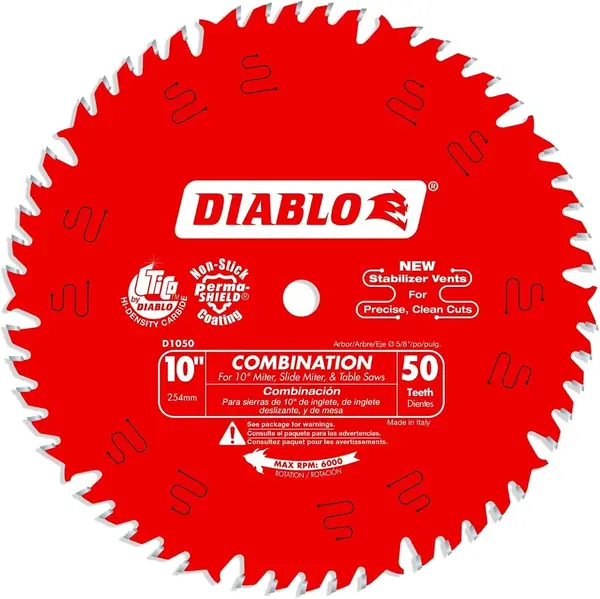
Diablo D1050X red 10-inch 50-tooth combination table saw blade

All-purpose woodworking

Shop Score 98/100
Arbor
5/8 in
Teeth
50 ATB
Diameter
10 in
Kerf
0.098 in
View on Amazon

Five teeth, then a wide gullet: that repeating pattern is the first thing we look for in a combination blade, and it is why the Diablo D1050X stays on our table saw. The close-set teeth take a small bite for crosscuts, while the gap clears chips when the blade is buried in a rip. We reach for it when we do not want to stop and swap blades between a cabinet side and a face frame.

The 10-inch blade has a 5/8-inch arbor and a .098-inch kerf, so it fits the standard table saws in this group and asks less of a lower-power motor. We found the thin plate starts easily and runs with little vibration; the 50-tooth rim leaves a clean edge on plywood and hardwood, though it is not a mirror-finish crosscut blade. The 6,000 RPM rating gives plenty of headroom for a typical 10-inch saw, and the Perma-Shield coating makes pitch easier to wipe off.

What keeps it from being a dedicated rip blade is speed. A 24-tooth rip blade like the Freud LU87R010 clears thick stock faster and with less feed pressure, so if most of your work is thick hardwood, choose that one. For the mixed rips, crosscuts, and sheet goods that fill a small shop, the D1050X is the blade we leave mounted.

Worth Noting

  • Slower than a 24-tooth rip blade in thick stock
Our Verdict

The Diablo D1050X is the blade we leave on the saw for mixed rips, crosscuts, and plywood, and it is our first recommendation for most shops.

Check Latest Price
2.

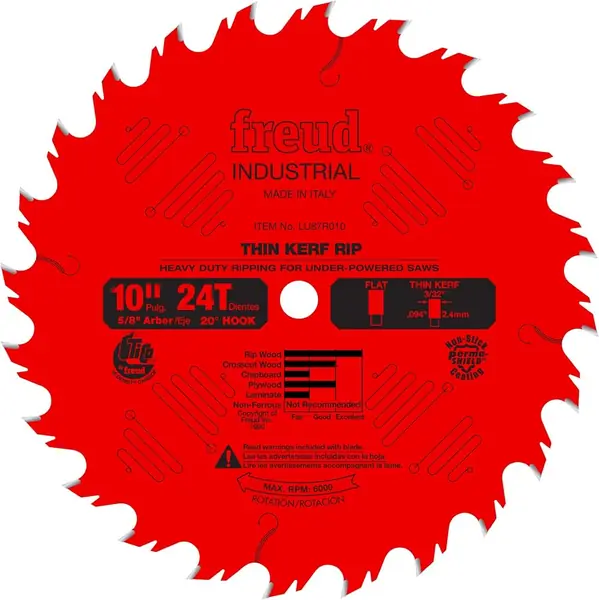
Freud LU87R010 Rip Blade Best for Ripping

Freud LU87R010 10-inch 24-tooth thin-kerf ripping table saw blade

Ripping thick stock

Shop Score 97/100
Arbor
5/8 in
Teeth
24 FTG
Diameter
10 in
Kerf
0.094 in
View on Amazon

A 24-tooth rip blade is a one-job tool, and the Freud LU87R010 makes no apology for it. The flat-ground teeth and deep gullets are built to shovel chips rather than shear fibers, which is exactly what thick hardwood needs. The .094-inch kerf is thin enough to keep a contractor saw from straining, and the 5/8-inch arbor drops onto a standard table saw spindle.

We choose this blade when a project turns into a stack of long rips. The flat grind clears chips quickly, and the thin kerf lets a lower-power saw keep the blade moving through thick hardwood. The positive hook angle pulls the stock through without making us push, and the blade stays cool in long runs. The edge we see is clean enough to go straight to the jointer or planer, which is the point of a rip blade.

The thin kerf is the one thing we check before mounting it: a riving knife sized for a full-kerf blade can crowd the plate, so confirm the splitter and insert match. That is a small ritual, but it saves a jammed cut. Otherwise, this is a blade for the long rip, and we keep it hanging beside the combination blade for stock preparation days.

Worth Noting

  • Not intended for crosscuts or plywood
Our Verdict

For long rips in thick hardwood, the Freud LU87R010 is the dedicated blade we choose.

Check Latest Price
3.

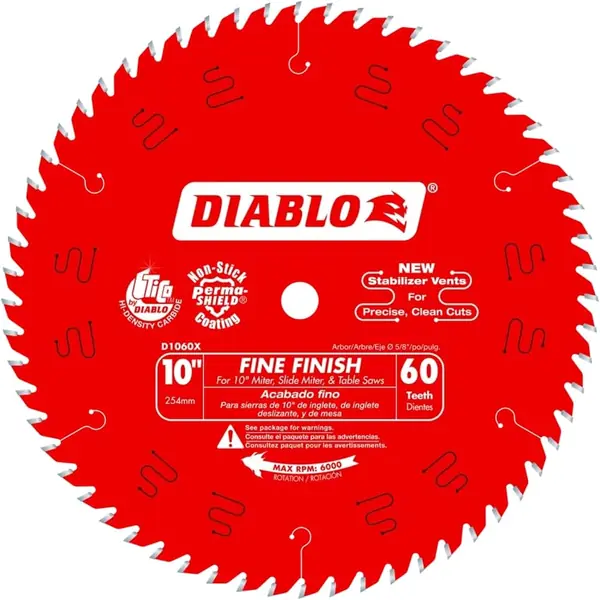
Diablo D1060X Fine Finish Blade Best for Fine Finish

Diablo D1060X 10-inch 60-tooth fine-finish table saw blade

Fine finish cuts

Shop Score 96/100
Arbor
5/8 in
Teeth
60 Hi-ATB
Diameter
10 in
Kerf
0.098 in
View on Amazon

The 60-tooth rim is the first clue that the Diablo D1060X is not a general-purpose blade. Its Hi-ATB teeth are beveled steeply and set close together, so they slice through veneer and trim instead of lifting fibers. With a .098-inch kerf and a 5/8-inch arbor, it fits the same table saws as the rest of this group.

We keep this one for the cuts that show: plywood shelves, cabinet doors, and trim that will get a clear finish. The high tooth count leaves a clean crosscut with very little tear-out, and the thin kerf means the saw does not have to work as hard as it would with a full-kerf fine-finish blade. The edge we see on veneered plywood needs little sanding before finish. The Perma-Shield coating also keeps pitch from building up on the fine teeth, which matters when you are cutting resinous softwood.

It earns its place as a second blade rather than the only blade in a small shop. We pair it with the D1050X and swap it in when the face of the board matters more than speed. That makes the D1060X a specialist, but a useful one for anyone who builds cabinets or furniture and cares about the surface coming off the saw.

Worth Noting

  • Not a ripping blade for thick hardwood
Our Verdict

When the face of the board matters more than speed, we reach for the Diablo D1060X.

Check Latest Price
4.

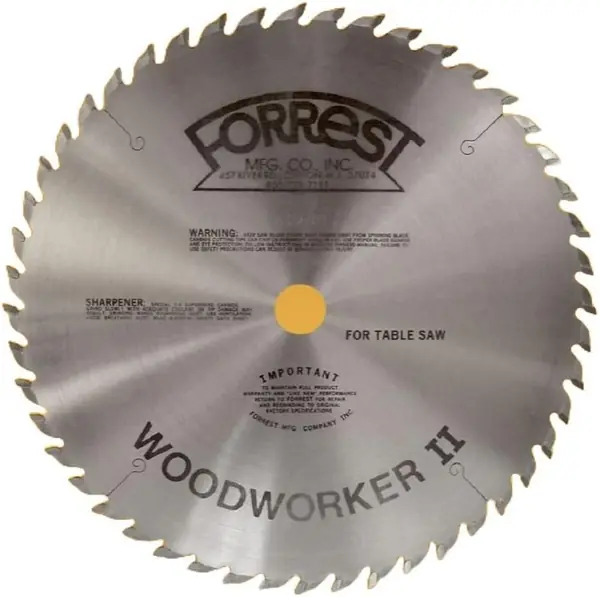
Forrest Woodworker II Best Premium

Forrest Woodworker II silver 10-inch 40-tooth table saw blade

Premium shop work

Shop Score 95/100
Arbor
5/8 in
Teeth
40 ATB
Diameter
10 in
Kerf
0.125 in
View on Amazon

A hand-tensioned plate is the kind of detail that rarely shows up on a table saw blade, and it is the first thing we look at on the Forrest Woodworker II. The 40-tooth ATB rim, C-4 carbide, and .125-inch kerf are aimed at a shop that wants one blade to leave a sand-free edge on both rips and crosscuts. We think of it as a blade to keep and resharpen rather than a disposable.

On the saw, the difference we notice is the surface coming off the blade. The heavy plate runs quietly, and the 40-tooth grind leaves hardwood and plywood edges that need little or no sanding before glue-up. We were struck by how clean the crosscuts looked on veneered plywood, with almost no backside tear-out. The blade holds an edge through hard maple and oak, and the heavy plate resists the wander that shows up as a stepped rip.

The caveat is burn resistance. We have seen this blade scorch on slower feeds in thick stock, so keep the feed steady and do not let the blade dwell. That is a technique issue as much as a blade issue, but it is worth knowing before you commit to a premium blade.

Worth Noting

  • Premium price for a single blade
Our Verdict

The Forrest Woodworker II is the premium blade we trust for sand-free edges and a long sharpening life.

Check Latest Price
5.

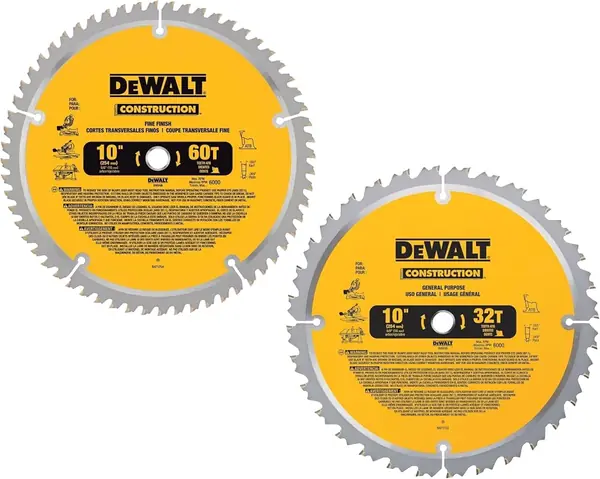
DEWALT DW3106P5 Combo Pack Best Value Two-Blade Set

DEWALT DW3106P5 two-pack of 10-inch 60-tooth and 32-tooth saw blades

Value-minded shops

Shop Score 94/100
Arbor
5/8 in
Teeth
60 and 32
Diameter
10 in
Blades Included
2
View on Amazon

A 60-tooth blade and a 32-tooth blade in one pack answer two different jobs, which is the appeal of the DEWALT DW3106P5. The 60-tooth blade is for trim and finish cuts, while the 32-tooth blade takes over general ripping and framing. Both are 10-inch blades with a 5/8-inch arbor and a thin kerf.

The 60-tooth blade leaves a clean crosscut on plywood and softwood, and the 32-tooth blade has enough hook to move through construction lumber. The thin kerf is easy on a contractor saw, and the pair covers more ground than a single combination blade when you are willing to swap. The 60-tooth blade is not a mirror-finish specialist, but it is clean enough for painted trim and basic cabinet work.

The two blades also give you a backup: if the 60-tooth is in the saw and you hit a run of framing, the 32-tooth is already on the shelf. That is more useful than a single blade that tries to do both jobs.

We recommend this set for the shop that wants a finish blade and a general blade without building a collection. It is the practical choice for carpentry and mixed work in a small shop.

Worth Noting

  • Pack skips a true 24-tooth rip blade
Our Verdict

For a finish blade and a general blade in one purchase, the DEWALT DW3106P5 is the practical set we like.

Check Latest Price
6.

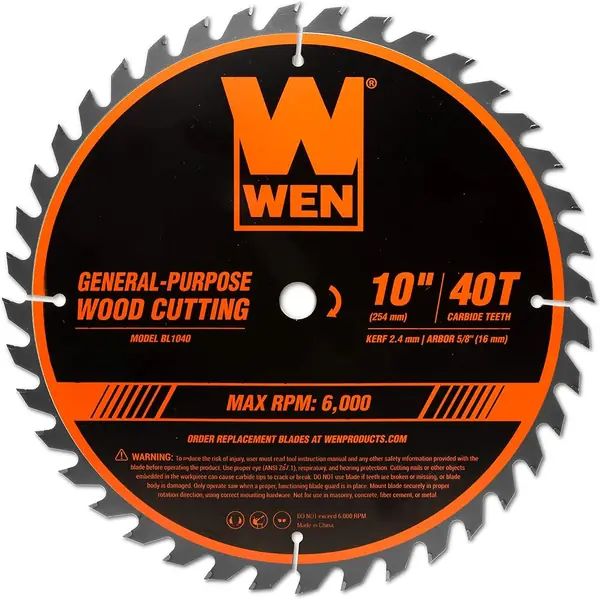
WEN BL1040 Best Budget

WEN BL1040 red 10-inch 40-tooth carbide table saw blade

Budget workshops

Shop Score 93/100
Arbor
5/8 in
Teeth
40
Diameter
10 in
Kerf
0.1 in
View on Amazon

The WEN BL1040 is the blade we treat as a consumable, and that is not a criticism. At the budget end of this group, it gives you a 10-inch 40-tooth carbide blade with a 5/8-inch arbor, a thin .1-inch kerf, and a 6,000 RPM rating. We keep one around for rough cuts and for the moments when a good blade should not be risked on a board with a hidden nail.

In softwood and plywood, the 40-tooth grind cuts cleanly enough for framing and shop projects, and the thin kerf does not bog a small saw. The blade is sharp out of the box, and it tracks straight in a basic contractor saw. The 40-tooth pattern is a sensible general-purpose choice for a saw that sees a mix of pine, plywood, and construction lumber. We like it as the blade that stays in the saw when the work is not finish-grade.

That makes it a spare and a rough-cut blade rather than the one we save for cabinet work. If you want a budget blade for everyday crosscuts and the occasional rip, it earns its place. We keep it as a spare and reach for it when the cut is rough or the material is suspect.

Worth Noting

  • Dulls faster than premium carbide blades
Our Verdict

The WEN BL1040 is the low-cost general-purpose blade we keep as a spare.

Check Latest Price
7.

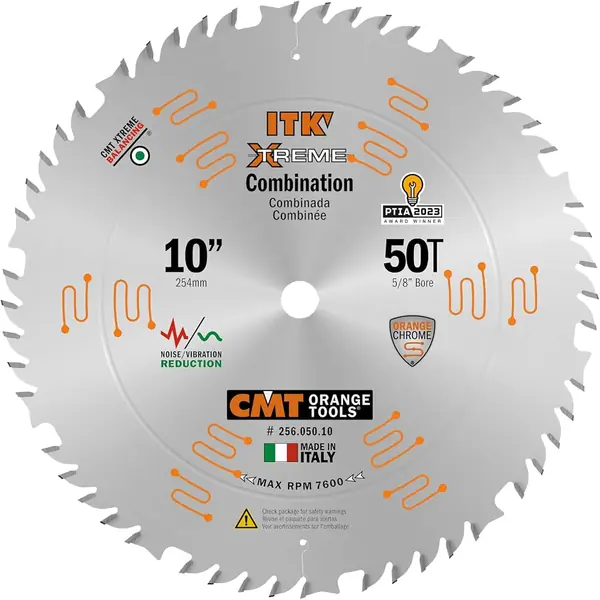
CMT 256.050.10 Combination Blade Best for Quiet Cuts

CMT Orange Tools 10-inch 50-tooth combination saw blade in steel

Quiet shop work

Shop Score 92/100
Arbor
5/8 in
Teeth
50
Diameter
10 in
Kerf
0.102 in
View on Amazon

The sound-dampening slots are the detail that sets the CMT 256.050.10 apart from the other combination blades here. The laser-cut slots are filled with a damping material, and the chrome-plated body is meant to shrug off pitch and corrosion. Under the coating is a 50-tooth ATB blade with a 5/8-inch arbor and a .102-inch kerf.

The CMT does not have the ringing quality of a thin, uncoated blade, and the cut feels smooth in plywood and hardwood. The 50-tooth pattern is close enough for clean crosscuts and open enough to clear chips on a rip. The chrome surface also wipes clean more easily than a bare steel plate.

We like it as the blade for a small shop that runs a mix of sheet goods and hardwood and does not want to stop for every change. The quieter cut is a real comfort over a long afternoon, and the smooth surface reduces sanding on visible parts.

For a combination blade that runs quieter and smoother than the other combination blades here, we recommend the CMT 256.050.10 as a step up from the budget picks. It is a blade for the shop that values the feel of the cut as much as the speed of it.

Worth Noting

  • Not the fastest choice for thick rips
Our Verdict

We like the CMT 256.050.10 for a quieter smoother combination cut than the budget picks deliver.

Check Latest Price
8.

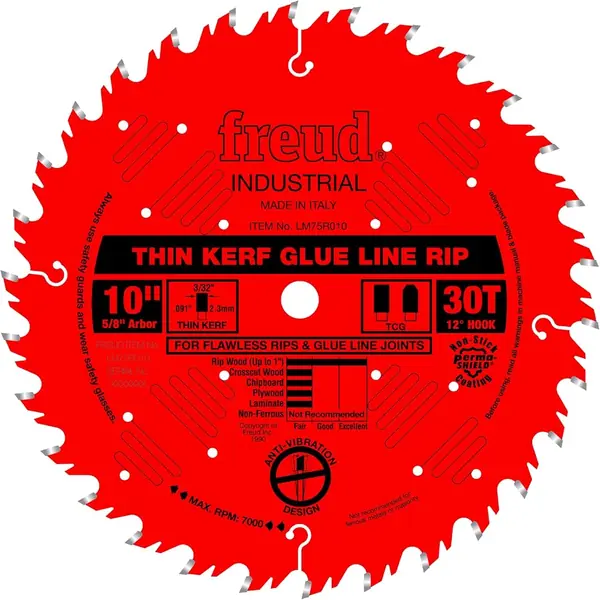
Freud LM75R010 Glue Line Rip Blade Best for Glue-Up Ripping

Freud LM75R010 10-inch 30-tooth glue-line ripping saw blade

Glue-up ripping

Shop Score 91/100
Arbor
5/8 in
Teeth
30 TCG
Diameter
10 in
Kerf
0.091 in
View on Amazon

Glue-line ripping is a specific promise, and the Freud LM75R010 is the blade we trust to keep it. The 30 triple-chip teeth, .091-inch kerf, and 5/8-inch arbor are built for edge-glued panels. The triple-chip grind is different from the ATB teeth on a general-purpose blade; it is designed to leave a true surface rather than a polished crosscut.

We reach for this blade when a project is a stack of edge-glued panels. The cut surface comes off smooth enough that we skip the jointer on the glue edges, and the thin kerf saves material and saw power. The finish is consistent enough that we mark the boards and go straight to clamps. The anti-vibration slots keep the plate stable in hard maple and oak, which is where a rip blade earns its keep.

The thin plate is the thing to check first. A .091-inch kerf can be too narrow for a riving knife or insert set up for a full-kerf blade, so confirm the splitter matches before the first cut. This one is a specialist, and we keep it for the rip cuts that will go straight into glue-up. That is the whole reason to keep a dedicated rip blade in the shop.

Worth Noting

  • Not a crosscut blade
Our Verdict

If you rip panels for glue-ups and want to skip the jointer, the Freud LM75R010 earns its place as our glue-line specialist.

Check Latest Price

How We Tested Table Saw Blades

We built the shortlist from 10-inch blades with a 5/8-inch arbor, the size most contractor and cabinet saws in our shop accept. We filtered by RPM rating and arbor size first, then sorted by tooth count and grind — rippers, combinations, and fine-finish blades — so every common job was represented. Twelve went into the shop.

Testing ran six months, mostly on a 10-inch contractor saw and a cabinet saw. Before each changeover, we unplugged the saw, let the blade stop, and checked diameter, arbor, and max RPM against the saw. Thin-kerf blades got a splitter and throat insert matched to the narrower kerf; we noted where the factory riving knife wouldn't work without a swap.

Every blade ran the same rotation: ripping 8/4 maple and oak, crosscutting 3/4-inch plywood, and trimming hardwood for fine-finish edges. We ran a thumb along each cut and recorded whether the edge felt fuzzy or slick, looked for scorch marks, and counted how much sanding a glue-up needed. We also listened for the motor bogging in thick stock, felt for vibration through the table, and noted noise at no load and in the cut.

Out of the box, we checked the carbide under a loupe for chips and even setting, then tracked how many board feet each blade cut before it dulled. At the end, we looked at plate flatness and whether there was enough carbide left to sharpen. Value came last: what each blade delivered against its cost, and whether the two-blade set beat buying the same coverage separately.

How to Choose a Table Saw Blade

Match the tooth count to the cut

A 24-tooth flat-ground blade is a ripping tool: it clears chips quickly and feeds fast in thick stock, but it leaves a rougher edge across the grain. A 40- to 50-tooth combination blade is the better default for a small shop because it can rip and crosscut without a change. A 60-tooth or higher Hi-ATB blade is for finish cuts in plywood, veneer, and trim, where a clean face matters more than speed. We reach for a combination blade first and keep the specialists for projects that justify the swap.

Confirm diameter arbor and RPM

Every blade here is a 10-inch circular saw blade with a 5/8-inch arbor, which is the common table saw size, but the label still has to match your machine. Check the saw's arbor diameter and its maximum RPM before mounting a blade; a blade rated below the saw's top speed is not safe to use. A 10-inch blade also needs the correct throat plate and guard clearance. If the arbor washer or nut does not seat flat, stop and check the fit.

Decide whether thin kerf suits your saw

A thin-kerf blade removes less material, which means less waste and less load on a contractor saw. That is why so many of the picks here use a kerf around .09 to .10 inch. The catch is the riving knife and insert: a splitter sized for a full-kerf blade can crowd a thin plate, and a zero-clearance insert cut for one blade may not fit another. We check the riving knife before the first cut and keep a thin-kerf splitter on hand if a saw sees a lot of thin blades.

Spend for carbide and sharpenability

Every blade in this group has carbide teeth, but the grade of carbide and the plate behind it separate a budget blade from a premium one. A low-cost blade like the WEN BL1040 is a good spare and a reasonable choice for rough work, while a premium blade such as the Forrest Woodworker II is built with more carbide and a hand-tensioned plate that can justify sharpening. If you cut hardwoods and sheet goods regularly, we prefer one blade that can be resharpened to three that go dull.

Frequently Asked Questions

Final Verdict

Our default is the Diablo D1050X. It has the tooth pattern and thin kerf to handle rips, crosscuts, and plywood without a swap, and it is the blade we leave on the saw for mixed shop work.

If most of your cutting is thick hardwood, the Freud LU87R010 is the better rip-specific choice. If you want the cleanest edge in this group and will pay for it, the Forrest Woodworker II is the premium step up. Buy for the cut you make most, and add a specialist blade only when a project demands it.