↑↓ navigate ↵ open Esc close All results →

Best Thin-Kerf Table Saw Blades of 2026

Underpowered contractor saws bog down fast behind a full-kerf blade, yet switching to a thin kerf trades plate stiffness for lower cutting resistance. The narrower bite stretches rough lumber and keeps motors spinning smoothly through thick stock, provided your riving knife matches the thinner kerf so cut boards cannot pinch and bind.

Nine months running 12 thin-kerf blades through thick oak and maple, trim crosscuts, plywood, and melamine showed how little packaging specs tell you on the saw. Stalling mid-rip on a modest motor comes down to kerf drag, tooth grind matched to the material, and whether the plate runs dead true at full RPM.

Plates that stayed dead true under load and paired cleanly with thin-kerf riving knives separated the dependable blades from the ones that wandered mid-rip.

Our Top Picks

The Best Thin-Kerf Table Saw Blades

1.

Diablo D1050X Combination Blade Best Overall
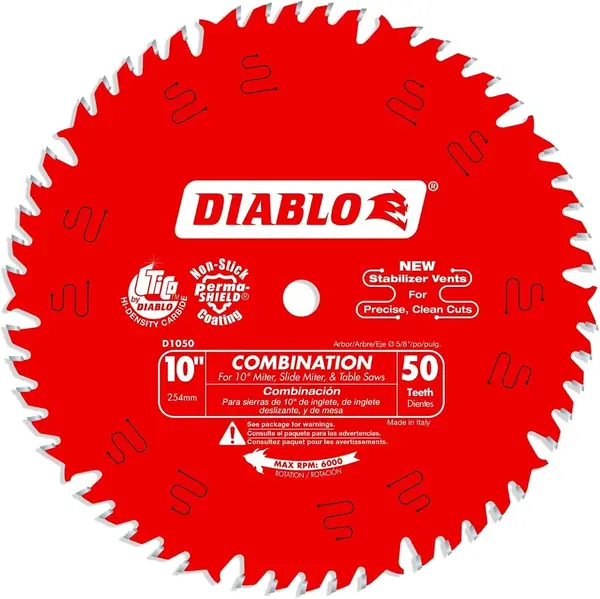
Diablo D1050X red 10-inch 50-tooth carbide table saw blade

One-blade shops

Shop Score 97/100
Teeth
50
Diameter
10 inches
Kerf
0.098 inch
Arbor
5/8 inch
View on Amazon

Most table saws live with one blade mounted, and the D1050X is the one we leave on ours. Its 50-tooth combination grind has enough hook and gullet room to rip a straight board and enough teeth to crosscut without a blade change. The 0.098-inch kerf is the other half of the appeal: it takes less wood and less motor effort than a standard 0.125-inch blade, so a contractor saw does not feel as strained.

The tooth grouping is what makes the compromise work. Five teeth cut in a close set for a smaller bite, then a large gullet clears the chips before the next group. We paid attention to that spacing because a combination blade that cannot clear waste will burn or bog down in a long rip. The 6,000 RPM rating is high enough for most 10-inch table saws, but check your saw's no-load speed before you mount it.

If your work is mostly thick ripping, the Freud LU87R010 is faster; if you want glass-smooth trim, the Freud LU88R010 is the better crosscut blade. But for mixed work, the D1050X's one-blade convenience is hard to beat. We like that it lets a small shop buy one good blade and spend the rest of the budget on lumber.

Worth Noting

  • Slower in thick rips and rougher on trim than specialty blades
Our Verdict

We recommend this as the default thin-kerf blade for a one-blade table saw because its 50-tooth grind rips and crosscuts well without a swap.

Check Latest Price
2.

Freud LU87R010 Rip Blade Best for Ripping

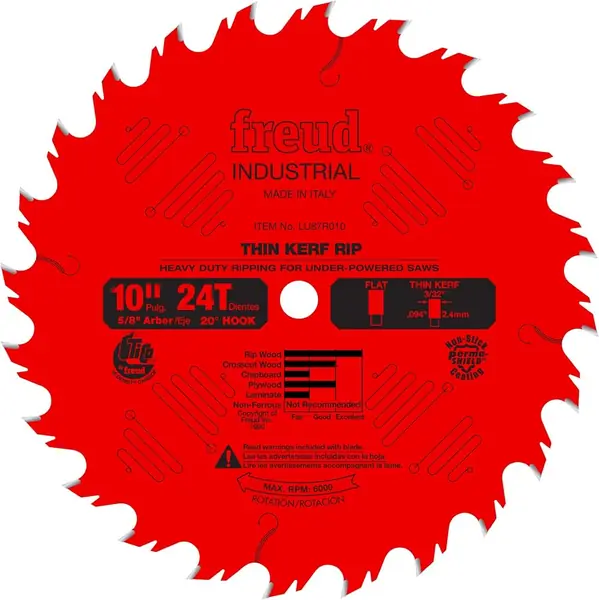
Freud LU87R010 silver 10-inch 24-tooth thin-kerf rip blade

Ripping thick stock

Shop Score 96/100
Teeth
24
Diameter
10 inches
Kerf
0.094 inch
Arbor
5/8 inch
View on Amazon

A thick board and a modest motor are a bad pair. The saw has to remove a lot of wood, the feed slows down, and the cut can burn before the board is halfway through. The LU87R010 is built for that fight: a 24-tooth flat-top grind, a 0.094-inch kerf, and a 20-degree hook angle that pulls the stock into the teeth.

We reach for this blade when the work is mostly ripping and the saw is not a 3-hp cabinet saw. The thin kerf asks less of the motor, and the coarse grind clears waste instead of rubbing it into the cut. It is a ripping tool, and a rip cut from this blade can come off the saw ready for edge jointing or glue-up with a light pass. The thin kerf also leaves a narrower strip of waste, which adds up when you are squaring a stack of boards.

The 24-tooth grind leaves a rougher crosscut than a 60-tooth blade, so keep it for rips and pair it with a crosscut blade for trim. What we like is the focus: it does one job without asking the saw to do more than it can.

Worth Noting

  • 24-tooth grind leaves rougher crosscuts than a dedicated crosscut blade
Our Verdict

We keep this rip blade for thick stock and low-horsepower saws, where its 24-tooth grind and 0.094-inch kerf cut fast.

Check Latest Price
3.

Freud LU88R010 Crosscut Blade Best for Crosscuts

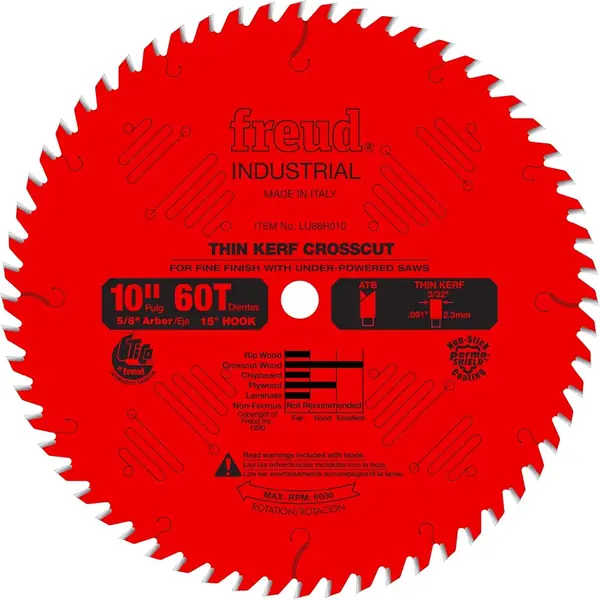
Freud LU88R010 10-inch 60-tooth carbide crosscut saw blade

Fine crosscuts

Shop Score 95/100
Teeth
60
Diameter
10 inches
Kerf
0.090 inch
Arbor
5/8 inch
View on Amazon

A crosscut blade earns its keep at the end of the cut, where a coarse tooth can blow out the far edge. The LU88R010 is aimed at that moment: 60 ATB teeth, a 0.090-inch kerf, and a grind that shears the wood fibers instead of tearing them. We choose it for trim, plywood, and miters where sanding is the enemy.

The thin kerf helps on a jobsite saw because it leaves less material for the motor to push through. The Perma-Shield coating is there to keep pitch from building up on the teeth, which matters when you are cutting resinous softwood or painted trim. We also like the clean edge it leaves on end grain, which is the hard test for a crosscut blade.

On a table saw, the 60-tooth grind is at its best in 1-inch and thinner stock, where the teeth can leave a polished edge without slowing the feed too much. The end grain comes off looking sanded, which is the reason we keep it on the saw for trim runs.

Worth Noting

  • Not intended for heavy ripping
Our Verdict

We choose this when crosscut finish matters most: its 60-tooth grind leaves trim and plywood edges clean.

Check Latest Price
4.

Diablo D1060X Fine Finish 2-Pack Best Fine-Finish Two-Pack

Two Diablo D1060X red 10-inch 60-tooth fine-finish blades

Finish trim work

Shop Score 94/100
Teeth
60
Diameter
10 inches
Kerf
0.098 inch
Pack
2 blades
View on Amazon

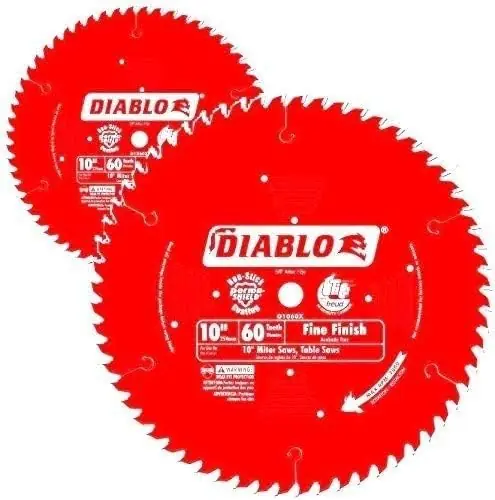
A two-pack of 60-tooth blades is a different purchase from one combination blade. The D1060X is built for trim, molding, plywood, and melamine, where the cut needs to be ready for finish rather than just close enough. The 0.098-inch kerf keeps it in thin-kerf territory, and the Hi-ATB grind is the tooth shape that limits tearout on the top and bottom edges. That is a different job from a general-purpose combination blade, and the tooth count reflects it.

We like this pack for the shop that does a lot of trim and hates stopping when a blade starts to dull. Two identical 60-tooth blades give you a fresh cutter without changing the setup or the finish you expect. The 5/8-inch arbor fits the common 10-inch table saw, and the 0.098-inch kerf is thin enough to be kind to a contractor saw.

If you need one blade for ripping and crosscutting, the D1050X is the better default. If your work is mostly trim and finish cuts, the second blade in this pack is not clutter; it is the spare that keeps a project moving when the first one starts burning.

Worth Noting

  • Higher upfront cost than a single blade
Our Verdict

We like this two-pack for finish carpenters who want a clean 60-tooth cut and a spare blade on the shelf.

Check Latest Price
5.

CMT 256.050.10 Combination Blade Best for Quiet Cuts

CMT Orange Tools 10-inch 50-tooth carbide combination saw blade

Quiet general cutting

Shop Score 93/100
Teeth
50
Diameter
10 inches
Kerf
0.102 inch
Arbor
5/8 inch
View on Amazon

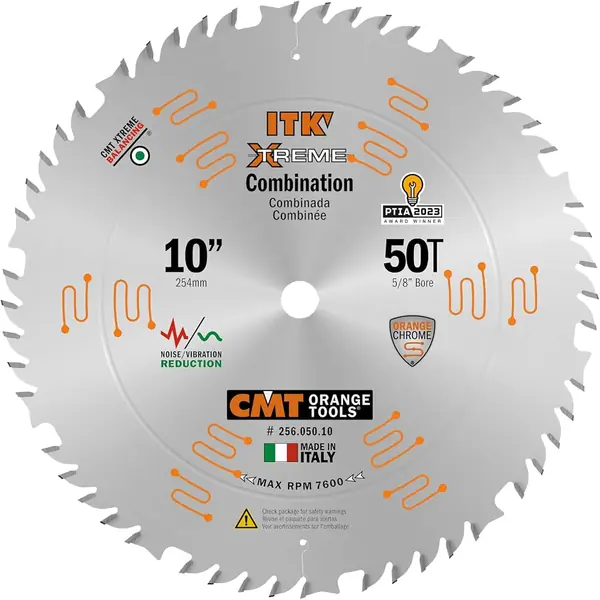
The CMT's kerf measures 0.102 inch, a hair wider than the 0.090–0.098-inch blades here. It is still a thin-kerf blade, and it removes far less stock than a standard 0.125-inch blade, but it does not save quite as much. If you are squeezing every board foot out of expensive hardwood, that difference is worth knowing.

The 50-tooth grind is a combination layout: four ATB teeth and a flat raker, which lets it crosscut cleanly and still handle moderate rips. The blade body is hardened and slotted, and the tensioning ring is designed to keep it stable and quiet in the cut. We appreciate that on a contractor saw, where vibration can show up as a rough edge or a louder cut.

We recommend the CMT when you want a step-up combination blade and value a smooth, quiet cut over the absolute thinnest kerf. It is not the cheapest blade here, but it is a pleasant one to run, and the finish it leaves on hardwood is worth the step up.

Worth Noting

  • 0.102-inch kerf removes slightly more wood than thinner blades
  • Priced above the budget thin-kerf options in this group
Our Verdict

We recommend this combination blade when you want smooth, quiet cuts and can accept a kerf a little wider than the thinnest here.

Check Latest Price
6.

WEN BL1040 Saw Blade Best Budget

WEN BL1040 red 10-inch 40-tooth carbide woodworking saw blade

Budget occasional cuts

Shop Score 92/100
Teeth
40
Diameter
10 inches
Kerf
0.1 inch
Arbor
5/8 inch
View on Amazon

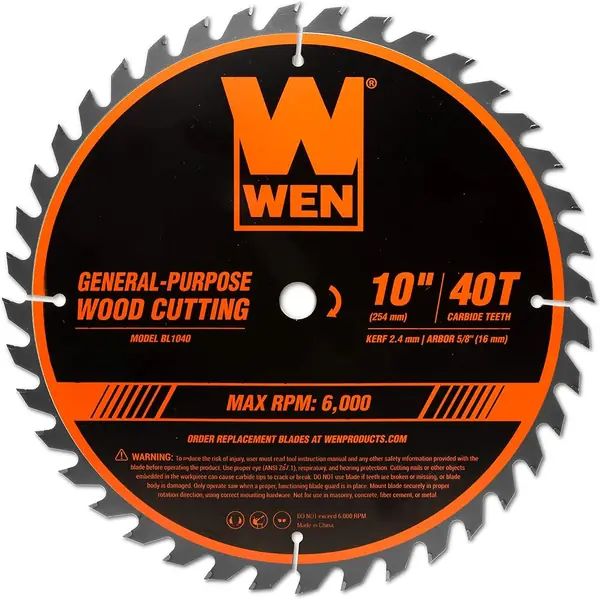
The BL1040 is the least expensive blade in this group, and it makes no secret of that. The 40-tooth carbide grind and 0.1-inch kerf are a general-purpose recipe: enough teeth for crosscuts, enough gullet for light ripping, and a thin enough body to keep a small saw from working too hard.

The 5/8-inch arbor and 6,000 RPM rating cover most 10-inch table saws, and the blade is light enough that it does not feel like a heavy shop blade on a jobsite saw. The 40-tooth count is also more forgiving of a slightly misaligned fence than an 80-tooth trim blade, which is useful on a jobsite. It will not match a premium blade on finish, but for framing, shelving, and shop jigs, it cuts cleanly enough to keep going.

We recommend it for the DIYer who needs a spare blade, a first blade, or a blade for lumber that might have a nail in it. The low outlay is the point: you can keep one on the shelf without treating it like a precious finish tool.

Worth Noting

  • Edge life trails premium blades in hardwood
Our Verdict

We point budget shoppers to this 40-tooth blade for occasional rips and crosscuts on a small table saw.

Check Latest Price
7.

Luckyway 80T 2-Pack

Luckyway two-pack of 10-inch 80-tooth carbide saw blades

Rough trim duty

Shop Score 91/100
Teeth
80
Diameter
10 inches
Arbor
5/8 inch
Pack
2 blades
View on Amazon

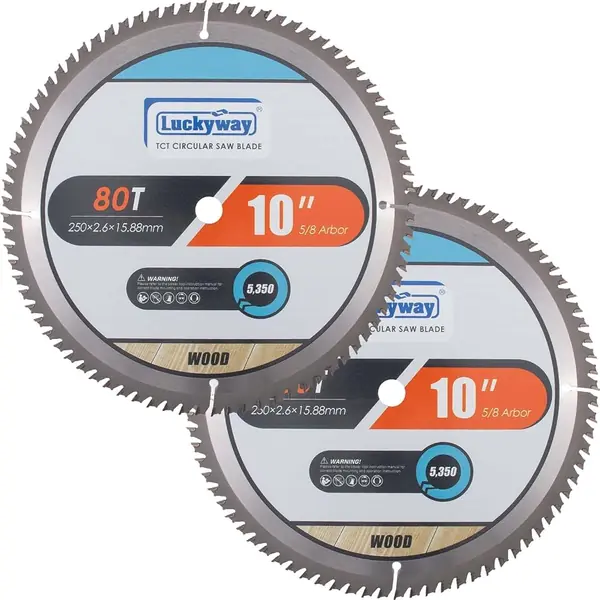
An 80-tooth blade is a trim tool, not a ripping blade. The Luckyway pair is aimed at crosscuts in trim, laminate, and plywood, where a high tooth count can leave a cleaner edge than a 40- or 50-tooth general-purpose blade. The 10-inch diameter and 5/8-inch arbor fit the common table saw, and the two-pack means you have a spare before the first blade dulls.

The appeal is simple: two 80-tooth blades for less than many single premium blades. The carbide tips are sharp enough for trim work, and the high tooth count is the right shape for melamine and finish plywood. We see it as a budget two-pack for trim and backup work.

The 80-tooth grind is slow in thick stock, so treat it as a crosscut and trim blade; for ripping, keep a 24-tooth blade on the shelf. That is not a flaw in a blade this cheap, but it is the reason it should not be your only blade.

We recommend it for the shop that wants a spare fine-cut blade for trim and does not want to spend much. Keep it for the jobs where a chipped edge means rework, and use a rip blade for the heavy stock.

Worth Noting

  • Edge life is short in hardwoods
  • Published kerf figures conflict
Our Verdict

We see this as a cheap two-pack for rough trim and backup work, not for a production shop.

Check Latest Price

How We Tested the Best Thin Kerf Table Saw Blades

We started by pulling every thin kerf blade we could find in the sizes that fit the saws most home shops run, then filtered on the things that rule a blade out before you ever spin it: listed kerf, tooth count and grind, marked maximum RPM, and price per blade in multi-packs. That left 12 blades, which we ran for nine months on the same contractor saw. Before each one went on, we checked the saw's no-load speed against the blade's marked maximum and swapped in a riving knife sized for the thinner cut.

Most of the testing happened in a garage shop on a Saturday-morning schedule: ripping thick oak and maple, crosscutting trim, and breaking down plywood and melamine. Every blade made the same three cuts straight out of the package so the comparisons stayed like for like; we noted whether the motor bogged or the cut burned on long rips, ran a fingernail along the exit side of each crosscut to feel for tearout, and counted how much sanding the finish actually needed. Calipers went to the first cuts to confirm the kerf matched the label, and we tallied stock saved against a full-kerf blade on the same boards.

Edge life got the longest look: we logged how many linear feet each blade cut before it started burning or needed extra feed pressure, then weighed that against the price of sharpening. We measured noise at the operator's ear and watched for vibration through the table on every start-up. Every cut was made with the blade guard, riving knife, and push sticks in place — a thin kerf saves stock, not fingers — and each blade was judged on what it cut, not what the label promised.

How to Choose a Thin-Kerf Table Saw Blade

Start With the Cut You Make Most

Tooth count is the first decision, not the brand. A 24-tooth rip blade clears waste and feeds fast in thick stock; a 50-tooth combination blade is the usual one-blade compromise; a 60-tooth crosscut blade is for trim and plywood; an 80-tooth and up blade is for the finest crosscuts. We do not treat a 90-tooth blade as a general-purpose choice.

If most of your work is ripping, pair the Freud LU87R010 with a crosscut blade. If you want one blade, the Diablo D1050X is our default. The mistake is buying a high-tooth-count blade for thick hardwood and then blaming the saw when the feed slows.

Check Kerf, Arbor, and RPM Before You Buy

The thin-kerf label is not a specification. Look for the actual kerf, usually between 0.071 and 0.102 inch here, and compare it with your riving knife and insert. A 5/8-inch arbor is the common U.S. size, but 1-inch and 20 mm arbors exist in other markets. Check the blade's maximum RPM against the saw's no-load speed; a blade rated below the saw's speed is not safe to mount. The CMT's 0.102-inch kerf is still thin, but it is the widest in this group.

Decide How Many Blades You Want to Own

One good combination blade is simpler and cheaper than a rack of specialists, but it is always a compromise. A two-blade shop, a 24-tooth rip blade and a 60-tooth crosscut blade, cuts faster and cleaner in each mode. A two-pack of finish blades, like the Diablo D1060X, makes sense for trim carpenters who dull blades on the same work. The budget WEN BL1040 is the blade we keep for lumber that might have a nail in it.

Expect Less Stock Loss but More Care

A thin kerf saves wood and motor load, but the blade plate is also less stiff. It can deflect if you force a cut or if the fence is out of alignment. Use a thin-kerf riving knife, keep the blade sharp, and let the teeth cut at their own pace. A zero-clearance insert helps with tearout on plywood, but it is not a substitute for a straight fence. We check alignment before we blame the blade.

Frequently Asked Questions

Final Verdict

For most table saw owners, we recommend the Diablo D1050X. Its 50-tooth combination grind and 0.098-inch kerf make it the best one-blade compromise here: it rips and crosscuts without a swap, and it leaves a finish that is good enough for most furniture and shop projects. If your work is mostly thick ripping, the Freud LU87R010 is the better companion; if clean crosscuts are the priority, the Freud LU88R010 is the blade we choose. The WEN BL1040 is the budget spare for occasional work.