↑↓ navigate ↵ open Esc close All results →

Best 10-Inch Miter Saw Blades of 2026

A factory blade leaves a chipped, feathery edge the first time it meets oak casing, even after chewing through two-by-four framing stock all morning. The saw is rarely at fault; clean crosscuts require matching tooth count, grind geometry, and kerf width to the material on the fence.

Running 14 ten-inch blades through trim, sheet goods, and treated lumber over eight months separated initial sharpness from real edge life. One blade that sliced pine cleanly began fuzzing out in hard maple, while another felt sharp out of the package and started dragging by its twentieth crosscut—proof that tooth grind matters just as much as tooth count.

The strongest performers range from dedicated fine-finish blades for visible miter joints to economical two-packs suited for rough cuts and shop spares, measured by cost per clean cut rather than sticker price.

Our Top Picks

The Best 10-Inch Miter Saw Blades

1.

Diablo D1060X 10-Inch Fine Finish Blade Best Overall
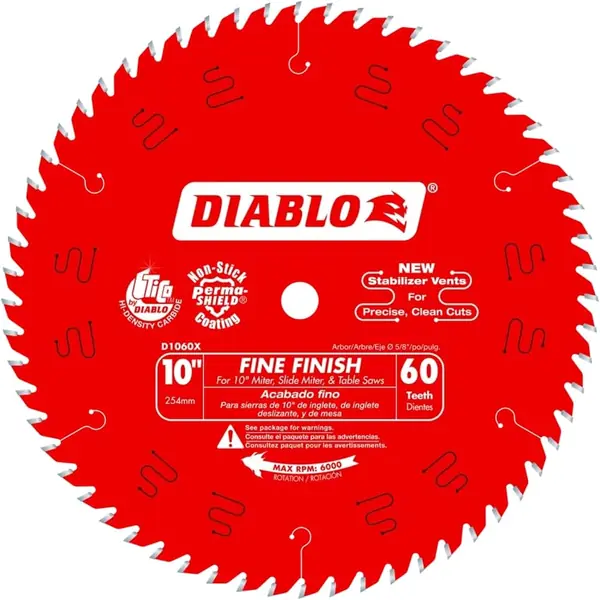
Diablo D1060X 10-inch 60-tooth fine finish saw blade with red Perma-SHIELD coating

Finish trim crosscuts

Shop Score 98/100
Teeth
60 Hi-ATB
Diameter
10 inches
Arbor
5/8 inch
Kerf
.098 inch
View on Amazon

Sixty Hi-ATB teeth in a .098-inch kerf is the combination that decides most miter saw work, and it is why this blade sits at the top of our list. The high alternate top bevel shears fibers ahead of the tooth rather than lifting them, so crosscuts in oak and maple come off the saw looking sanded. On prefinished trim, where a chipped edge cannot be sanded back, that geometry is the difference between an install and a do-over.

The thin kerf earns its place on saws that are not monsters. Narrowing the cut takes load off the motor, and a computer-balanced plate keeps vibration out of the cut, which is where a wobbly blade's tearout actually comes from. We paid close attention to the coating: Perma-SHIELD sheds pitch, so the teeth keep cutting instead of gumming up halfway through a run of pine casing.

Against the 80- and 90-tooth blades here, 60 teeth is the more forgiving count. It crosscuts cleanly without demanding a slow, deliberate feed, and it is less likely to scorch cherry or maple when you pause mid-cut — a real risk with a very fine grind on a saw that is not perfectly tuned. That balance is what we keep coming back to.

Worth Noting

  • 60-tooth grind makes thick rips slow going
Our Verdict

Sixty Hi-ATB teeth on a thin kerf leave trim, casing, and end grain clean enough to finish without sanding, and that is the job most miter saw work asks for.

Check Latest Price
2.

Makita A-93681 10-Inch 80-Tooth Miter Saw Blade Best for Ultra-Fine Trim Cuts

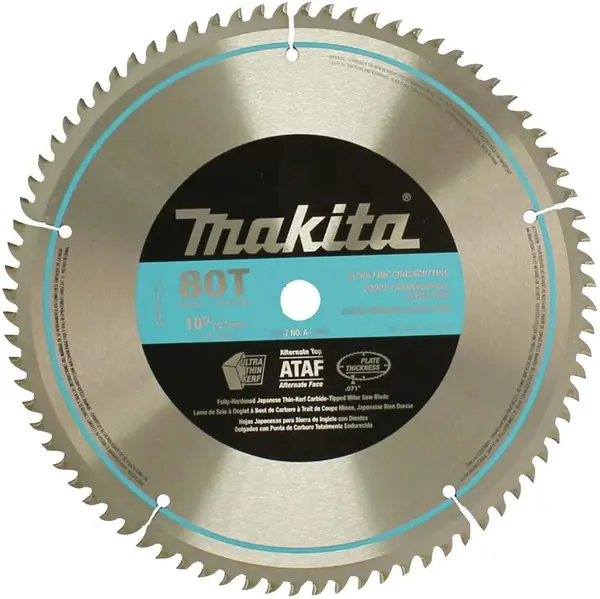
Makita A-93681 10-inch 80-tooth micro-polished miter saw blade in silver

Fine trim work

Shop Score 97/100
Teeth
80 ATAF
Diameter
10 inches
Kerf
Japanese ultra-thin
Tooth Grind
ATAF (alternate top and alternate face)
View on Amazon

Prefinished baseboard, laminate plank, and picture-frame miters are the jobs where a blade either saves you a sanding block or sends you back for another length of trim. The A-93681 is aimed squarely at that work: 80 micro-grain carbide teeth in Makita's ATAF grind — alternate top, alternate face — honed to a mirror finish and set in a Japanese-style ultra-thin kerf.

We think it takes the cleanest edge of anything here on factory-finished material. The ATAF geometry slices across the grain rather than chipping through it, and 80 teeth leave a surface you can install without touching up. It also rewards a light hand: thin kerf, fine teeth, and a fully hardened, hand-tensioned plate that runs true when the arbor is clean.

Where it stops being the right choice is on a battery saw or any miter saw that already struggles in hardwood — 80 teeth need torque, and forcing the feed heats the plate and burns the cut. On a corded slider that is a non-issue. On a small jobsite saw, use one of the 60-tooth blades here instead and save this one for trim day.

Worth Noting

  • Demands high torque on battery or smaller jobsite saws
  • Forcing the feed heats the plate and burns cuts
Our Verdict

For prefinished trim, laminate, and picture-frame miters, we have not seen a cleaner edge in this group than this 80-tooth ATAF grind leaves.

Check Latest Price
3.

Freud LU88R010 Thin Kerf Crosscut Blade Best for Lower-Power Saws

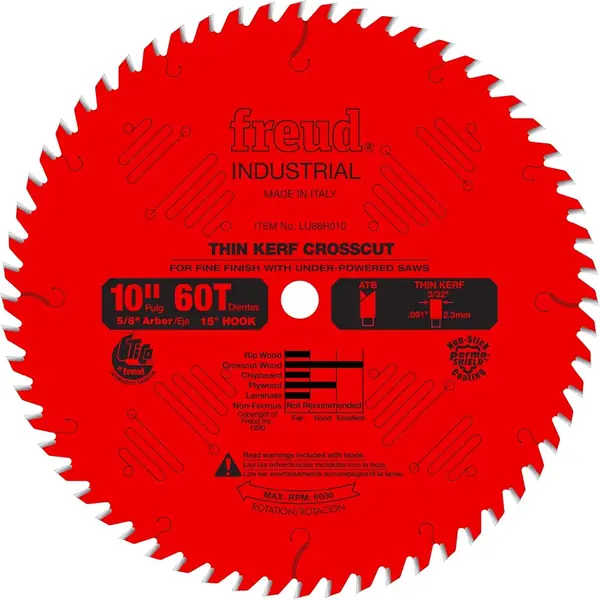
Freud LU88R010 10-inch 60-tooth thin kerf crosscut blade with Perma-SHIELD coating

Underpowered saws

Shop Score 96/100
Teeth
60 ATB
Diameter
10 inches
Arbor
5/8 inch
Kerf
.090 inch
View on Amazon

The pitch is simple: this blade takes a .090-inch bite instead of .098, and Freud pairs a 60-tooth ATB grind with 15 degrees of hook so the cut feeds itself rather than being pushed through. That is why we like it on a saw that feels short of power — an older miter saw, a contractor saw on a long extension cord, anything that sags in hard maple. It gives back the cutting speed a full-kerf blade took away.

Finish does not suffer for it. Crosscuts in oak and oak plywood come off clean, the Perma-Shield coating keeps pitch from welding itself to the teeth, and the plate is flat enough that you are not fighting vibration in the cut. Against the Diablo D1060X, that blade's Hi-ATB grind still takes the cleaner end grain; the Freud is the nimbler of the two when the motor is the limiting factor.

The coating does real work in treated lumber, where moisture and pitch both attack a blade, and the carbide is heavy enough to take a resharpening rather than a trip to the bin. That is why the Freud stays bolted to the saw that lives in the truck.

Worth Noting

  • Thin plate can deflect under a forced feed
Our Verdict

We point anyone whose saw sags in hardwood toward this one: the .090-inch kerf and 15-degree hook give back cutting speed without a ragged edge.

Check Latest Price
4.

DEWALT DW3106P5 10-Inch Blade Combo Pack Best Two-Blade Starter Set

DEWALT DW3106P5 two-blade pack with 60-tooth fine finish and 32-tooth general purpose blades

Framing and trim

Shop Score 95/100
Teeth
60 and 32
Diameter
10 inches
Arbor
5/8 inch
View on Amazon

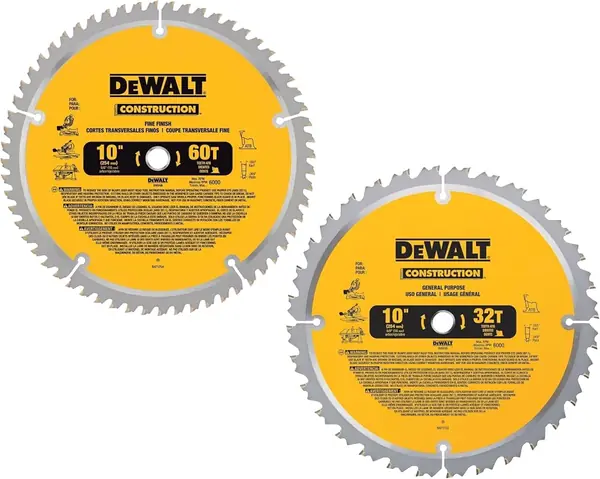
Two blades in one pack is not a marketing gesture here; the two grinds do genuinely different work. The 60-tooth is a fine-finish blade for trim, casing, and plywood, and the 32-tooth is a general-purpose cutter for framing stock and anything that will be painted or hidden.

Both are thin-kerf, both carry the standard 5/8-inch arbor for a 10-inch miter or table saw, and the plate is computer-balanced to cut vibration, which matters more on a jobsite saw sitting on a folding stand than on a cast-iron cabinet saw. A wedge of steel behind every tip backs up the carbide where the impact happens.

The 32-tooth is the one that surprises people. It leaves a rougher edge, as a 32-tooth should, but it cuts fast and does not complain about pressure-treated lumber or a stack of two-by stock. Keep it for the framing and the deck, and swap to the 60 for anything you will look at.

Where the pair wins for us is as a first purchase: one blade on the saw, one on the shelf, no gap in coverage. It is the set we point a first-time miter saw buyer to, because it answers the two questions that actually come up — what do I crosscut with, and what do I break stock down with.

Worth Noting

  • 60-tooth blade trails the dedicated finish blades
Our Verdict

Two blades, one box: a 60-tooth that handles trim and a 32-tooth that handles framing, and we think that covers a first miter saw completely.

Check Latest Price
5.

Luckyway 10-Inch 32T and 60T Blade Set Best Budget Pair

Luckyway two-pack of 10-inch carbide-tipped saw blades with 32 and 60 teeth

Budget and spares

Shop Score 94/100
Teeth
32 and 60
Diameter
10 inches
Arbor
5/8 inch
Tooth Design
ATB (alternate top bevel)
View on Amazon

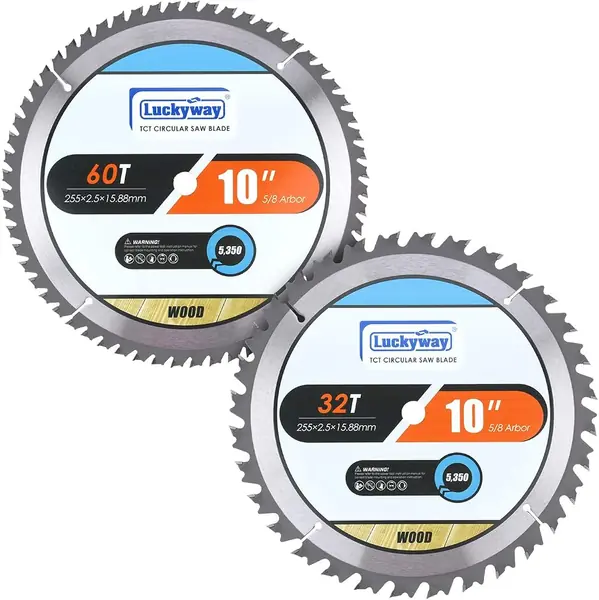
The arbor hole is the first thing to check on an inexpensive blade, and this one fits tight with no slop on the spindle — a small thing that decides whether a cheap blade cuts clean or shakes. Both blades are ATB, carbide-tipped, and built on a fully hardened plate that resists bending when a cut starts to go crooked.

You get a 32-tooth and a 60-tooth, both on the 5/8-inch arbor for a miter or table saw. The 60 does trim and floor planks cleanly enough to install; the 32 rips two-inch oak without complaint. For a home shop doing a mix of both, that is the whole job covered.

We treat this pair as the set that lives in the truck: sharp out of the box, honest enough for real work, and inexpensive enough that hitting a nail is an inconvenience rather than a loss. For occasional trim and a weekend of deck boards, that is the right calculation to make.

Worth Noting

  • Edges dull faster than premium blades
Our Verdict

We treat this pair as the truck set: sharp out of the box, two grinds for trim and framing, and inexpensive enough that a hidden nail is not a disaster.

Check Latest Price
6.

Diablo D1090X Ultimate Polished Finish Blade Best for Picture-Frame Miters

Diablo D1090X 10-inch 90-tooth polished finish saw blade with red coating

Picture-frame miters

Shop Score 93/100
Teeth
90 ASFG
Diameter
10 inches
Arbor
5/8 inch
Kerf
.087 inch
View on Amazon

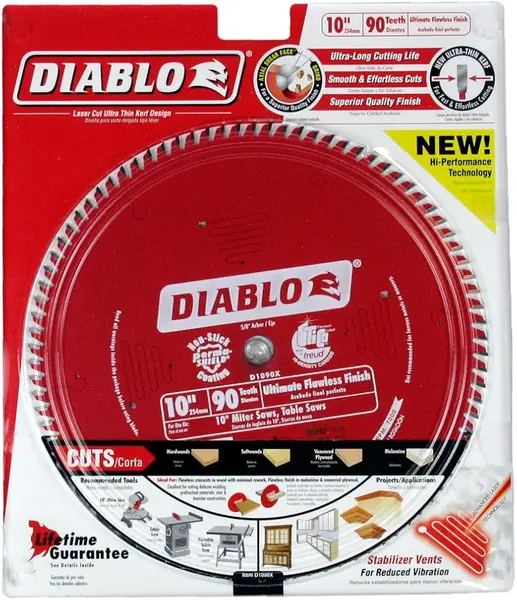
Ninety teeth is a lot of carbide to bolt to a miter saw, and it buys one thing: an edge that goes straight to finish. Alternate top bevel with a shear-face grind is the geometry Diablo builds for the last step before glue-up, and it shows in the way a miter comes off the saw.

We reach for this one when the edge will be seen and never sanded. The axial shear-face grind slices rather than scrapes, and the surface it leaves is closer to 220-grit than to a saw cut, which is the whole point of paying for 90 teeth. It is also the blade that made us stop assuming a miter saw cannot produce a glue-ready joint.

It asks for a true-running saw and an unhurried feed; 90 fine teeth heat up if you rush them, and a hot blade will burn cherry and maple. Diablo files it under circular saws, but it is a standard 10-inch, 5/8-inch-arbor blade rated to 6000 RPM, so any miter saw running below that speed is fair game.

Worth Noting

  • Premium price for a single-purpose blade
Our Verdict

We reach for the 90-tooth Diablo when an edge has to be finished off the saw — picture-frame miters, laminate, and veneered panels.

Check Latest Price
7.

CMT 256.050.10 Combination Blade Best for Ripping and Crosscutting

CMT Orange Tools 256.050.10 10-inch 50-tooth combination blade with chrome-plated body

Ripping and crosscutting

Shop Score 92/100
Teeth
50
Weight
1.7 lb
Blade Specification
D=10 B=5/8 ß=4 ATB 15 + 1 FLAT K=0.102 P=0.071 a=15
View on Amazon

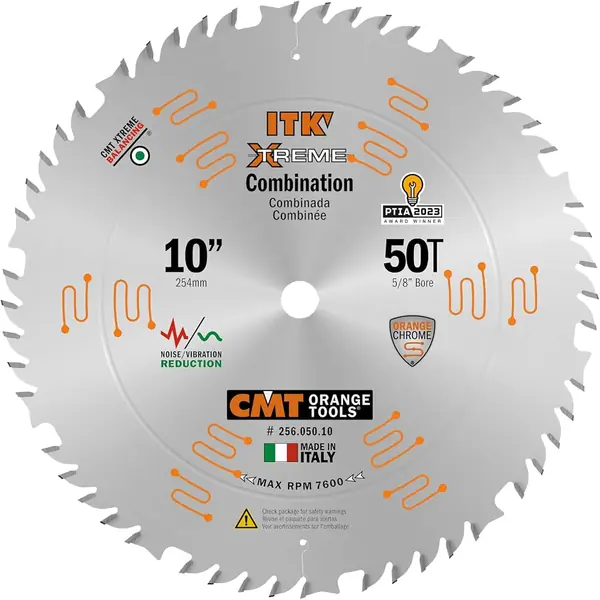
Quiet is not a word that comes up much with saw blades, and it is the first thing we noticed here. The laser-cut slots in the plate are filled with sound-dampening material, and the difference is obvious next to an uncoated blade of the same size — the saw sounds like it is working less.

The rest of the build is unusually thorough: German harmonic steel hardened to 46-48 Rockwell, a visible tensioning ring that keeps the body stable in the cut, expansion slots for heat, and a chrome-plated face that sheds pitch and resists rust.

The 50-tooth ATB grind with a flat raker is a real combination design, so it rips and crosscuts both. Crosscuts in veneered plywood come off clean, and rips in two-inch hardwood go through without the blade bogging or the motor loading up.

We like it as the one blade a small shop leaves mounted — it handles both directions of cut and runs smoother than its price suggests. What it is not is a dedicated finish blade: for melamine, prefinished trim, or a miter that has to be perfect off the saw, the 80- and 90-tooth blades here are the ones to own.

Worth Noting

  • Wider .102-inch kerf wastes more material
Our Verdict

Our pick for a shop that wants one blade mounted for both rips and crosscuts, and the quietest, steadiest cutter in this group.

Check Latest Price
8.

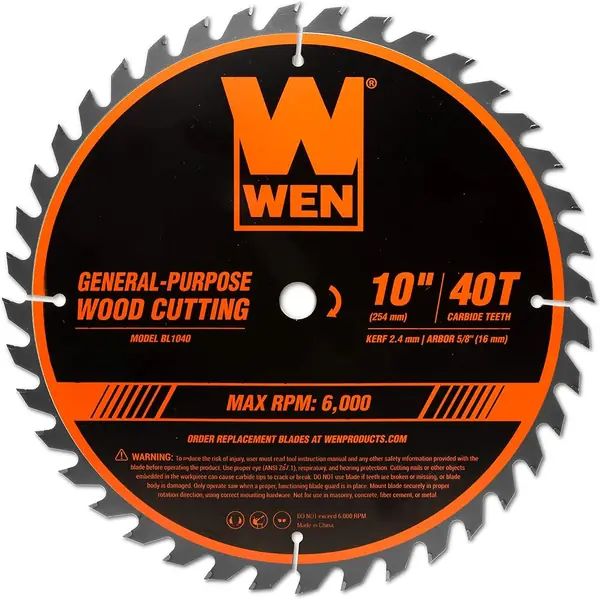
WEN BL1040 10-Inch 40-Tooth Blade

WEN BL1040 10-inch 40-tooth carbide-tipped woodworking saw blade with red coating

Rough carpentry

Shop Score 91/100
Teeth
40
Diameter
10 inches
Arbor
5/8 inch
Max Speed
6000 RPM
View on Amazon

This is the least expensive blade in the group, and it does not pretend to be anything else. A 40-tooth ATB grind, a 5/8-inch arbor, a 6000 RPM rating, and a 1/10-inch kerf add up to a general-purpose cutter rather than a finish blade.

In pine, plywood, and painted trim it cuts fast and clean, and the thin kerf keeps a small saw from bogging. It fits the majority of 10-inch miter saws, jobsite saws, and table saws, which is the whole appeal of keeping one on the shelf as a second blade.

We keep one for stock that might have a staple or a hidden nail in it, and for framing cuts where the edge gets caulked, painted, or covered. It is not the blade for prefinished trim, melamine, or a miter that shows — at 40 teeth it leaves a cut that needs sanding, and that is the honest boundary of what this one is for.

Worth Noting

  • Goes dull quickly in hardwood
Our Verdict

We keep this one for framing lumber, painted trim, and boards that might hide a staple — sharp, inexpensive, and no heartbreak if you ruin it.

Check Latest Price

How We Tested 10-Inch Miter Saw Blades

We built the shortlist from manufacturer specs and retailer listings, filtering first for 10-inch diameter and a 5/8-inch arbor so every blade would mount on the saws in our shop, then by tooth count and grind until we had 14 blades covering fine trim, combination work, and framing. Before anything went on a saw, we checked each blade's maximum RPM rating against that saw's no-load speed; a blade rated below the saw never got mounted.

Testing ran eight months, mostly during a kitchen trim-out and a deck build, so the blades were doing real work on a deadline. We crosscut oak and poplar casing, then looked at each cut edge under a raking light and ran a fingernail across the end grain to feel tearout; we counted chip-out along the back edge and sanded with 220-grit until the edge was smooth, counting passes.

Combination blades got a ripping session in treated two-by-four, where we watched feed pressure and listened for bogging — the thin-kerf blades were noticeably easier on a lower-power saw. We also spun each blade up and watched the teeth against a reference mark for wobble, then checked plate flatness on a granite slab and listened for resonance in the cut.

For durability, we kept a stack of hard maple and treated offcuts and tallied cuts until a blade needed noticeably more push or started burnishing the wood, then priced out resharpening against replacement. Any blade that chipped or lost a tooth came off the saw and stayed off; we didn't keep cutting with it to see what happened.

How to Choose a 10-Inch Miter Saw Blade

Start With the Tooth Count

A 40-tooth blade is a general-purpose cutter: it crosscuts fast, rips in a pinch, and leaves an edge you will sand. Sixty teeth is the trim and finish count — clean enough for casing and stain-grade stock without demanding a glacial feed. Eighty and 90 teeth are for the last few percent: prefinished trim, melamine, laminate, and miters that come off the saw and go straight to glue-up.

The trap is buying the highest count you can find. Fine teeth need feed speed and motor torque, and a 90-tooth blade pushed through two-inch maple burns and dulls. If most of your cutting is dimensional lumber, a 60-tooth is the better blade, not a compromise.

Know What the Grind Is Doing

ATB, or alternate top bevel, is the standard woodworking grind: the teeth score the surface ahead of the cut and lift the chip away. Hi-ATB sharpens that bevel angle for cleaner edges in veneered plywood and melamine, which is why the fine-finish blades here use it. A combination grind adds a flat raker tooth every few teeth, which makes ripping possible at the cost of some finish.

Buy for the material you actually cut. Hi-ATB for prefinished stock and sheet goods, a standard ATB crosscut grind for solid-wood trim, and a combination blade only if you want one blade doing rip and crosscut duty and can live with the middle ground.

Thin Kerf Is Free Power, Not Free

A thin-kerf blade removes less wood, which means less drag on the motor, a faster feed, and less waste. On a 10-inch miter saw with a modest motor, dropping from a full kerf to something around .090 inch is the difference between a blade that sails through white oak and one that bogs down halfway.

The trade is stiffness. A thin plate deflects if you force the cut or feed at an angle, and a deflected blade leaves a stepped cut and wears unevenly. Let the teeth cut at their own rate and keep the plate clean of pitch, and thin kerf costs you nothing.

Check the Arbor, the Diameter, and the Saw's Speed

A 10-inch miter saw blade almost always means a 5/8-inch arbor, and every blade here is built for that. If you are looking at a blade with a 1-inch bore, it needs a bushing to fit your saw, and a bushing that is not snug will vibrate and cut rough.

Then check the rating on the blade. It carries a maximum RPM, and that number has to be at or above your saw's no-load speed — a blade rated below the speed the saw spins is a hazard, not a shortcut. Two minutes with the manual and the label settles it before you mount anything.

Frequently Asked Questions

Final Verdict

We recommend the Diablo D1060X as the blade most people should buy first: 60 Hi-ATB teeth on a thin kerf cut trim, casing, and end grain cleanly without demanding a perfectly tuned saw or a slow, deliberate feed. It is the count and grind that match the way a miter saw actually gets used.

If your saw is short on power, the Freud LU88R010's thinner plate gives back cutting speed. And if the work is prefinished trim, laminate, or picture-frame miters, the Makita 80-tooth takes the cleanest edge here — provided the saw has the torque to feed it.