↑↓ navigate ↵ open Esc close All results →

Best 12-Inch Miter Saw Blades of 2026

The blade bolted to a new miter saw is a framing blade, and it acts like one: it will crosscut a pressure-treated 2x4 all morning, then leave a fuzzy edge on painted casing that you'll be sanding, filling, and explaining. A 12-inch blade built for finish work is what turns that saw into a trim machine, with joints that close dry and shoulders you don't have to touch up.

We ran a dozen 12-inch blades for nine months — trim, melamine shelving, oak nosings, pressure-treated deck boards — and the quiet specs turned out to matter most. Tooth count gets all the credit, but hook angle decides whether a sliding saw's head feels planted or grabs, and a thin kerf that feeds easily through a smaller saw will start to wander if you lean on it.

What these picks share is a clean exit from the cut: no tear-out on the face you'll see, no burn on the edge you'll feel, no shudder through the handle. They differ in price per blade and in how long they hold that edge.

Our Top Picks

The Best 12-Inch Miter Saw Blades

1.

Diablo D1280X 80-Tooth Best Overall
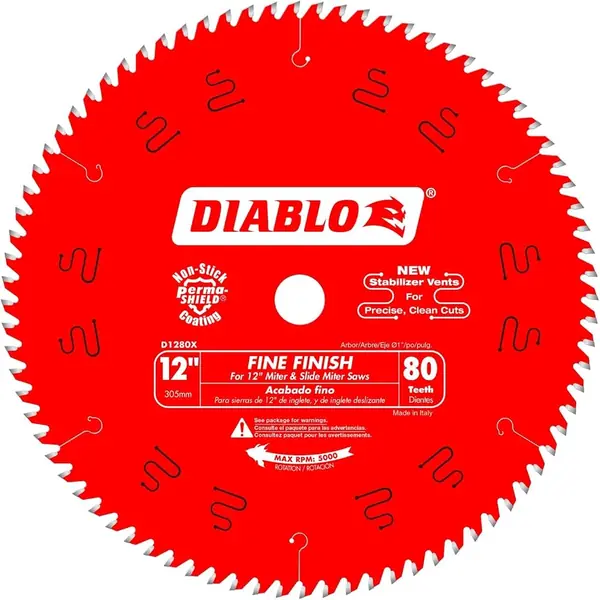
Diablo D1280X 12-inch 80-tooth circular saw blade with red coating and 1-inch arbor

Finish trim work

Shop Score 96/100
Teeth
80
Diameter
12 in
Arbor
1 in
Tooth Grind
Hi-ATB
View on Amazon

The measure of a trim blade is the offcut: if end grain comes off the saw ready for finish, the blade has done its job. The D1280X gets closer to that than anything else here. Its 80 teeth are ground Hi-ATB, with a steeper face than a standard alternate top bevel, so the tips slice across the grain instead of chopping it — which is what keeps the back edge of a casing cut from blowing out.

Everything behind the teeth supports that edge. The kerf is laser-cut thin, which keeps a 12-inch blade from loading a smaller miter saw motor, and the Perma-Shield coating sheds pitch and glue so the plate stays slick between cleanings. We also like that the body is hardened and tensioned: a plate that stays flat is the reason the last cut of an afternoon matches the first.

Feed it steadily. A thin plate this sharp prefers a light hand, and hurrying the head through a thick piece is how you trade a glassy exit for a ragged one.

Where it earns its place is finish carpentry: crown, casing, baseboard, and melamine-faced shelving come off this blade without a second pass at the sander. If your saw mostly cuts framing lumber, buy a 40-tooth blade and save this one for the cuts that show.

Worth Noting

  • Crosscut-only grind, not for ripping stock
Our Verdict

Our top pick for finish carpenters: 80 Hi-ATB teeth leave casing and end grain ready for finish, and the thin plate keeps a 12-inch saw cutting straight.

Check Latest Price
2.

Freud LU91R012 72-Tooth Best for Sliding Miter Saws

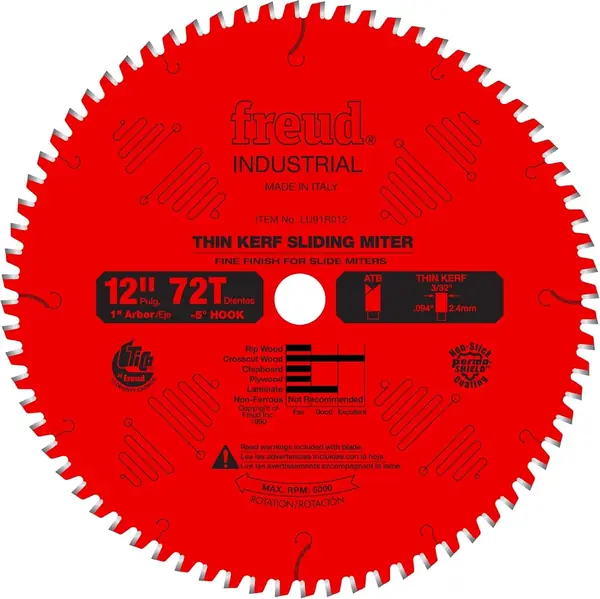
Freud LU91R012 12-inch 72-tooth thin-kerf miter saw blade with silver plate

Sliding miter saws

Shop Score 95/100
Teeth
72
Diameter
12 in
Arbor
1 in
Hook Angle
5° negative
View on Amazon

A sliding compound miter saw pulls the blade forward through the work, and a positive hook angle wants to climb that cut. Freud grinds this blade at 5° negative, which pushes the workpiece down and back against the fence. On a slider that difference is control: the head tracks where you put it instead of grabbing and running.

We like it for exactly that reason. The 72-tooth ATB grind leaves casing and crown with a surface that needs no sanding, and the thin kerf keeps a 12-inch carriage from bogging down in thick hardwood. A blade that stays sharp and stays controlled is what a slider wants, and this one is built around both.

Two things to know going in. A plate this thin rewards a steady feed — force the head and you can feel the cut wander — and it is not the blade to hand a helper who has never run a slider. For a shop that keeps the saw set up and cuts casing all day, neither is a real objection.

Worth Noting

  • Priciest single blade in this group
Our Verdict

Our pick for a sliding compound miter saw: the negative hook keeps the head under control and 72 ATB teeth finish casing cleanly.

Check Latest Price
3.

CMT 255.096.12 96-Tooth Best for Melamine and MDF

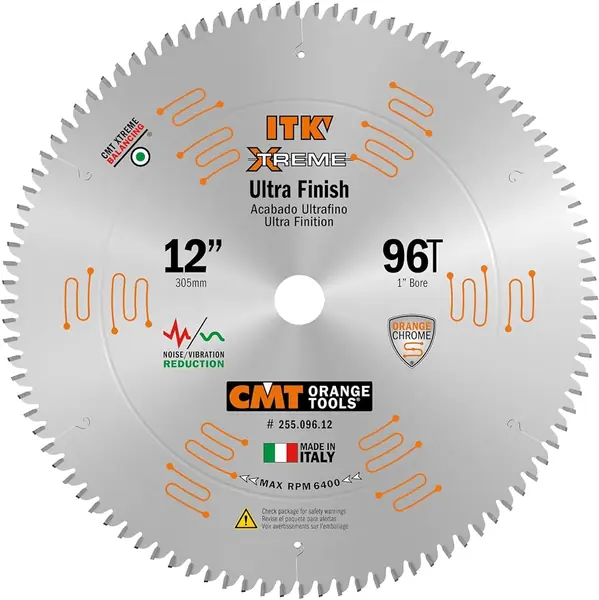
CMT Orange Tools 96-tooth 12-inch saw blade with chrome plate and laser-cut slots

Melamine and veneer

Shop Score 94/100
Teeth
96
Diameter
12 in
Arbor
1 in
Tooth Grind
Hi-ATB
View on Amazon

Melamine is where fine-finish blades embarrass themselves: the teeth exit the cut and take a chip of factory finish with them. CMT builds this blade for that moment — 96 teeth in a Hi-ATB grind, sharpened to a mirror at the tip, on a chrome-plated plate that keeps resin from laminate and MDF from building up and dragging.

The engineering is unusually specific. Laser-cut slots filled with sound-dampening material absorb the ring of the plate, a visible tensioning ring holds it flat, and the steel is hardened before it is ground so the body resists warping. We noted the filled slots in particular, because a 12-inch blade cutting MDF can sing badly without something to absorb it.

That damping is what we appreciate most. A quieter plate is easier to stand next to for an afternoon of cabinet parts, and the payoff on the cut itself is an edge on melamine and veneered plywood that comes off the saw clean. It is a finishing blade in the strict sense: it wants clean, flat stock and a saw that is already dialed in.

Keep it away from pressure-treated lumber, anything that might hide a nail, and demolition work. And because thin plates run narrow, measure the actual kerf on the blade in your hand before you set a stop for a run of parts — a few thousandths is the difference between a cabinet side that fits and one that does not.

Worth Noting

  • Unsuitable for pressure-treated lumber, nails, or demolition work
  • Thin plate requires measuring kerf before setting stops
Our Verdict

If your work is melamine, MDF, or veneered plywood, this is the blade we hand you: 96 Hi-ATB teeth and a damped plate cut chip-free.

Check Latest Price
4.

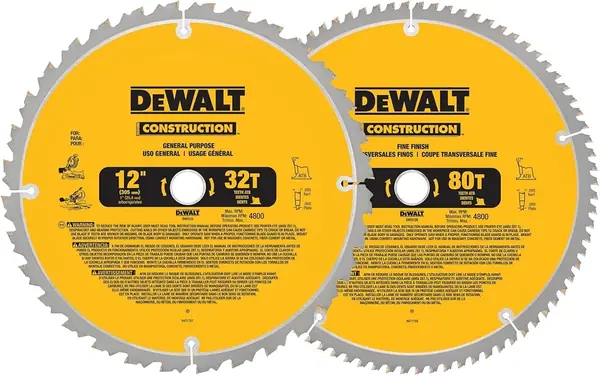
DEWALT DW3128P5 2-Pack Best Two-Blade Kit

DEWALT DW3128P5 two-pack of 12-inch miter saw blades, 80-tooth and 32-tooth

Trim and framing

Shop Score 93/100
Teeth
80 and 32
Diameter
12 in
Kerf
Thin kerf
Quantity
2 blades
View on Amazon

Two blades arrive in one box: an 80-tooth crosscut blade for trim and a 32-tooth blade for everything coarser. Both are thin kerf, both ride on computer-balanced plates with a wedge shoulder behind every tip, and both are sized for a 12-inch miter saw.

The 80-tooth blade is the reason to buy the kit. Its ATB grind leaves casing and baseboard smooth off the saw, and the thin kerf keeps the cut quick on a saw that is not especially powerful. The 32-tooth is a framing blade — fast and perfectly happy in pressure-treated lumber.

Balance matters more on a 12-inch blade than people expect. A plate that is off shows up as a ripple in the cut and a saw that feels like it is fighting you, which is why the computer-balanced plate is worth mentioning. The wedge shoulder puts extra steel behind each tip so a knot is less likely to claim a tooth.

What we like is the honesty of the pairing. Plenty of kits bundle a finish blade with a second blade nobody needs; here the 32-tooth does real work on framing and decking, and the 80-tooth is a genuine finish blade rather than a token extra. If your saw swings between trim and structure, the two of them cover the week.

Worth Noting

  • 32-tooth blade is for framing, not finish trim
Our Verdict

Buy it when one saw has to do trim and framing: a real 80-tooth finish blade plus a 32-tooth workhorse, both thin kerf, in one box.

Check Latest Price
5.

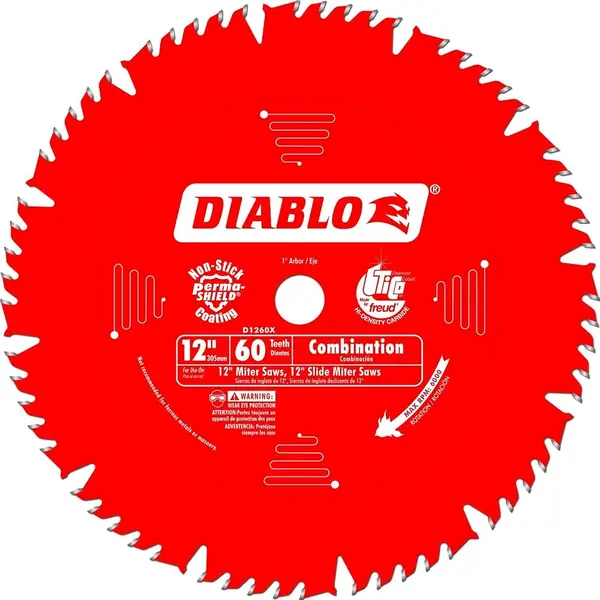
Diablo D1260X 60-Tooth Best One-Blade Option

Diablo D1260X 12-inch 60-tooth combination saw blade with Perma-SHIELD coating

Mixed-material remodels

Shop Score 92/100
Teeth
60
Diameter
12 in
Arbor
1 in
Max RPM
6,000
View on Amazon

If changing blades mid-project annoys you as much as it annoys us, a 60-tooth combination grind is the compromise worth making. This one pairs ATB teeth with raker teeth, so it crosscuts trim and still rips a board down without a second trip to the saw.

It is a pleasant blade to run. The thin kerf eases the load on a 12-inch motor, laser-cut stabilizer vents keep vibration down, and the Perma-SHIELD coating does the same pitch-shedding job as the rest of Diablo's line. Sixty teeth is a nice place to sit: enough for a clean crosscut, few enough that it does not crawl through 2-by stock.

Where it gives ground is the finish. On paint-grade casing an 80-tooth blade leaves a surface this one does not match, and on a stained joint that gap is visible. That is the price of not changing blades every time the material does.

We keep one on the saw for the messy middle of a remodel — decking, blocking, shelving, and the trim that gets caulked and painted. It is also the blade we hand someone who is going to cut whatever comes next without asking which blade is mounted.

Worth Noting

  • Cannot match an 80-tooth blade on fine trim finishes
Our Verdict

For a remodel where materials change all afternoon, we like this 60-tooth combination blade better than swapping between two.

Check Latest Price
6.

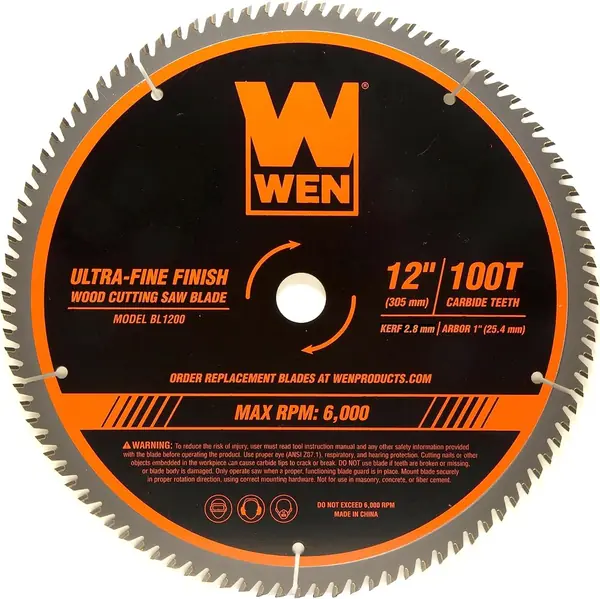
WEN BL1200 100-Tooth Best Budget Fine Finish

WEN BL1200 12-inch 100-tooth carbide-tipped saw blade with silver finish

Budget finish work

Shop Score 91/100
Teeth
100
Diameter
12 in
Arbor
1 in
Kerf
1/10 in (2.8 mm)
View on Amazon

The BL1200 is the least expensive route in this group to an ultra-fine 100-tooth grind, and it does not cut the corners that matter: carbide-tipped teeth, a genuine 1/10-inch kerf, and the standard 1-inch arbor.

We like the kerf most. At a tenth of an inch the blade removes very little material, so a 12-inch miter saw pulls it easily and the feed stays quick through laminate and MDF. The 100 teeth are ground for finish, and on engineered flooring and painted trim the edge comes off clean.

It is not a blade for thick hardwood — 100 teeth in 8/4 oak burn more than they cut — and the thin plate will let you know if you hurry it. On sheet goods and flooring, which is what it was ground for, it is genuinely good.

Worth Noting

  • Edge life is short on hard flooring
Our Verdict

The least expensive credible route to a 100-tooth finish edge here; buy two and treat them as consumables on laminate and MDF.

Check Latest Price
7.

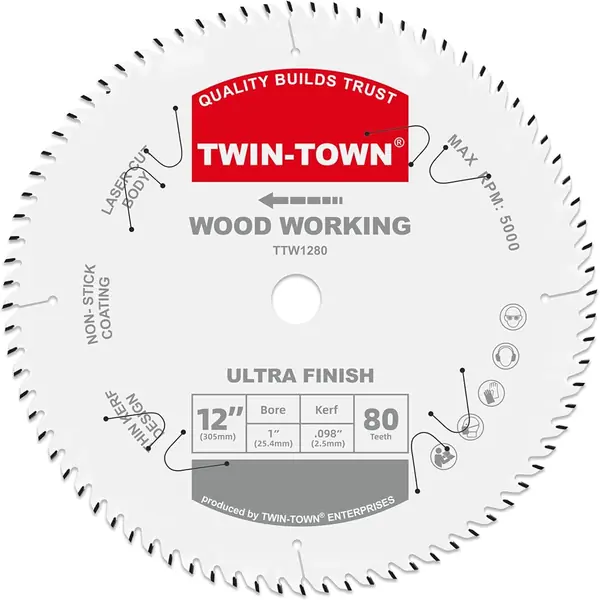
TWIN-TOWN TTW1280 80-Tooth Best for Everyday Crosscuts

TWIN-TOWN TTW1280 12-inch 80-tooth ATB saw blade with coated steel plate

Everyday crosscuts

Shop Score 90/100
Teeth
80
Diameter
12 in
Arbor
1 in
Max RPM
5,000
View on Amazon

Eighty teeth is the count we recommend for trim work, and this blade delivers it at a budget price, with a 1-inch arbor and a thin plate that suits a 12-inch miter saw.

The specification list is sensible for the money: C4 micrograin carbide, a coating that resists gumming, expansion slots and stabilizer vents, and a 5,000 RPM rating that covers typical 12-inch miter saws.

What we like is how little it gives up. Crosscuts in plywood and pine come off splinter-free, and the 80-tooth ATB grind is fine enough for painted trim. It will not hold an edge like the Freud or the CMT — this is a blade to run hard and replace — but at this price you can keep a spare.

Worth Noting

  • Thin plate deflects when the cut is forced
Our Verdict

A budget 80-tooth blade that still leaves plywood and trim splinter-free — we keep one as a spare for everyday crosscuts.

Check Latest Price
8.

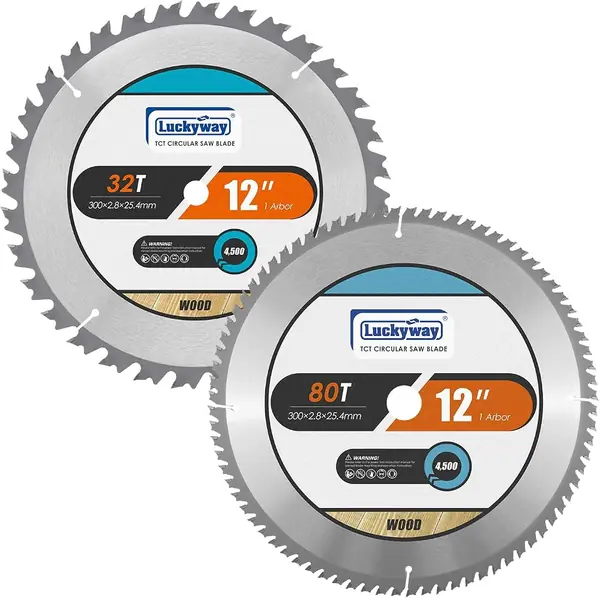
Luckyway 32T & 80T 2-Pack

Luckyway two-pack of 12-inch miter saw blades, 32-tooth and 80-tooth

One-remodel coverage

Shop Score 89/100
Teeth
32 and 80
Diameter
12 in
Arbor
1 in
Max RPM
4,500
View on Amazon

Mid-remodel, the spare blade on the shelf is worth more than the good one in the box. This pair puts a 32-tooth general-purpose blade and an 80-tooth fine-finish blade in your hands for about what one premium blade costs, both with a 1-inch arbor and a 4,500 RPM rating.

The 80-tooth is the one that earns its keep. Its ATB grind leaves engineered flooring and trim without splinters, and the thin kerf keeps a 12-inch saw moving through sheet goods. The 32-tooth takes treated lumber and anything where speed matters more than the surface.

What the pair is not is a precision instrument. The polish on the cut is a step behind the D1280X, and the plates are not finished to the same tolerance as the Freud or the CMT — set them aside for rough work and keep the fine blade for cuts that show.

Between the two, the 80-tooth is the one we keep mounted; the 32-tooth lives in the case until something rough comes up. If you cut trim for a living this is not the kit, but for one remodel it is the practical buy.

Worth Noting

  • Neither blade is worth resharpening when dull
Our Verdict

Two usable blades for about the cost of one premium one — our pick for a single remodel where resharpening never enters the plan.

Check Latest Price

How We Chose and Tested 12-Inch Miter Saw Blades

We built the shortlist from the specs that rule a blade in or out on the saw itself: a 12-inch diameter, a 1-inch arbor (with the bushing a saw calls for where one is needed), and a labeled maximum RPM we could check against the saw's no-load speed before mounting anything. From there we sorted by tooth count and grind, from 32-tooth general-purpose blades up through 100-tooth finishers, and made sure the group spanned thin kerf and standard blades, single blades and two-blade kits, and a wide enough price range that a budget buyer and someone who sharpens every blade weren't getting the same answer.

Twelve blades spent nine months in a garage shop and on weekend job sites. We trimmed out two rooms with baseboard, casing, and shoe molding; built closet shelving from melamine and MDF; and cut pressure-treated deck boards and oak stair nosings. Every blade went on with the guard and kerf plate in place, and we noted hook angle and kerf on each one because both change how a sliding saw's head behaves.

At each step we looked at the exit edge, counting fuzz and chip-out on the face that would show, and dry-fitted the joints to see which ones closed without a shim. We watched for scorch marks and gumming on melamine, noted whether the saw fed itself through the cut or we had to push, and felt for vibration through the handle. We logged linear feet cut per blade, and once one dulled we priced a sharpening against a replacement so value for money meant something more than sticker price.

How to Choose a 12-Inch Miter Saw Blade

Tooth Count and Grind Decide the Finish

Eighty teeth is our default for trim. That count in an ATB or Hi-ATB grind leaves casing and baseboard smooth enough to paint without sanding, which is why the Diablo D1280X and the Freud LU91R012 both sit there. Sixty teeth with raker teeth added, as on the Diablo D1260X, crosscuts acceptably and still rips. Ninety-six to a hundred teeth is for factory finishes — melamine, veneered plywood, laminate — where any chip shows.

The trap is assuming more teeth is always better. A 100-tooth blade in 8/4 oak feeds slowly and can scorch the very edge it was bought to protect. Match the count to the material you cut most, not to the smoothest cut you can imagine.

Check the Arbor and the Saw's RPM Rating

Most 12-inch miter saws take a 1-inch arbor, and every blade here is built around one, but the bore is the specification people get wrong when ordering. Saws with a 5/8-inch arbor need a bushing or a different blade; nothing about a 12-inch diameter guarantees a 1-inch bore on a circular saw blade.

Confirm the arbor from the manual before you buy, and compare the blade's maximum RPM with the saw's no-load speed. A blade rated below the speed your saw turns should never go on it, however good the price looks.

Thin Kerf or Full Kerf

A thin kerf, around a tenth of an inch, removes less material, so the motor works less and the feed feels quicker. On a 12-inch sliding miter saw that is usually what you want, and it is why the WEN BL1200 and the Freud LU91R012 cut above their weight on saws that are not especially powerful. The cost is stiffness: a thin plate can deflect if you force it and is less forgiving in stock that wants to pinch. Full-kerf blades are stiffer for heavy production, but on a standard miter saw we take the thin plate.

Hook Angle Matters Most on Sliding Saws

Hook angle describes how the tooth leans into the work. A positive hook bites aggressively, which suits a table saw where you feed the work into the blade. A sliding miter saw pulls the blade through the work instead, and an aggressive hook can make the head climb.

That is why the Freud LU91R012 is ground at 5° negative: it presses the workpiece down against the fence and keeps the cut controlled. If your saw has a sliding carriage, look at the hook angle before you look at anything else.

Decide Whether You Will Sharpen or Replace

Budget and premium blades differ less in their first cut than in their twentieth. A premium plate with high-grade carbide is worth resharpening; an inexpensive one usually costs less to replace, so the sensible move is to buy two and swap when the surface starts to go fuzzy. We treat the budget end of this list as consumables and the CMT and Freud as tools to keep and sharpen.

Frequently Asked Questions

Final Verdict

For finish work, the Diablo D1280X is the blade we keep mounted: 80 Hi-ATB teeth leave a paint-ready surface, and the thin plate cuts straight on any 12-inch miter saw. It is the safest default for anyone whose saw spends most of its time on trim.

If your saw has a sliding carriage, the Freud LU91R012 earns its premium — the negative hook does more for cut control than another 20 teeth would. And if the budget is fixed, the WEN BL1200 puts a 100-tooth finish edge on the saw for the least money here.