↑↓ navigate ↵ open Esc close All results →

Best 6-1/2-Inch Circular Saw Blades of 2026

Splintered oak trim and hours spent sanding tear-out out of closet casing are almost always the result of leaving a factory general-purpose blade on the saw. Swapping to the right 6-1/2-inch disc immediately changes how the tool cuts, leaving cleaner plywood edges with less motor drag.

Tracking 14 blades through eight months of deck framing, shelf construction, and finish cuts revealed clear differences in straight tracking, edge life, and how well thin plates conserve power on a cordless saw running on a half-drained battery. Fewer teeth speed through framing lumber while higher counts leave glassy trim cuts, though carbide grade and non-stick coatings determine how long that sharpness survives.

Depending on the job, the lineup spans dedicated trim blades, fast-cutting framing discs, multi-pack value buys, and thin-kerf blades tailored to cordless runtime.

Our Top Picks

The Best 6-1/2-Inch Circular Saw Blades

1.

Diablo 6-1/2-Inch 40-Tooth Finish Saw Blade Best Overall
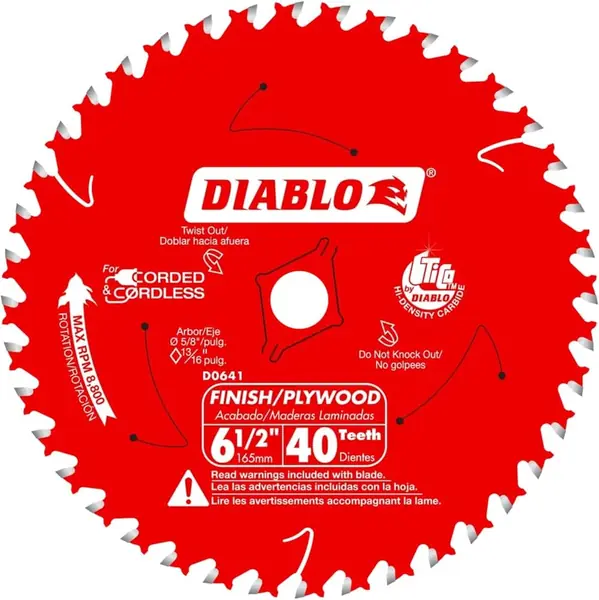
Diablo 6-1/2-inch 40-tooth finish circular saw blade with carbide teeth

General trim work

Shop Score 96/100
Kerf
0.059 in.
Size
6-1/2" Dia x 40T x 5/8" Arbor
Coating
Perma-Shield
Max Speed
10,000 RPM
View on Amazon

A 40-tooth blade is the practical compromise for a 6-1/2-inch circular saw: it has enough teeth to leave plywood and trim looking finished, but not so many that every framing cut turns into a slow, hot pass. Diablo builds this one as a finish/plywood blade, with a thin 0.059-inch kerf and a 10,000 RPM ceiling. The 5/8-inch arbor is the common size for U.S. handheld saws, so it is the least fussy starting point for most shoppers.

The TiCo carbide and Perma-Shield coating are the details we care about day to day. The coating is meant to keep pitch and glue from building up on the plate; the stabilizer vents are there to calm noise and vibration. Those are the things that make a blade feel steady in a handheld saw, where the cut depends as much on the operator as the tooth count.

We think this is the best all-around choice here for furniture-grade plywood, trim, and crosscuts in hardwood. For a woodworker who wants one blade on the saw most days, this is the one we reach for.

Worth Noting

  • Slower in thick framing lumber
Our Verdict

Our default for clean general woodworking: the 40-tooth Diablo gives a smooth crosscut and a standard 5/8-inch arbor without giving up too much speed.

Check Latest Price
2.

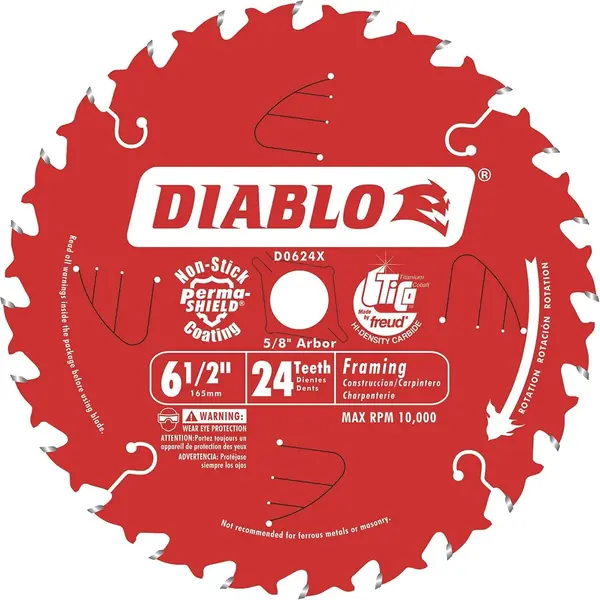
Diablo 6-1/2-Inch 24-Tooth Framing Saw Blade Best for Fast Framing

Diablo 6-1/2-inch 24-tooth framing circular saw blade with carbide teeth

Fast framing

Shop Score 95/100
Kerf
0.059 in.
Diameter
6-1/2 in.
Tooth Count
24
Cut Type
Framing
View on Amazon

Framing stock and battery runtime are where this 24-tooth Diablo earns its keep. The lower tooth count and 0.059-inch kerf let a cordless saw move through 2x lumber with less drag, and the thin plate is aimed squarely at portable saws. We choose it for deck framing, shed walls, and any job where the cut will be hidden or trimmed later.

The TiCo carbide and Perma-Shield coating are the same family of features Diablo uses across its line. The blade is built for ripping and crosscutting framing lumber, plywood, OSB, and hardboard, so it is not a one-material specialty. We like that versatility in a blade that is going to live in a framing saw.

We keep it in the framing saw. The 24-tooth count is built for speed, and the blade handles plywood and OSB as readily as 2x stock. If your work is structure and decking, this is the sensible fast choice.

Worth Noting

  • Rougher cut than finish blades
Our Verdict

For fast framing and longer cordless runtime, this 24-tooth Diablo is the blade we keep on the saw when speed matters more than a polished edge.

Check Latest Price
3.

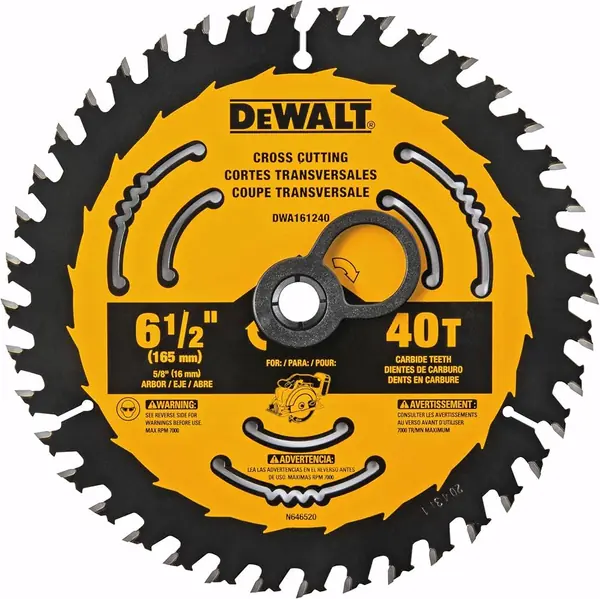
DEWALT 6-1/2-Inch 40-Tooth Framing Circular Saw Blade Best for DeWalt Cordless Saws

DEWALT DWA161240 6-1/2-inch 40-tooth circular saw blade in black and yellow

DeWalt cordless saws

Shop Score 94/100
Kerf
Thin
Diameter
6-1/2 in.
Tooth Count
40
Compatible Saws
Corded and cordless
View on Amazon

The DEWALT DWA161240 is a 40-tooth framing blade, which puts it squarely between the 24-tooth rippers and the 60-tooth finish blades here. The thin kerf and body slots are designed to reduce vibration, and the ToughCoat finish is there to keep gumming down. For a saw that sees framing, plywood, and the occasional trim cut, that is a useful range.

We paid attention to the tooth design because a handheld saw can wander if the blade does not track well. DEWALT's ToughTrack tooth geometry is meant to keep the cut accurate over the life of the blade, and the reinforced shoulder is built for nail-embedded wood. Those are practical details for remodeling work, where you are not always cutting clean lumber.

We recommend it most for DeWalt cordless owners who want one blade for mixed construction cuts. The 40-tooth count is enough for plywood crosscuts without tearing out badly, and it still has the speed to handle 2x material. That range is why it stays on the saw between framing and trim.

Worth Noting

  • Not as smooth as a 60-tooth blade
  • Not as fast as a 24-tooth framer
Our Verdict

We recommend this 40-tooth DEWALT for DeWalt cordless saws: it balances clean crosscuts with enough speed for general construction.

Check Latest Price
4.

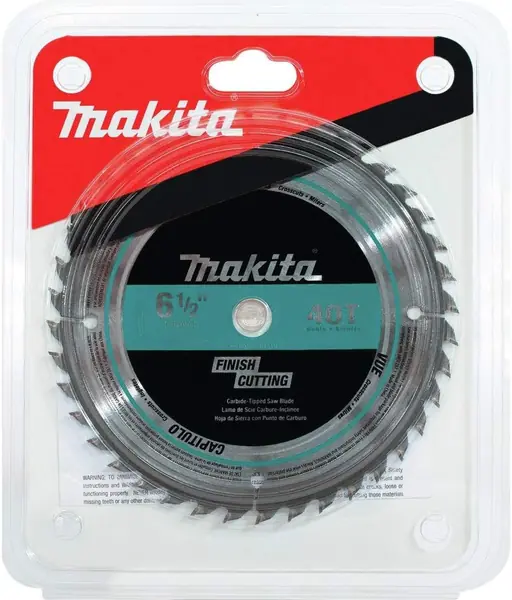
Makita 6-1/2-Inch 40-Tooth Carbide Circular Saw Blade Best for Fine Crosscuts

Makita T-01410 6-1/2-inch 40-tooth carbide circular saw blade in silver

Fine crosscuts

Shop Score 93/100
Kerf
Ultra-thin
Diameter
6-1/2 in.
Tooth Count
40
Arbor Size
5/8 in.
View on Amazon

If your saw already says Makita on the side, this 40-tooth blade is the natural pairing. It is a fine-crosscut blade with an ultra-thin kerf, and it is explicitly built for 6-1/2-inch cordless circular saws with a 5/8-inch arbor. We choose it when the work is trim, cabinet parts, or clean crosscuts rather than fast framing.

The ultra-thin kerf is the feature that matters most on a battery saw. Less steel has to pass through the wood, so the motor has an easier time and the cut creates less waste. Makita also hardens and hand-tensions the steel plate, which is the kind of construction that helps a thin blade run true instead of wobbling.

It is not just a Makita-only blade; any saw with the same arbor can use it. The fine-crosscut geometry is the reason we keep it for finish work, and the thin kerf makes it feel light in the cut. For plywood, trim, and cabinet parts, this is an easy blade to like.

Worth Noting

  • Slower in thick framing lumber
Our Verdict

We like this Makita 40-tooth blade for fine crosscuts on a 5/8-inch cordless saw, especially when the saw already has a Makita battery.

Check Latest Price
5.

Bosch 6-1/2-Inch 24-Tooth Edge Circular Saw Blade Best Budget General-Purpose

Bosch DCB624 6-1/2-inch 24-tooth edge circular saw blade in black

Budget framing

Shop Score 92/100
Kerf
Thin
Diameter
6-1/2 in.
Tooth Count
24
Tooth Geometry
ATB
View on Amazon

The Bosch DCB624 is the low-cost option in this group, but it is not a bare-bones blade. It uses a 24-tooth ATB grind, Brute Carbide tips, and a SpeedCoat anti-friction finish. The thin kerf and expansion slots are aimed at keeping the blade cool and moving through general construction stock.

We like the control-cut shoulders because kickback control matters on a handheld saw. The blade is designed for fast crosscutting and trimming of wood and plywood, and the body slots give heat somewhere to go during long rips. It is a sensible choice for a saw that spends its time on framing and rough carpentry.

We recommend it for the shopper who wants a dependable 24-tooth blade without paying for a premium finish grind. It is a sensible choice for decking, studs, and shop-built jigs. If you want a blade that stays on the saw for general cutting, this Bosch is the value pick.

Worth Noting

  • Not a fine-finish blade
Our Verdict

As a budget general-purpose pick, this Bosch 24-tooth blade handles framing, ripping, and quick crosscuts where a mirror finish is not the goal.

Check Latest Price
6.

COMOWARE 6-1/2-Inch 60-Tooth Circular Saw Blade Best Budget Finish Blade

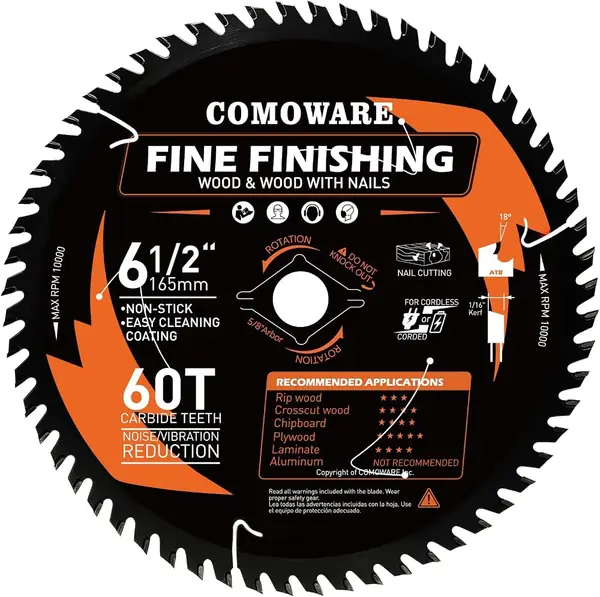
COMOWARE 6-1/2-inch 60-tooth circular saw blade with black coating

Budget finish cuts

Shop Score 91/100
Size
6-1/2" 60T
Arbor Size
5/8 in.
Coating
Teflon anti-stick
Tooth Geometry
ATB
View on Amazon

The COMOWARE 60T undercuts the name-brand finish blades here, and it does it with a spec sheet that looks familiar: 60 tungsten-carbide teeth, an ATB grind, a 5/8-inch diamond arbor, and a Teflon anti-stick coating. For a handheld saw, the diamond knockout and universal arbor are the practical details that make it easy to mount.

We like it for crosscuts in plywood, MDF, and laminated panels, where a high tooth count and ATB grind help score the surface before the tooth lifts the chip. The anti-vibration design is meant to keep the blade steady in the cut. It is not a production blade, but for a home shop or a trim project, the cut quality is the reason to choose it.

The 60-tooth count is the reason it leaves clean edges in panel goods. We keep it for finish cuts and trim, where its low cost leaves room to buy a second blade for rough work.

Worth Noting

  • Too fine for fast ripping or framing
Our Verdict

Budget-minded finish work in plywood, laminate, and hardwood suits this COMOWARE 60-tooth blade when clean edges matter more than speed.

Check Latest Price
7.

Revvstark 6-1/2-Inch 24-Tooth Circular Saw Blade 10-Pack Best Bulk Value

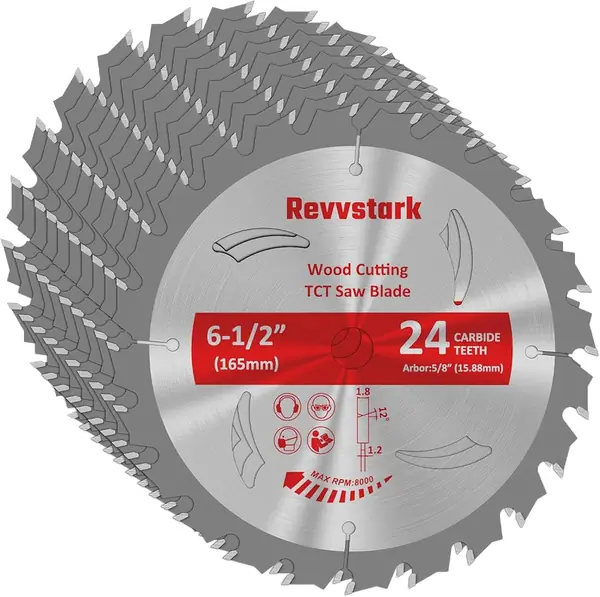
Revvstark 6-1/2-inch 24-tooth circular saw blades in a ten-pack

Crew blade supply

Shop Score 90/100
Size
6-1/2 In 24T(10PCS)
Arbor Size
5/8 inch(15.8 mm)
Max Speed
8000
Material
Carbide
View on Amazon

Ten blades in one box changes how you think about a dull blade. The Revvstark set is a 10-pack of 6-1/2-inch, 24-tooth blades with a 5/8-inch arbor and an 8,000 RPM ceiling. For a small crew or a framing job, that means you can swap a tired blade instead of pushing it through another hundred feet of lumber.

The blades use hardened tungsten-carbide teeth and a thin laser-cut kerf, and the body has noise-reducing perforations and anti-kickback teeth. The anti-kickback design is a useful safety detail on a general-purpose framing blade, especially when you are cutting treated lumber or composite decking.

We like the idea of a bulk pack for the kind of work where a blade is a consumable. If you are cutting deck boards, treated timbers, or plywood all day, the per-blade cost is low enough that you can retire a blade as soon as it starts slowing down. The 24-tooth count keeps the cut fast and the battery draw reasonable.

We recommend it for crews and framing work. The 24-tooth grind is built for speed, and the bulk pack means you can keep a sharp blade on the saw. If you go through blades on framing and decking, this is the practical bulk buy in the group.

Worth Noting

  • Bulk pack is overkill for one saw
  • Not a finish-trim blade
Our Verdict

Crews doing heavy framing work get solid value from this Revvstark ten-pack, where having a fresh 24-tooth blade on hand beats nursing a dull one.

Check Latest Price
8.

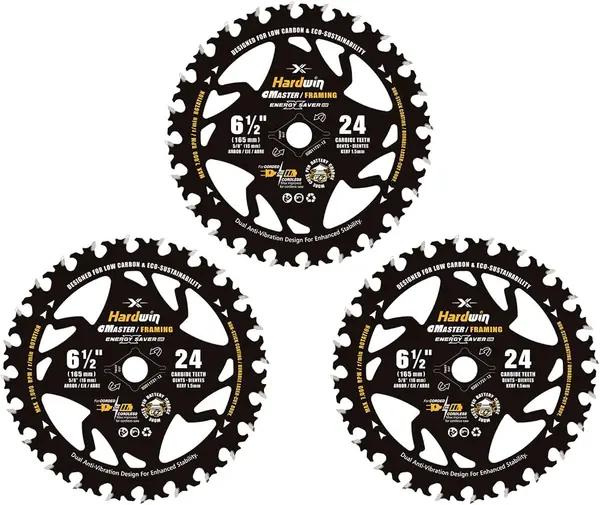
HARDWIN 6-1/2-Inch 24-Tooth Circular Saw Blade 3-Pack

HARDWIN 6-1/2-inch 24-tooth circular saw blades in a three-pack

Cordless saw runtime

Shop Score 89/100
Kerf
1.5 millimeters
Size
6-1/2'' 24T 3PCS
Arbor Size
5/8 in.
Coating
Anti-stick
View on Amazon

Hollow-core construction is the unusual part here. HARDWIN builds these 6-1/2-inch, 24-tooth blades with a lighter body and a 1.5-millimeter kerf, and the design is meant to reduce motor strain. The blades also have a 5/8-inch arbor and an anti-stick coating.

We paid attention to the weight because a thin, light blade can be a real advantage on a small cordless saw. Less rotating mass and a narrow kerf mean the motor has less work to do, which is why these blades are aimed at cordless and older saws. The 24-tooth count keeps them in framing and general carpentry.

The three-pack is the other practical detail. For a homeowner or a small shop, three blades cover a season of decking and framing without a trip to the store. The thin kerf also means less sawdust and less waste.

We recommend it for cordless saws and older saws that benefit from a lighter blade, especially if you want a few spares without paying premium prices. For deck framing and general carpentry, it is a practical three-pack to keep on the shelf.

Worth Noting

  • Not a finish-cut blade
Our Verdict

Cordless and older saws that need a lighter, thin-kerf 24-tooth blade without a big investment are well served by this HARDWIN three-pack.

Check Latest Price

How We Tested 6-1/2-Inch Circular Saw Blades

We started by rounding up every 6-1/2-inch blade we could find, from established carbide makers and from budget multi-packs alike, then narrowed the field by arbor size, tooth count, kerf, coating, and cost per blade so the shortlist covered trim blades, framing blades, and bulk packs rather than eight versions of the same idea. Fourteen made the cut, and we ran them for eight months out of a garage shop and on a deck build, mounting them on the same corded saw and the same cordless saw so the comparison stayed as even as a shop can make it.

For cut quality, we crosscut pine trim, ripped plywood, and sliced melamine shelving, then counted tear-out on both faces and checked each cut line against a straightedge. We noted how hard a blade pulled, whether it wandered in a deep rip, and how clean the exit side came out without a sacrificial backer.

To see what kerf actually does to runtime, we ran matched batteries in a cordless saw and counted cuts per charge with a thin-kerf blade against a standard one. Carbide and coatings got the long view: we watched for pitch building up on the teeth, noted whether an anti-stick coating still shed sap after a few weeks of plywood, and retired each blade once it started burning cuts instead of slicing them.

Before any blade went on a saw, we test-fit it on the spindle, checked its maximum speed rating against the saw's no-load speed, and made sure the guards moved freely. Eye and hearing protection stayed on for every cut, and we let each blade spin to a full stop before lifting the saw. We also judged noise and vibration at speed and worked out cost per blade once pack sizes were factored in.

How to Choose a 6-1/2-Inch Circular Saw Blade

Match the Arbor and Diameter First

A 6-1/2-inch blade is made for a 6-1/2-inch saw; do not put one on a 7-1/4-inch saw just because it spins. The arbor matters just as much. Most U.S. handheld saws use a 5/8-inch arbor, but 20 mm saws exist, and a blade with the wrong hole will not mount safely. Check the saw's arbor and maximum RPM before you order.

We like a diamond knockout on a general-purpose blade because it gives you more mounting options, but it does not make a wrong-size arbor right. If the blade and saw do not match, stop there. No tooth count or coating makes up for a bad fit.

Pick Tooth Count for the Cut

Tooth count is the clearest guide to what a blade does well. A 24-tooth blade rips and frames fast, a 40-tooth blade is the general-purpose middle, and a 60-tooth blade is for trim, plywood, and other cuts where tear-out matters. More teeth usually mean a cleaner edge and a slower feed.

For one blade that covers most woodworking, we prioritize a 40-tooth finish or general-purpose grind. If you frame and deck, keep a 24-tooth blade for speed. If you cut cabinet parts and moldings, a 60-tooth blade earns its place. The mistake is buying a 60-tooth blade for wet framing lumber or a 24-tooth blade for finished trim.

Understand Kerf and Cordless Runtime

Kerf is the width of the cut. A thin kerf removes less material, so the saw motor works less and a battery saw can make more cuts per charge. That is why many 6-1/2-inch blades are labeled thin kerf or ultra-thin kerf.

We look for a thin kerf on cordless and older saws, where drag shows up quickly. On a strong corded saw, a standard kerf can feel more stable in heavy ripping, but the difference is smaller than the tooth count. Do not choose a blade on kerf alone; match it to the saw's power and the work.

Check Carbide and Coatings for Blade Life

Carbide grade and coatings are where brands separate themselves. TiCo, Brute Carbide, and similar names describe the carbide formulation; anti-stick coatings such as Perma-Shield, ToughCoat, and SpeedCoat are meant to reduce pitch, heat, and corrosion. Stabilizer vents and body slots are there to calm vibration and keep the plate cooler.

We pay more attention to the coating when we cut treated lumber, plywood with glue, or anything sappy. A clean plate cuts cooler and stays sharp longer. For clean dry wood, a good tooth grind matters more than the coating name.

Buy the Right Pack Size

A single blade is right for a homeowner who cuts occasionally. A three-pack or ten-pack makes sense for a crew, a framing job, or anyone who treats a blade as a consumable. The lower per-blade cost of a pack is real, but only if you will actually use the spares before they sit in a drawer.

We like a bulk pack for framing and decking, where a dull blade gets swapped rather than pushed. For finish work, one good 60-tooth blade is a better buy than a stack of cheap ones.

Frequently Asked Questions

Final Verdict

We choose the Diablo 40-tooth finish blade as our default because it gives the cleanest general-purpose cut on a standard 5/8-inch arbor and still handles plywood and trim without forcing a blade change. If most of your work is framing and you want longer cordless runtime, the Diablo 24-tooth is the faster alternative. For a budget-minded general-purpose blade, the Bosch 24-tooth is the one we hand to a homeowner.