↑↓ navigate ↵ open Esc close All results →

Best Circular Saw Blades for Composite Decking of 2026

Composite decking contains plastic polymers that soften as friction rises, turning saw dust into sticky shavings that weld onto standard carbide teeth and smear across the cut edge. A blade engineered for composite clears chips rapidly and stays cool enough to leave a finished board end in a single pass rather than requiring cleanup with a utility knife.

Five months of cutting capped composite, PVC trim, and surrounding pressure-treated framing with 16 blades showed that tooth geometry outweighs raw tooth count. A 44-tooth triple-chip grind sliced cleaner than a 60-tooth general-purpose wood blade on the same plank, whereas stock framing blades gummed up almost immediately — making a two-blade approach practical on any full deck build, saving the composite blade for visible ends.

Sized for both 7-1/4-inch corded saws and 6-1/2-inch cordless models, the seven blades ranked below finished long cut lists without scorching or melting the board face.

Our Top Picks

The Best Circular Saw Blades for Composite Decking

1.

Diablo TrexBlade D0744CD 7-1/4-Inch 44T Best Overall
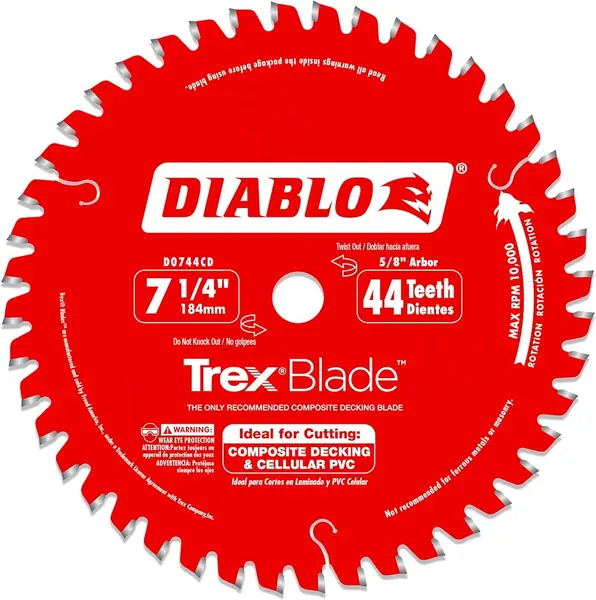
Diablo TrexBlade 7-1/4-inch 44-tooth circular saw blade in red with Perma-SHIELD coating

Composite decking

Shop Score 96/100
Teeth
44 MTCG
Diameter
7-1/4 in
Kerf
.065 in
Arbor
5/8 in
View on Amazon

Most circular saw blades are generalists, and a generalist will cut composite decking — it just won't leave the edge you want on a board that stays visible. The TrexBlade was designed around the material: 44 teeth in a modified triple chip grind, a -3° hook angle, a .065-inch kerf on a .040-inch plate, and Diablo's non-stick coating over the top. Diablo also says it's the only blade Trex recommends for its own decking, which is a strong claim in a category full of generic carbide.

The grind is what earns it the top spot. Composite doesn't chip the way wood does; it produces hot, sticky shavings that load the teeth and drag a smear through the kerf, and the melt-free cut built into the MTCG geometry aims squarely at that. Cutting board ends side by side is where we noticed the difference first — one blade leaves a crisp corner, the other leaves something you reach for sandpaper to fix.

A .065-inch kerf matters more here than it does in pine. Composite is dense and abrasive, and a narrow cut asks less of the saw, so a cordless model holds its speed through a deck board instead of bogging halfway. The blade carries a 10,000 RPM rating, comfortably above anything a handheld saw will ask of it.

The honest caveat is that it's a specialist. It's happiest in composite and cellular PVC, and you'll still want a general-purpose blade for the joists, blocking, and plywood, because this isn't the grind to frame with.

Worth Noting

  • Premium price against general-purpose blades
Our Verdict

If you're cutting composite decking, this is the blade we tell people to buy: the composite-specific grind leaves clean, melt-free edges and the thin kerf keeps a cordless saw moving.

Check Latest Price
2.

Diablo D0740A 7-1/4-Inch 40T Finishing Blade Best All-Around Value

Freud Diablo D0740A 7-1/4-inch 40-tooth finishing blade in red with diamond knockout arbor

Deck and framing

Shop Score 95/100
Teeth
40 ATB
Diameter
7-1/4 in
Arbor
5/8 in diamond knockout
Coating
Perma-SHIELD
View on Amazon

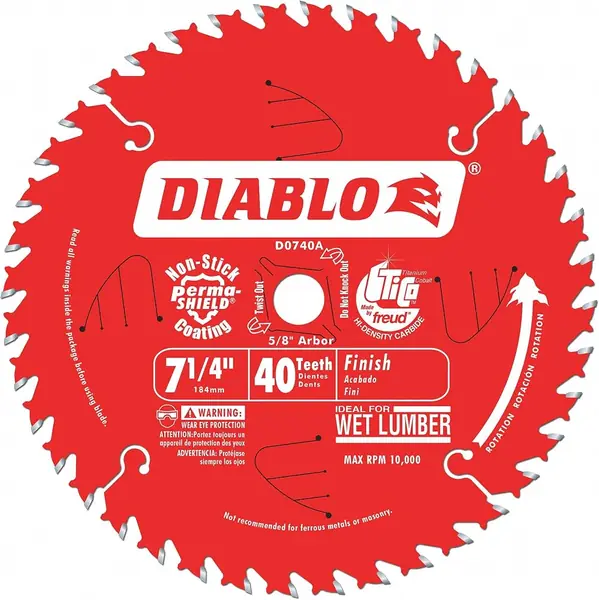
About half the price of a composite-specific blade and good enough for most deck work — that's the case for the D0740A, and it's why we treat it as the default on a mixed project. Forty ATB teeth leave a clean edge on decking and 1x stock, and the same blade keeps going into joists, blocking, and plywood without a swap. For crosscutting deck boards and trimming them to length, that's most of what the job asks.

It's a finishing grind rather than a framing grind, so it crosscuts a deck board smoothly and leaves fewer fibers standing than a 24-tooth blade will. What it isn't is composite-specific: there's no modified triple chip geometry here to hold the material's temperature down, so on long rips through thick board a dedicated blade stays cleaner. Trimming board ends and cutting stair stringers, we didn't miss it.

Fit is broad — a 5/8-inch arbor with a diamond knockout covers most 7-1/4-inch saws — and the thin laser-cut kerf is easy on a smaller motor. Tri-metal brazing holds the carbide through the kind of knock that happens when a board pinches, and the Perma-SHIELD coating keeps pitch from building up between cuts. At 6.56 ounces it adds almost nothing to a saw you're carrying up a ladder all afternoon.

Worth Noting

  • General-purpose grind, not composite-specific
Our Verdict

Our pick when one blade has to cover the whole build: 40 teeth leave a clean edge on decking, and it costs about half what a composite-specific blade does.

Check Latest Price
3.

FOXBC 7-1/4-Inch 60-Tooth Fine Finish Best Budget Fine Finish

FOXBC 7-1/4-inch 60-tooth carbide circular saw blade in yellow with thin kerf

Visible board ends

Shop Score 94/100
Teeth
60 ATB
Diameter
7-1/4 in
Kerf
0.063 in
Arbor
5/8 in diamond knockout
View on Amazon

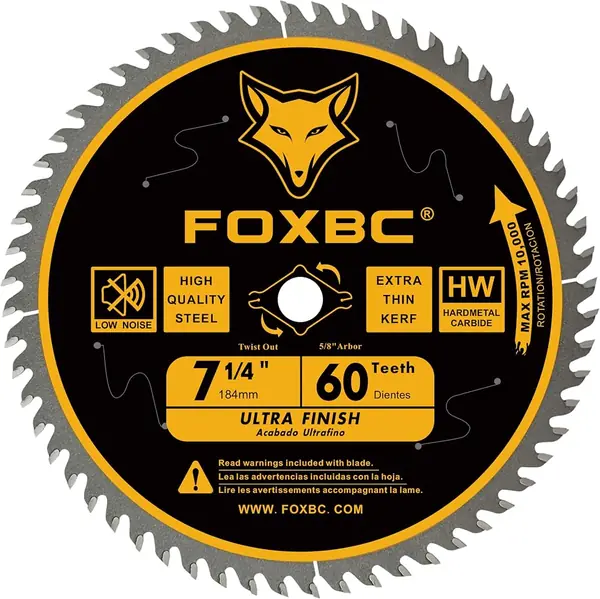
Look closely at the plate and you'll see slots cut into the blade body, the kind that let heat escape instead of soaking into the steel. On composite decking, where the usual failure is a gummed blade dragging hot plastic through the kerf, that's not a cosmetic detail.

The rest of the specification lines up: 60 ATB teeth, a .063-inch kerf, a 5/8-inch arbor with a diamond knockout, and high-density tungsten carbide tips. Sixty teeth feed slower than a 24-tooth framing blade — you steer the saw rather than push it — but the cut end it leaves on a deck board is close to what a sharpening-level finish would produce. It's built as a direct replacement for Diablo's D0760A and DEWALT's DWA171460, so it drops onto the same saws.

Where it gives ground to the TrexBlade is at the tooth: this is a standard ATB grind, and it doesn't have composite-specific geometry working to keep the material cool on a long rip. What it has is a very fine tooth and a thin kerf for very little money, and we're happy to keep one in the case for visible ends and trim work.

Worth Noting

  • Feeds slowly through thick boards
Our Verdict

We recommend it when you want a glassy edge without a premium price: 60 ATB teeth and a .063-inch kerf for well under what a composite-specific blade costs.

Check Latest Price
4.

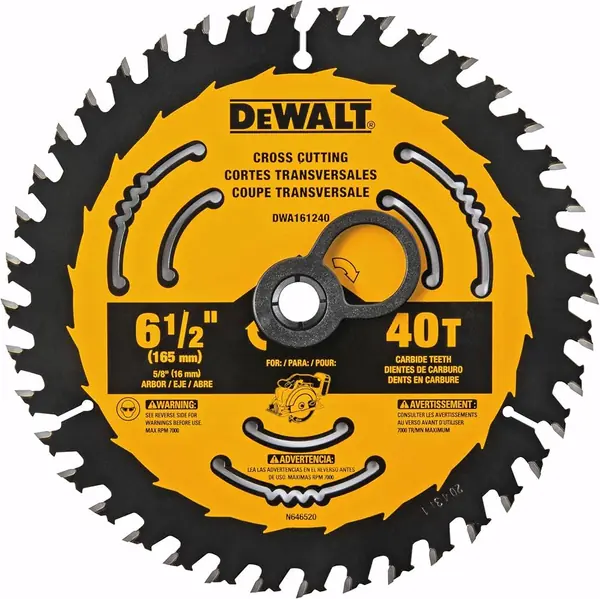
DEWALT DWA161240 6-1/2-Inch 40T Best for 6-1/2-Inch Saws

DEWALT DWA161240 6-1/2-inch 40-tooth circular saw blade in black and yellow

6-1/2-inch saws

Shop Score 93/100
Teeth
40
Diameter
6-1/2 in
Tooth Design
ToughTrack
Compatible Saws
Corded and cordless circular saws
View on Amazon

Saw size decides this one before anything else does. If your cordless circular saw takes a 6-1/2-inch blade, your options are shorter and mostly coarser, and this 40-tooth thin-kerf blade is the one we point to first. It fits corded and cordless saws of that size, so it moves between tools without a second purchase.

What we paid attention to is vibration. The patented body slots are there to break up the shake a thin, fast-turning blade picks up in a deep cut, and that shake is exactly what shows on a deck board as a wavy edge. Add high-density carbide, the ToughCoat anti-stick finish, and a thin kerf, and you have a blade that keeps a small saw cutting straight instead of chattering. The reinforced shoulder is aimed at nail-embedded lumber, which isn't what you're cutting on a deck, but it costs you nothing in composite.

A 6-1/2-inch blade also gives up depth of cut to a 7-1/4-inch one, which matters if you're cutting stacked boards or posts and not at all on a single deck board. For trimming, blocking, and framing on the same saw, that's a fair trade.

Worth Noting

  • 40 teeth leave a slightly coarser edge
Our Verdict

For 6-1/2-inch cordless saws, this is the blade we point to first: a thin kerf, vibration-damping body slots, and 40 teeth that crosscut composite cleanly.

Check Latest Price
5.

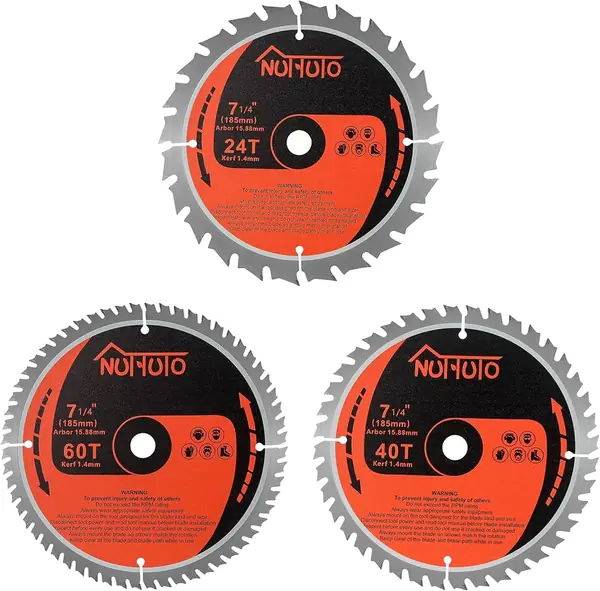
NUTTUTO 7-1/4-Inch 24T/40T/60T 3-Pack Best Multi-Blade Value

NUTTUTO three-pack of 7-1/4-inch circular saw blades in red with 24, 40, and 60 teeth

Whole-deck projects

Shop Score 92/100
Teeth
24T, 40T and 60T
Diameter
7-1/4 in
Kerf
0.063 in
Max Speed
8,000 RPM
View on Amazon

Twenty-four, 40, and 60 teeth, all 7-1/4 inches, all on a 5/8-inch arbor, all with a .063-inch kerf — this set is three blades for roughly what one composite-specific blade costs, and we think that's the smart purchase for a weekend deck project. All three are rated for corded and cordless saws.

The logic of the set is that you stop pretending one blade does everything. The 24-tooth goes on for joists, blocking, and rough rips nobody will see, the 40 handles general crosscuts, and the 60 stays sharp for the board ends that stay visible. Swapping takes ten seconds, and keeping the fine blade out of framing work is what makes it last.

What you don't get is composite-specific engineering: no modified triple chip grind, no melt-control geometry, just thin-kerf ATB blades with an anti-stick coating and an 8,000 RPM ceiling. The 60 will cut decking cleanly, but it isn't doing anything special to stop the material smearing on a hot afternoon.

Worth Noting

  • 24-tooth blade suits rough cuts only
Our Verdict

We like this set for a full deck build — 24, 40, and 60 teeth let you keep the fine blade out of rough work, and three blades cost about what one composite blade does.

Check Latest Price
6.

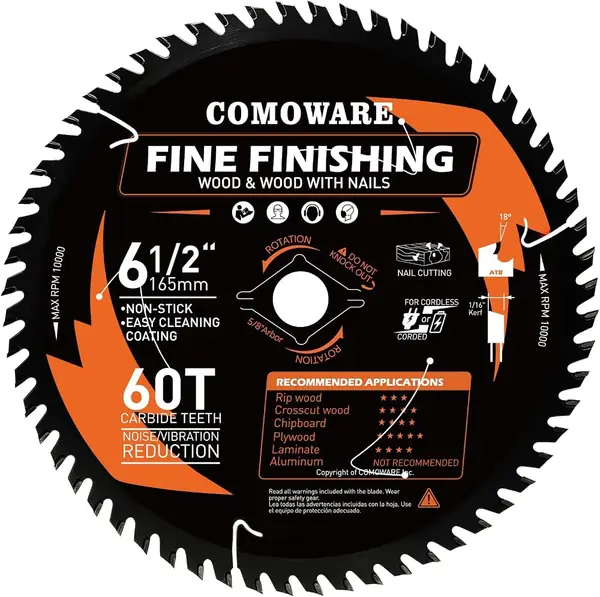
COMOWARE 6-1/2-Inch 60T

COMOWARE 6-1/2-inch 60-tooth circular saw blade in black with diamond arbor

Spare finish blade

Shop Score 91/100
Teeth
60 ATB
Diameter
6-1/2 in
Arbor
5/8 in diamond
Coating
Teflon anti-stick
View on Amazon

At the bottom of the price range sits a 6-1/2-inch blade with 60 ATB teeth, a Teflon anti-stick coating, and a 5/8-inch diamond arbor that seats on both round and diamond-hole saws. It's sold for crosscutting and ripping in wood, plywood, MDF, chipboard, and laminated panels, and the 60-tooth count is the one to pick for cuts you'll actually look at.

Sixty teeth is a lot of carbide packed into a small circle, and the anti-vibration geometry is designed so the teeth can take a second sharpening rather than being a one-job consumable. At 6.7 ounces it's also among the lighter blades here.

What we like about it is how little it asks of you. It's the blade to keep in the case as a spare, so a dulled edge halfway through a deck doesn't turn into a drive to the store, and on a compact saw it's the least expensive route to a clean cut end. It won't outlast a composite-specific blade, and at a fraction of the price you shouldn't expect it to.

Worth Noting

  • 6-1/2-inch diameter limits depth of cut
Our Verdict

If you run a 6-1/2-inch saw and want a clean cut end without spending much, this 60-tooth blade is the value pick we keep coming back to.

Check Latest Price
7.

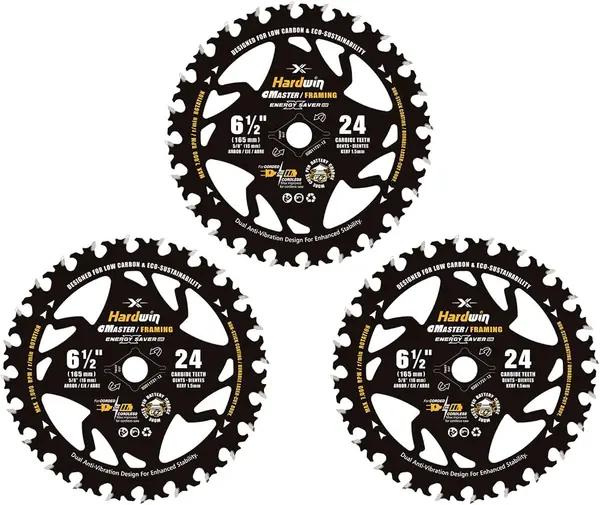
HARDWIN 6-1/2-Inch 24T 3-Pack Best for Rough Framing Cuts

HARDWIN 6-1/2-inch 24-tooth circular saw blades, three-pack, in black with thin kerf

Rough framing cuts

Shop Score 89/100
Teeth
24
Diameter
6-1/2 in
Kerf
1.5 mm
Pack Size
3 blades
View on Amazon

Hollow-core construction, a 1.5 mm kerf, three blades in the pack — this set is built around the idea that the saw, not the blade, is often the weak link. The hollow body is meant to shave weight, and a lighter blade making a narrower cut means less drag on a cordless motor.

Twenty-four teeth are about speed and chip clearance, and that's what a 24-tooth blade does well: ripping, framing, joist tails, blocking, anything whose edge disappears into the assembly. It's the blade you put on when the pace matters more than the polish.

The battery claim is the part we paid attention to. A thin kerf plus a lighter plate is genuinely easier on an older corded saw or a cordless one working through treated lumber, and the coated plate keeps resin from building up between cuts. Three blades also mean a sharp spare is always in the truck.

Where the set earns its place is rough work and tired saws. Three sharp blades for less than a single composite-specific blade is a straightforward value case, and a hollow-core 24-tooth is the friendliest thing you can put on an old saw that stalls in treated lumber.

Worth Noting

  • 24-tooth grind suits rough cuts, not finished edges
Our Verdict

Our choice for rough framing cuts and tired cordless saws: light hollow-core blades with a thin kerf, three to a pack, at a price that makes them disposable.

Check Latest Price

How We Tested Circular Saw Blades for Composite Decking

We started by reading specs the way a shopper has to: diameter and arbor first, since a blade that won't fit the saw already on your shelf doesn't matter, then tooth grind, kerf width, and what a replacement costs. From there we gathered 16 blades — 7-1/4-inch and 6-1/2-inch, 24 to 60 teeth, thin-kerf and standard — and ran them for five months, from a spring deck build into early fall fencing and planter boxes.

Before mounting, we matched each blade's stamped maximum RPM against the saw's no-load speed, and we pulled the battery or unplugged the saw for every change, letting a hot blade cool before handling it. Then we cut. Each blade ran the same sequence: crosscuts on composite decking, rips and stair stringers, picture-frame borders with exposed ends, and a stretch of wet pressure-treated lumber to see how it handled the framing around a deck. Both sides of every offcut were supported so the kerf couldn't close up.

What we tracked was simple: how many board feet went by before the cut edges started fuzzing or scorching, how much pitch caked onto the plate, and whether the saw bogged or the battery dropped a bar during long rips with a thin-kerf blade. We cleaned a blade only when the cut quality forced us to, then noted how easily the pitch came off. At the end we set each blade's cost against the linear feet it survived.

How to Choose a Circular Saw Blade for Composite Decking

Start With the Grind, Not the Tooth Count

Tooth count tells you how fine a cut a blade can produce in wood. Composite asks a different question — whether the blade can keep the material cool enough not to melt. A modified triple chip grind, like the one on the Diablo TrexBlade, presents a flatter-topped tooth that slices rather than scoops, and it's usually paired with a negative hook angle so the blade doesn't grab and heat the cut.

That's why a 60-tooth ATB blade and a 44-tooth composite blade aren't interchangeable even though both leave a decent edge. The ATB blade leans on tooth count and a thin kerf; the composite blade leans on geometry and coating. Expect a general-purpose blade to look great on short crosscuts and to struggle on long rips.

Match Diameter and Arbor to the Saw You Own

A 7-1/4-inch blade is the common size for a full-size handheld saw; 6-1/2-inch blades are for compact and many cordless models. The smaller blade will physically mount on a bigger saw, but you give up depth of cut, which matters on stacked boards and posts and not at all on a single deck plank.

Arbor is the other half of fit. Standard handheld saws take a 5/8-inch arbor, and many blades add a diamond knockout — a square-with-corners hole that lets the blade seat on saws using a diamond arbor washer. Look for both. A 3/8-inch arbor blade is built for a mini circular saw and won't do you any good here.

Go Thin on Kerf if Your Saw Is Cordless

Kerf is the width of the slot a blade cuts. The picks here run .059 to .065 inch, and a narrow kerf removes less material, asks less of the motor, and stretches a battery charge further. On composite, which is dense and drags on the plate, that shows up as a saw that holds its speed instead of bogging halfway through a board.

The trade-off is stiffness. A very thin plate can flex if you force a cut or let a board pinch, so support both sides of the offcut and let the teeth do the work rather than leaning on the saw.

Buy Two Blades, Not One

Our preference is a two-blade kit: a coarse 24-tooth for joists, blocking, and rough rips, plus a composite or high-tooth blade held back for anything visible. Keeping the finish blade out of framing work is what makes it last, and it's why a set like the NUTTUTO three-pack or a pair of singles makes more sense than one do-everything blade.

A spare in the truck also beats a drive to the store when an edge goes dull in the middle of a deck. Composite is abrasive enough that you should plan on it.

Frequently Asked Questions

Final Verdict

For a deck build, the Diablo TrexBlade is the blade we recommend. Its composite-specific grind is the only thing here engineered to keep melted plastic out of the kerf, and on a board end that stays visible that difference shows up immediately.

If the deck is one part of a larger framing job, the Diablo D0740A covers most of the same ground for about half the money. And if you want the cleanest possible edge at the lowest cost — and you can live with a slower feed — the FOXBC 60-tooth is the budget answer.