↑↓ navigate ↵ open Esc close All results →

Best Circular Saw Blades for MDF of 2026

A burned kerf edge and a furry underside on a freshly ripped MDF shelf usually point to the blade rather than the saw. Although medium-density fiberboard feels soft under a hand plane, its wood fibers are bound with abrasive resins that scorch easily and dull low-tooth framing blades faster than many hardwoods.

Over seven months in a garage shop, 14 blades broke down sheets of 3/4-inch MDF for shelving, cabinet panels, and jigs on both a 7-1/4-inch corded circular saw and a 6-1/2-inch cordless model. Matching tooth count and kerf to the sheet yielded glue-ready edges and far less cleanup sanding on finished cabinet runs.

Upgrading tooth count improves cut quality more than switching saws, provided the plate's maximum RPM rating matches the tool before tightening the arbor nut. The six blades ahead span fine-finish cabinetry, budget sheet breakdown, and cordless trim work.

Our Top Picks

The Best Circular Saw Blades for MDF

1.

Freud Diablo D0740A 40T Blade Best Overall
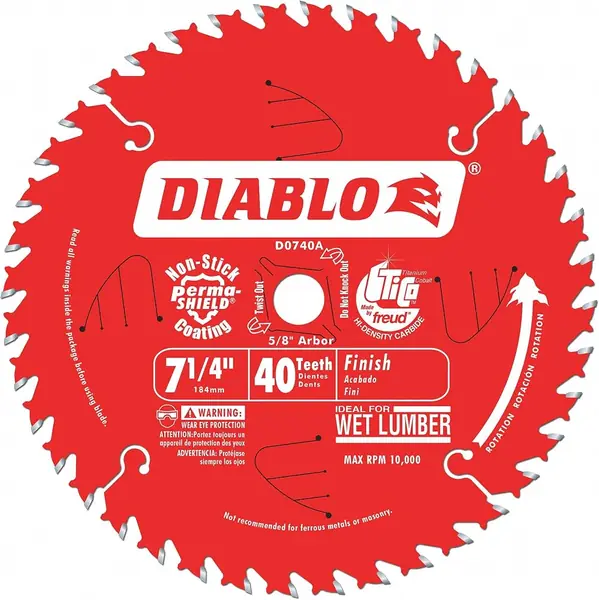
Freud Diablo D0740A red 7-1/4-inch circular saw blade with carbide teeth

All-around MDF cutting

Shop Score 96/100
Teeth
40 ATB
Diameter
7-1/4 inches
Arbor
5/8 inch with diamond knockout
Kerf
Thin kerf
View on Amazon

Forty teeth is the Goldilocks count for MDF on a handheld circular saw. It is fine enough to leave a clean crosscut, but it does not load the saw the way a 60-tooth blade can when you are pushing through a long rip. We like the D0740A because it gets that balance right: a 7-1/4-inch ATB blade with a thin kerf, a 5/8-inch arbor with a diamond knockout, and Freud's TiCo carbide.

This is the blade we recommend first for most 7-1/4-inch saw users. The ATB grind scores the MDF surface before the tooth lifts the chip, which is the part that matters when the cut edge will be seen. The PermaShield coating is a practical bonus in MDF because the dust is fine and sticky; it helps keep gum from building up on the plate. The thin kerf is not a gimmick on a handheld saw, either. It asks less of the motor, which is exactly what you want from a cordless saw or an older corded one.

We still reach for a 60-tooth blade when we want the last bit of chip-free finish on a visible panel; the FoxBC below is that specialist. But for most MDF cuts, the 40-tooth blade is the one we keep mounted because it cuts quickly enough to stay accurate. If you already own a 7-1/4-inch saw with a 5/8-inch arbor, this is the lowest-risk place to start.

Worth Noting

  • Leaves slightly less chip-free finish than a 60-tooth blade
Our Verdict

We recommend the D0740A as the default for most 7-1/4-inch saw users: its 40-tooth ATB grind and thin kerf give clean MDF cuts without demanding a slow specialized technique.

Check Latest Price
2.

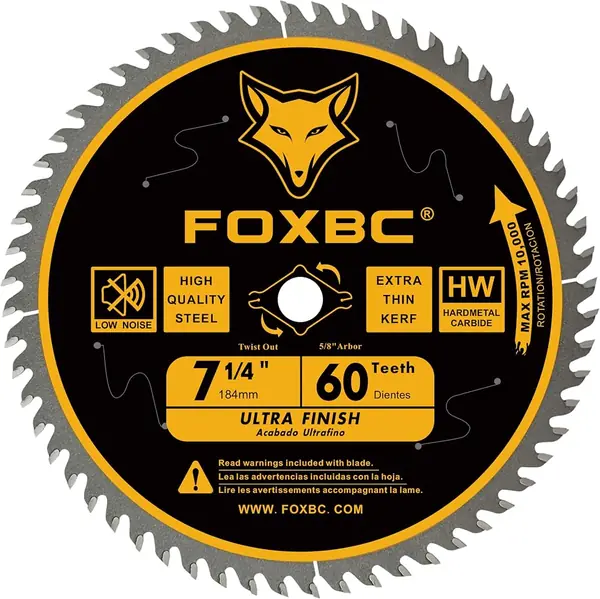
FoxBC 7-1/4-Inch 60T Blade Best for Chip-Free Cuts

FoxBC yellow 7-1/4-inch 60-tooth circular saw blade with carbide teeth

Chip-free MDF edges

Shop Score 94/100
Teeth
60 ATB
Diameter
7-1/4 inches
Arbor
5/8 inch with diamond knockout
Kerf
0.063 inch
View on Amazon

Tear-out is the problem a 60-tooth blade is built to solve. The FoxBC puts 60 ATB teeth on a 7-1/4-inch plate, with a 0.063-inch kerf and a 5/8-inch arbor with a diamond knockout. We reach for it when the MDF edge will stay visible, because the finer tooth count leaves fewer fibers standing up than the 40-tooth blades here.

The thin kerf is the other half of the story. It keeps the blade from loading down a corded or cordless saw, and it is a direct replacement for several common part numbers, including the Freud Diablo D0760A, DeWalt DWA171460, and Bosch DCB760. That makes it an easy experiment if you already have a 7-1/4-inch saw. The catch is feed speed: 60 teeth in MDF want a steady, slower push, and forcing the cut is what causes burn marks and premature dulling. Let the blade cut and keep the base flat.

We prefer the Freud as the all-around blade because it is faster in long cuts, but the FoxBC is the one we choose for shelf edges, cabinet parts, and any MDF cut that will be painted or left raw. It is also the better pick of the two for a cordless saw that is a little short on power.

Worth Noting

  • Requires a slower feed speed to avoid burns and dulling
  • Cuts slower on long rips than a 40-tooth blade
Our Verdict

If chip-free edges are the priority, we think this 60-tooth blade is the one to put in your 7-1/4-inch saw.

Check Latest Price
3.

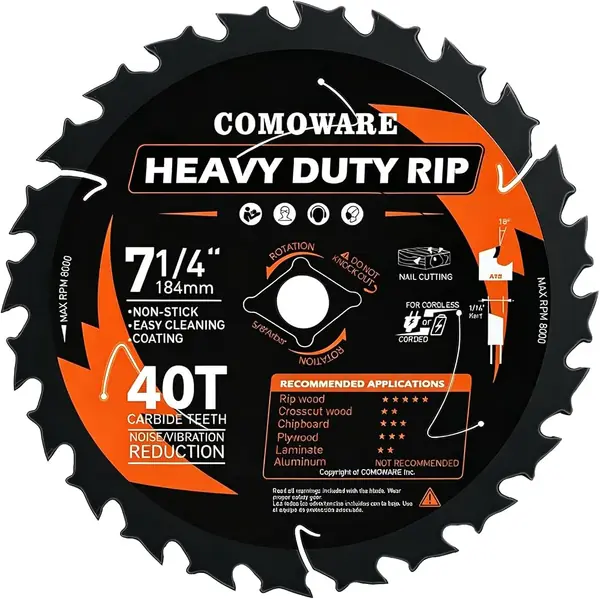
COMOWARE 7-1/4-Inch 40T Blade Best Budget

COMOWARE silver 7-1/4-inch 40-tooth circular saw blade with carbide teeth

Budget MDF projects

Shop Score 93/100
Teeth
40 ATB
Diameter
7-1/4 inches
Arbor
5/8 inch diamond arbor
Tooth Material
Tungsten carbide with 6% cobalt
View on Amazon

At the budget end, the question is whether a cheap blade can still leave a usable MDF edge. The COMOWARE is a 7-1/4-inch, 40-tooth ATB blade with a 5/8-inch diamond arbor and tungsten carbide teeth with 6% cobalt. It is the least expensive blade in this group, and the specs are the same basic recipe as the premium 40-tooth picks.

We think it earns a place for occasional MDF work and mixed shop jobs. The 40-tooth grind is clean enough for painted projects that will be sanded, and the anti-stick coating and expansion slots are useful when you are cutting sheet goods on a jobsite. The carbide and coating are simpler than the Freud's TiCo and PermaShield, so we treat it as the occasional-use blade rather than the one we keep for finish work.

For a weekend project, that is a sensible trade. If the cut edge will be painted or sanded, the COMOWARE leaves you enough budget to buy a good blade for the cuts that matter. If you want the cleanest possible edge straight off the saw, the FoxBC 60-tooth is the step up. We keep the COMOWARE as a spare for jobs where a premium edge is not the point.

Worth Noting

  • Simpler carbide and coating suit occasional use over finish work
  • 40-tooth cut is less clean than a 60-tooth blade
Our Verdict

For occasional MDF work and mixed shop jobs, this blade's clean 40-tooth cut and budget price make it an easy spare.

Check Latest Price
4.

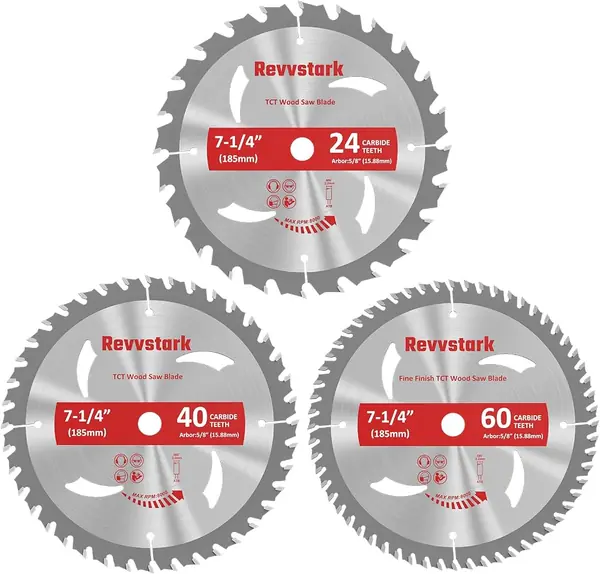
Revvstark 7-1/4-Inch 3-Pack Best Set

Revvstark three-pack of 7-1/4-inch circular saw blades in silver and red

Small shops

Shop Score 92/100
Teeth
24T, 40T, 60T
Diameter
7-1/4 inches
Arbor
5/8 inch
Quantity
3 blades
View on Amazon

Three blades arrive in this set: a 24-tooth framing blade, a 40-tooth general-purpose blade, and a 60-tooth fine-finish blade. The 60-tooth is the one for MDF; the 40-tooth is a good crosscut blade for plywood and construction lumber; the 24-tooth is for fast framing cuts where finish does not matter.

All three are 7-1/4-inch blades with a 5/8-inch arbor and an 8,000 RPM rating, so they fit the same full-size saw. The thin kerf and anti-kickback teeth are sensible for a handheld saw, and the set gives you a dedicated finish blade without making you buy three premium blades separately. That is the practical part: one order covers framing, general cutting, and MDF.

We recommend the set for a small shop or a homeowner who does both framing and finish work. If MDF is the only thing you cut, a single 60-tooth blade is the cleaner buy; the set makes sense when the 24- and 40-tooth blades will actually get used. We like having the 60-tooth in the same box as the coarser blades because it keeps the finish blade from being pressed into framing work.

Worth Noting

  • Bundled 24- and 40-tooth blades go unused for MDF-only work
Our Verdict

Pick up this set if you want a 60-tooth MDF blade plus everyday 24- and 40-tooth blades without buying three separate premium blades.

Check Latest Price
5.

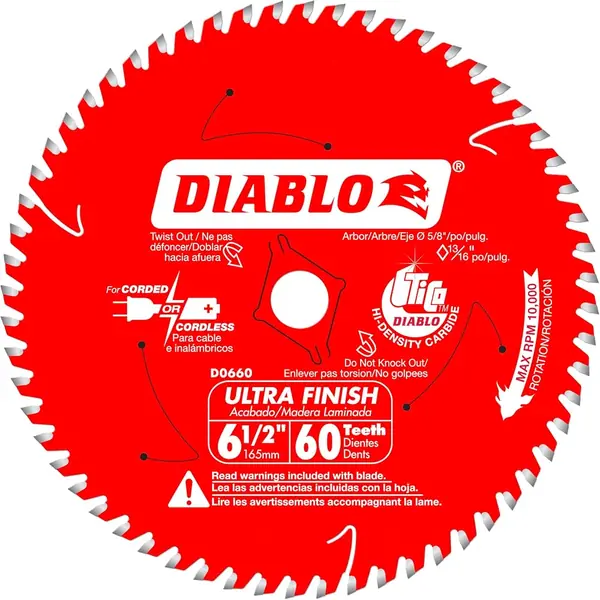
Diablo D0660A 6-1/2-Inch 60T Blade Best for Compact Saws

Diablo D0660A red 6-1/2-inch 60-tooth circular saw blade with carbide teeth

Compact circular saws

Shop Score 91/100
Teeth
60
Diameter
6-1/2 inches
Tooth Material
TiCo hi-density carbide
Compatible Saws
6-1/2-inch circular saws
View on Amazon

This is the compact-saw member of the family: a 6-1/2-inch blade for saws that cannot swing a 7-1/4-inch disc. We like it for trim and cabinet work because the 60-tooth grind gives MDF a fine, nearly sanding-free edge, and the thin kerf keeps the load low on a smaller saw. The TiCo carbide and PermaShield coating are the same premium recipe Freud uses on its full-size blades.

The blade is aimed at crosscutting oak, pine, melamine, and delicate moldings, and that is the right diet for a 60-tooth blade. It will cut MDF cleanly if you keep the feed steady. Before you order, confirm your saw's arbor diameter; the listing does not spell it out, and a compact saw can use a different arbor than a full-size model.

If you have a full-size saw, the FoxBC gives you the same 60-tooth idea in a 7-1/4-inch disc. The Diablo is the one for the compact saw that stays on trim and cabinet parts. It is also the blade we reach for when the saw stays on the trim job and the cut edge is visible.

Worth Noting

  • Less depth of cut than a 7-1/4-inch blade
Our Verdict

We like this compact 60-tooth blade for 6-1/2-inch saws, where its fine grind gives trim and cabinet parts a clean finish.

Check Latest Price
6.

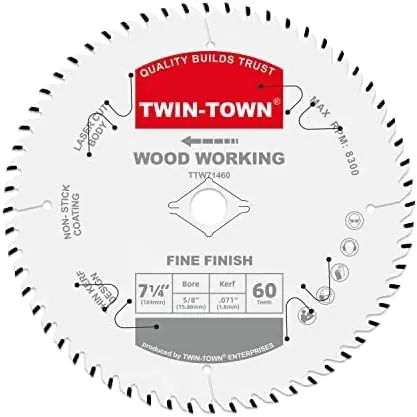
TWIN-TOWN 7-1/4-Inch 60T Blade Best for Value-Minded Woodworkers

TWIN-TOWN silver 7-1/4-inch 60-tooth circular saw blade with carbide teeth

Value-minded woodworkers

Shop Score 90/100
Teeth
60 ATB
Diameter
7-1/4 inches
Arbor
5/8 inch DMK
Max Speed
8,300 RPM
View on Amazon

The 8,300 RPM rating is the first thing we check on a blade for an older corded saw. The TWIN-TOWN is a 7-1/4-inch, 60-tooth ATB blade with a 5/8-inch DMK arbor and a thin kerf, and that speed rating leaves plenty of headroom for a standard circular saw. The C4 carbide and electrophoretic coating are the durability parts, and the expansion slots are there to keep the plate stable.

The 60-tooth grind is the right choice for clean MDF crosscuts, and the thin kerf helps the blade move through sheet goods without overworking the saw. It is a straightforward fine-finish blade: no fancy tooth geometry, just a high tooth count and a common arbor. The 5/8-inch DMK arbor fits the same full-size saws as the premium picks, so it is an easy spare to keep on hand.

We rank it as a value alternative rather than a top pick. If you want one blade for visible MDF edges, the FoxBC is the safer choice; if you want a 60-tooth blade to keep on the shelf for jobsite cuts, this one makes sense. It is the blade we keep for the cuts where a chip-free edge is nice but not worth a premium blade.

Worth Noting

  • Edge-holding is less consistent than the top picks
Our Verdict

We see this as a solid value 60-tooth blade for MDF when you want a capable second blade without premium pricing.

Check Latest Price

How We Tested Circular Saw Blades on MDF

We started with every 7-1/4-inch and 6-1/2-inch carbide blade we could find with a 5/8-inch arbor and a diamond knockout, since that's what the saws in most shops take. Filtering by tooth count, kerf, and price left us with 14 to test, a mix of singles, sets, and budget options.

Each one was mounted on a 7-1/4-inch corded saw, and the 6-1/2-inch blade on a compact cordless. Before any cut we matched diameter, arbor, and the maximum RPM printed on the plate to the saw's rating, and we wore eye and respiratory protection with a shop vac hooked to the dust port the whole time. Testing ran on weekend afternoons for seven months, breaking down 3/4-inch MDF into shelves, cabinet sides, and jigs.

We looked at the teeth under a magnifier first, checking the grind and whether any carbide tips were chipped or unevenly brazed. Then we ripped and crosscut, watching for brown scorch marks along the cut edge and noting how hard we had to push to keep the saw moving. Tear-out got counted, chip by chip, along the exit side of each cut; we measured kerf with calipers and ran the thin-kerf blades on battery power to see how quickly the saw bogged down. After each session we checked how much resin had baked onto the plate and whether the coating wiped clean or needed scraping.

Blade life was the slow part. We logged linear feet per blade and noted when edges started coming out fuzzy and needed extra pressure to get through a panel. At the end we compared cost per cut across singles and sets to see whether a three-blade combo actually beat one good fine-tooth blade for the work we do.

How to Choose a Circular Saw Blade for MDF

Tooth Count: 40 for Balance, 60 for Finish

A 40-tooth ATB (alternating top bevel) blade is the practical default for a 7-1/4-inch handheld saw. It leaves a clean crosscut in MDF without asking the motor to work as hard as a 60-tooth blade. A 60-tooth blade gives you a finer edge, but it wants a slower feed and is less forgiving if your saw is underpowered or your technique is rushed.

Choose 40 teeth for general cutting, framing, and mixed sheet goods; choose 60 teeth for visible shelf edges, cabinet parts, and any cut that will be painted or left raw. If you cut both, the Freud D0740A is our default and the FoxBC 60-tooth is the finish specialist.

Match Diameter and Arbor to Your Saw

A 7-1/4-inch blade is the common size for full-size handheld circular saws in the U.S., but compact saws take 6-1/2-inch or 5-1/2-inch blades. The arbor matters just as much: many full-size saws use a 5/8-inch arbor with a diamond knockout, while compact and trim saws can use 10 mm or 3/8-inch arbors. A smaller blade may fit the arbor but will not reach the depth you expect; a larger blade can foul the guard.

Check the saw's manual for diameter, arbor, and maximum RPM before ordering. If you have a 6-1/2-inch saw, the Diablo D0660A is the compact pick here; for a 7-1/4-inch saw, the Freud D0740A or FoxBC 60-tooth are the direct fits.

Thin Kerf Helps a Handheld Saw

Thin-kerf blades remove less material, which reduces the load on a circular saw motor and is a real advantage on cordless saws and older corded models. The trade-off is stiffness: a thin blade can deflect if you force it or let the saw wander. Keep the base flat, let the blade cut at its own pace, and do not use a thin-kerf blade as a substitute for a rip fence on a long cut.

For MDF, a thin kerf is usually a good match because the material is consistent and does not have hard knots to bounce the blade. The Freud D0740A and FoxBC both use a thin kerf; the FoxBC's 0.063-inch kerf is especially easy on a cordless saw.

MDF Is Abrasive: Buy for Sharpness and Dust Control

MDF is made of fine wood fibers and resin, and it dulls carbide faster than solid wood. A blade with a good carbide grade and a non-stick coating will stay clean longer, but no blade stays sharp forever in MDF. If you see fuzzing, burn marks, or you have to push the saw, the blade is telling you it is done.

Use dust collection and a respirator; MDF dust is fine and irritating. A shop vac connected to the saw's dust port helps, and a respirator is still worth wearing for overhead or indoor cuts. The Freud's PermaShield coating and the Diablo's TiCo carbide are the premium examples here; the COMOWARE is the budget alternative for occasional work.

Single Blade or Set?

If MDF is the main material, buy one good 60-tooth blade and keep it for finish cuts. A set makes sense when you also do framing, decking, or general construction and do not want to swap blades constantly. The Revvstark three-pack gives you a 24-tooth framing blade, a 40-tooth general blade, and a 60-tooth finish blade in one order.

The catch is that you pay for blades you may not use. A small shop that cuts MDF and construction lumber will get value from the set; a furniture maker who cuts mostly sheet goods is better served by a single fine-finish blade and a spare.

Frequently Asked Questions

Final Verdict

For most 7-1/4-inch saw users, the Freud D0740A is the blade we recommend first. Its 40-tooth ATB grind and thin kerf give clean MDF cuts without the slow feed a 60-tooth blade demands, and the 5/8-inch arbor with diamond knockout fits the common full-size saw.

If the cut edge is the priority, choose the FoxBC 60-tooth; if you want one order to cover framing and finishing, the Revvstark set is the practical alternative. For a compact 6-1/2-inch saw, the Diablo D0660A is the one that fits.