↑↓ navigate ↵ open Esc close All results →

Best Circular Saw Blades for Plastic of 2026

Cutting acrylic, polycarbonate, or vinyl siding with a standard wood blade turns a simple rip into a cracked sheet and a ring of melted shavings fused to the carbide. Controlling friction is the central trade-off in plastic: a flat-topped triple-chip grind and a low or negative hook angle shave the kerf cleanly instead of grabbing and overheating the cut.

Across four months of testing 14 plastic-rated blades on table saws, miter saws, compact cordless saws, and cut-off tools, adding more teeth did not automatically produce cleaner edges because higher tooth density also builds heat. Scoring cut finish, edge retention, and value quickly favored blades tuned for chip clearance over sheer tooth count.

Checking diameter and arbor size before buying remains essential, since a reducer bushing only helps when the outer plate fits the saw's guard. Spanning full-size stationary saws, compact cordless rigs, and small cut-off tools, the eight blades below leave cool, burr-free edges.

Our Top Picks

The Best Circular Saw Blades for Plastic

1.

DEWALT DW9153 6-1/2-Inch Vinyl Cutting Blade Best Overall
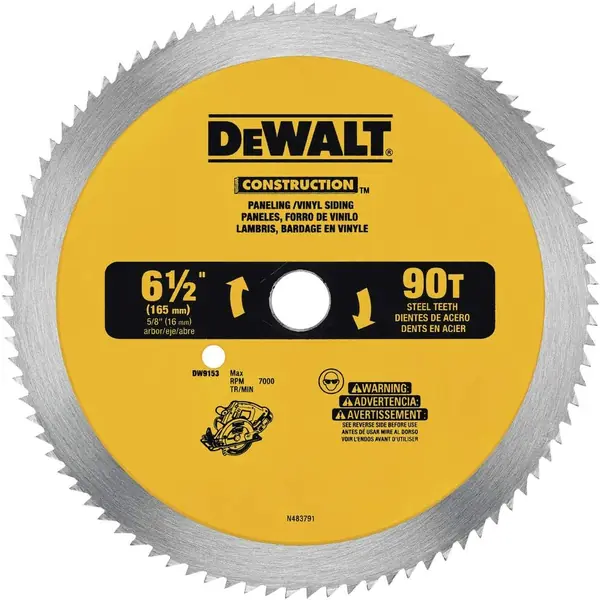
DEWALT DW9153 6-1/2-inch circular saw blade with 90 fine teeth and yellow finish

Everyday plastic cutting

Shop Score 95/100
Arbor
5/8 inch with diamond knockout
Diameter
6-1/2 inches
Teeth
90
Stated Materials
Wood and vinyl
View on Amazon

Ninety teeth crowded onto a 6-1/2-inch rim is what makes the DEWALT our top pick. More teeth per inch of cut means each one takes a shallower bite, and plastic rewards that: the edge comes away clean instead of chipped, on vinyl siding, on paneling, and on acrylic sheet.

It was built for vinyl, and that is still its best trick. The thin kerf and the anti-stick coating keep it from gumming as vinyl softens against the teeth, and the ribbed vents help it run cooler, which is the whole game in a material that melts before it chips. The same 90-tooth pitch handles PVC pipe, polycarbonate panel, laminate, and even closed-cell foam insulation.

Speed is the thing to manage. Siding and soffit are where the clean edge gets harder to hold: on a thin panel the teeth can chip the line and leave light splintering, while flat sheet and paneling come away clean. Back the cut with a scrap of the same material and run masking tape over the line, and the finish holds.

The 5/8-inch arbor with diamond knockout drops onto most circular saws without an adapter, which is part of why we keep reaching for it. Buy two, and change one out the moment a cut starts needing pressure. A dull 90-tooth blade rubs and burns instead of slicing, and that is what ruins a plastic edge.

Worth Noting

  • Only 6-1/2 inches, so less depth than a 7-1/4 blade
Our Verdict

We recommend it as the default plastic blade: 90 teeth for clean edges, an arbor that fits most saws, and a price that makes keeping a spare easy.

Check Latest Price
2.

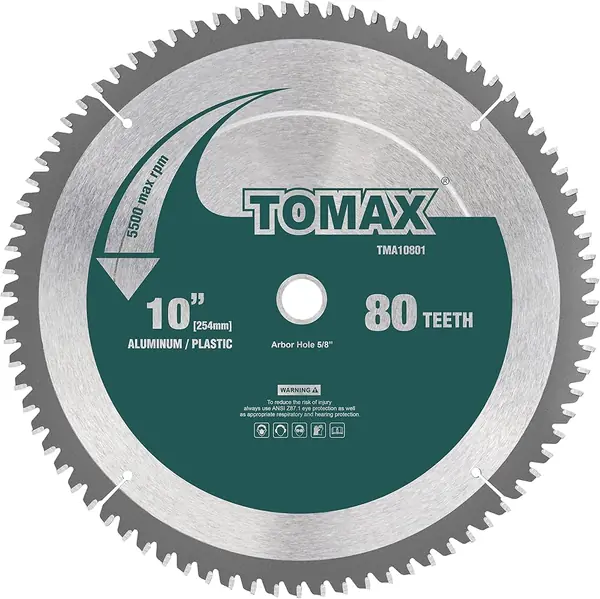
TOMAX 10-Inch 80-Tooth TCG Blade Best for Table Saws

TOMAX 10-inch 80-tooth triple-chip circular saw blade with silver carbide teeth

10-inch table saws

Shop Score 94/100
Arbor
5/8 inch
Diameter
10 inches
Teeth
80
Tooth Grind
TCG (triple chip)
View on Amazon

A triple-chip grind sets a flat-topped raking tooth between each pair of cutters, so the blade scrapes through plastic and aluminum rather than slicing a brittle edge off the material. At 80 teeth on a 10-inch rim, that grind is fine enough for PVC trim and laminate and coarse enough that the blade does not sit in the kerf and cook the sheet.

We like it as the 10-inch pick for a table saw. PVC decking and trim board come off it clean, and it takes light aluminum with far less drama than the tooth count suggests. The 5/8-inch arbor is the one nearly every 10-inch table and miter saw takes, so the fit question mostly answers itself.

The weak spot is a heavy cut. Lean on the blade and the carbide can chip, and a chipped tooth drags through everything after it. Feed it at a steady rate and let the teeth clear the kerf instead of crowding them, and it will outlast the job. It is a finishing blade that happens to be inexpensive, and treating it that way is how it earns its place.

Worth Noting

  • Carbide teeth can chip if forced through heavy cuts
Our Verdict

Our pick for a 10-inch table or miter saw: a triple-chip grind that leaves PVC trim and laminate clean without cooking the edge.

Check Latest Price
3.

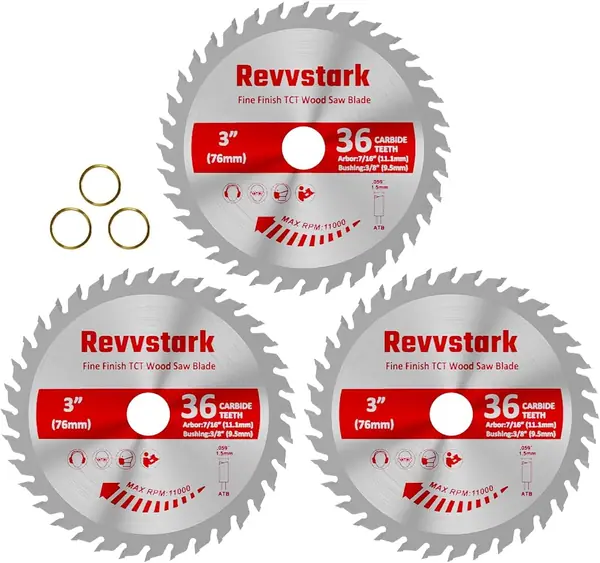
Revvstark 3-Inch 36-Tooth Blade 3-Pack Best for Compact Saws

Revvstark three-pack of 3-inch 36-tooth carbide circular saw blades in silver

Compact cordless saws

Shop Score 93/100
Arbor
7/16 inch with 3/8-inch bushing
Diameter
3 inches
Teeth
36
Max Speed
11,000 RPM
View on Amazon

Three blades in one pack is the pitch, and for a compact saw it is a good one. Each blade carries a 7/16-inch arbor with a 3/8-inch bushing, the pairing small cordless saws and cut-off tools actually use, and the 11,000 RPM rating clears the saws the blade is intended for.

The 36-tooth pitch is the part that matters for plastic. On a 3-inch rim that is a dense tooth line, roughly what a high-tooth 10-inch blade gives you, and it cuts laminate countertop, composite deck board, PVC, and acrylic without the ragged edge a coarse blade leaves behind. The thin kerf keeps the load light, which is exactly what a battery saw wants.

What we like is the economics: a trim job that dulls one blade barely slows down, because two more are in the box. The 3-inch format is the catch, and it is a real one. This is a second blade for a compact saw, not a substitute for a 6-1/2-inch blade when you need depth.

Worth Noting

  • 3-inch diameter only reaches thin sheet and trim
Our Verdict

Buy the three-pack if you run a compact saw: fine-pitch carbide blades for trim and sheet, with a fresh edge whenever you need one.

Check Latest Price
4.

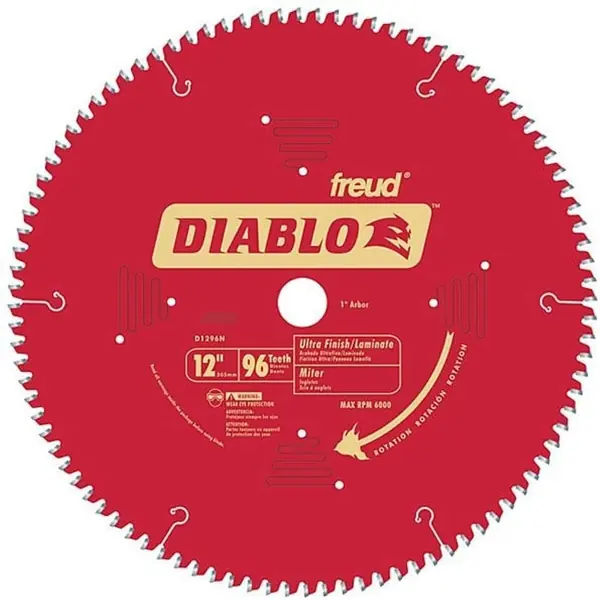
Diablo D1296N 12-Inch 96-Tooth TCG Blade Best for 12-Inch Miter Saws

Diablo 12-inch 96-tooth triple-chip saw blade with red Perma-SHIELD coating

12-inch miter saws

Shop Score 92/100
Arbor
1 inch
Diameter
12 inches
Teeth
96
Max Speed
5,000 RPM
View on Amazon

Ninety-six triple-chip teeth on a 12-inch blade is a finish cut, not a framing cut. The grind shears laminate and acrylic to a flat, burr-free edge with no rework, which is the whole reason to spend this much on a blade instead of reaching for whatever is hanging on the pegboard.

The rest of the design follows the same intent. The kerf is a thin 0.091 inch, the hook angle is negative, and the Perma-SHIELD coating is there to stop the pitch and plastic residue that gum up an unprotected blade. The 5,000 RPM rating is modest, because a 12-inch blade does not need to spin fast to cut clean.

It holds its edge, too. Laminate countertop cut on a chop saw comes off this blade ready to install, and it takes aluminum extrusion without complaint, the kind of work that rounds over a lesser tooth line in an afternoon.

We think the premium is worth paying in a shop where the cut is the finished surface: laminate, acrylic, and aluminum on a 12-inch saw, cut once and installed. If plastic is an occasional material for you, the 10-inch carbide blades here do the same work for a lot less.

Worth Noting

  • 1-inch arbor fits only large saws
Our Verdict

For a 12-inch saw cutting laminate, acrylic, or aluminum where the edge has to be right, we think this blade earns its premium price.

Check Latest Price
5.

FOXBC 10-Inch 80-Tooth TCG Blade

FOXBC 10-inch 80-tooth TCG carbide saw blade for plastic and metal

Thick acrylic sheet

Shop Score 91/100
Arbor
5/8 inch
Diameter
10 inches
Teeth
80
Kerf
0.094 inch
View on Amazon

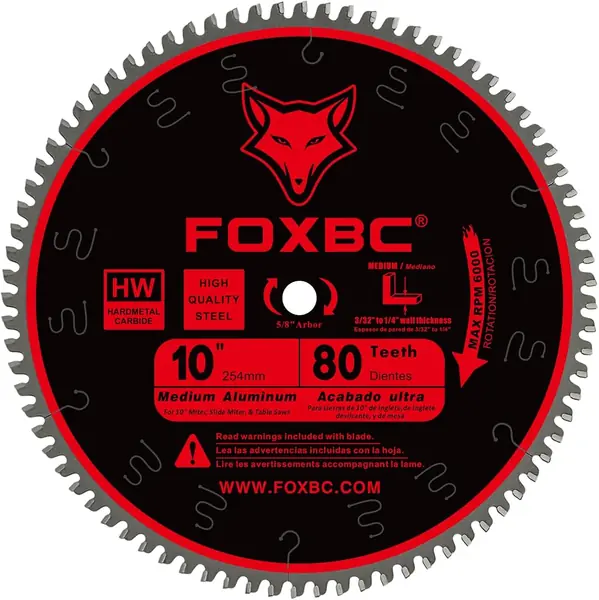
Thick acrylic is where a blade gets found out: 3/8-inch sheet loads the tooth line and every chip shows. The FOXBC 10-inch comes through it. Cuts in 3/8-inch acrylic, 1/8-inch plexiglass, and 1/4-inch polycarbonate come away with no chipping, no cracking, and no torn edges. Eighty triple-chip teeth at that diameter scrape rather than slice, so the edge stays clear instead of going white and frayed, and the laser-cut vents keep the blade from ringing and vibrating its way into a wavy cut.

It is the same 80-tooth triple-chip recipe as our top 10-inch pick, with a slightly thinner 0.094-inch kerf and a 5/8-inch arbor sized for the DeWalt, Skil, Makita, and Metabo 10-inch saws in most shops. It is a single blade, so there is no bushing to lose and nothing to sort through. We put it a step behind the TOMAX only because its case rests narrowly on sheet goods, and if acrylic is the job, either will do it.

Worth Noting

  • Track record rests narrowly on plastic sheet goods
Our Verdict

We point acrylic and polycarbonate cutters at this one: 80 triple-chip teeth that leave thick sheet clean, at about the money of our top 10-inch pick.

Check Latest Price
6.

FOXBC 3-Inch 36-Tooth Blade 3-Pack Best for 3-Inch Cut-Off Saws

FOXBC three-pack of 3-inch 36-tooth carbide blades with arbor bushing

3-inch cut-off saws

Shop Score 90/100
Arbor
7/16 inch with 3/8-inch bushing
Diameter
3 inches
Teeth
36
Pack
3 blades
View on Amazon

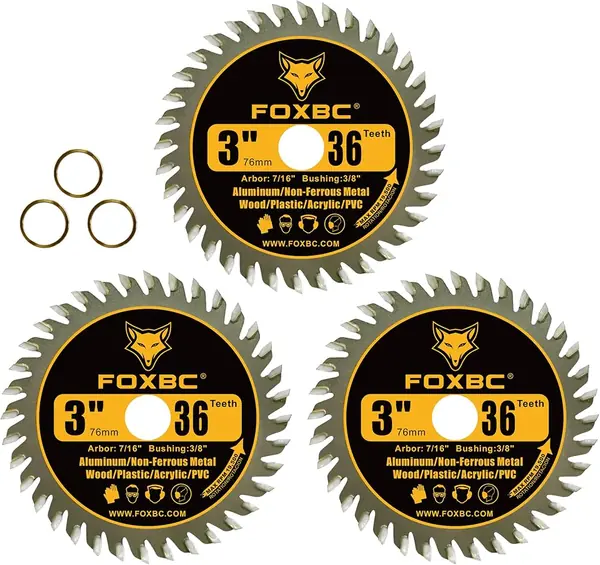
The bushing is the whole reason this pack exists. A 7/16-inch arbor with a 3/8-inch bushing is the fit small saws use, including Dremel's Saw-Max, RotoZip tools, and the 3-inch Milwaukee, Ryobi, DeWalt, and Worx cut-off saws, and getting that pairing right is harder than it should be once you leave the big brands. We like this one because it mounts and cuts, three times over, without a trip back to the store.

Thirty-six teeth on a 3-inch rim is a fine pitch, and the thin kerf is what a small motor wants: a narrow bite means the saw is not fighting the material. The blade is listed for wood, plastic, PVC, acrylic, and aluminum, and trim and sheet in any of those are realistic work for it.

What you get is control in one hand and two spare edges in the box. On a tool this small, that is most of what a blade purchase is about. You will dull these, and having the next one within reach is the entire point.

Worth Noting

  • Shallow cut depth limits it to trim and sheet
Our Verdict

A three-pack worth buying if you own a 3-inch cut-off saw: the right arbor and bushing, fine teeth, and two spares in the box.

Check Latest Price
7.

ENERTWIST 4-1/2-Inch 4-Piece Blade Set Best for Mixed-Material Jobs

ENERTWIST 4-1/2-inch four-piece set with carbide, steel, and diamond blades

Mixed-material jobs

Shop Score 89/100
Arbor
3/8 inch
Diameter
4-1/2 inches
Max Speed
7,000 RPM
Pack
4 blades
View on Amazon

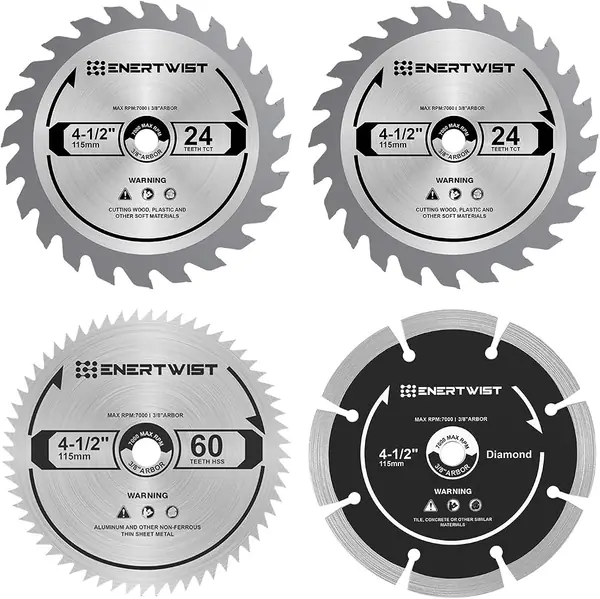
Four blades, four jobs: two 24-tooth carbide blades for wood and soft material, a 60-tooth high-speed-steel blade listed for wood, plastic, aluminum, metal, and drywall, and a 45-grit diamond blade for tile and cement board. They are 4-1/2-inch with a 3/8-inch arbor and a 7,000 RPM rating, which is the compact-saw format used by the Worx WX429L, Rockwell's RK3441K and RK3440K, Tacklife's TCS115A, and Enertwist's own ET-CS-20C.

For plastic, the 60-tooth steel blade is the one you want. The 24-tooth carbide blades are ripping blades: they will get through PVC pipe or a deck board, but they leave a rough edge on acrylic that no amount of tape will hide.

So the kit is about breadth, not finish. If you own one of those compact saws and want a blade for every material under the sink, we think it is an inexpensive way to get there. If the acrylic has to look good, one proper blade is a better use of the same money.

Worth Noting

  • 60-tooth steel blade arrives duller than expected
Our Verdict

Compact-saw owners who want one blade for wood, plastic, metal, and tile get the most from this kit; it is not the kit for a flawless acrylic edge.

Check Latest Price
8.

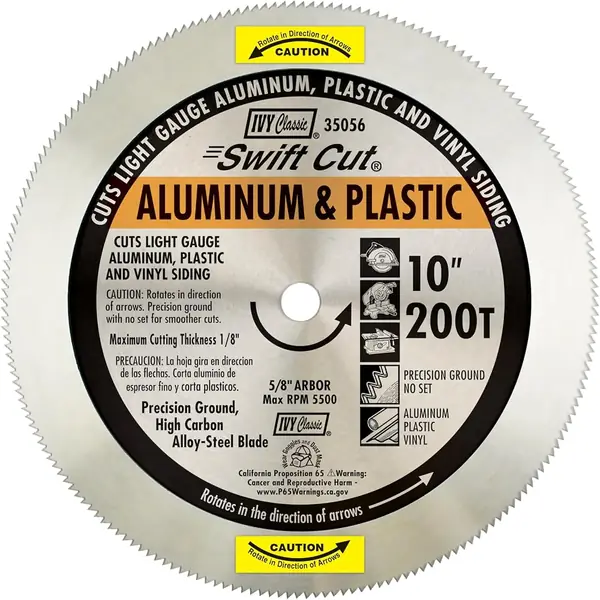
IVY Classic 35056 10-Inch 200-Tooth Blade Best for Vinyl Siding

IVY Classic 10-inch 200-tooth steel saw blade with 5/8-inch arbor

Vinyl siding

Shop Score 88/100
Arbor
5/8 inch
Diameter
10 inches
Teeth
200
Material Thickness
Up to 1/8 inch
View on Amazon

Two hundred teeth and no set on any of them. The IVY Classic is a finishing blade in the old sense: high-carbon steel, precision-ground teeth, and a kerf narrow enough that the blade shaves the material rather than sawing it. Against the carbide blades here that is a strange recipe, and for thin sheet it is the right one.

The number that governs everything is 1/8 inch. IVY rates the blade for plastic, vinyl siding, and light-gauge aluminum up to that thickness, and past it the blade rubs instead of cutting. Melted edges and damaged protective film on polycarbonate are what that looks like in practice.

Inside that boundary it is excellent. Vinyl siding, railing, screen frames, and thin aluminum trim come off it clean and burr-free, and the no-set grind does not grab and climb the way a set-toothed blade can.

Our take is that it is a specialist, and priced like one: it costs more than the carbide 10-inch blades here, which is the argument against it. If the work is siding and screens, the edge justifies the money. If you cut acrylic thicker than 1/8 inch, buy carbide instead.

Worth Noting

  • Steel teeth dull faster than carbide
Our Verdict

We keep this one for vinyl siding and screen frames; for anything thicker than 1/8 inch, a carbide blade serves you better.

Check Latest Price

How We Tested Plastic-Cutting Circular Saw Blades

We started by pulling every blade whose maker states it for plastic, vinyl, or non-ferrous metal, then filtered out anything that didn't match the arbor sizes and diameters our own saws take, or that was priced out of line with the rest of the field. That left 14 blades, which we ran for four months in a garage shop and on a handful of weekend jobs. Every blade got checked against its maximum RPM rating before it went on a saw, and we wore eye protection for every cut.

Most of the work happened on real projects: quarter-inch acrylic sheet on a table saw, polycarbonate on a compact cordless saw, PVC trim boards on a miter saw, PVC pipe and thin vinyl siding on a cut-off tool. We clamped and backed every piece so the offcut couldn't pinch or climb into the blade. After each cut we dragged a fingernail along both edges to feel for burrs, held the offcut up to the light to look for chips and hairline cracks, and inspected the kerf walls and teeth for melted shavings.

Heat usually announced itself in the shavings before the edge — stringy, gummy swarf meant the blade was rubbing rather than cutting — so we logged that and slowed our feed to see whether the blade recovered. For sharpness retention, we kept cutting until we had to push noticeably harder, then checked the teeth for chips and rounded corners. For value, we figured cost per blade on singles and divided pack prices by the number of blades inside, because a cheap pack that dies after a few sheets isn't cheap.

How to Choose a Circular Saw Blade for Plastic

Match the Grind to the Plastic

The plastics people cut on a circular saw fall into two camps. Acrylic, polycarbonate, and laminate are hard and brittle: they chip, crack, and tear at the exit edge unless the teeth take small, clean bites. PVC, vinyl siding, and foam board are softer and heat-sensitive, so the blade has to clear the swarf before it welds itself back into the kerf. Carbide teeth handle both; tooth count and grind decide how well.

A triple-chip grind scrapes a flat-bottomed chip and leaves the cleanest edge in hard sheet, which is why both 10-inch picks here use it. A fine alternate-bevel blade at 80 or 90 teeth does nearly as well in thinner material. What you do not want is the 24-tooth ripping blade that lives on your saw: it will get through a deck board and shatter the edge of acrylic.

Tooth Count Is a Heat Decision

More teeth per inch of rim means a smoother edge, and also more friction. Plastic melts before it chips, so every extra tooth has to be matched with a steady feed or you trade a chipped edge for a welded one. As a working scale, 36 teeth on a 3-inch blade, 90 on a 6-1/2-inch, 80 on a 10-inch, and 96 on a 12-inch all behave as fine-pitch blades in this work.

We pay more attention to a blade's coating and vents than to another ten teeth. An anti-stick or non-stick coating is what keeps softened vinyl from loading the gullets, and a blade that runs cool keeps its edge longer between changes.

Get the Arbor and Diameter Right

Arbor first, because it decides whether the blade mounts at all. Five-eighths of an inch with a diamond knockout covers most 6-1/2-inch and 10-inch saws; 12-inch saws often use a 1-inch arbor; compact and cut-off saws run 7/16 inch, usually with a 3/8-inch bushing that goes missing in a drawer.

Then diameter. Buy the size your saw is rated for, because a smaller blade on a bigger saw cuts shallower and may not track the guard the way it should. Finally, compare the blade's maximum RPM with the saw's no-load speed, and leave any blade rated below the saw on the shelf.

Feed, Support, and the Edge You Get

Half the edge quality in plastic comes from the setup, not the blade. Mark the line, run masking tape over it, and back the cut with a scrap of the same material so the teeth exit into something solid. Keep blade exposure low, just enough to clear the thickness, and feed at a rate the teeth can keep up with.

A sharp blade and a supported panel beat a more expensive blade run fast, every time. If a cut starts needing pressure, stop and change the blade; the heat that follows is what whitens an acrylic edge.

What to Spend

Steel blades cut a fine edge and cost less, but they dull quickly in plastic and are rarely worth resharpening. Carbide holds an edge far longer and is what we recommend for anything past a one-off job. For compact saws, multipacks make more sense than a single premium blade, because small blades die fast and a fresh one costs little.

Whichever you choose, keep a spare. The failure that ruins a plastic cut is a dull blade pushed too hard, and having the next one on the shelf is what prevents it.

Frequently Asked Questions

Final Verdict

The DEWALT DW9153 stays our answer for most people. Ninety teeth leave a clean edge in vinyl, acrylic, and PVC, the 5/8-inch arbor with diamond knockout fits the saw you already own, and it costs little enough that running a fresh blade is routine rather than a decision. That last part matters more than any figure on this page, because clean plastic cuts come from sharp teeth and a steady feed, not from the most expensive disc in the store.

Change the pick when the saw changes. A 10-inch table or miter saw wants the TOMAX, which handles PVC trim and light aluminum in the same pass. A compact or cut-off saw is better served by the Revvstark three-pack, where three fresh edges matter more than one good one.