↑↓ navigate ↵ open Esc close All results →

Best Circular Saw Blades of 2026

The blade is the cheapest part of a circular saw setup and the one that decides what the cut looks like. A saw that burns and splinters cabinet plywood is often just wearing the wrong tooth count; swap in a finishing blade and the same saw leaves an edge you can glue. Most of us blame the tool. It's nearly always the blade, or a blade matched to the wrong job.

We ran 15 blades for six months through a deck rebuild, plywood shelving in a garage, and a basement's worth of trim, and the same lesson kept showing up: the right blade makes a modest saw feel stronger and takes sanding out of the job. The two specs shoppers skip are arbor shape and kerf — a blade that doesn't sit flat on the spindle will wobble no matter the tooth count, and thin kerf is often what lets a cordless saw pull through a wet 2x10 instead of stalling. Edge life matters too, since treated lumber eats teeth, and a blade you can afford to replace without flinching beats a precious one you baby.

Our Top Picks

The Best Circular Saw Blades

1.

Freud Diablo D0740A 7-1/4-Inch 40-Tooth Finishing Blade Best Overall
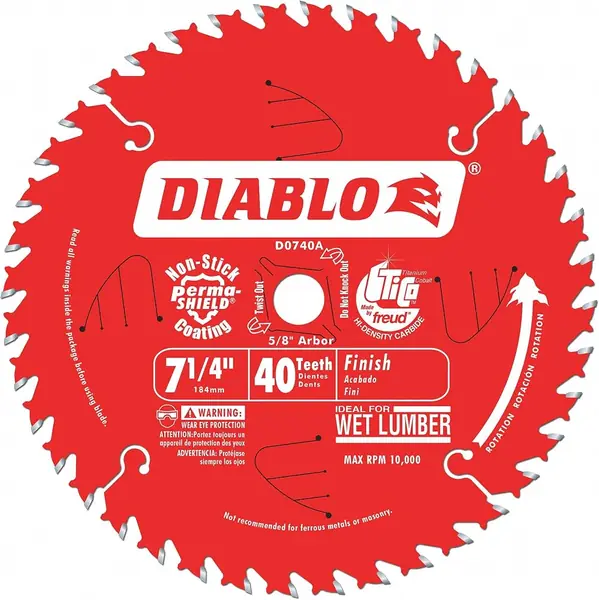
Freud Diablo 7-1/4-inch 40-tooth carbide circular saw blade with red PermaShield coating

Trim and plywood

Shop Score 97/100
Diameter
7-1/4 inches
Arbor
5/8 inch with diamond knockout
Coating
PermaShield non-stick
Tooth Count
40 ATB
View on Amazon

A 40-tooth blade is the difference between an edge you glue and an edge you sand, and this Diablo left the cleanest plywood cut of anything we ran. No tear-out on the top veneer, no burn marks on end grain. On a 7-1/4-inch sidewinder it turns a rough-framing saw into something that behaves like a finish tool.

The thin laser-cut kerf earns its keep two ways: it removes less stock, which you notice when hardwood is bought by the board foot, and it drags less, so a saw that isn't the most powerful one in the shop doesn't bog down in 2x material. The plate weighs 6.56 ounces and spins up fast, and the PermaShield coating kept pitch from welding itself to the teeth through a long session in green treated lumber.

We paid close attention to the arbor, because that's where a good blade becomes the wrong purchase. The 5/8-inch bore with a diamond knockout works on both a plain round spindle and the diamond-shaped arbor found on plenty of older worm-drive saws, so it's the version to order when you haven't pulled the old blade off yet. The TiCo carbide and tri-metal brazing are the parts you can't see; what you can see is a blade that still cut cleanly after a pile of pressure-treated 2x4s.

Forty teeth is a finish grind, not a framing grind. In thick, wet stock the thin plate will wander if you lean on it, so take a deep rip in two lighter passes and let the teeth do the work. For shelving, cabinet parts, plywood, and deck boards that have to look right, it's the blade we reach for first. Keep a 24-tooth on the shelf for the cuts nobody will see.

Worth Noting

  • Carbide tips chip if the blade is dropped on edge
Our Verdict

This is the blade we recommend to anyone with a 7-1/4-inch saw: 40 teeth, a thin kerf, and a diamond knockout that fits both common arbors.

Check Latest Price
2.

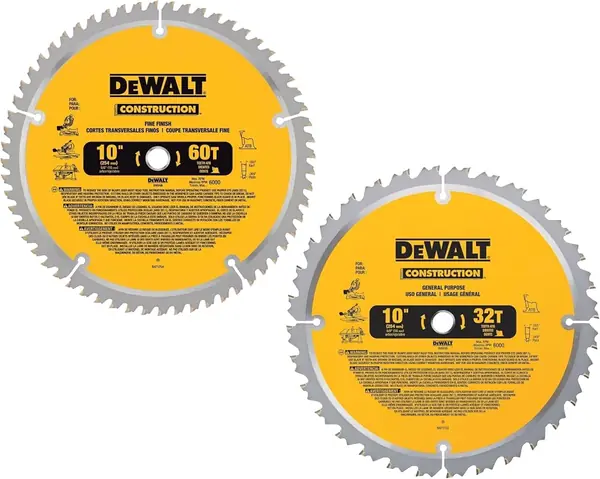
DEWALT DW3106P5 10-Inch 60-Tooth and 32-Tooth Combo Pack Best for Miter and Table Saws

DEWALT 10-inch two-blade combo with 60-tooth finish blade and 32-tooth general purpose blade

Miter saw work

Shop Score 96/100
Diameter
10 inches
Arbor
5/8 inch
Teeth
60 and 32
Plate Thickness
0.07 inches
View on Amazon

Two blades in one box answers the question that comes up halfway through a project on any 10-inch saw: keep the general-purpose blade on and live with the edge, or stop and swap. The DW3106P5 pairs a 32-tooth blade for sizing and ripping with a 60-tooth blade for trim, both 10-inch, both on a 5/8-inch arbor.

The 60-tooth is the one we kept coming back to. On a miter saw it left casing and shelving ready for a light sanding, and the thin 0.07-inch plate cuts with less vibration than the thick general-purpose blades that ship on most saws. What sells the pair, though, is that the second blade is already in the shop: you swap in under a minute instead of deciding the rough edge is good enough.

We liked that the 32-tooth is a real ripping blade and not a spare. It handles construction lumber and plywood sheathing without the burning that shows up when too many teeth are forced through wet 2x, and the computer-balanced plate keeps it from shaking the saw.

Both blades are 10-inch, so this set lives on the miter or table saw and does nothing for a sidewinder. It's a pair for 3/4 stock and trim rather than resawing a 6x6. If your work is all framing, one cheap 24-tooth does the job; if you finish what you frame, having both in the case is the reason to buy.

Worth Noting

  • 10-inch diameter does not fit handheld circular saws
  • Built for 3/4-inch stock rather than resawing heavy timbers
Our Verdict

For a 10-inch miter or table saw, buying the pair gets you a rough blade and a finish blade at once, and that's the sensible first purchase.

Check Latest Price
3.

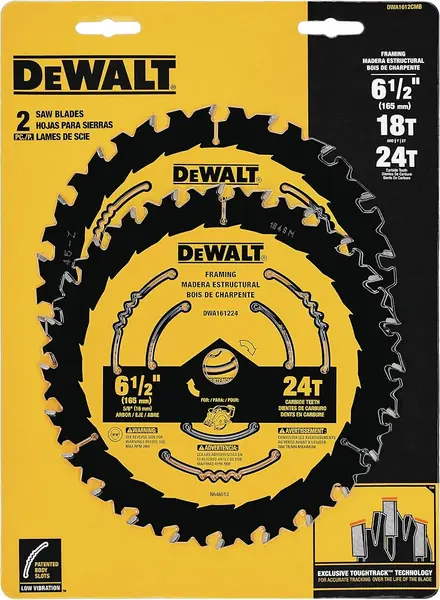
DEWALT DWA1612CMB 6-1/2-Inch 18-Tooth and 24-Tooth Combo Best for Compact Cordless Saws

DEWALT 6-1/2-inch circular saw blade two-pack with 18-tooth and 24-tooth carbide blades

Compact cordless saws

Shop Score 95/100
Diameter
6-1/2 inches
Teeth
18 and 24
Coating
ToughCoat anti-stick
Kerf
Thin kerf
View on Amazon

Framing with a battery saw is a fight against the power you have, and the 18-tooth half of this pack is built for that fight: fewer teeth, bigger bites, less drag on the motor. The 24-tooth is the one for everything that has to look decent afterward.

Most of our cutting time went to the 24-tooth, which handled plywood and 2x without the burning that appears when a cordless saw is asked to do too much. The 18-tooth came out for treated decking and demolition lumber, where the reinforced shoulder behind each tip does real work — that extra steel is there for the nail you didn't see.

The thin kerf and the body slots cut vibration noticeably compared with a stock blade, and the ToughCoat finish kept sap from building up on the teeth. We also appreciated that the teeth are high-density carbide rather than the softer grade that goes on bargain blades; a 6-1/2-inch saw doesn't have the power to waste on a dull edge.

Six and a half inches is its own size, so this pair fits compact cordless saws and nothing bigger — check the blade on your saw before ordering. What keeps it on our list is the range: a tool that does trim one day and decking the next doesn't have to choose.

Worth Noting

  • Costs more per blade than a bulk framing pack
Our Verdict

If your cordless saw takes a 6-1/2-inch blade, these two grinds cover framing and finish work without a second order.

Check Latest Price
4.

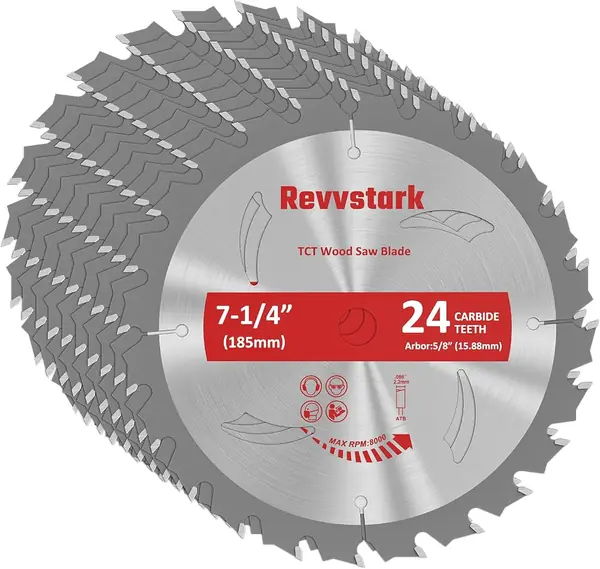
Revvstark 7-1/4-Inch 24-Tooth 10-Pack Best Bulk Buy

Revvstark ten-pack of 7-1/4-inch 24-tooth carbide-tipped circular saw blades in silver

Framing and decks

Shop Score 93/100
Diameter
7-1/4 inches
Arbor
5/8 inch
Tooth Count
24
Pack Size
10 blades
View on Amazon

Coaxing one more sheet of OSB out of a tired edge is how most of us work, and a box of ten ends that habit. You pull the blade, hang a fresh one, and keep moving — on a framing day that's worth more than any single premium blade's extra edge life.

Twenty-four teeth is the right grind for that job. The blades went through treated 2x and plywood sheathing without splintering, and the short tooth count clears waste fast enough that the saw doesn't labor. We noted the noise-reducing perforations doing something real: this cuts quieter than the solid-body blades we compared it against, which matters over a long day.

The details are sensible. The anti-kickback tooth geometry gives a little more margin when a cut closes up on you, the laser-cut kerf is thin enough to suit a mid-power saw, and the 8,000 rpm ceiling covers the sidewinders most of us run. Five-eighths-inch arbor, round bore, so it drops straight onto a common 7-1/4-inch saw without an adapter.

Where the pack pays off is the middle of a job, when a blade starts to labor and there are still forty feet of decking left. Swapping takes a minute and the work keeps its pace, which is the whole argument. Buy it for framing, sheathing, and treated lumber in volume, and keep a finishing blade on the shelf for anything visible.

Worth Noting

  • Twenty-four teeth leave a rougher edge
  • Only one grind in the ten-pack
Our Verdict

Buy the ten-pack if you cut framing, decking, and demolition lumber; a fresh 24-tooth blade always beats a tired one.

Check Latest Price
5.

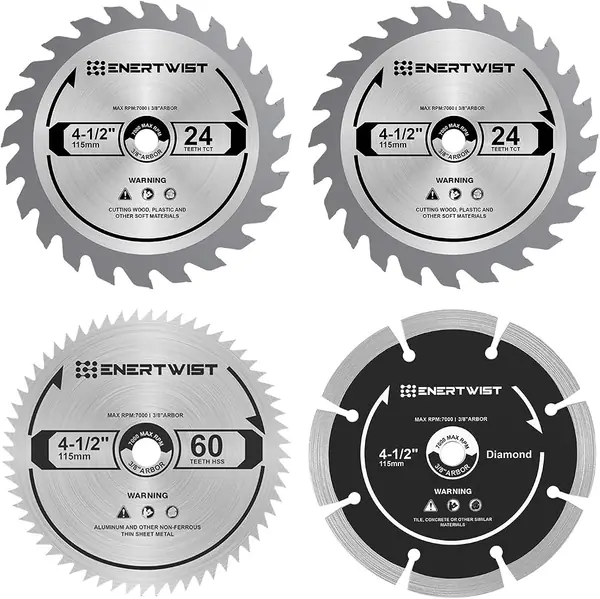
ENERTWIST 4-1/2-Inch 4-Piece Compact Saw Blade Set Best for Mixed-Material Mini Saws

ENERTWIST four-piece 4-1/2-inch compact saw blade set with wood, metal, and diamond blades

Mixed-material mini saws

Shop Score 92/100
Diameter
4-1/2 inches
Arbor
3/8 inch
Max RPM
7,000
Pieces Included
Two 24-tooth wood, one 60-tooth metal, one diamond
View on Amazon

It's a set that promises to cut everything, and on a compact saw the claim holds up better than we expected. Two 24-tooth carbide wood blades, a 60-tooth high-speed-steel blade, and a segmented diamond blade all ride a 3/8-inch arbor sized for 4-1/2-inch mini saws.

The two carbide wood blades do the everyday work — plywood, softwood, plastic — and they cut cleanly enough for a saw this size. The 60-tooth steel blade is the weakest of the four: high-speed steel is softer than carbide, so it will get through aluminum and plastic but won't hold an edge in wood the way the carbide blades do.

The diamond blade is what earns the set its place for us. Backer board and ceramic tile are exactly the jobs a wood blade can't touch, and having one in the case means a bathroom repair doesn't turn into a second trip to the store.

Check the arbor before ordering. Three-eighths inch suits the compact saws this set is built for — Enertwist's ET-CS-20C, the Tacklife TCS115A, the Worx WX429L, and Rockwell's RK3441K and RK3440K among them — and it will not fit a full-size sidewinder. The 7,000 rpm ceiling is well above what a mini saw turns, so match it against your own saw's rating and you're fine. If clean wood cuts are the whole job, one 40-tooth carbide blade serves you better.

Worth Noting

  • Only two wood blades in the four-piece set
Our Verdict

Worth it for a compact saw that meets tile, backer board, and light metal — jobs a wood blade simply cannot do.

Check Latest Price

How We Tested Circular Saw Blades

We started by sorting blades by the thing that decides whether one will even mount: diameter against the saw's rated capacity, and arbor bore and shape. From there we narrowed by tooth count and the cut it's meant for, kerf width, carbide grade and coating, and how many blades a project realistically dulls. Fifteen blades made the shortlist across the common saw sizes — full-size sidewinders, miter and table saws, compact cordless saws, and small trim saws — with round arbors, diamond knockouts, and the reduced bores compact tools take.

Before any blade touched wood, we checked its stamped maximum RPM against the saw's no-load speed and test-fit the arbor by hand; a blade that rocked on the spindle, or needed an adapter to sit flat, didn't get mounted. Then we spent six months cutting: tearing out and rebuilding a deck in pressure-treated stock, breaking down plywood for garage shelving, running trim in a basement, and slicing composite decking and PVC. We let each saw reach full speed before the teeth met material and kept hands clear of the cut line.

On every cut we watched for tear-out on the plywood's face veneer, burning along rip cuts, and whether an edge came off the saw ready to install or needed sanding. We counted cuts in treated lumber until the saw started slowing, checked coated blades for pitch buildup, and noted how often a blade had to come off mid-project. Value got measured the same way: how many clean cuts a blade turned in before it dulled.

How to Choose a Circular Saw Blade

Match the blade to the saw first

Full-size sidewinders take a 7-1/4-inch blade on a 5/8-inch arbor; compact saws run 4-1/2-inch blades on a 3/8-inch arbor; miter and table saws in home shops are usually 10 or 12 inch. The trap is the arbor. A diamond knockout bore runs on a plain round spindle and on a diamond-shaped one, which is why we treat it as the safer buy when you haven't pulled the old blade yet.

A 3/8-inch compact blade will not fit a full-size saw, and fitting an oversized blade under a guard is never the answer. If the diameter and the bore both check out, everything else on this page is a preference.

Let tooth count follow the cut

Twenty-four teeth is a framing and ripping grind: big bites, fast feed, a rougher edge. Forty teeth is the general-purpose finishing count on a handheld saw and leaves plywood and 1x stock close to glue-ready. Sixty and up is trim and miter work in 3/4-inch material.

The common mistake is buying the highest tooth count you can find and putting it on a low-power saw. More teeth means a slower feed and more heat, and heat burns an edge instead of cutting it. Match the grind to the saw's muscle as well as to the material.

Treat thin kerf as a power decision

A thin kerf takes less material and asks less of the motor, which is why it's standard on blades meant for cordless and mid-power saws. You also get more boards out of a stack of hardwood, and on a finish blade there's simply less stock to drag through the cut.

What you give up is stiffness. In a deep rip through wet stock, a thin plate can wander if you push it, so take those cuts in two passes. On a heavy table saw doing full-depth rips all day, a full-kerf blade is the steadier choice.

Carbide grade, coatings, and edge life

The teeth are where the money goes. Carbide-tipped (TCT) teeth hold an edge far longer than high-speed steel, which is why steel shows up mainly on metal-cutting blades; diamond segments are for tile, backer board, and stone. Coatings such as PermaShield and ToughCoat are anti-stick rather than armor — they keep pitch from building up so the teeth keep cutting instead of rubbing.

A hardened, balanced plate matters too. It's what keeps a thin blade from shaking in a deep cut, and it's the difference between a blade that tracks straight in its second month and one that doesn't.

Buy as many blades as you'll actually dull

One good finishing blade is the right purchase for a home shop that builds shelves and trim. If you frame, deck, or demolish, the math flips: a ten-pack of 24-tooth blades means you swap the moment a cut starts to labor instead of pushing a dull edge through another sheet.

Combination packs sit in between — a rough blade and a finish blade in one box, covering both ends of a project without a second trip. Pick the packaging that matches how you actually work rather than the blade with the longest claimed life.

Frequently Asked Questions

Final Verdict

Start with the Freud Diablo D0740A if you own a 7-1/4-inch saw and want one blade that finishes as well as it crosscuts. Forty teeth, a thin kerf, and an arbor that fits both common spindles make it the easiest recommendation here, and it's the one we'd keep on the saw by default — except we said we'd keep it, so: it's the one that stays on our saw.

Switch to the DEWALT 10-inch pair if your cutting happens on a miter or table saw, where a 32-tooth ripper and a 60-tooth finisher in the same box end the swap argument. And if the work is decks and framing rather than furniture, buy the Revvstark ten-pack and stop thinking about it.