↑↓ navigate ↵ open Esc close All results →

Best Circular Saw Blades for Aluminum of 2026

Aluminum looks like it should cut like hardwood, and for the first inch it almost does. Then the blade loads up with hot chips, the teeth stop feeling sharp, and the cut starts throwing a burr. A blade ground for non-ferrous metal fixes all three: a triple-chip grind that shaves instead of scoops, a tooth count matched to the finish you want, and a diameter, arbor, and speed rating that fit your saw.

I wrecked a length of quarter-inch angle with a wood blade and a lot of optimism. We've since tested 16 aluminum-cutting blades over five months, from 4-1/2-inch trim saws up to 12-inch miter blades, and the gap between a cool, clean cut and a gummy one came down to fewer things than we expected.

The spec shoppers overrate is tooth count; the triple-chip grind and the carbide matter more for the finish. The one they underrate is kerf: thin blades are easier on a small saw's motor but flex more. These seven cover the saw sizes most of us own, at prices that make sense for how much aluminum you cut.

Our Top Picks

The Best Circular Saw Blades for Aluminum

1.

MASTEC 10-Inch 100T TCG Aluminum Saw Blade Best Overall
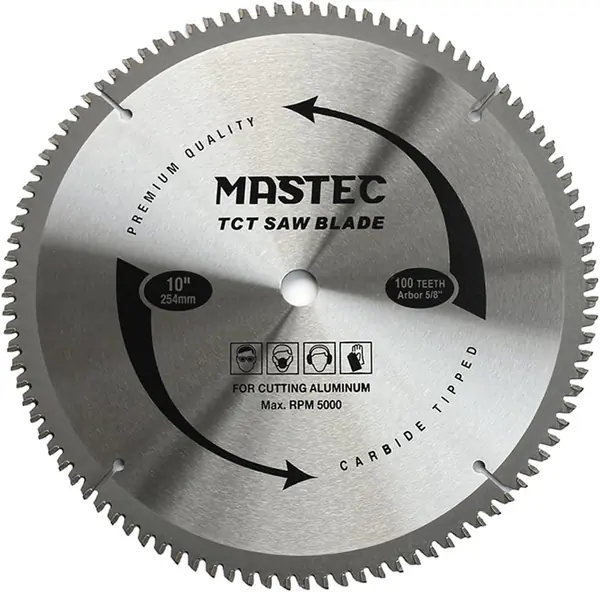
MASTEC 10-inch 100-tooth carbide TCG circular saw blade with silver body

Clean miter cuts

Shop Score 94/100
Arbor
5/8 in
Diameter
10 in
Teeth
100 TCG
Max Speed
5,000 RPM
View on Amazon

Aluminum is unforgiving of tooth geometry. The wrong grind walks, grabs, and leaves a torn edge you have to file back to square, which is why metal work starts with a triple-chip grind and a high tooth count. This MASTEC is a 10-inch, 100-tooth TCG blade with a thin kerf, a 5/8-inch arbor, and a 5,000 RPM ceiling, and it drops onto a 10-inch miter saw without an adapter.

Heat is what we watch first. Aluminum pulls heat straight into the carbide, and a blade running hot starts welding chips to the tips instead of shearing them off. The blade came off a run of 1/8-inch wall tubing and aluminum edging barely warm, with edges that needed nothing more than a light pass of a mill file — and on a few cuts, not even that. That is the whole argument for buying this one over the cheaper steel blades here.

It also earns its place on the other materials a miter saw gets fed around aluminum work: plexiglass, plastic, and vinyl stock all cut cleanly enough that we stopped swapping blades between materials. It costs slightly less than the other 10-inch blade here, so for a 10-inch saw there is no budget case against it.

Feed it steadily. A hundred teeth cut on patience and punish a shove, and clamping the work matters more with aluminum than with wood — the material grabs a spinning blade faster than most people expect.

Worth Noting

  • 10-inch size fits only 10-inch saws
Our Verdict

This is our default aluminum blade: 100 triple-chip teeth on a 10-inch body leave edges you can assemble without filing.

Check Latest Price
2.

TOMAX 7-1/4-Inch 60T TCG Saw Blade Best for 7-1/4-Inch Circular Saws

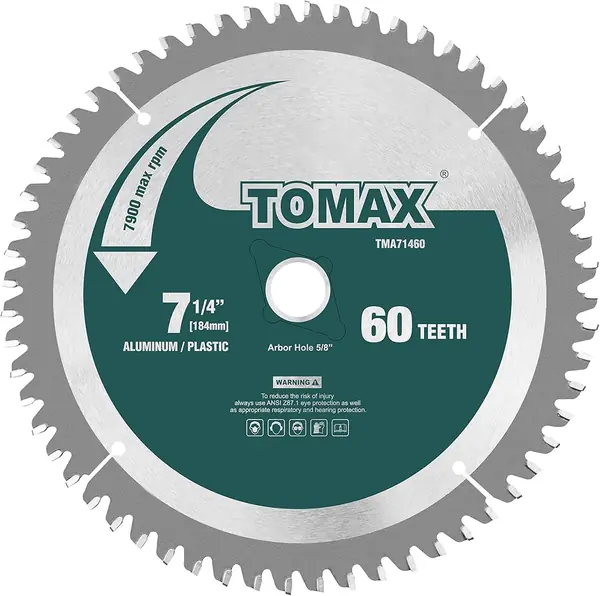
TOMAX 7-1/4-inch 60-tooth carbide TCG saw blade in silver

Handheld circular saws

Shop Score 93/100
Arbor
5/8 in
Diameter
7-1/4 in
Teeth
60 TCG
Kerf
2.0 mm
View on Amazon

A 7-1/4-inch blade is the least expensive way into clean aluminum cuts, and this TOMAX is the one we keep coming back to for it. Sixty triple-chip teeth, a 2.0 mm kerf, a hardened steel body with anti-vibration slots, and a 5/8-inch diamond-knockout arbor — that last detail means it mounts on saws with either a round or a diamond spindle, so you are not hunting for an adapter mid-job.

In use it handled half-inch aluminum bar stock and a run of extrusion with the kind of cut you can live with straight off the saw: square, cool to the touch, and clean enough that a couple of passes with a file finished it. It also went through PVC trim without the smearing a fine wood blade tends to leave behind.

Force it through thick plate and the carbide tips will chip; lighter passes with a wax stick keep the edge intact far longer, and that habit is worth building with any 60-tooth blade. Where the TOMAX really earns its keep is on a saw you carry — the 7-1/4-inch format goes where a 10-inch blade cannot, and the electrophoretic coating means it comes out of the case without rust spots after a humid week.

Worth Noting

  • Leaves a working edge in thick plate
Our Verdict

We keep this 60-tooth blade on the 7-1/4-inch saw because it cuts extrusion and trim cleanly for the money.

Check Latest Price
3.

Diablo D1296N 12-Inch 96T TCG Blade Best for 12-Inch Miter Saws

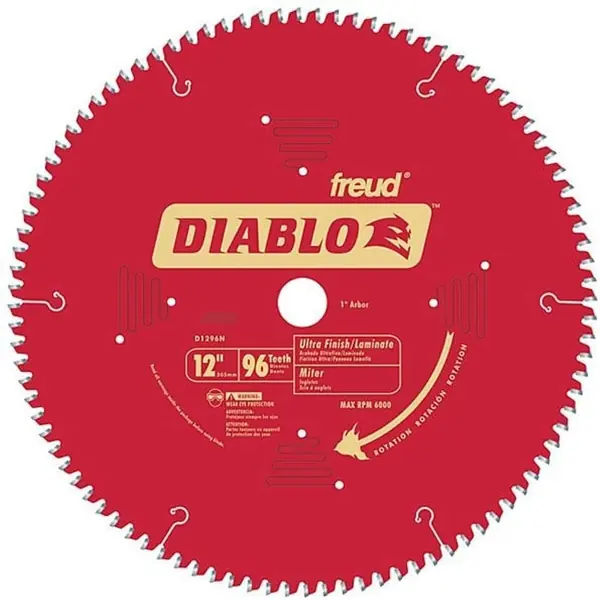
Diablo D1296N 12-inch 96-tooth TCG circular saw blade for aluminum

12-inch miter saws

Shop Score 92/100
Arbor
1 in
Diameter
12 in
Teeth
96 TCG
Kerf
.091 in
View on Amazon

A one-inch arbor tells you what this blade is for. Diablo builds the D1296N as a 12-inch, 96-tooth triple-chip blade for 12-inch miter saws, with a -5-degree hook, a .091-inch kerf, a .071-inch plate, and a 5,000 RPM ceiling. The titanium-cobalt carbide, tri-metal brazing, and Perma-SHIELD coating are the parts you are paying for.

Stacked 20 mm T-slot extrusion is the test we care about, and the blade went through several pieces at once without the plate feeling warm or the cut drifting. Solid bar stock cut the same way. The coating matters here: aluminum wants to stick to a bare tooth, and a blade whose gullets stay clear keeps cutting at the same rate instead of slowing down and heating up.

The premium is real, and we think it is justified for anyone cutting aluminum as part of the job rather than once a season. What the money buys is an edge that survives impact and a finish that does not need chasing. For one railing or a set of screen frames, this is more blade than the work asks for, and our top pick will do the same job for less.

Take the cut slow. The negative hook angle and the fine tooth count reward a steady feed and punish anyone who tries to hurry a 12-inch blade through extrusion — that is where teeth get broken, not in the material itself.

Worth Noting

  • Costs the most of any blade here
  • 1-inch arbor fits 12-inch saws only
Our Verdict

Buy it if aluminum is your daily work: the 96-tooth Diablo holds its edge and runs cool through stacked extrusion.

Check Latest Price
4.

DEWALT DW3329 7-1/4-Inch 68T Metal Blade Best Budget

DEWALT DW3329 7-1/4-inch 68-tooth steel saw blade for non-ferrous metal

Light aluminum jobs

Shop Score 91/100
Arbor
5/8 in with diamond knockout
Diameter
7-1/4 in
Teeth
68
Tooth Material
High-speed steel
View on Amazon

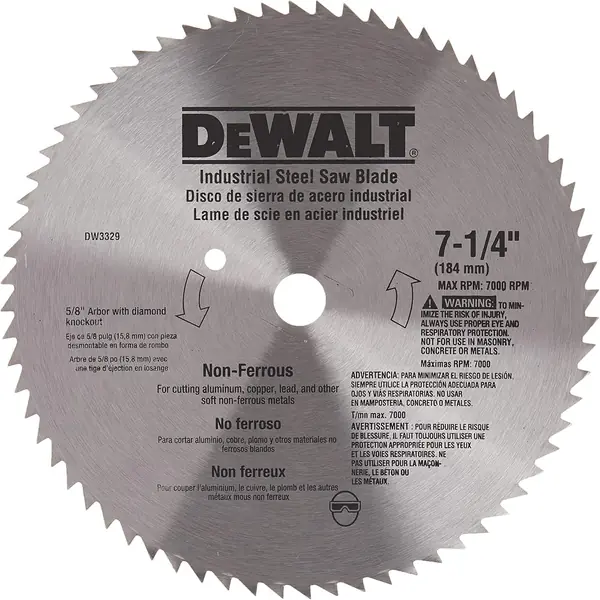
High-speed steel instead of carbide is the whole story. The DW3329 is a 7-1/4-inch, 68-tooth steel blade for non-ferrous metal, with a 5/8-inch arbor and a diamond knockout, a friction-reducing coating, and a body thick enough to take some abuse. It is the least expensive blade here by a wide margin.

That makes it a consumable, and we treat it like one. Light pressure through 1/8-inch sheet and thin channel gets a clean, straight cut, and nobody minds retiring a blade that costs this little. The buyer who gets the most out of it is cutting one door opening or a few screen frames, not running a production line.

Two practical notes. The round bore and the diamond knockout together mean it mounts on nearly any 7-1/4-inch sidewinder, so it is a safe spare to keep on the shelf. And light pressure is not politeness — bearing down on a steel blade is what turns a cut into a smoking, wandering mess.

Worth Noting

  • Steel teeth dull faster than carbide
  • Not rated for steel or ferrous metal
Our Verdict

We treat this steel blade as a consumable, and at its price that makes sense for light aluminum and the occasional sheet.

Check Latest Price
5.

CRALY 4-1/2-Inch 42T TCG Blade Best for Compact Saws

CRALY 4-1/2-inch 42-tooth carbide saw blade with black non-stick coating

Small trim saws

Shop Score 90/100
Arbor
3/8 in
Diameter
4-1/2 in
Teeth
42 TCG
Kerf
1.6 mm
View on Amazon

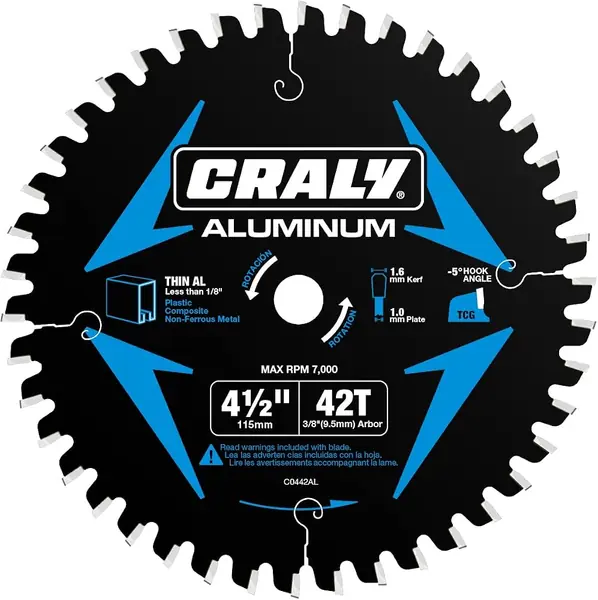
Compact saws get overlooked in aluminum work, and 4-1/2 inches is where they live. The CRALY C0442AL is a 42-tooth triple-chip carbide blade on a 3/8-inch arbor, with a 1.6 mm kerf, a laser-cut hardened body, and a Black Ice coating that keeps friction down.

We ran it through 3/8-inch aluminum angle and a pile of closet rod. The cuts came out smooth and square with no burr worth filing, and the blade was cutting the same on the last piece as the first. It ships with bushings, so it takes up on spindles smaller than the nominal 3/8 inch — the kind of small inclusion that saves a return.

The thin kerf is why we like it on a small saw: a compact motor has less torque to spare, and a narrow slot means less material to remove and less heat in the cut. If your work is trim, railing, and rod rather than plate, this is the blade that makes the small saw feel like the right tool instead of a compromise.

Worth Noting

  • Small diameter limits depth of cut
Our Verdict

For a compact saw, we have not cut aluminum with anything sharper; the thin kerf suits a small motor.

Check Latest Price
6.

FOXBC 10-Inch 80T TCG Saw Blade Best for Plastic and Aluminum

FOXBC 10-inch 80-tooth TCG carbide saw blade for aluminum and plastic

Plastic and aluminum

Shop Score 89/100
Arbor
5/8 in
Diameter
10 in
Teeth
80 TCG
Kerf
0.094 in
View on Amazon

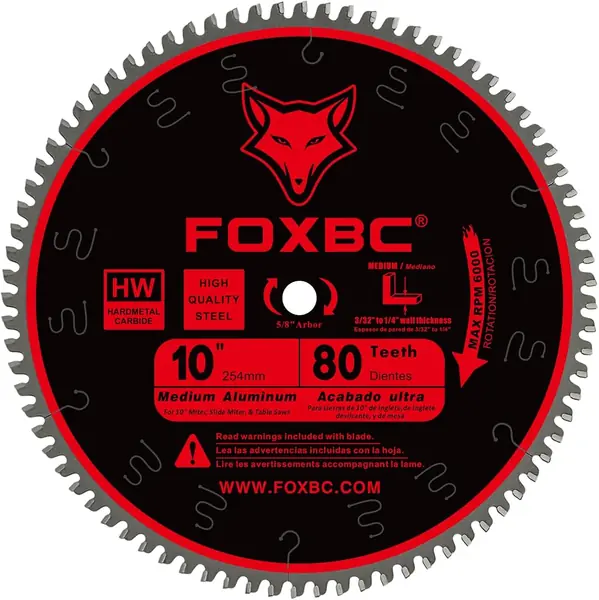
Eighty teeth sits between the fast sixty and the fine hundred, and for a shop that runs plastic across the same saw as aluminum, that is a good place to be. The FOXBC is a 10-inch, 80-tooth TCG blade with a 0.094-inch kerf, a 5/8-inch arbor, and laser-cut stabilizer vents meant to trap noise and cut vibration. We like it as the second 10-inch blade in a shop rather than the only one.

It is the most comfortable blade here in acrylic and plexiglass. Quarter-inch sheet came off with a smooth edge and no chipping, half-inch nylon bar cut without complaint, and the same blade went into aluminum with clean results and no more burr than the hundred-tooth pick. If your projects cross between metal and plastic, that flexibility is worth more than the last few percent of finish.

Where it loses to our top pick is straightforward: it costs more and carries twenty fewer teeth, and nothing about the cut argued for the swap on aluminum alone. Buy it because the saw sees plastic, not because it is the sharper aluminum blade.

Worth Noting

  • Price sits above our 100-tooth top pick
Our Verdict

Our pick if the same 10-inch saw cuts acrylic and aluminum; the 80-tooth grind handles both without chipping.

Check Latest Price
7.

IVY Classic 35050 Swift Cut 7-1/4-Inch Blade

IVY Classic 7-1/4-inch steel saw blade for aluminum and vinyl siding

Thin aluminum trim

Shop Score 88/100
Arbor
5/8 in diamond knockout
Diameter
7-1/4 in
Tooth Material
High-carbon alloy steel
Max Aluminum Thickness
1/8 in
View on Amazon

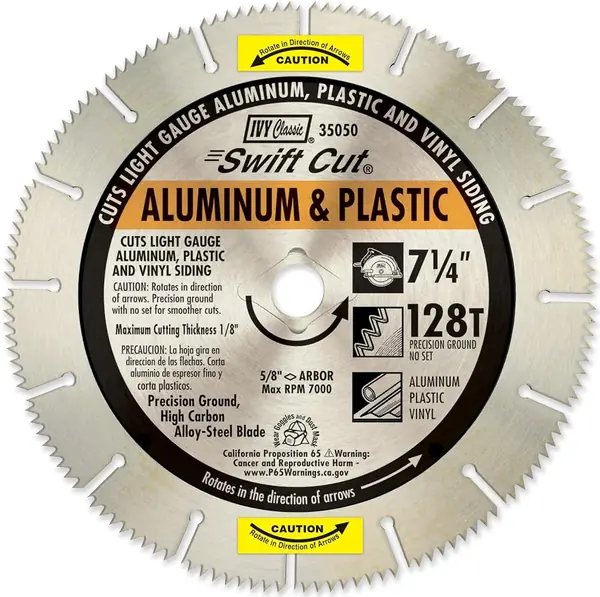
The limit is printed on the package: 1/8-inch aluminum, nothing thicker. IVY builds the 35050 as a 7-1/4-inch high-carbon alloy steel blade with precision-ground teeth and no set, expansion slots to shed heat, and a 5/8-inch diamond-knockout arbor. It is a specialist, and it is honest about it.

Where it shines is exactly where a carbide TCG blade is overkill: vinyl siding, window screen frames, thin aluminum trim, and plastic. The no-set teeth leave a smooth edge in sheet goods, and the expansion slots keep the plate from warping across a long run of siding — the kind of job where you cut forty pieces and want the fortieth to look like the first.

What it is not is a general aluminum blade. Extrusion, bar stock, and anything past that eighth-inch boundary belong to a carbide triple-chip blade, and forcing this one into that work is how you end up with a ruined edge and a story about a bad blade. The steel holds a fine edge for the sheet work it was ground for, and it gives that edge up sooner than carbide would.

Bought for what it is — a siding and screen blade that also handles thin aluminum — it is good value and easy to keep on the truck. Bought as your only metal blade, it will disappoint. That distinction is the whole review.

Worth Noting

  • Steel edge wears faster than carbide
Our Verdict

We recommend it for vinyl siding and screen frames, not for anything thicker than an eighth inch of aluminum.

Check Latest Price

How We Tested Aluminum-Cutting Blades

We built the shortlist from blades sold for aluminum and non-ferrous metal, then dropped any that wouldn't fit a common saw: a diameter or arbor bore (diamond knockout included) that matched no saw we had, or a marked maximum speed below what that saw spins. Sixteen blades, from 4-1/2 to 12 inches, ran for five months in a garage shop, mostly on Saturday afternoons and the odd weeknight.

Each blade went on the saw it was meant for: a small trim saw, a 7-1/4-inch handheld on sawhorses, a 10-inch miter saw, and a 12-inch slider. We clamped every piece of stock, 1/8-inch sheet, thin-wall angle, trim, and some plastic, because thin aluminum lifts and grabs a spinning blade, and we kept each blade inside the thickness its maker rated it for. Eye and hearing protection stayed on for every cut, and we compared each blade's marked maximum speed to the saw's before mounting it.

After each cut we ran a thumbnail along the edge to feel for a burr or a rolled lip, and looked at the teeth for aluminum smeared onto the carbide, the first sign of a blade running hot. We timed long rip cuts and listened for the saw bogging, measured kerf against the spec, and noted which blades ran loud enough to make ear protection feel like a very good idea. Sharpness we tracked as cut counts: how many pieces a blade went through before we had to lean on it.

Value came down to that count against price, since a blade that dulled after ten pieces cost more per cut than one that kept going all afternoon. Five months in, we're still cutting with the finalists and will update this guide if that changes.

How to Choose a Circular Saw Blade for Aluminum

Fit the Arbor and Diameter First

Pull the blade currently on your saw and read the numbers stamped on it. Most 7-1/4-inch circular saws and 10-inch miter and table saws take a 5/8-inch arbor; 12-inch miter saws commonly use a 1-inch bore, which is why the Diablo here will not go on the 10-inch saw in your shop. Diameter is fixed by the saw too — a 10-inch blade in a 7-1/4-inch saw is not a close call, it simply does not fit.

One trap worth knowing: a blade listed as 5/8-inch with a diamond knockout mounts on both round and diamond spindles, so check which your saw has before you assume you need an adapter.

Match Tooth Count to the Finish You Want

Triple-chip grind is the geometry to look for: a flat-topped raker tooth between two beveled teeth, shearing aluminum instead of scooping it. Tooth count then sets the trade between speed and finish. Sixty teeth clear chips fast and leave a working edge that wants a file; eighty to a hundred teeth leave an edge you can put together dry, at the cost of a slower feed and more heat in the cut.

We reach for 60 teeth on framing and rough trim, and 100 when the aluminum is going to stay visible.

Decide How Much Kerf You Want

Kerf is the width of the slot the blade cuts, and thin is the direction the good blades have gone — the picks here run from 1.6 mm on the compact CRALY to .091 inch on the Diablo. A thin kerf removes less material and asks less of the motor, which matters on a small battery saw or a table saw you are already pushing hard.

The trade is a slightly more flexible plate that can deflect in a deep, fast cut. On a small saw, take the thin kerf every time; on a big one, either works.

Carbide, Steel, and What Aluminum Does to an Edge

Aluminum conducts heat into the tooth faster than wood does, and a hot edge starts picking up metal instead of cutting it. Carbide holds up to that far better than the high-speed steel in the budget DEWALT, which is why a steel blade is a short-job tool. Whatever you buy, a wax stick or a few drops of light oil along the cut line keeps chips from welding to the tips and adds life.

Feed at a steady, moderate pace. Forcing the blade is what chips teeth, not the aluminum itself.

Check the Thickness Rating Before You Cut

A blade rated for light gauge work is not the blade for half-inch plate. IVY states an eighth-inch aluminum ceiling on the 35050, and that is a real boundary rather than a suggestion. Thin sheet, siding, and screen frames are one job; extrusion, bar stock, and plate are another, and they want a carbide TCG blade with a high tooth count.

If a project mixes both, buy for the thicker material and take the thin stock slowly.

Frequently Asked Questions

Final Verdict

For most woodworkers cutting aluminum, the 10-inch MASTEC is the blade to buy: a hundred triple-chip teeth, a 5/8-inch arbor, and an edge that comes off the saw ready to assemble. It is the pick that fits the miter saw already on the bench and does not ask you to change how you work.

If your saw is the 7-1/4-inch sidewinder, take the TOMAX instead — it costs about the same and fits the tool you actually reach for. And if the aluminum is light gauge and the job is small, the budget DEWALT will get it done for a fraction of the money.