↑↓ navigate ↵ open Esc close All results →

Best 8-1/4 Table Saw Blades of 2026

The blade that ships with a new table saw is a compromise — usually a general-purpose 24-tooth that rips acceptably and leaves fuzz on everything else. Put the right 8-1/4-inch blade on the same saw and plywood crosscuts with barely a tear-out, end grain comes off smooth enough to glue without jointing, and trim stops fighting you. What you're actually buying is surface quality: the saw supplies the spin, but tooth count and grind decide how much of your evening goes into sanding.

We ran 14 blades for eight months, ripping framing lumber, crosscutting hardwood, and trimming plywood and MDF, and we checked diameter, arbor, and maximum RPM against the saw before installing a single one. One thing we learned living with these: 60 teeth on a dull blade finishes worse than 40 teeth that are still sharp, and thin kerf is a real gift to a compact saw's motor right up until you feed fast enough to make the plate flex.

The picks below cover general woodworking, fast ripping, clean crosscuts, two-blade setups, and cordless saws. Some are built for speed, some for finish, and each one does what its tooth count promises.

Our Top Picks

The Best 8-1/4 Table Saw Blades

1.

Diablo D0840X 40-Tooth Best Overall
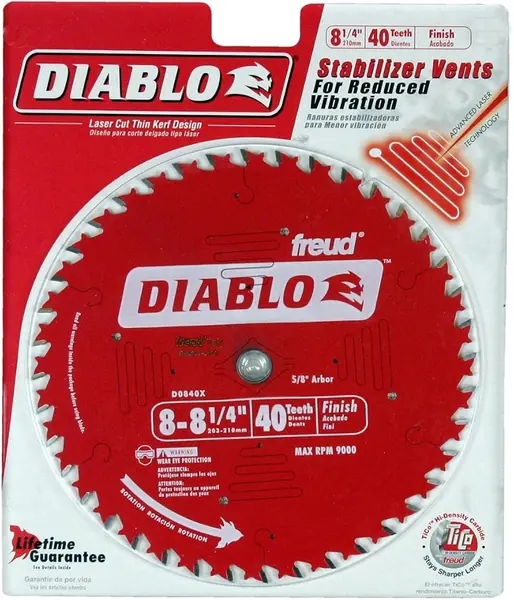
Diablo D0840X 8-1/4-inch 40-tooth carbide table saw blade

General woodworking

Shop Score 95/100
Teeth
40 ATB
Diameter
8-1/4 inches
Arbor
5/8 inch
Max Speed
9,000 RPM
View on Amazon

A 40-tooth blade has to do two jobs on a compact table saw: crosscut cleanly and rip without loading the motor. The Diablo D0840X is built for that middle ground, with 40 ATB teeth, a thin kerf, and a 9,000 RPM rating in an 8-1/4-inch, 5/8-inch-arbor package. We like that it does not feel like a compromise blade; it feels like the one you leave on the saw.

The ATB grind leaves plywood and trim with a finish that needs little sanding, while the thin kerf keeps a smaller saw from bogging down in 1-by stock. We were also struck by the Perma-SHIELD coating, which is the kind of practical detail that matters after the tenth sheet of plywood: less pitch, less gumming, fewer reasons to stop and clean. For a single blade, we think it's the strongest balance of cut quality and versatility in this set.

It is not a resaw blade. If your work is mostly thick hardwood rips, the Makita 24-tooth blade is the better tool, and we switch to it when the cut is about speed rather than a finished edge. What keeps the Diablo on our saw is simpler: it makes the ordinary cuts feel finished.

Worth Noting

  • Not suited for thick hardwood rips or resawing
Our Verdict

We recommend the Diablo D0840X as the default 8-1/4-inch table saw blade for woodworkers who want one blade for clean crosscuts and everyday rips.

Check Latest Price
2.

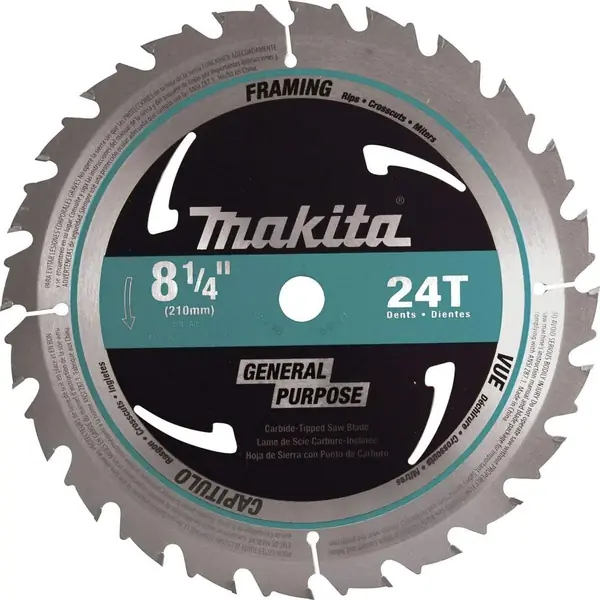
Makita D-21521 24-Tooth Best for Ripping

Makita D-21521 8-1/4-inch 24-tooth carbide ripping table saw blade

Fast ripping

Shop Score 94/100
Teeth
24
Diameter
8-1/4 inches
Arbor
5/8 inch
Max Speed
5,700 RPM
View on Amazon

Twenty-four teeth is not a compromise if most of your cuts are rips. The Makita D-21521 is built around that idea, with a 5/8-inch arbor, a 20-degree hook, and 24 carbide teeth for 8-1/4-inch table saws that need to move thick stock rather than polish it. We choose it when the job is framing, decking, or ripping wet treated lumber, and we do not ask it to leave a furniture-ready crosscut.

The low tooth count takes a bigger bite and clears chips quickly, so the saw does less work to get through a long rip. We noticed the blade stays stable under load, which matters more on a compact saw than a fancy tooth geometry. The 20-degree hook also gives it a confident feed, especially in thicker stock.

The limits are straightforward. Crosscuts come out rougher than they would with a 40-tooth blade, and for the work it is built for, that is a fair trade. It is a specialist, and it earns its place by being honest about that.

Worth Noting

  • 5,700 RPM ceiling rules out faster saws
Our Verdict

The Makita D-21521 is the blade we choose when the job is ripping stock fast and a rougher crosscut can wait.

Check Latest Price
3.

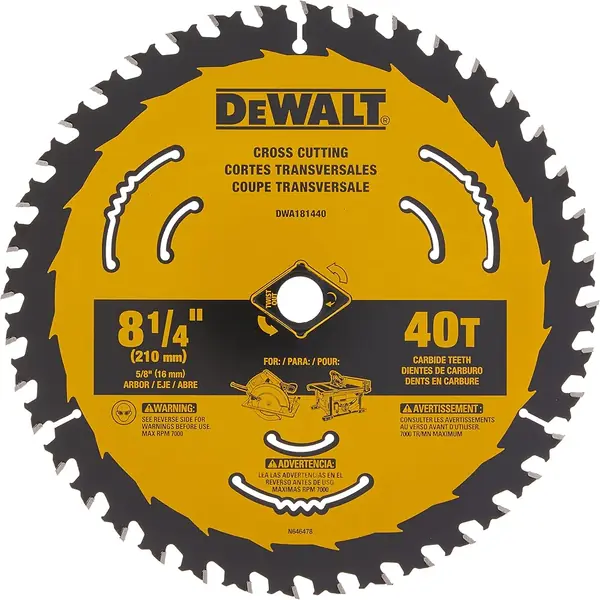
DEWALT DWA181440 40-Tooth Best for Crosscuts

DEWALT DWA181440 8-1/4-inch 40-tooth crosscutting saw blade

Clean crosscuts

Shop Score 93/100
Teeth
40
Diameter
8-1/4 inches
Kerf
Thin kerf
Coating
Tough Coat anti-stick
View on Amazon

Crosscutting is where a general-purpose blade either earns its keep or leaves a splintered edge. The DEWALT DWA181440 is aimed at that job, with 40 teeth, a thin kerf, and a reinforced shoulder for the nail-embedded lumber that shows up on remodeling work. We like that it is not trying to be a ripping blade; it is a crosscut blade that still handles everyday 1-by stock.

The thin kerf and anti-stick coating are the details that matter on a jobsite saw, where the motor is modest and pitch builds up fast. We found the blade leaves clean edges in plywood and trim, and the reinforced shoulder gives it a little more forgiveness when a hidden fastener interrupts the cut. That is useful insurance, not a reason to go looking for nails.

Before ordering, confirm the arbor and blade-retention hardware match your saw. Otherwise, this is the blade we reach for when the visible cut is the one that matters, and it asks less of a small saw than a heavier general-purpose blade.

Worth Noting

  • Not the fastest choice for thick rips
Our Verdict

We think the DEWALT 40-tooth blade is the crosscut specialist to buy when clean plywood and trim cuts matter more than ripping speed.

Check Latest Price
4.

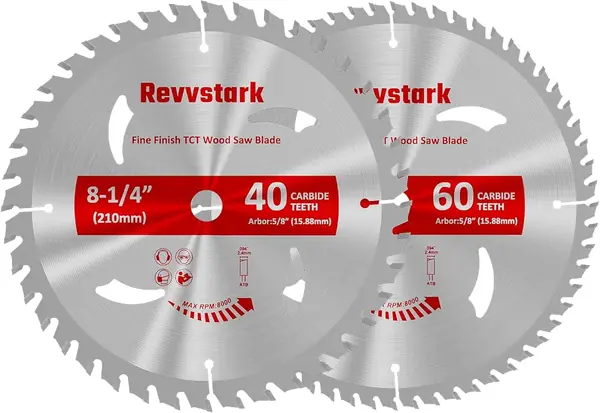
Revvstark 40T/60T Two-Pack Best Two-Blade Value

Revvstark 8-1/4-inch 40- and 60-tooth carbide saw blade two-pack

Two-blade setups

Shop Score 92/100
Teeth
40 and 60
Diameter
8-1/4 inches
Arbor
5/8 inch
Max Speed
8,000 RPM
View on Amazon

The appeal of a two-blade pack is easy to explain: one blade for framing and general cuts, one for trim and plywood, and no single blade asked to be good at everything. Revvstark's 8-1/4-inch set gives you 40- and 60-tooth blades with a 5/8-inch arbor and an 8,000 RPM rating. We think it is the most practical way to cover both jobs on a compact table saw without building a blade collection.

Both blades use a thin kerf and carbide teeth, and the 60-tooth is the one we reach for when a cut will show. The 40-tooth is the better match for framing, treated lumber, and quicker crosscuts, and the noise-reducing perforations are a small bonus on a jobsite. We also like that the pair shares the same arbor, so there is no adapter hunt between changes.

The pair covers the ordinary jobsite cuts without asking you to buy a third blade for trim, and the shared arbor keeps changes simple. For a compact saw, that is a lot of capability in one box.

Worth Noting

  • 40-tooth blade is not a dedicated ripper
Our Verdict

We like the Revvstark two-pack for shoppers who want a 40-tooth general blade and a 60-tooth finish blade without buying two premium blades.

Check Latest Price
5.

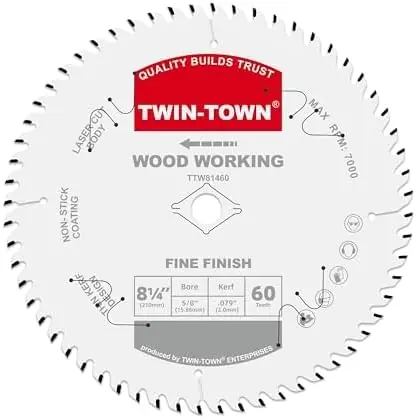
TWIN-TOWN TTW81460 60-Tooth Best Budget Fine Finish

TWIN-TOWN 8-1/4-inch 60-tooth ATB fine-finish carbide saw blade

Budget fine finish

Shop Score 91/100
Teeth
60 ATB
Diameter
8-1/4 inches
Arbor
5/8 inch DMK
Max Speed
7,000 RPM
View on Amazon

A fine-finish blade does not have to be the most expensive blade in the drawer. The TWIN-TOWN TTW81460 gives you 60 ATB teeth, a 5/8-inch diamond-knockout arbor, and a 7,000 RPM rating for a budget outlay. We like it for trim, plywood, and crosscuts where a 40-tooth blade leaves fuzz.

The thin kerf and expansion slots are the practical parts: the blade cuts quickly without asking much of a small saw, and the 60-tooth grind leaves a clean edge in plywood and hardwood. We noticed the finish holds up on visible work, which is the whole reason to keep a 60-tooth blade around.

We treat it as a budget finish blade for occasional projects, where a clean edge matters more than a premium name. For that job, it is easy to justify, and the 60-tooth grind is the reason.

Worth Noting

  • Not suited to heavy ripping in thick stock
Our Verdict

The TWIN-TOWN 60-tooth blade earns our recommendation when a fine finish matters but the budget is tight.

Check Latest Price
6.

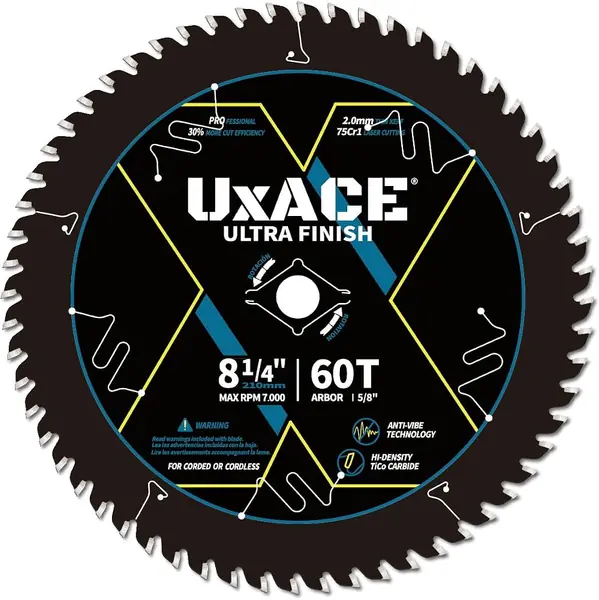
UXACE 0860UF 60-Tooth Best for Cordless Saws

UXACE 8-1/4-inch 60-tooth carbide thin-kerf saw blade

Cordless table saws

Shop Score 90/100
Teeth
60
Diameter
8-1/4 inches
Arbor
5/8 inch
Kerf
2.0 mm
View on Amazon

A cordless table saw has less power to spare, so a blade that drags is more than an annoyance—it eats runtime. The UXACE 0860UF is a 60-tooth, 2.0 mm-kerf blade with a 5/8-inch arbor and a 7,000 RPM rating, and that combination is why we reach for it on battery-powered saws.

The thin kerf is the main event. It removes less wood, so the saw does less work, and the 60-tooth grind still leaves a clean edge in plywood and trim. We were impressed by how settled the cuts felt for a blade at this price, and the anti-vibe design is a useful part of that rather than a spec-sheet ornament.

We think the UXACE makes the most sense on a cordless or compact saw where every bit of drag matters, and where a clean 60-tooth cut is the point. That is a specific role, and it fills it well.

Worth Noting

  • Not the first choice for fast thick rips
Our Verdict

We favor the UXACE 60-tooth blade for cordless table saws because its thin kerf asks less of the battery while still leaving a finished edge.

Check Latest Price
7.

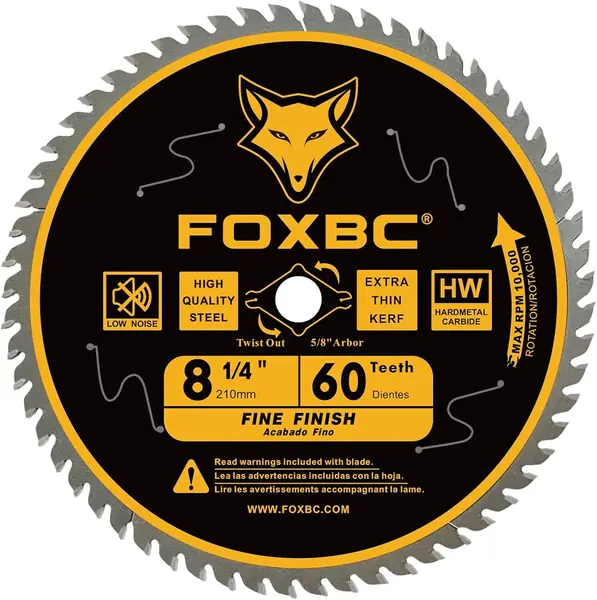
FOXBC 210-60T 60-Tooth Best for Thin-Kerf Finishing

FOXBC 8-1/4-inch 60-tooth thin-kerf table saw blade with yellow finish

Thin-kerf finishing

Shop Score 89/100
Teeth
60 ATB
Diameter
8-1/4 inches
Arbor
5/8 inch diamond knockout
Kerf
0.079 inch
View on Amazon

A 0.079-inch kerf is the number to notice on the FOXBC 210-60T. That thin cut, paired with 60 ATB teeth and a 5/8-inch diamond-knockout arbor, makes this a finish blade for 8-1/4-inch table saws that do not have power to waste.

The 60-tooth grind is aimed at plywood, hardwood, and trim, and the thin kerf helps the saw keep its speed through sheet goods. We liked the clean edges it left in plywood, and the diamond knockout is a practical detail if your saw's arbor uses that pin pattern.

The blade is at its best when the cut will show: cabinet parts, trim, and crosscuts where tear-out is the thing you are trying to avoid.

We recommend the FOXBC for a table saw with the matching arbor and a steady diet of finish cuts. If your saw lacks the diamond knockout, or you want one blade for everything, the Diablo is the easier default. This one is a specialist, and it earns its place when the edge quality is the priority.

Worth Noting

  • Not the blade for heavy ripping
Our Verdict

The FOXBC 60-tooth blade is our pick for table saws with a diamond-knockout arbor and shoppers who want a thin-kerf finish cut.

Check Latest Price
8.

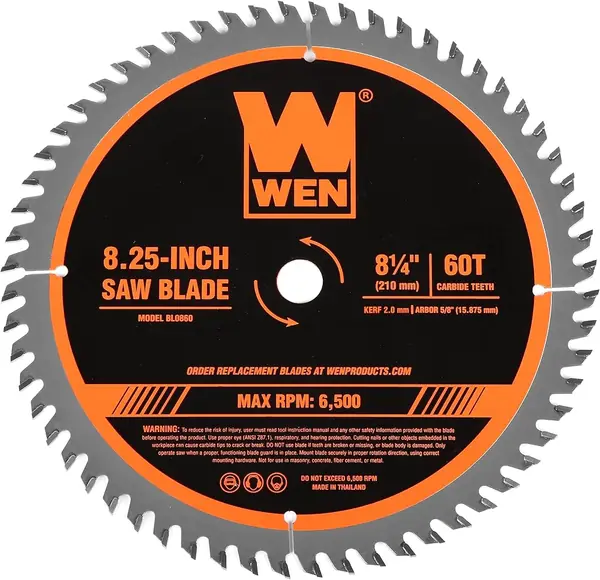
WEN BL0860 60-Tooth Best for Light-Duty Finishing

WEN BL0860 8.25-inch 60-tooth carbide fine-finish saw blade

Light-duty finishing

Shop Score 88/100
Teeth
60
Diameter
8.25 inches
Arbor
5/8 inch
Max Speed
6,500 RPM
View on Amazon

A 60-tooth blade for light-duty work does not need a premium price tag. The WEN BL0860 gives you an 8.25-inch blade, 60 carbide teeth, a 5/8-inch arbor, and a 6,500 RPM rating, and it does the basic job of a finish blade without asking much.

The 2.0 mm kerf is thin enough to keep a small saw from laboring, and the 60-tooth count is right for trim and plywood. We like that the arbor and speed are straightforward to match to a saw, because those are the numbers that decide fit.

The cut quality is aimed at finish work, and we think it is a sensible choice for occasional projects, a spare blade, or a first 60-tooth blade for someone who is not ready to spend premium money.

We like it for light table saw work and for shoppers who want a clean finish blade without treating it as a long-term investment. If you need one blade for everything, the Diablo is the safer default. The WEN is the low-cost finish option, and it makes sense on that basis.

Worth Noting

  • Not for heavy ripping in thick stock
Our Verdict

We think the WEN 60-tooth blade is a sensible low-cost finish blade for light table saw work and occasional plywood projects.

Check Latest Price

How We Tested the 8-1/4-Inch Blades

We built the shortlist from spec sheets. Every blade had to be 8-1/4 inches with a 5/8-inch arbor, and we checked its maximum RPM rating against the saw it would run on before we ordered anything. From there we sorted by tooth count and grind — 24-tooth ripping blades, 40-tooth general purpose, 60-tooth fine finish — and made sure the group included thin-kerf options, diamond-knockout arbors, a two-blade pack, and budget picks rather than only premium ones.

Fourteen blades spent eight months in a garage shop. We ripped framing lumber and hardwood, crosscut oak and maple, broke down plywood and MDF for shelving, and trimmed out a closet in pine. On every cut we looked at both faces of the board and noted whether the fibers were cleanly severed or torn at the exit edge, and we measured kerf width with calipers so we knew what each blade actually removed from the cut.

The thin-kerf blades also went onto a compact cordless saw to see whether the smaller motor bogged down in thick oak, and we listened for vibration and noise at the end of long rips. Edge retention was tracked by board feet: we counted how much hardwood each blade cut before it started leaving a fuzzy edge or demanded extra feed pressure, which is the real signal that a blade is due for replacement and what makes a two-blade pack worth the money. Blades were changed with the saw unplugged, and every through-cut was made with the guard, riving knife, and anti-kickback pawls in place.

How to Choose an 8-1/4-Inch Table Saw Blade

Fit the Blade to the Saw First

An 8-1/4-inch blade is a size, not a guarantee that it belongs on your saw. Check the arbor diameter—5/8 inch is the common size here—and whether your saw needs a diamond knockout, the small pin pattern some compact saws use. Then confirm the blade's maximum RPM is at least as high as the saw's no-load speed. We check the arbor and RPM before we look at tooth count.

Many of these blades are sold as circular saw blades, and that label does not disqualify them from table-saw use. What matters is the arbor, the diameter, the RPM rating, and whether the blade is intended for wood. If your saw calls for a diamond knockout and the blade has one, installation is straightforward; if it does not, a plain arbor is simpler.

Pick Tooth Count for the Cuts You Make

Twenty-four teeth are for ripping: the teeth take a bigger bite and clear chips quickly, which keeps thick stock moving. Forty teeth are the general-purpose compromise, clean enough for crosscuts and plywood while still able to rip 1-by material. Sixty teeth are for finish work—trim, veneered plywood, and crosscuts where tear-out shows.

If one blade has to do everything, we choose 40 teeth. A 60-tooth blade will leave a cleaner edge, but it cuts more slowly and is the wrong tool for heavy ripping; a 24-tooth blade is faster in thick stock but leaves a rougher crosscut. The Diablo D0840X is the 40-tooth default we recommend, while the Makita 24-tooth covers ripping.

Understand Thin Kerf and Saw Power

Thin-kerf blades remove less wood, so they ask less of the motor and are especially useful on compact table saws and cordless saws. The trade-off is that the plate is lighter, so a steady feed and a properly aligned fence matter. If you force a thin-kerf blade through wet or thick stock, you can get more deflection than with a heavier blade.

We treat thin kerf as a feature for 8-1/4-inch saws, not a shortcut. The FOXBC's 0.079-inch kerf and the UXACE's 2.0 mm kerf are both in that camp. On an underpowered saw, the reduced drag can be the difference between a clean cut and a bogged-down motor.

Decide Between One Premium Blade and a Two-Blade Pack

A single 40-tooth blade is the simplest setup: fewer changes, fewer storage decisions, and one predictable cut. A two-blade pack makes more sense if you regularly move between framing and finish work, because you can keep a 40-tooth blade for rough cuts and a 60-tooth blade for visible edges.

We like the Revvstark pack for that routine, and we like a single premium blade when the work is mostly finish cuts. The money question is not which blade costs more; it is whether you will actually change blades for the cut in front of you. If you will not, buy a 40-tooth blade you trust and learn its limits.

Frequently Asked Questions

Final Verdict

We recommend the Diablo D0840X as the default because it covers the widest range of ordinary table saw work: clean crosscuts, sheet goods, and everyday rips with one blade. If your work is mostly thick stock, the Makita 24-tooth blade is the better ripping tool; if you need a low-cost finish blade, the TWIN-TOWN 60-tooth is the practical choice. Start with the Diablo unless your cuts are clearly specialized.