↑↓ navigate ↵ open Esc close All results →

Best Ripping Blades for Table Saws of 2026

Bogging down mid-cut and scorching every third hardwood board is what usually happens when a general-purpose factory table saw blade gets pressed into steady ripping. Switching to a dedicated rip blade lets the exact same saw feed oak and walnut smoothly, leaving straight, glue-ready edges instead of burn marks.

Running a dozen 10-inch blades through plywood, oak, and walnut over eight months on both a 1.75-horsepower contractor saw and a 3-horsepower cabinet saw made clear that kerf width is a horsepower choice rather than a quality grade. Thin-kerf plates help smaller motors clear thick hardwood without stalling, whereas full-kerf bodies dampen plate flutter on higher-powered saws so tooth marks never appear along the edge.

Because thin-kerf rippers, triple-chip glue-line cutters, and flat-top grind blades solve different shop tasks — from underpowered saws to clean joinery grooves — these five options map directly to the machine and cut in front of you.

Our Top Picks

The Best Ripping Blades for Table Saws

1.

Freud LU87R010 Thin Kerf Rip Blade Best Overall
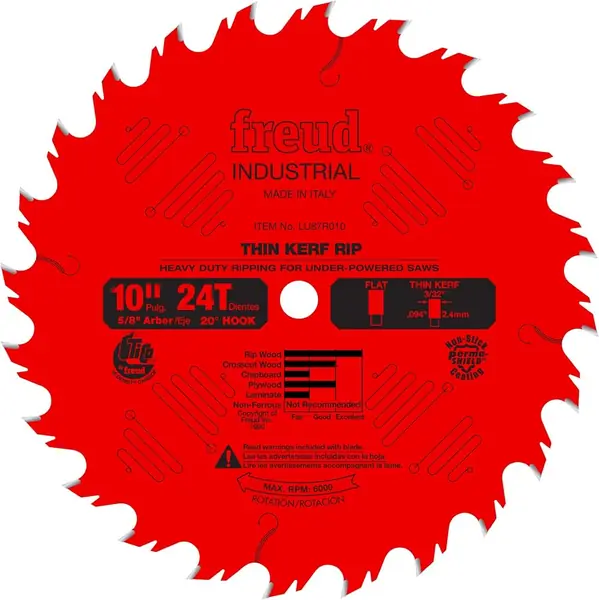
Freud LU87R010 10-inch thin kerf rip blade with 24 carbide teeth and silver coating

Underpowered table saws

Shop Score 96/100
Kerf
0.094 inch
Teeth
24, flat-top grind
Diameter
10 inches
Arbor
5/8 inch
View on Amazon

Twenty-four flat-top teeth, a 0.094-inch kerf, and a 20-degree hook angle describe the whole strategy: chisel the wood away fast rather than shear it slowly. That is the geometry that suits a 1- or 2-horsepower contractor saw, because a narrow kerf removes less material and asks less of the motor on every inch of cut. The listed working range of 3/4 to 2-3/4 inches covers most furniture and cabinet stock.

We reach for this one first because it makes an ordinary saw feel more capable. Flat-top teeth clear chips instead of packing them into the kerf, so the feed stays steady through thick hardwood, and the steep hook keeps stock moving rather than stalling it. Twenty-four teeth do not leave the polished surface a glue-line blade does, but the cut is clean and consistent, and a light pass with a hand plane takes it the rest of the way.

The Perma-Shield coating earns its place on a rip blade, where pitch and resin build quickly; a coated plate sheds them and keeps cutting the way it did on the first board. We pair it with a set of stiffening washers, since a plate this thin can deflect in deep, fast cuts. At the low end of what these blades cost, it is the easiest of the group to justify leaving on the arbor.

Worth Noting

  • Edges need a hand-plane pass before glue-up
Our Verdict

We make this the default pick for most table saws: a 0.094-inch kerf and 24 flat-top teeth rip hardwood fast without asking much of the motor.

Check Latest Price
2.

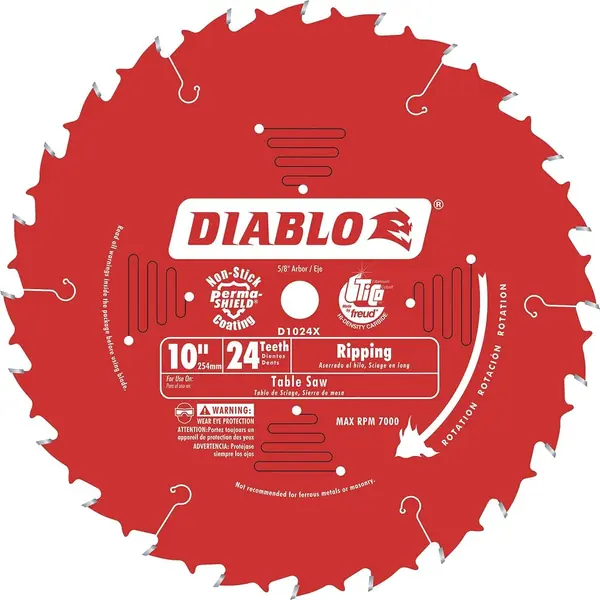
Diablo D1024X Ripping Blade Best for Sheet Goods and Framing

Diablo D1024X 10-inch 24-tooth ripping blade with thin kerf and ATB teeth

Sheet goods and framing

Shop Score 95/100
Kerf
0.098 inch
Teeth
24, ATB grind
Diameter
10 inches
Max Speed
6,000 RPM
View on Amazon

Plywood, OSB, and framing lumber are where this blade makes its case. Alternating top bevel teeth shear the fibers at the edges of the cut instead of chiseling straight down the way a flat-top does, so sheet goods and hardboard siding come off the saw with less splintering along the edges. If your ripping is as likely to be a cabinet panel as a 2x4, that behavior matters more than raw speed.

A 15-degree hook is milder than the 20 degrees on our top pick, which makes the blade less grabby on the push, and the 0.098-inch kerf keeps the load light on a mid-size saw. It is rated to 6,000 RPM, more headroom than most 10-inch table saws will ever use, and it runs quiet for a 24-tooth blade.

What we like most is how little fuss it takes: drop it in for an afternoon of mixed work and it rips and crosscuts without complaint. What it will not do is leave a jointed edge. The surface sands out in a pass or two, but a panel glue-up wants the triple-chip blade below. For everything short of that, this is the one that stays on the saw.

Worth Noting

  • Edges sand rather than glue straight off the saw
Our Verdict

We reach for this one for plywood and framing lumber, where alternating top bevel teeth splinter less and the edge sands out in a pass.

Check Latest Price
3.

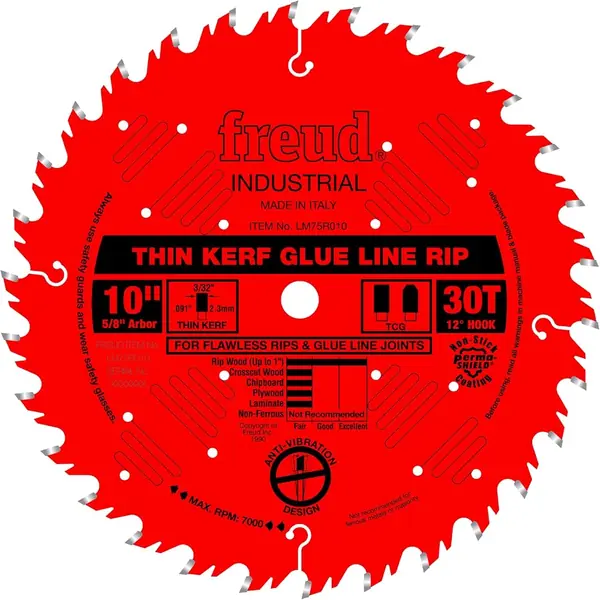
Freud LM75R010 Glue Line Rip Blade Best for Glue-Line Edges

Freud LM75R010 10-inch 30-tooth glue line rip blade with anti-vibration slots

Glue-ready rips

Shop Score 94/100
Kerf
0.091 inch
Teeth
30, triple-chip grind
Diameter
10 inches
Working Range
1/8 to 1 inch
View on Amazon

Skipping the jointer is the promise we care about here, and a 30-tooth triple-chip grind is how this blade keeps it. The pattern alternates a flat raker with trapezoid teeth that shear the sides of the kerf, leaving a surface true enough to glue without running the boards over a jointer afterward. On a project built from ripped panels, that is an entire step removed from the process.

Twelve degrees of hook is the gentlest angle in this group, and you feel it in the feed: stock moves through with steady pressure instead of being pulled, which is exactly the behavior you want when the edge will stay visible. Laser-cut anti-vibration slots do the stabilizing on their own, so this thin plate does not need a set of stiffeners the way a plain one does.

The listing puts its working range at 1/8 to 1 inch thick, which undersells it; the 30 teeth simply ask for a slower feed than a 24-tooth blade, and the reward is an edge that goes straight into clamps. It costs more than the rip blade we recommend first, and that difference buys a finish, not speed. For anyone who resents the jointer, that is the whole argument.

Worth Noting

  • Slower feed than a 24-tooth rip blade
Our Verdict

This is the blade we put on when the edge goes straight into a glue-up: the triple-chip grind takes the jointer out of the process.

Check Latest Price
4.

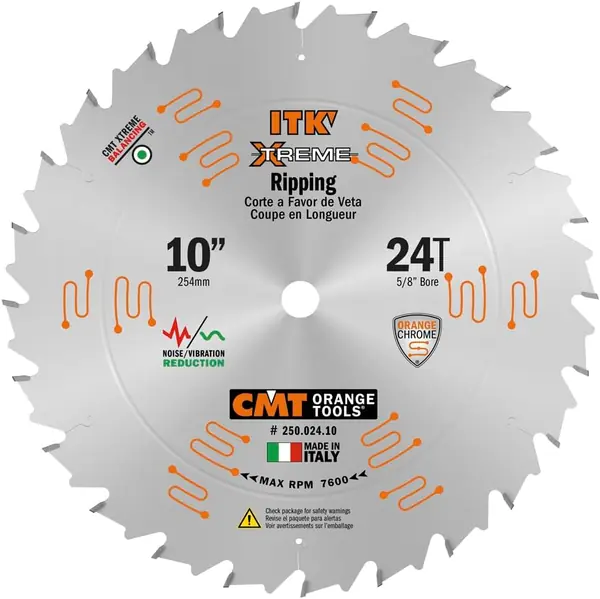
CMT 250.024.10 ITK Xtreme Rip Blade Best for Hardwood Ripping

CMT 250.024.10 Orange Tools 10-inch 24-tooth ATB rip blade with chrome-plated body

Hardwood ripping

Shop Score 90/100
Kerf
0.102 inch
Teeth
24, ATB grind
Diameter
10 inches
Hook Angle
10 degrees
View on Amazon

Ten degrees of hook is the mildest angle here, and it changes the character of the cut. Where a steep-hook blade pulls stock through, this one asks you to feed it and gives back a controlled cut that does not grab at the end of a long board. Hardwood ripping is the job it was built for, and the laser-cut expansion slots and tensioning ring keep the plate flat as it warms up.

CMT hardens the plate to 46-48 on the Rockwell scale and plates it in chrome, and the practical result is a blade that resists pitch and can go back to the sharpener more than once instead of being disposable. The 0.102-inch kerf is the widest of the thin-kerf blades here, which trades a little motor load for a bit more stiffness in the plate.

What we give up for that calm feed is speed: the mild hook and the wider kerf make this the slowest of the thin-kerf picks in thick stock. What we get back is a cut that barely needs sanding and a blade that comes back from service ready to work. If a cut starts to wander, check the arbor flange before blaming the blade, because a thin plate amplifies a dirty arbor.

Worth Noting

  • Gentle hook and wider kerf slow thick rips
Our Verdict

The blade we pick when we want a calm, controlled feed in hardwood rather than the fastest possible pass.

Check Latest Price
5.

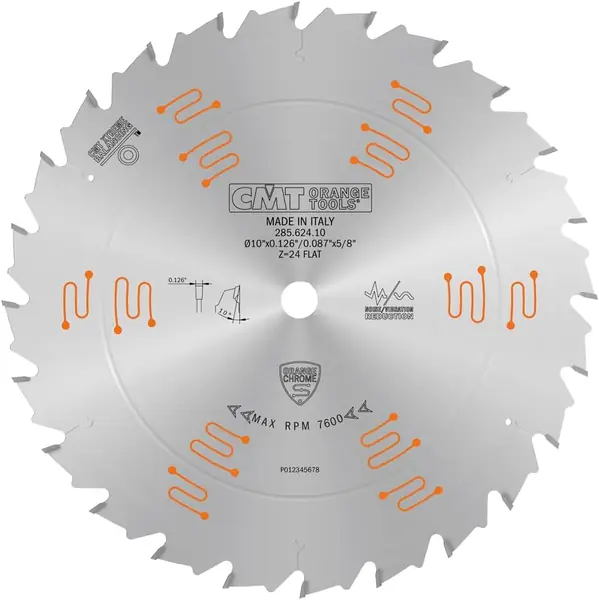
CMT 285.624.10 Rip Blade Best for Grooves and Dados

CMT 285.624.10 10-inch 24-tooth flat-top rip blade with steel plate

Grooves and dados

Shop Score 89/100
Kerf
0.126 inch
Teeth
24, flat-top grind
Diameter
10 inches
Hook Angle
15 degrees
View on Amazon

A flat-top grind leaves a square-bottomed kerf, and that is the reason to own this one. Splines, inlay, and stopped grooves all want a bottom you can register against, and 24 flat teeth cut those cleanly alongside ordinary rip work. The kerf measures 0.126 inch, a hair over an eighth, which is worth knowing before you count on it for a 1/8-inch slot.

We like the heavier plate more than we expected to. At 0.087 inch it is substantially thicker than the thin-kerf blades here, and that shows up as a blade that holds its line in a deep cut instead of wandering when you push a thick board through. The trade is horsepower: a full kerf removes more wood, and a small saw feels it on every pass.

That makes this the specialist of the group rather than the blade to buy first. A 15-degree hook and a thick body want a 2-horsepower or larger saw behind them, and on that saw the combination of smooth thick-stock rips and square-bottomed joinery cuts is hard to argue with.

Worth Noting

  • Wants a saw with real horsepower
  • Wide kerf wastes more stock
Our Verdict

We keep this one for flat-bottomed work, grooves, dados, and splines, and for heavy rips where a thicker plate holds its line.

Check Latest Price

How We Tested Ripping Blades

We started with 10-inch blades on a 5/8-inch arbor, then filtered by kerf width, tooth count and grind, hook angle, plate thickness, and published maximum RPM — a blade without an RPM rating never made the bench. Price relative to the rest of the group settled the edges of the list. That left 12 blades, and we ran them for eight months.

Each one spent time on a 1.75-horsepower contractor saw and a 3-horsepower cabinet saw, ripping 3/4-inch plywood, 8/4 red oak, and walnut. We measured every kerf with calipers and held the number against the saw's riving knife; where a thin kerf left daylight behind a standard knife, we flagged the mismatch rather than making the cut. Through-rips ran with the guard and anti-kickback pawls in place, and we checked each blade's rating against the saw's no-load speed before mounting it.

During cuts we watched for burn, tooth marks, and flutter, and judged glue-readiness by pressing two ripped edges together and holding them to a light. Blades that needed a stabilizer to run clean lost ground for it, and we noted how hard we had to push to keep a blade tracking in the cut. Sharpness and edge retention were tallied in board feet: how many before cut quality dropped off, and whether resharpening made sense against what the blade cost.

How to Choose a Ripping Blade for a Table Saw

Match the Kerf to Your Saw's Horsepower

A thin kerf removes less wood, and on a 1- or 2-horsepower contractor saw that is the difference between a motor that holds speed through a long rip and one that bogs halfway. Full-kerf blades cut a wider path, but the thicker plate resists deflection in deep cuts and is the right call on a 3-horsepower cabinet saw. As a rough rule, buy thin kerf below 2 horsepower and full kerf above it.

Riving knife thickness is the trap. A 0.09-inch blade running behind a standard 1/8-inch knife can bind, because the knife is wider than the kerf it is meant to follow. Measure your knife before the first cut and switch to a thin-kerf knife if the two do not agree.

Read the Grind, Not the Marketing

Tooth count sets speed against finish, and the grind decides what kind of edge you get. Twenty-four flat-top teeth chisel out big chips and feed fast, which is the classic ripping setup, but the surface wants a light pass before glue. Thirty teeth in a triple-chip pattern slow the feed and leave a surface you can glue straight off the saw. Alternating top bevel teeth shear the edges of the cut and are the better compromise when plywood and OSB are on the cut list.

Rip solid stock most of the time and a 24-tooth flat-top is all you need. Build panels and a 30-tooth glue-line blade is worth adding as a second blade rather than a replacement.

Decide How Good the Edge Has to Be

A glue-line blade is only as good as the saw under it. If the arbor flange is dirty, the trunnions are out of alignment, or the fence is not parallel to the blade, a premium blade leaves a stepped edge and you have paid for a finish you cannot get.

Clean the flange, set the fence to the miter slot, and make a test rip on scrap before deciding you need a better blade. Once the saw is dialed in, a glue-line blade genuinely can remove the jointer from a panel glue-up, which is why we keep one on hand.

Check Diameter, Arbor, and RPM

Every blade we recommend here is 10 inches with a 5/8-inch arbor, the common combination on U.S. table saws. If your saw takes something else, none of these will mount.

Two numbers to verify before the first cut: the blade's maximum RPM, which has to meet or exceed your saw's no-load speed, and the thickness of stock you plan to rip. Thin kerf plus moderate depth is what keeps a small saw happy; a full-kerf blade in 8/4 hardwood on a 1-horsepower saw is how motors get hot.

Frequently Asked Questions

Final Verdict

Start with the Freud LU87R010. Its 0.094-inch kerf and 24 flat-top teeth make the most of an ordinary 1- or 2-horsepower saw, and it is the least expensive blade here that we are happy to leave on the arbor for a full afternoon of ripping.

Two requirements change the answer. If the edge goes straight into a glue-up, the Freud LM75R010 earns its extra cost and takes the jointer out of the process. If your ripping is plywood and framing lumber, the Diablo D1024X leaves the cleaner panel edge.