↑↓ navigate ↵ open Esc close All results →

Best Bar Clamps for Woodworking of 2026

A dry-fitted cabinet panel or butcher-block top can still cure crooked if a clamp bar bows under load and pulls the joint out of flat. Between spreading glue and watching the squeeze-out bead up, a shop needs clamps that hold steady pressure with one hand free to align the next joint before the open time runs out.

Over six months, we tested 12 sets of trigger, screw-and-clutch, and parallel-jaw clamps on butcher-block countertops, cabinet face frames, a split chair rail, and picture frames. Published pound ratings act as an upper limit rather than a guarantee of rigidity, and short throat depth quickly becomes a regret when a joint sits farther from the edge than expected.

Building out a clamp rack takes a mix of lengths and styles—long parallel bars for wide panels, quick trigger clamps for solo assembly, and affordable clutch clamps worth buying in multiples—without creeping under pressure or marring finished faces.

Our Top Picks

The Best Bar Clamps for Woodworking

1.

Jorgensen Steel Bar Clamps 4-Pack Best Overall
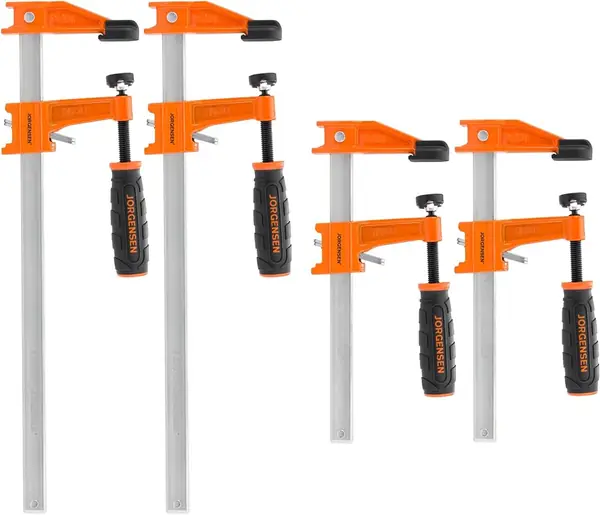
Orange and black Jorgensen steel bar clamps with two 6-inch and two 12-inch bars

General woodworking

Shop Score 97/100
Clamping Force
600 lb
Throat Depth
2-1/2 in.
Bar Lengths
6 in. and 12 in. (two each)
Head Type
Multi-disc clutch sliding head
View on Amazon

The sliding head on this Jorgensen set is threaded for the screw and held by a stack of clutch discs, so it parks anywhere along the bar before the handle takes over. That is the combination we want in a general-purpose F-clamp: the head slides to the work in a second, and the screw does the squeezing rather than your forearm.

Six hundred pounds of rated load is more pressure than any trigger clamp here can put down, and the mix of two 6-inch and two 12-inch bars covers most of what a small shop does in a week — drawer boxes and small frames on the short ones, carcass and rail work on the long ones. We especially like that the 2-1/2-inch throat gets the jaw past a doubled edge without the bar fouling the stock. Cast jaws and a plated bar feel like tools rather than toys, and the orange enamel is easy to spot when one disappears under a pile of offcuts.

Two things to know before you buy. The clutch bites hard, but jamming it down on a slick, finished surface is how the plastic pads end up sliding out of their seats, so seat them flat and let the screw build the pressure. And these are medium-duty clamps: a 24-inch panel glue-up wants the parallel pair listed below.

Worth Noting

  • Screw tightening needs two hands
Our Verdict

We think this is the set to buy first: 600 pounds of screw-driven pressure, two bar lengths, and cast jaws that hold through a full glue-up.

Check Latest Price
2.

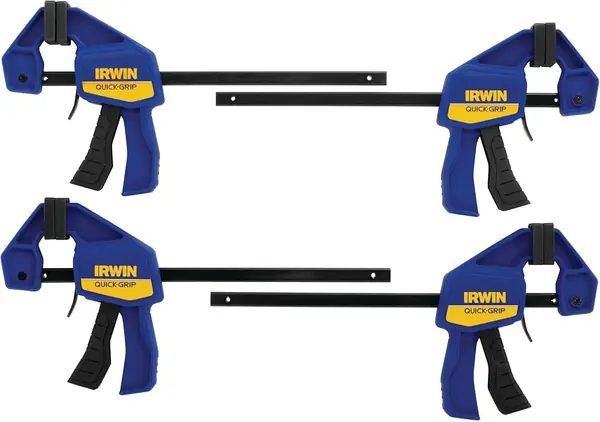
IRWIN Quick-Grip Mini Bar Clamps 4-Pack Best One-Handed

Four blue IRWIN Quick-Grip mini bar clamps with 6-inch steel bars and resin bodies

One-handed small work

Shop Score 96/100
Clamping Force
140 lb
Pack Count
4
Bar Length
6 in.
Body Material
Resin with hardened steel bars
View on Amazon

Four 6-inch clamps rated at 140 pounds will not pull a bowed panel flat, and that is not the job we hand them. What they do is hold small parts together while the glue sets, and they do it one-handed — squeeze the trigger to close, press the lever to release. That single feature is why a set lives within arm's reach of our bench.

The 6-inch opening suits drawer boxes, face frames, small boxes, and jigs, and the non-marring pads mean you can clamp a finished face without cutting a caul first. At 6 inches they sit entirely on top of a small assembly, so nothing hangs over the edge pulling the work off the bench, and the whole four-pack weighs about a pound.

Where these really earn their place is speed. Setting a row of them along a frame takes a fraction of the time a screw clamp needs, and the release lever falls under your thumb, so one hand holds the work while the other lets go. That is the trade: less pressure, more speed.

Worth Noting

  • Resin body can crack under steady use
Our Verdict

Buy these for small parts you need to hold with one hand; they are the quickest, lightest clamps here for glue-up work under 6 inches.

Check Latest Price
3.

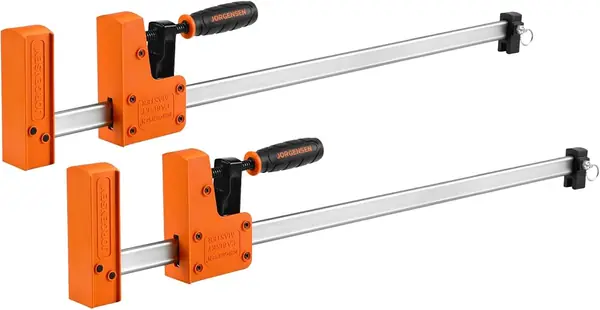
Jorgensen Cabinet Master 24-Inch Parallel Clamps Best for Panel Glue-Ups

Two orange Jorgensen Cabinet Master parallel clamps with steel jaws and maple handles

Panel glue-ups

Shop Score 95/100
Clamping Force
1,500 lb
Pack Count
2
Opening Capacity
24 in.
Jaw Type
Parallel steel jaws
View on Amazon

An F-clamp pulls from one side of a joint, and on a panel that is enough to bow the edges you just jointed. Parallel clamps pull straight down the full depth of the jaw instead, so two boards come together flat. That difference is why a cabinet shop keeps a pair of these next to a rack of cheaper clamps.

Fifteen hundred pounds is the highest rating in this group, and the maple handles spread that load across your palm, so you can put real torque on a joint without your hand giving out first. The jaws seat square along their full depth, the heads reverse for spreading, and the clamp stand holds a 24-inch clamp upright on the bench while you line up the next one.

Cost is the other half of the story. These are the most expensive clamps here by a wide margin, and we think of them as the pair you add after the basic rack is built rather than before. When the first cabinet door comes together, the flatness is worth the wait.

Worth Noting

  • About 15 lb for the pair
Our Verdict

If you are gluing panels or cabinet doors, these hold the edges flat in a way no other clamp here can; buy the pair and keep your trigger clamps for everything else.

Check Latest Price
4.

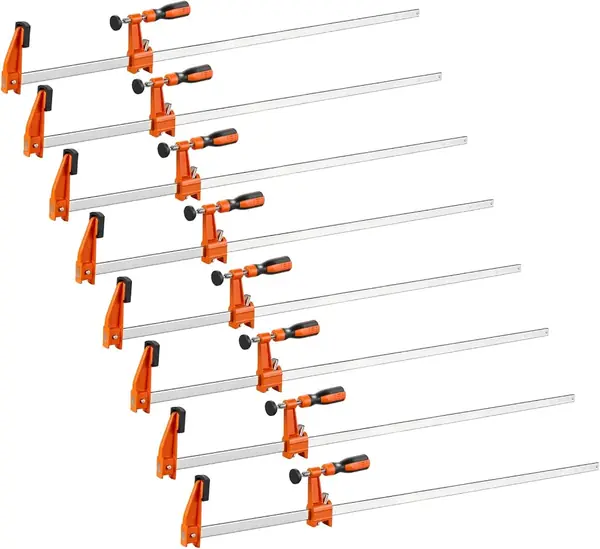
VEVOR 36-Inch Bar Clamps 8-Pack Best for Large Glue-Ups

Eight black and orange VEVOR bar clamps with 36-inch steel bars and cast iron bodies

Large glue-ups

Shop Score 94/100
Clamping Force
600 lb
Pack Count
8
Throat Depth
2-1/2 in.
Bar Length
36 in.
View on Amazon

Eight 36-inch clamps is enough iron to walk around a dining table and clamp every apron and rail at once, the kind of coverage that otherwise means buying two smaller sets and still running short. That is the case for this VEVOR pack: not refinement, coverage.

The clamps are cast iron on steel bars, rated to 600 pounds, with a 2-1/2-inch throat and a self-locking latch that keeps the sliding jaw from slipping back while you set the screw. We like the raised end stop, which keeps the head from walking off the end of the bar when you slide it fast — a small detail that saves a lot of hunting on the floor.

Three feet of steel is a lot of bar, and under real pressure a 36-inch clamp will flex; on these, the jaws can bow outward and the pads can shift once you lean on the handle. Set each clamp square to the joint and bring the pressure up evenly rather than all at once, and they hold. For the coverage they give, that is a trade we make happily.

Worth Noting

  • About 22 lb for the set
Our Verdict

When the glue-up is bigger than your clamp rack, this eight-pack buys reach and count together; set them square and do not lean on them.

Check Latest Price
5.

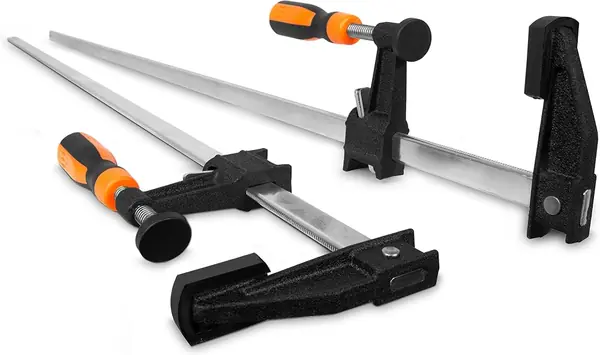
WEN 36-Inch Quick-Adjust Bar Clamps Best Quick-Adjust Long Bar

Two WEN quick-adjust bar clamps with 36-inch steel rails and 2.5-inch throats

Wide assemblies

Shop Score 93/100
Clamping Force
1,200 lb across the pair
Pack Count
2
Throat Depth
2.5 in.
Bar Length
36 in.
View on Amazon

At the handle end of this WEN sits a micro-adjustment knob, a small addition that separates it from the quick-release clamps around it. The ridged rail grabs at set stops, so you slide the head, squeeze to take up the slack, and then dial the last fraction of pressure with the knob instead of fighting a trigger.

The 2.5-inch throat clears a doubled edge, the pads are non-marring, and the pair is rated at 1,200 pounds across the workpiece — 600 per clamp, the same figure the Jorgensen and VEVOR clamps carry. Two 36-inch bars span a tabletop or a wide carcass, and the quick-adjust head slides the length of the rail without a button to press.

For medium pressure across a wide panel, that is a good trade: two 36-inch clamps for about what a single parallel clamp costs, with a knob that lets you stop exactly where you want to. On a twisted board that needs everything a clamp has, we reach for the Jorgensens instead.

Worth Noting

  • Handle can slide on the rail under load
  • Light bar flexes on wide glue-ups
Our Verdict

A good way to add long reach without parallel-clamp money, and the micro-adjustment knob is what separates this pair from the other long bars here.

Check Latest Price
6.

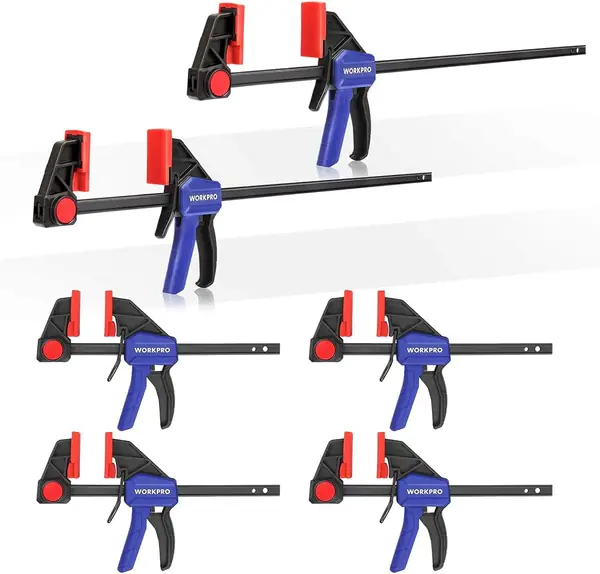
WORKPRO 6-Pack Bar Clamps Best Mixed-Size Kit

Six blue WORKPRO quick-release bar clamps in 6-inch and 12-inch lengths

First clamp set

Shop Score 92/100
Clamping Force
150 lb
Pack Count
6
Bar Lengths
6 in. (four) and 12 in. (two)
Set Weight
5.3 lb
View on Amazon

The ratio in this box is the sensible part: six clamps, four short and two long. Six-inch clamps handle drawer boxes and small frames, but the 12-inch bars are the ones that get borrowed and never find their way back to the rack, and having two of them in the same set saves a second purchase.

These are light-duty clamps — 150 pounds, a nylon body over a hardened steel bar — with a quick-release latch so the head slides to the work and a couple of squeezes set it. Both sizes convert to spreaders by pressing the red button and reversing the jaw, which comes up more often than you expect on a tight drawer or a racked frame.

Weight is the other argument in their favor. At a bit over five pounds for all six, a 12-inch clamp on a small box does not tip the assembly over while you reach for the next one, and the whole set moves from bench to bench in one hand.

So we treat this as the starter kit: the size mix covers small furniture and cabinet parts, the light weight suits working alone, and the cost per clamp is among the lowest here. What it is not is a replacement for a 600-pound screw clamp when a joint has to be pulled shut.

Worth Noting

  • Grip is lighter than screw-style clamps
  • Release button sits under your palm
Our Verdict

Our pick for a first set: six light clamps in the two sizes small projects use, with spreader conversion thrown in.

Check Latest Price
7.

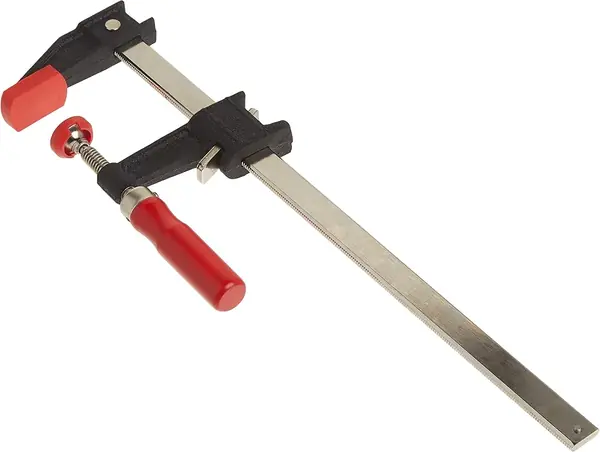
Bessey GSCC2.512 Clutch Style Bar Clamp Best Single Clamp

One Bessey clutch-style bar clamp with a 12-inch serrated steel rail and black handle

Adding capacity

Shop Score 91/100
Clamping Force
600 lb
Throat Depth
2-1/2 in.
Opening Capacity
12 in.
Bar Size
3/4 x 1/4 in.
View on Amazon

Most of the clamps here arrive as a set. This one arrives as a single 12-inch clamp at the lowest per-clamp cost in the group, which is how a lot of shops actually get built — one at a time, as the work asks for it.

The mechanism is old-fashioned in the best way. The sliding jaw is a clutch riding a serrated rail: slide it to the work and it bites where you leave it, then the handle turns a screw with a swivel pad and the pressure comes on gradually instead of all at once. The bar is 3/4 by 1/4 inch nickel-plated steel and the jaws are powder-coated cast iron.

What we noticed in use is how little drama there is. The clutch holds its place on the rail while you position the clamp one-handed, the swivel pad sits flat against an angled face, and the handle gives enough leverage to load a joint without the bar twisting. Nothing about it is fast, and nothing about it needs to be.

If you are starting from nothing, buy a set — you want four clamps before you want one good one. If you already own a few and keep coming up short on glue-up day, this is the clamp to add, and a shelf of mismatched Bessey singles is nothing to apologize for.

Worth Noting

  • Sold as a single clamp
Our Verdict

One clamp at a time is how most shops grow, and this is the one we add: 600 pounds, a clutch that bites where you set it, and the lowest per-clamp cost here.

Check Latest Price
8.

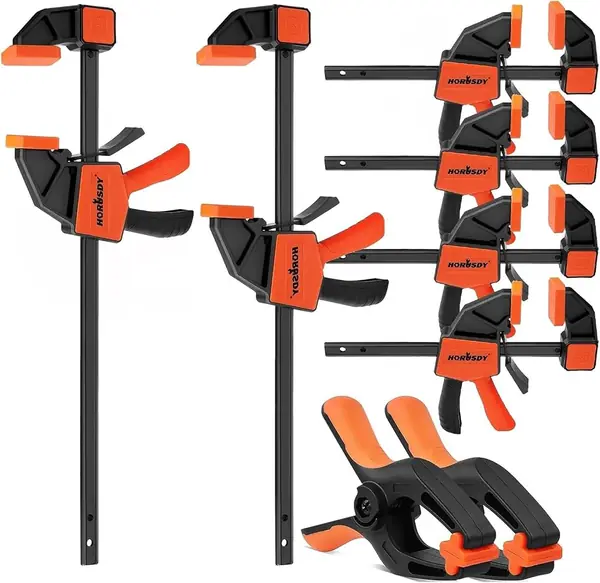
HORUSDY 8-Pack Bar Clamps Best for Budget Outfitting

Orange HORUSDY bar clamps in 6-inch and 12-inch lengths with two spring clamps

Budget outfitting

Shop Score 90/100
Clamping Force
150 lb
Pack Count
8
Bar Lengths
6 in. (four) and 12 in. (two)
Spring Clamps Included
2
View on Amazon

If the clamp budget is the tightest line in the shop, this pack stretches it furthest: eight pieces, six of them bar clamps in two lengths, at a lower cost per clamp than anything else here.

The bar clamps are 150-pound light-duty units with nylon bodies and hardened steel bars — four at 6 inches, two at 12 — and both sizes flip into spreaders. The other two pieces are 6-inch spring clamps, which will not hold a joint closed on their own, but we use them for holding a caul or a backer while the real clamps go on.

Longevity is the other thing to plan for: the nylon bodies and bumpers take abuse that cast iron shrugs off, so treat a dropped clamp as a maybe. For a first set on a beginner's bench, that is a fair trade for the cost.

Worth Noting

  • Grip can let go on slick or angled faces
Our Verdict

The cheapest way here to put a lot of light clamps on the shelf at once; grip is the part you trade away.

Check Latest Price

How We Tested Bar Clamps in a Working Shop

We started by pulling the published numbers on every clamp we could find — load rating, bar length, throat depth, pack count, and what the body and jaws are made of — and set aside anything that wouldn't state a rating or that sold a mixed set without saying how many of each length you get. That left 12 sets, which we used in a working garage shop for six months.

The main event was real glue-ups: a butcher-block countertop, a set of cabinet face frames, a split chair rail, drawers, and a run of picture frames. Before the glue came out, we opened each clamp to its maximum and measured the gap with a tape, then checked throat depth by reaching it past the edge of a face frame to see how much of that edge sat behind the bar.

During glue-ups we cranked each clamp to its stated load limit, never past it, and sighted down the bar with a straightedge to see how much it bowed at mid-span. We marked the rail with a pencil to catch heads that crept backward under pressure, then clamped finished maple and oak offcuts to look for dents and for pieces that slid while we tightened. One-handed models got closed with one hand while the other held the joint square, fingers kept clear of the jaw opening.

We weighed every clamp on a kitchen scale and noted which ones our forearms gave up on three joints into a long panel. We also wiped glue off with the clamp still on the bar, left them hanging through humid weeks, and flipped the convertible jaws to push a frame open instead of closed.

How to Choose Bar Clamps for Woodworking

Clamping Force: What the Pound Rating Buys

The ratings here run from 140 pounds on the IRWIN mini clamps to 1,500 on the Jorgensen parallel pair, and the gaps mean something. Light-duty 150-pound clamps hold parts that are already aligned while the glue sets. Six-hundred-pound screw clamps can pull a small gap closed. Parallel clamps at 1,500 pounds do it across a two-foot panel without bowing the work.

Here is the trap: the rating is a ceiling, not a promise. On a slick or angled face the pads can let go well before you reach the limit, so a 150-pound clamp that slips is worse than no clamp on a joint that needs pulling. If the boards do not meet on their own, buy pressure and a stiff bar.

Bar Length, Throat Depth, and Flex

Bar length is the reach you buy, but throat depth decides whether the clamp is useful once it gets there. Most clamps here run a 2-1/2-inch throat, which clears a doubled edge or a rail sitting proud; a deeper jaw is worth paying for only if you regularly clamp past a wide face.

Long bars flex. A 36-inch clamp spread across a tabletop bows in the middle under hard pressure, which opens the joint at the center of the panel exactly where you stopped watching. Alternate long clamps above and below the work, bring the pressure up evenly, and keep the 6- and 12-inch bars for the smaller assemblies they suit.

Trigger Clamps vs. Screw-and-Clutch Clamps

A one-handed trigger clamp sets and releases in a second, which is why the IRWIN minis and the WORKPRO set are the ones people grab while dry-fitting. What they give up is pressure and slip resistance; the ratchet can walk back under load. Screw-and-clutch clamps such as the Jorgensen F-clamps are slower but hold their position on the bar and can be loaded until the joint closes.

We keep both. Trigger clamps hold small parts and jigs; screw clamps do the glue-ups that matter. If you can only buy one kind first, buy the screw clamp — a four-pack of triggers can follow later.

When a Parallel Clamp Earns Its Cost

For panel glue-ups, cabinet doors, and anything where two faces must end up flush, parallel clamps do something the others cannot: the jaws stay parallel down their depth, so the clamp draws the joint straight instead of bowing one board against the other. They are heavier, they run several times the cost of a bar clamp, and they stand on their own feet while you line up the rest of the row.

Our advice is to add them after the basics. Four screw clamps and a couple of long bars carry most furniture work; the parallel pair starts earning its keep the first time you glue up a 24-inch panel and want the seam to disappear.

Frequently Asked Questions

Final Verdict

Start with the Jorgensen four-pack. Six hundred pounds of screw-driven pressure, a 6-inch and a 12-inch bar in the same box, and cast jaws that hold through a full glue-up make it the set that covers the most work with the fewest compromises.

Then add what your work asks for. The Cabinet Master pair earns its cost the first time you glue up a panel and want the seam invisible, the IRWIN four-pack handles small one-handed jobs, and a single Bessey is the cheapest way to stop coming up one clamp short.