↑↓ navigate ↵ open Esc close All results →

Best Band Clamps of 2026

Ordering an exhaust band clamp by nominal pipe size alone is an easy way to stall a driveway repair, since a 2.5-inch clamp and a 2.5-inch pipe do not always match once wall thickness and slip-fit overlap enter the equation. Unlike a U-bolt that crimps thin-wall tubing out of round, a stainless sleeve or strap pulls evenly around the seam to join cut ends and seal exhaust gas ahead of the muffler.

Fitting 14 clamps across five months—from straight same-size splices to a turbo downpipe—underscored one rule: identify the joint before picking the hardware. Measuring true outside diameter for a butt joint, or both inner and outer diameters for a stepped lap joint, ensures even clamping force without exhaust leaks.

Covering wide bolt-on sleeves, narrow straps for tight underbody clearances, stepped lap clamps, and weld-on V-band flanges for assemblies that come apart often, the four designs here match either a quick patch or a serviceable build.

Our Top Picks

The Best Band Clamps

1.

EVIL ENERGY 2.5-Inch Butt Joint Band Clamp Best Overall
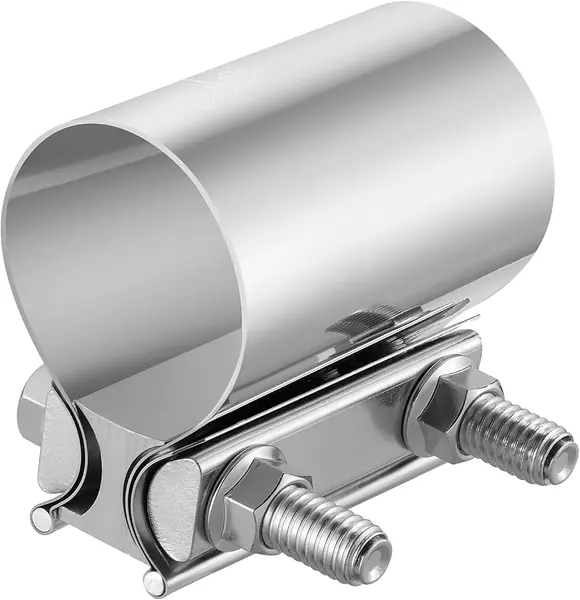
EVIL ENERGY stainless steel butt joint band clamps with silver bands and M10 bolts

Same-size pipe splices

Shop Score 92/100
Pipe Size
2.5-inch outside diameter
Joint Type
Butt joint sleeve
Band Material
304 stainless steel
Hardware
Zinc-plated M10 bolt and nut
View on Amazon

Two clamps in the box is the practical argument for this pair — a spare on the shelf beats a reorder when a joint starts buzzing a week before a road trip. For a straight splice between two pipes of the same diameter, it is the clamp we reach for first, because it asks for nothing beyond a ratchet and a few minutes underneath the car.

The band is 304 stainless and draws down through an aluminum alloy block and a steel gasket, so the squeeze lands around the whole circumference instead of pinching at two points the way a U-bolt does. We paid close attention to that evenness on a cut joint, since a band that loads one side first will walk the pipes out of line before it seals anything.

Both bolts are M10 and take a 14 mm socket, and the rated torque is 63 N·m. We stop at that number; going past it on thin-wall tubing buys a dented pipe, not a tighter joint. The maker also recommends exhaust sealant on the pipe ends before assembly, and that is cheap insurance on a butt joint, which has no overlap to hide a gap.

Sizing is where people get into trouble. This listing is the 2.5-inch version, measured on the pipe's outside diameter, and the same clamp runs from 1.75 inches up to 5. Use a caliper rather than a tape measure — a sixteenth of an inch is the difference between a clamp that slides on and one that has to go back.

Worth Noting

  • Butt joints only; overlaps call for a lap clamp
Our Verdict

This is the pair we hand most people first: a 2.5-inch butt-joint clamp that splices two same-size pipes with a ratchet and no welding.

Check Latest Price
2.

EVIL ENERGY 3-Inch Narrow Band Muffler Clamp Best for Tight Clearances

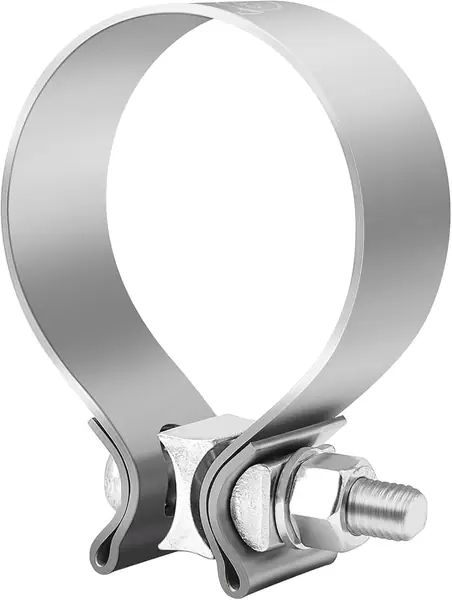
EVIL ENERGY narrow band exhaust clamp pair in stainless steel with bolt and block

Tight clearance joints

Shop Score 91/100
Pipe Size
3.0-inch OD-ID slip fit
Joint Type
Narrow band
Band Material
304 stainless steel
Band Width
1.22 inches (31 mm)
View on Amazon

Clearance is the whole reason this clamp exists. At 1.22 inches (31 mm) wide, the band is narrow enough to sit at a joint where a full-width sleeve would foul a heat shield, a crossmember, or the floorpan, and it takes up less room around the pipe while you get a socket on the bolt.

It is made for slip-fit connections, where one pipe slides inside another and the clamp lands on the overlap — 3.0-inch OD to ID in this listing, with the same 304 stainless band, zinc-plated M10 hardware, steel gasket, and aluminum block as the butt-joint clamp above. What we appreciate most is how the narrow band concentrates its squeeze on a short length of pipe: the joint goes from loose to immovable with less bolt travel than a wide sleeve needs.

Sealing is the honest caveat with any clamp this narrow. A slip joint offers more surface to seal than a butt joint, but the band squeezes rather than fills, so pitted or out-of-round pipe will leak no matter how hard you crank it. The maker recommends exhaust sealant on the pipe ends before assembly, and on older tubing that extra minute is worth taking.

Worth Noting

  • Cannot be opened once fitted over a pipe
Our Verdict

Where a wide sleeve will not fit, this narrow-band clamp earns its place: a 1.22-inch band that slips into tight exhaust joints.

Check Latest Price
3.

LEDAUT 2.5-Inch Lap Joint Band Clamp (4-Pack) Best Lap Joint

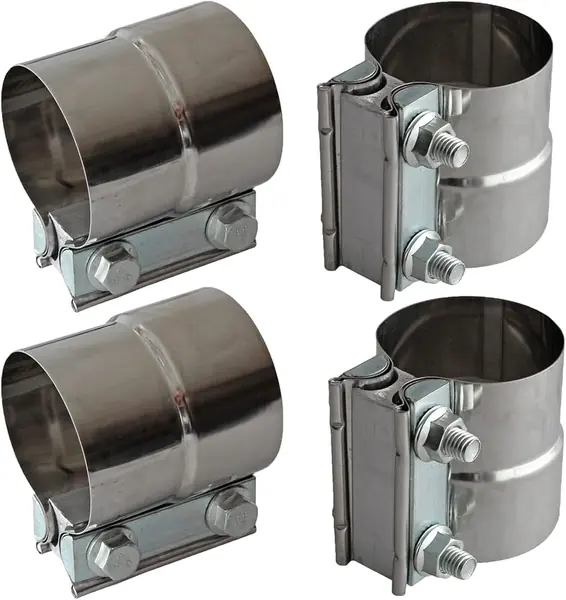
Four LEDAUT stainless steel lap joint exhaust band clamps with bolts and blocks

Overlapping pipe joints

Shop Score 90/100
Pipe Size
2.5-inch OD to 2.5-inch ID
Joint Type
Lap joint
Material
304 stainless steel
Pack Count
4 clamps
View on Amazon

A lap joint is what you have when one pipe slides over another instead of meeting it end to end, and the clamp shaped for that overlap looks different from a sleeve: one block, one band, and far less material spanning the seam. We keep a box of these for the afternoons when a muffler inlet already telescopes and four joints are coming apart at once.

The 304 stainless band grips a slip fit hard. On a straight run it takes very little bolt travel to go from loose to immovable, and the joint stays put afterward. We got the best results tightening in stages with a ratchet — the bolts are the part to treat gently, and an impact driver on a clamp this size is how people end up with a clamp in two pieces and a pipe still apart.

Installation is as simple as the design suggests: slide the clamp over the joint, seat the block, run the nut down. A finished connection looks like it belongs there rather than like a repair, and undoing it later takes one bolt, which matters if you are the person who will be back under the car next season.

Four in a box is the other reason this earns a spot. A cat-back rebuild eats three clamps before you make a single mistake, and having the fourth on the shelf means one trip under the car instead of two.

Worth Noting

  • Band will not conform close to a bend
Our Verdict

The cheapest clamp per unit here and the right shape for overlapping pipe, so we buy the four-pack when an exhaust goes back together in sections.

Check Latest Price
4.

GaeaAuto 3-Inch Quick Release V-Band Clamp Best for Frequent Disassembly

GaeaAuto stainless steel V-band clamp assemblies with male and female weld-on flanges

Turbo and downpipe

Shop Score 89/100
Pipe Size
3.0-inch
Joint Type
V-band with flanges
Material
304 stainless steel
Installation
Weld-on flanges
View on Amazon

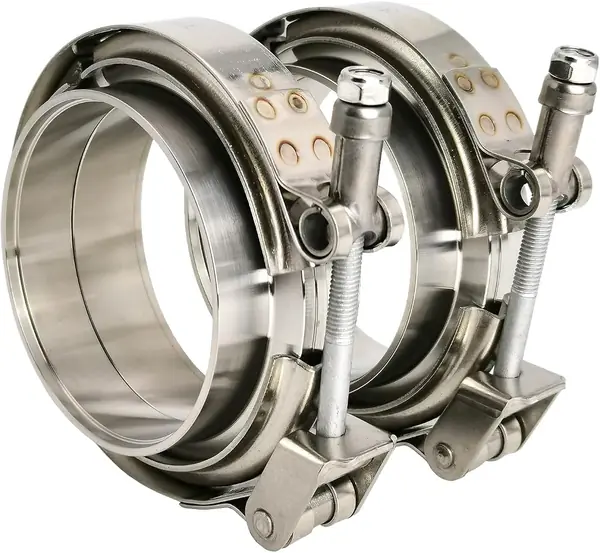
The reason to own a V-band is the second time you take the exhaust apart. Two flanges welded to the pipe ends, one clamp around them, one bolt, and the section drops off in the time it takes to find the right socket. For a downpipe, a turbo outlet, or anything that comes apart for service, that is worth real money.

The flanges are male and female, so they seat into each other and line the pipes up before the clamp does any work, and the seal is metal to metal with no gasket to blow out. This 3.0-inch listing fits pipe with a 3.0-inch outside diameter, the clamp and flanges are 304 stainless, and the T-bolt is mild steel with an M8 x 1.25 thread.

Welding is the whole job: tack the flange square, check that the two faces meet evenly, then finish the bead, keeping spatter off the inner sealing face because that surface is what holds the joint. We like these better than a slip joint for anything that comes apart more than once, and two assemblies in the box cover both ends of a mid-section.

Position is the other thing to get right. Once the flanges are welded, the joint lives where you put it, so mock the section up with the clamp closed, confirm the pipes line up, and only then strike an arc. Get that right and the joint comes apart and goes back together square every time.

Worth Noting

  • Flanges must be welded to each pipe end
  • Costs the most per clamp in this group
Our Verdict

If the exhaust has to come open again — a turbo, a downpipe, a track car — these weld-on flanges and a single T-bolt are worth the welding.

Check Latest Price

How We Tested Band Clamps

We started by collecting every band clamp we could find in the common exhaust sizes, then sorted them by joint type, since a butt joint sleeve, a lap joint, and a V-band flange solve different problems and can't be judged against each other. From that pool we bought 14 clamps, favoring stainless steel and checking that each listing said whether its size meant outside or inside diameter.

Testing ran five months, mostly in a driveway on a car with a rusted-out mid-pipe joint. We measured the pipe with calipers before ordering and recorded where each clamp actually landed, because several that claimed a given size sat looser or tighter on the same tube. Each went on with hand tools, then to the maker's torque spec with a torque wrench — snugging by feel deforms thin-wall pipe, and an oval end won't seal again.

After installation we idled the engine cold and hot and listened at the seam, then drove a week and looked for soot streaks, which show up at a leak before your ears catch it. We noted whether a cut end needed sealant or the sleeve bridged it on its own. The weld-on V-band flanges went to a shop for the welding, with eye protection and ventilation, and we tracked how many times each joint came apart and went back together. Band width was checked against real clearance — one otherwise good clamp was too wide to get a socket onto under a floor pan.

We also counted what a job actually took, a single splice or several along a run, and left the hardware out through road salt and spray to see what the bolts and bands did.

How to Choose an Exhaust Band Clamp

Start with the joint, not the clamp

Before you order anything, look at how the two pipes meet. If the ends butt together with a gap between them, you need a sleeve-style butt-joint clamp whose band and block bridge that seam. If one pipe slides inside the other, a lap-joint or narrow-band clamp grips the overlap. A V-band is a different animal: flanges welded to each pipe end, with one clamp pulling them face to face.

We start every recommendation here, because the wrong joint type is the one mistake a bigger clamp cannot fix. Measure and photograph the joint, then buy for it.

Measure the pipe, not the old clamp

The number in a listing is the pipe's diameter, not the clamp's. A clamp sold for 2.5-inch pipe measures wider than that across the band and block, and a tape hooked over a rusty pipe will give you a size that does not exist. Use a caliper on clean metal and write the outside diameter down before you shop.

If the end is pitted or out of round, clean it back to sound metal before you measure. A band clamp squeezes a pipe; it does not pull a deformed one back into shape.

Narrow band, wide band, and how much room you have

Band width is a clearance decision as much as a sealing one. The narrow-band clamp here runs 1.22 inches wide, which is what you want where a heat shield, crossmember, or floorpan leaves little space and the joint is a short slip fit. A wider sleeve spreads its force across more pipe, which forgives a slightly uneven cut on a butt joint.

Crawl under the car with the clamp's width in mind. A band that fouls a heat shield will not sit square, and a clamp sitting crooked rarely seals.

What a band clamp can and cannot seal

A band squeezes; it does not fill. It will close a sound slip fit or a clean butt joint, but it will not bridge a rust hole, a crushed section, or pipe that is out of round. That is why the makers recommend sealant on cut ends, and why sealant is not a substitute for good pipe.

Check the joint once it is together, starting the engine from cold and checking before the pipe gets hot enough to burn you. A leak ahead of the muffler can put exhaust gas where it does not belong.

Bolt-on or weld-on

Three of the four picks here go on with hand tools in minutes. The V-band is the exception, because its flanges have to be welded to each pipe end before the clamp does anything, which makes it a lift-or-shop job rather than a driveway fix.

It earns that trouble on a turbo car or anything that comes apart for service, where one bolt beats cutting out a welded joint. For a daily driver with a cracked pipe, the no-weld clamps are the entire point.

Frequently Asked Questions

Final Verdict

For a straight splice on a daily driver, we buy the EVIL ENERGY butt-joint pair: nothing to weld, nothing to measure beyond the pipe itself, and a spare clamp in the box.

Switch to the GaeaAuto V-band when the exhaust has to come apart for service. The weld-on flanges cost more and demand a welder, and they pay that back the first time you drop a section in minutes.