↑↓ navigate ↵ open Esc close All results →

Best Dowel Jigs of 2026

A dowel joint depends entirely on two blind holes meeting in exact alignment. Bore the first board square and drift a hair off center on the mating piece, and assembly turns into twenty minutes of fighting clamps with a rubber mallet while a shelf sits visibly twisted.

Locking a jig onto the stock and guiding the bit through hardened bushings removes that guesswork from the first board through the last. Across eight months of drilling plywood cabinet boxes, poplar face frames, a side table, and shop shelving in stock from 1/2-inch pine to 2-inch maple with 12 jigs, self-centering proved secondary to rigid bodies, repeatable edge stops, and depth collars you can trust near thin panels.

Spanning self-centering clamps for weekend bookcase builds and multi-hole indexing kits for production cabinet runs, the eight jigs ranked below keep consecutive joints aligned all afternoon.

Our Top Picks

The Best Dowel Jigs

1.

Dowl-it 1000 Doweling Jig Best Overall
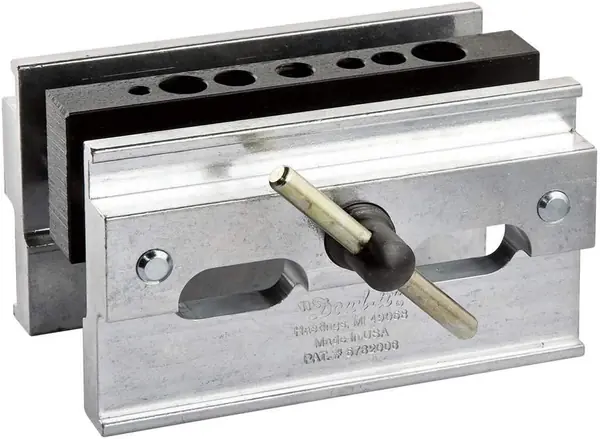
Dowl-it 1000 self-centering doweling jig with a solid hardened steel center block

Precision panel joinery

Shop Score 93/100
Weight
2.4 lb
Center Block
Solid hardened steel
Stock Capacity
Up to 2 inches
View on Amazon

A hardened steel center block and nothing else to adjust — that is the Dowl-it 1000, and the simplicity is why it is our top pick. Set it on the stock, center it, clamp, and drill. Holes land on the board's centerline, and the mating board gets the same treatment from the same reference. Most dowel joints that fail go wrong at the drilling stage rather than the gluing stage, and it is almost always because the jig shifted or the bit wandered in the first inch. This jig has very few ways to do either.

The center block is one hardened piece rather than a bushing pressed into a casting, so the bit is held on line from the moment the point touches wood. We used it mostly on panel glue-ups and shelf joinery, where the hole has to sit dead center in the thickness of the board, and it was the jig we reached for when the boards were expensive. Nothing about the body flexes when you lean into the drill, and there is no fence to knock out of square between holes.

Where it asks something of you is layout and clamping. With no edge stops or indexing pins, spacing several dowels along a rail is still square-and-pencil work — the jig guarantees the centerline, not the distance between holes. For one joint that costs you nothing; for a run of twenty identical cabinet joints, the Milescraft 1334 or the JessEm will earn back the difference. Ours stays set up next to the drill press for panel work, which is where a dead-center hole matters most.

Worth Noting

  • Limited to stock under 2 inches thick
Our Verdict

We recommend the Dowl-it 1000 to any woodworker who wants dowel holes that line up the first time; just plan on supplying your own clamps.

Check Latest Price
2.

Milescraft 1334 Joint Master Best Self-Clamping Jig

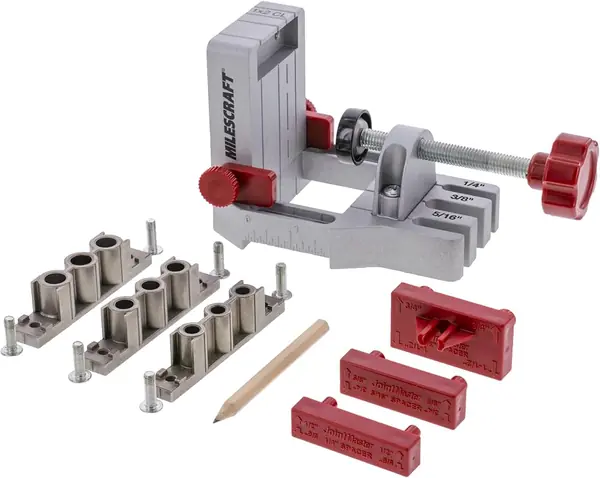
Milescraft 1334 Joint Master aluminum doweling jig with retractable edge stops and three drill blocks

Mixed joint styles

Shop Score 92/100
Body
All aluminum
Dowel Sizes
1/4, 5/16, 3/8 inch
Stock Thickness
1/2 to 3 inches
Joint Types
Edge, corner, surface
View on Amazon

The Joint Master clamps itself to the board, which means you do not need to own a pair of bar clamps before your first dowel joint. Set the aluminum body on the edge, tighten it down, and two retractable edge stops drop in to register the second board against the first. Those stops are the detail we appreciate most: they take the measurement out of matching board A to board B, and across a cabinet's worth of shelves that is the difference between a pleasant afternoon and a long one.

Aluminum construction is why we rank it near the top of this set for rigidity. A plastic-bodied jig can flex when you lean on the drill; this one does not, and the three hardened steel drill blocks for 1/4, 5/16, and 3/8-inch dowels lock in with a positive feel. It takes stock from 1/2 inch to 3 inches, which covers 2x material and thick aprons without a second jig. Edge, corner, and surface joints all come off the same body, and the centering spacers that set the blocks for common thicknesses are the kind of small extra that saves a real setup.

Centering is manual. You adjust the drill blocks to the thickness of your stock and check the result, and a test joint on scrap is worth the two minutes it takes. Once it is set, though, it stays set for the whole batch, which is how this jig wants to be used: dial it in for the thickness you are building with and run every rail and stile through it before you change anything. Do that and the setup cost disappears into the first ten minutes of the project.

Worth Noting

  • Centering needs manual adjustment and test holes
Our Verdict

Our pick when a project mixes corner, edge, and surface joints: it clamps itself and switches between all three without extra parts.

Check Latest Price
3.

JessEm 08350 Dowelling Jig Master Kit Best for Repeat Layouts

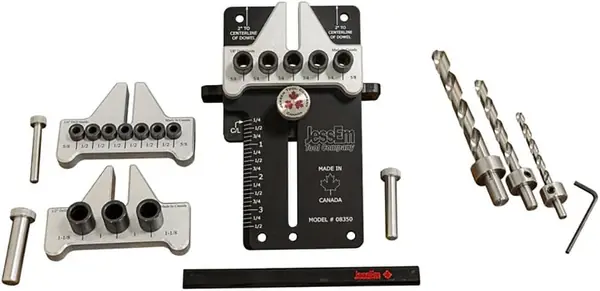
JessEm 08350 doweling jig master kit with anodized aluminum body and stainless steel indexing pins

Repeat layouts

Shop Score 91/100
Body
CNC-machined anodized aluminum
Dowel Sizes
1/4, 3/8, 1/2 inch
Indexing
1/8-inch increments
View on Amazon

This is the most expensive jig in this guide, and it is priced that way on purpose. Everything about the JessEm is aimed at the woodworker who drills hundreds of dowel holes a season and needs each one in a preset spot without thinking about it.

What the money buys is repeatability. Dowel locations can be preset in 1/8-inch increments, and a built-in alignment slot lets you carry that spacing across a wide panel so holes twelve inches apart still match their partners. Three guide bushing carriers cover 1/4, 3/8, and 1/2-inch dowels, and the indexing pins are machined stainless steel rather than a folded clip. Set a spacing once and the jig repeats it piece after piece.

Where our money actually goes is the machining. The body is CNC-machined aluminum, anodized, laser engraved with the scales, and it feels like a measuring instrument rather than a jig. Nothing about it flexes, the carriers slide without slop, and a configuration you set at the start of a project is still true at the end of it. If you have ever drilled the same joint forty times and had four of them come out a hair off, that consistency is the whole feature.

For everyone else the arithmetic is less kind. A hobby shop building two or three pieces a year gets the same joints from the Milescraft 1334, and the tolerance inside a cabinet carcase rarely shows the difference. Buy the JessEm when the layout, not the joint, is the hard part of the work.

Worth Noting

  • No clamp or case included
Our Verdict

For furniture makers drilling dozens of identical dowel holes, the JessEm earns its premium — and for everyone else it is more jig than the work needs.

Check Latest Price
4.

Milescraft 1309 Dowel Jig Kit Best Starter Kit

Milescraft 1309 dowel jig kit with Joint Mate body and 82-piece accessory set

First dowel projects

Shop Score 90/100
Dowel Sizes
1/4, 5/16, 3/8 inch
Stock Thickness
1/2 to 1-1/2 inches
Kit Size
82 pieces
View on Amazon

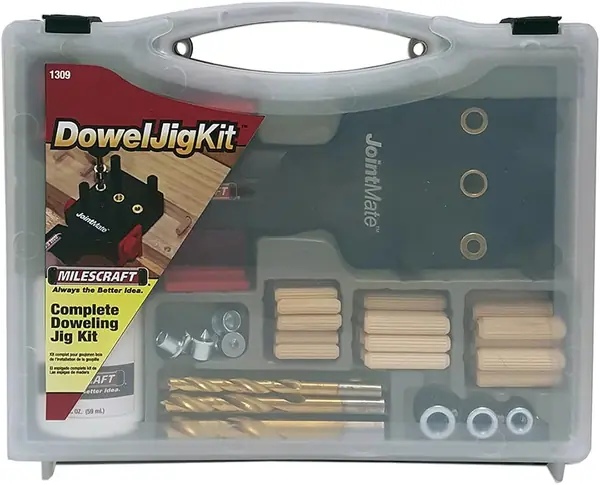
Eighty-two pieces come in the case: the Joint Mate jig with its fence and knobs, three brad-point bits, 62 fluted dowel pins, six dowel centers, three drill stops, an Allen wrench, and a bottle of glue. For a first dowel project that inventory matters more than any single feature. You are not stopping halfway through a Saturday to order pins, and you are not guessing which bit goes with which dowel.

We like this kit for how much of the learning curve it removes. The jig self-centers on the board and the adjustable fence sets the offset, metal bushings keep the bit tracking straight, and the drill stops keep you from punching through a shelf. It works with stock from 1/2 inch to 1-1/2 inches and covers 1/4, 5/16, and 3/8-inch dowels, which is most of what a homeowner or cabinet builder will ask of it. The dowel centers alone are worth the shelf space: they mark the mating board directly instead of asking you to transfer a measurement.

The ceiling is precision work. Fine furniture tolerances, where a joint has to close with no filler, are past what this jig reliably delivers, and the adjustable fence takes a little practice before it holds a setting the way you expect. For cabinets, shelving, face frames, and repairs neither matters. Keep the case, too — the small parts are what turn a kit into a drawer of loose hardware.

Worth Noting

  • Drill stop collars can slip under pressure
Our Verdict

We hand the Milescraft 1309 to anyone drilling a first dowel joint, because the box already holds the bits, pins, stops, and glue.

Check Latest Price
5.

Eleon Self-Centering Dowel Jig Best for Wide Stock

Eleon self-centering dowel jig in blue aluminum with elongated jaws and six drill bushings

Extra-wide stock

Shop Score 89/100
Body
Aluminum alloy
Dowel Pins
30 included
Drill Bushings
6 included
Clamping Opening
Up to 6.7 inches
View on Amazon

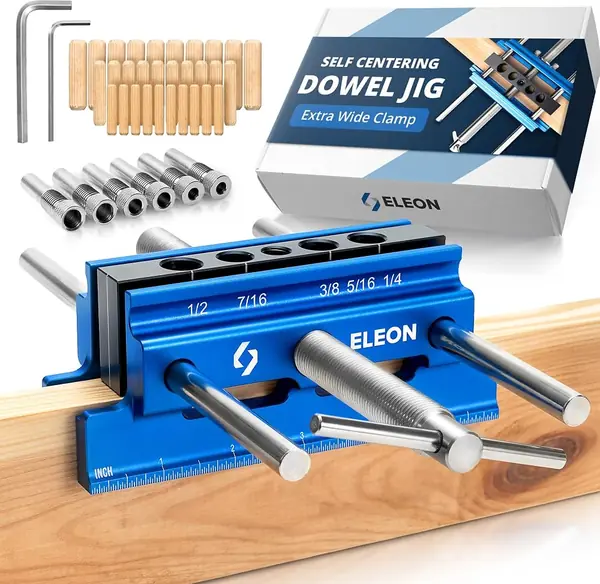
Six and seven-tenths inches of clamping opening is the reason to look at this one. Most self-centering jigs here top out around two, which is fine for a cabinet rail and useless for a glued-up panel or a thick bench apron. We like that the Eleon opens wide enough to be a jig for shelf edges and table aprons, not just frames, because that is the work that usually pushes people toward a router and a slot cutter instead.

The rest of the body is aluminum, 3.59 pounds of it, with elongated clamping jaws that spread pressure along the board instead of biting at two small points. In use that shows up as a jig that sits flat and stays flat while you drill. Ruler markings down the side speed up positioning, the height of the body helps hold the bit at 90 degrees, and the box includes six drill bushings and 30 dowel pins, so the first project does not need a second order.

The one thing we noticed while handling it is the heft. At 3.59 pounds it is heavier than the compact jigs here, and holding it against a tall cabinet side while you tighten the clamp takes a second hand. On a bench with the work flat, that weight is an asset — it sits on the board and stays put. This is a bench jig, not a pocket one.

Worth Noting

  • Alignment marks can sit slightly off center
Our Verdict

Wide boards, thick aprons, and glued-up panels are where we send people to the Eleon, whose clamp opens to 6.7 inches.

Check Latest Price
6.

Blekoo Self Centering Doweling Jig Kit Best Budget Pick

Blekoo self-centering doweling jig kit in blue with six hardened steel drill bushings

Budget shop jig

Shop Score 87/100
Body
Aircraft-grade aluminum
Bushings
Six hardened steel
Board Width
7/16 to 2.4 inches
View on Amazon

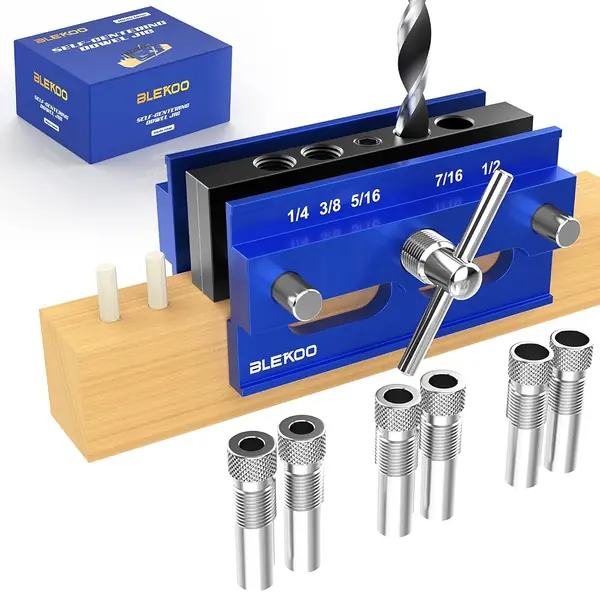
Whether a cheap self-centering jig actually centers is the question this one has to answer, and the answer is usually yes, provided you do not overdo the clamp. The Blekoo runs on the same principle as the expensive jigs here: two jaws squeeze the board and the drill guide sits on the centerline between them.

The body is aircraft-grade aluminum with laser-etched scales, and it arrives ready to drill with no assembly. It fits stock from 7/16 inch up past 2 inches, which covers sheet goods, 1x material, and most 2x boards. Six hardened steel bushings come in the box along with an instruction sheet that is thin but adequate. At 2.09 pounds it is light enough to hold in one hand while you tighten with the other.

The clamp is where it needs care. The jaws are smooth, and cranking them down hard pulls the jig off the centerline rather than holding it tighter, so snug is the setting you want. On hard maple, a strip of 120-grit between jaw and board stops the slide without changing the setting. That is a technique adjustment rather than a fault, and it is the one habit worth building before your first project with it.

For shelf pins, cabinet frames, and shop jigs, the holes we have drilled with it have come out where we wanted them, and the laser scale reads faster than the stamped marks on more expensive jigs. It is not a precision instrument, and it does not pretend to be. Put the money you save toward a good 3/8-inch brad-point bit; bushings are only as good as the bit spinning in them.

Worth Noting

  • Won't span boards wider than 2.4 inches
Our Verdict

We keep the Blekoo as a second jig: cheap enough to leave set up, accurate enough for shelf pins and cabinet frames.

Check Latest Price
7.

GOINGMAKE Dowel Jig Kit Best Kit with Built-In Clamp

GOINGMAKE all-metal dowel jig kit in black with a built-in quick clamp

Self-contained clamping

Shop Score 86/100
Dowel Sizes
1/4, 3/8, 1/2 inch
Weight
4.13 lb
Clamping
Built-in quick clamp
Stop Increments
1/8-inch stops, 1/16-inch scale
View on Amazon

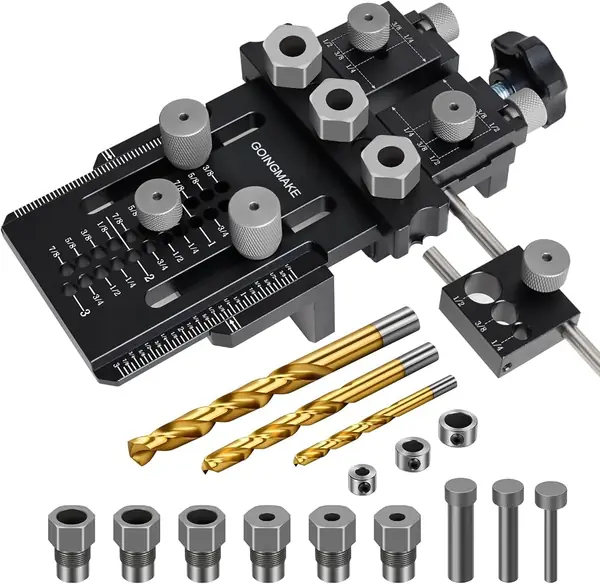
The best jigs on this list all assume you own a couple of bar clamps. The GOINGMAKE does not: a quick-release clamp is built into the body, so the jig locks onto the workpiece by itself and comes off just as fast. That single design decision is why it is here, and it is why we rate it as the most self-contained kit in this set.

Everything else is aimed at repeat work. Nine hardened steel drill guides cover 1/4, 3/8, and 1/2-inch dowels, positive stops index in 1/8-inch increments with a laser scale fine enough for 1/16-inch adjustments, and the extension rod and alignment slot let you reach the middle of a wide panel and carry the spacing across it. It weighs over four pounds and there is not a plastic part in the working assembly.

Setup has a curve. The manual is mostly pictures, and the first configuration takes longer than the second; work through one joint on scrap before you touch the good stock. After that the logic is straightforward — set the stop once, and every subsequent hole follows from it without measuring.

At a premium price we expect the clamp to feel like part of the tool rather than an accessory bolted on, and this one does. What we keep coming back to is how little reconfiguration it needs between boards: clamp, drill, release, repeat. Against the JessEm you trade a little machined precision for a clamp that is already there, and for most shops that is the better trade.

Worth Noting

  • Picture-heavy manual gives initial setup a learning curve
  • Premium price with slightly less precision than JessEm
Our Verdict

We point people to the GOINGMAKE when they want repeatable stops without owning bar clamps, since the clamp is part of the body.

Check Latest Price
8.

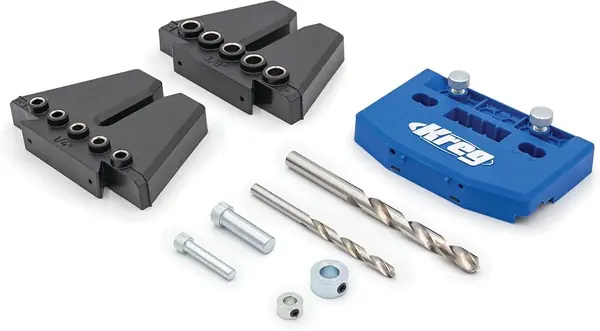
Kreg KHJD345 Dowel Jig Kit

Kreg KHJD345 dowel jig kit with removable hardened steel drill guides and built-in centering

Standard 3/4-inch stock

Shop Score 83/100
Clamping
Use with trigger clamps
Centering
Built-in
Footprint
2.13 x 10.88 x 7.5 inches
Drill Guides
Removable hardened steel
View on Amazon

The Kreg's drill guides are fixed in the body, which is why there is nothing to measure: clamp it, drill, unclamp, move to the next joint. On a run of cabinet face frames or a quick repair, that speed is the whole argument for owning it. It also makes it the least intimidating tool here — you can hand it to someone who has never drilled a dowel hole and get a usable joint on the first try.

Two removable hardened steel guides sit in the body with a built-in centering feature, and an alignment pin transfers hole positions from one piece to the next. It works with trigger clamps you already own, and its compact body is the easiest of these to carry out to a job. At just over a pound it does not need a dedicated drawer.

The fixed guides are also the catch. Because there is nothing to adjust, the jig centers on one stock thickness; use it on 2x material and the dowels sit off center by enough to matter. That is less a flaw than a definition — this is a jig for 3/4-inch stock and the joints that follow from it. Compared with the Milescraft 1334, you give up corner joints and adjustable centering and gain a tool you can set with one hand and drop in a toolbox.

Worth Noting

  • Centering cannot be adjusted for thicker stock
Our Verdict

We like the Kreg for fast edge and face work in 3/4-inch stock, and we steer thicker lumber toward a self-centering jig.

Check Latest Price

How We Tested Dowel Jigs in a Working Shop

We started with manufacturer specs, customer reviews, and woodworking forum threads, comparing stock thickness ranges, dowel sizes, clamping method, and what came in the box. Any jig that asked us to hold it steady by hand didn't make the cut; every jig here locks to the workpiece and guides the bit through a hardened bushing. From there we tested 12 jigs over eight months, on real projects.

Those projects were plywood cabinet boxes, poplar face frames, a white oak side table, drawer boxes, and shop shelves in stock from 1/2-inch pine to 2-inch maple, plus a 1x12 to see how the wide-jaw jigs handled a shelf. For accuracy, we drilled both halves of a joint, drove the dowels dry, and checked the seam against a square; then we measured each hole's offset from the centerline with calipers and compared it to its mate on the second board.

For repeatability, we locked the edge stop once and drilled 25 holes down a row, checking every fifth for drift. We also noted which joint styles each jig could set up without a second fixture and how the bushings were spaced and marked.

We timed setup on each jig's first joint with a stopwatch, then again on the tenth, to see how much of the learning curve stuck. Clamping got its own pass: we locked jig and workpiece to the bench for every hole and watched for body shift or jaw marks on the wood. We set the stop collar before each new setup, since a long dowel bit will punch out of 1/2-inch stock, wore eye protection, and kept hands clear of the bit's exit path. At the end we packed each kit back into its case and counted what survived: bushings, pins, hex keys. Rigid bodies, honest stops, and kits that stayed organized came out ahead.

How to Choose a Dowel Jig

Self-Centering or Self-Clamping

A self-centering jig registers off both faces of the board and puts the hole on the centerline of its thickness. You clamp it, drill, and move on — the Dowl-it 1000, Eleon, and Blekoo all work this way. A self-clamping doweling jig like the Milescraft 1334 grabs the work itself and adds stops that register the second board against the first, which is faster when you are joining a lot of same-size parts. Neither is more accurate in principle. The self-centering design needs clamps; the self-clamping design needs you to trust its stops.

The trap here is that a self-centering jig centers across the thickness of the board and does nothing about where along its length the hole goes. Layout is still yours, and a square and pencil belong on the bench next to any of these.

Repeatability Is What You Pay Extra For

One accurate joint is easy. Twenty identical ones is the harder problem, and it is where the money goes. Edge stops, indexing pins, and positive stops let you move the jig by a set amount instead of marking every hole: the retractable stops on the Milescraft 1334, the 1/8-inch presets on the JessEm, and the stop system on the GOINGMAKE all attack the same problem from different angles.

If your doweling is one joint per project, skip this and buy accuracy instead. If you build in batches, repeatability saves more time than any other feature on this page — and it is the one thing you cannot add to a jig later.

Check the Stock Range Against Your Thickest Board

Most self-centering jigs here take stock from about half an inch to two inches. The Milescraft 1334 reaches three inches, and the Eleon opens to 6.7 inches for wide panels. Measure the thickest material in your current project before you order, because a bench apron or a 4x4 leg will rule out half of this list.

The related question is clamping. If you do not own four bar clamps, a self-clamping jig removes a purchase from the equation, and the GOINGMAKE builds the clamp into the body outright.

Dowel Sizes, Bits, and Depth Stops

Every jig here covers 1/4, 5/16, and 3/8-inch dowels, and the premium kits add 1/2 inch. Choose the dowel from your stock: 1/4-inch for half-inch boards, 5/16 or 3/8 for 3/4-inch material. The bit matters as much as the bushing — a brad-point bit enters cleanly where a twist bit can wander, and a worn bit rattles in a hardened bushing and drills oversize.

Set depth with a stop collar rather than by eye. A hole a hair deep is fine; a hole through the face of a shelf is a remake, and a spare set of collars costs less than the lumber.

Frequently Asked Questions

Final Verdict

Buy the Dowl-it 1000 if you want dowel holes that line up on the first try and you already own clamps. It is the simplest jig here and the one least likely to introduce an error, which is why it is our overall pick.

If your projects mix corner, edge, and surface joints, the Milescraft 1334's self-clamping body and three-inch capacity make it the more versatile tool for less money. And if you are drilling your first dowels at all, start with the Milescraft 1309 kit and skip the separate orders.