↑↓ navigate ↵ open Esc close All results →

Best Door Hinge Router Jigs of 2026

A hinge mortise is only about an eighth of an inch deep, yet cutting one slightly off line leaves a door binding, sagging, or sitting proud of the jamb—turning a quick hang into an expensive replacement slab. Routing inside a dedicated hinge jig keeps the bit captured so every mortise lands flush and square.

Mortising slabs and questionable frames across a garage bench, a full hallway rehang, and a rental rehab over eight months with 12 jigs exposed the spec buyers most often miss. Plenty of templates stop at 3- and 3-1/2-inch hinges, leaving you stuck the moment a heavier 4-inch exterior hinge shows up on the job.

Corner profiles—1/4-inch radius, 5/8-inch radius, and square—along with whether a template clamps onto a door or screws into a jamb divide the lineup, and all eight jigs below cut clean, square mortises at consistent depth.

Our Top Picks

The Best Door Hinge Router Jigs

1.

Gohelper Door Hinge Jig Best Overall
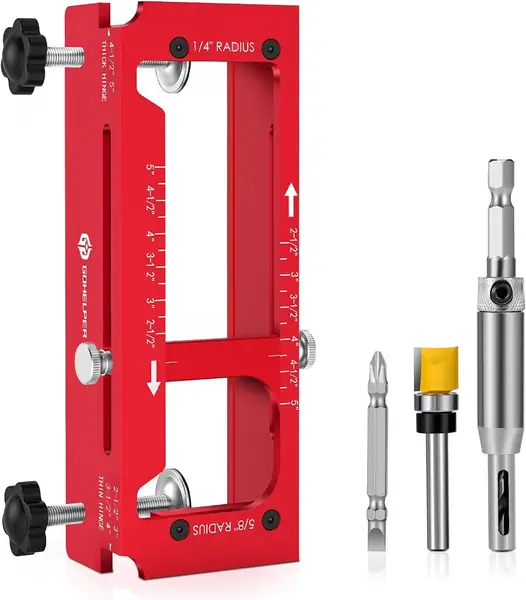
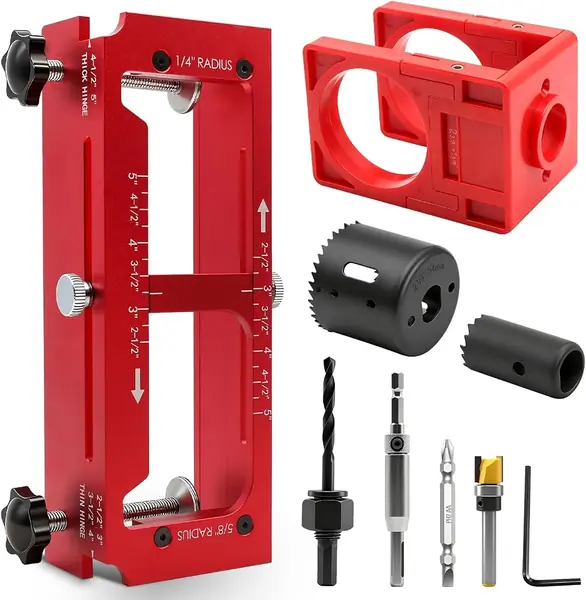
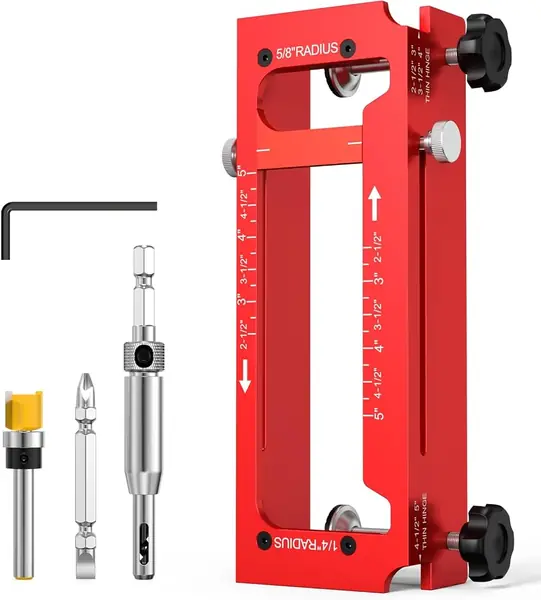
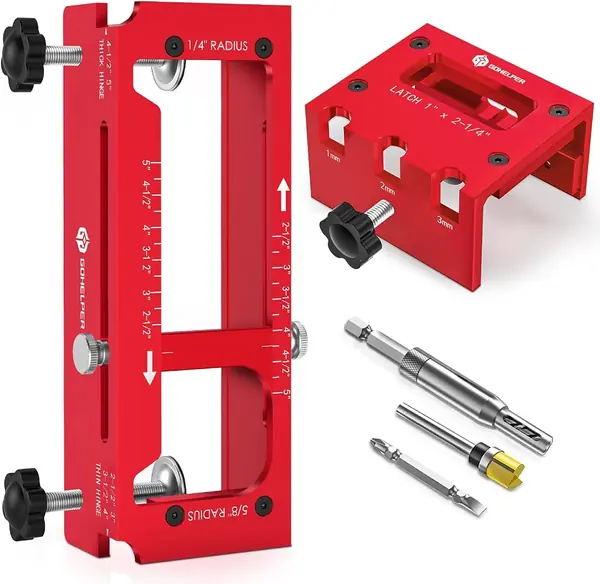
Red Gohelper aluminum door hinge jig with depth gauge and corner inserts

Hanging slab doors

Shop Score 89/100
Corner Profiles
1/4-inch radius, 5/8-inch radius, square (chisel)
Material
Anodized 6061 aluminum
Depth Gauge
Thin (2-1/2 to 4 in.) and thick (4-1/2 to 5 in.)
Hinge Length Range
2-1/2 to 5 inches
View on Amazon

A hinge pocket is the part of hanging a door that punishes impatience: a sixteenth shallow and the door stands proud of the jamb, a sixteenth deep and the hinge binds. This jig takes the chisel out of that for door-side work. Set it on the face, clamp it, and the router base has a flat aluminum runway around a pocket sized for hinges from 2-1/2 to 5 inches.

The material is what sold us. The body is 6061 aluminum with an anodized finish, roughly 8.6 inches long and 3.15 inches wide, and it doesn't dish or flex when you press a trim router down on it, which is the failure that turns a soft template into scrap after a dozen doors. A built-in depth gauge handles thin hinges from 2-1/2 to 4 inches and thick ones from 4-1/2 to 5, so depth is set once and repeated.

Corners come from inserts: 1/4-inch and 5/8-inch radius drop straight in, and the square option leaves a routed recess you finish with a chisel, which is normal for a door hinge jig of this type. The box also holds the router bit, a self-centering hinge bit that locates the screw holes, and a double-ended driver bit, so a trim router is the only thing you add.

You'll need two clamps to hold it, since none ship in the box, and if the frame side of a new installation is part of the job, the Plumking screws flat to a jamb and adjusts its mortise width, which this one isn't set up to do.

Worth Noting

  • Door only; no jamb mounting
Our Verdict

Aluminum that won't flex, coverage from 2-1/2 to 5 inches, and the router and self-centering bits in the box make this the jig we recommend first.

Check Latest Price
2.

Milescraft 1222 Hinge Mate 150 Best Budget

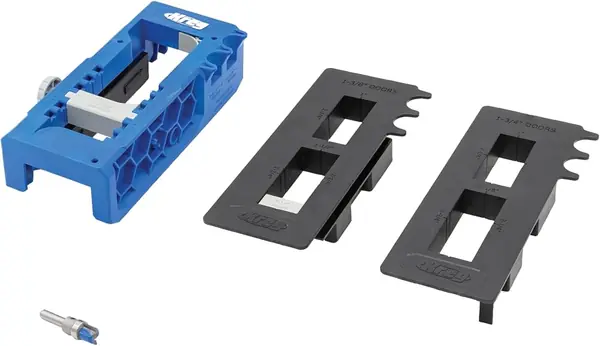
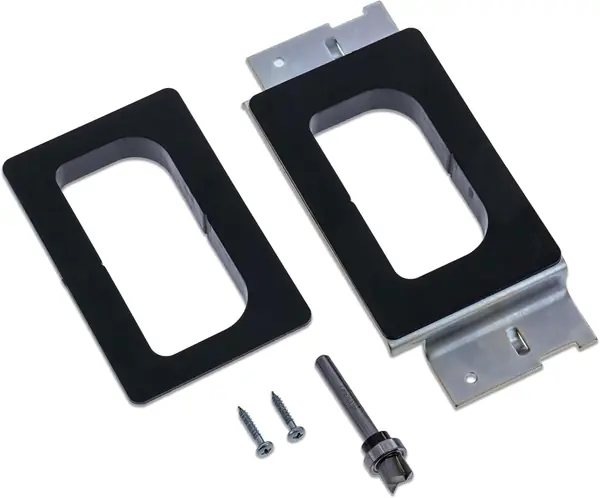
Milescraft Hinge Mate 150 steel template frame with mounting screws

Tight budgets

Shop Score 88/100
Hinge Sizes
3 and 3-1/2 inches
Corner Profiles
1/4-inch and 5/8-inch radius
Mounting
Door or jamb, two screws
Included Bit
1/2-inch bearing-guided router bit
View on Amazon

Two hinge sizes and the lowest cost here is the whole pitch, and it's still the jig we hand to someone hanging a first door. The Hinge Mate 150 does 3- and 3-1/2-inch hinges with dual-position templates that rotate between a 5/8-inch and a 1/4-inch radius, and it mounts to a door face or a jamb.

For the money there's more here than we expected: a steel template frame, the 1/2-inch bearing-guided router bit in the box, and a solid lip for the router to ride against instead of a soft plastic edge. It sits flat on a door or a jamb and stays put while the bit works, which is most of what a jig has to get right.

Square-corner hinges are the one thing it can't do, since both inserts are radius only, so a square-hinge door means paring the corners with a chisel afterward. That corner rarely comes up on standard interior doors. The template itself just needs a clean, flat surface underneath it; set it on a jamb with a proud stop and nothing sits true.

Worth Noting

  • Covers only 3- and 3-1/2-inch hinges
  • Screws rather than clamps hold it down
Our Verdict

For a couple of doors on 3- or 3-1/2-inch hinges, we see no reason to spend more than this.

Check Latest Price
3.

Plumking Door Hinge Jig Best for Doors and Jambs

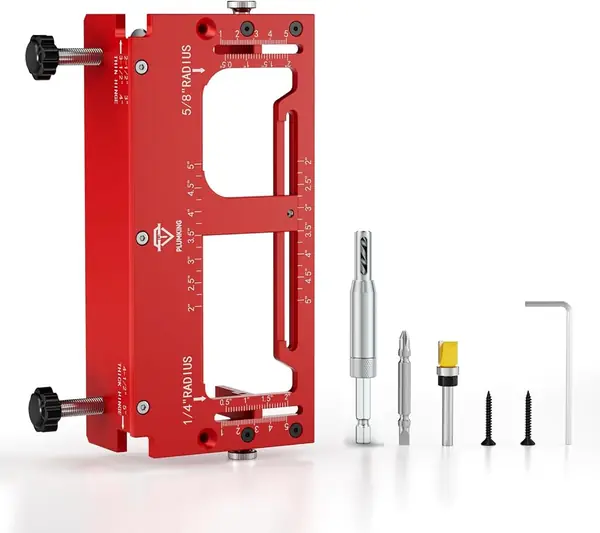
Red Plumking aluminum door hinge jig with adjustable mortise width

Door and jamb

Shop Score 85/100
Hinge Sizes
2 to 5 inches
Corner Profiles
1/4-inch radius, 5/8-inch radius, square
Mounting
Clamps on doors, screws on jambs
Mortise Width
Adjustable to hinge and door thickness
View on Amazon

Most jigs in this group stop at the door face. The Plumking is built to work both sides of the opening: clamp it to a slab, or fasten it to a jamb, and it sets mortise width to match the hinge and the door thickness instead of cutting one fixed pocket for everything.

That adjustable width is worth more than we expected. A pocket a hair wider than the leaf lets a hinge drop in without persuasion from a mallet, and it's the setting that lets the same jig work on 1-3/8- and 1-3/4-inch doors. The body is anodized 6061 aluminum, and it carries 1/4-inch radius, 5/8-inch radius, and square-corner profiles for hinges from 2 to 5 inches.

The cost of that flexibility is real: jamb work means fastening the jig down with screws rather than clamping it, which is slower and leaves small holes to deal with. On a whole-house install, where both the frame and the slab are being cut fresh, we think the trade is worth making.

Worth Noting

  • Jig only; router bit sold separately
Our Verdict

We point jamb work at the Plumking: it screws flat to the frame and adjusts the mortise width to the hinge.

Check Latest Price
4.

Vorhixa Door Hinge Jig and Lock Kit Best Hinge and Lock Kit

Vorhixa red aluminum hinge jig with plastic lock hole drilling guide

Full door installs

Shop Score 84/100
Hinge Sizes
2-1/2 to 5 inches
Corner Profiles
1/4-inch radius, 5/8-inch radius, square
Lock Bore
2-1/8-inch hole, 2-3/8- or 2-3/4-inch backset
Door Thickness
1-3/8 and 1-3/4 inches
View on Amazon

Hanging a door usually means two tools: a template for the hinge pockets and a guide to bore the 2-1/8-inch hole for the lock. The Vorhixa bundles both, with an aluminum hinge jig for 2-1/2- to 5-inch hinges and a drilling guide that covers 2-3/8- and 2-3/4-inch backsets on 1-3/8- and 1-3/4-inch doors.

The hinge half is the part we trust. It's aluminum with 1/4-inch radius, 5/8-inch radius, and square-corner profiles, it clamps to the door face, and the anti-slip pads keep it from walking under the router. It's door-only, so the frame side of a new opening still needs another approach.

The lock guide is the bonus, not the reason to buy. It's plastic, and it feels like the accessory in the box rather than a precision tool, so plan on taking your time centering it on the first bore. If the hinge pockets are the job and the lock hole is a convenience, this kit covers both without a second purchase.

Worth Noting

  • Door only; no jamb mounting
Our Verdict

We like the Vorhixa when one door needs both hinge pockets and a bored lock hole and one box should cover it.

Check Latest Price
5.

ReeMoo Aluminum Door Hinge Jig Best Value All-Metal

ReeMoo anodized aluminum hinge jig with silicone anti-slip pads

Budget aluminum jig

Shop Score 83/100
Hinge Sizes
2-1/2 to 5 inches
Corner Profiles
1/4-inch radius, 5/8-inch radius, square
Material
CNC-machined 6061 aluminum
Grip
Silicone anti-slip pads
View on Amazon

A full 2-1/2- to 5-inch range in a machined aluminum body is where the money usually goes, and this is the least expensive way to get there. The ReeMoo is CNC-machined 6061 with an anodized finish, and it carries 1/4-inch radius, 5/8-inch radius, and square-corner profiles plus a depth gauge for thin and thick hinges.

The details are sensible: silicone pads on the clamping faces keep the jig from sliding or marking a finished door, and a solid aluminum body doesn't dish the way a soft template does after a run of doors. Set it, clamp it, and the router has a flat surface to work against.

Our one caveat is the knobs: they're hand-tightened, and the frame will bend if you crank them, so snug is the setting. Keep them there and the jig behaves like the aluminum template it is.

Worth Noting

  • Hand-tightened knobs can bend the frame if cranked
Our Verdict

Aluminum, adjustable to 5 inches, and three corner profiles: the ReeMoo is the metal jig we point to when the budget is tight.

Check Latest Price
6.

Kreg Door Hinge Routing Jig Best for Kreg Bit Owners

Kreg gray door hinge routing jig with adjustable guide stop

Kreg bit owners

Shop Score 82/100
Hinge Sizes
2-1/2 to 5 inches
Depth
Built-in depth settings and bit depth guide
Latch Routing
1-3/8- and 1-3/4-inch doors
Bit Compatibility
Kreg 1/2-inch flush-trim bit, 1/4-inch shank
View on Amazon

This one is built around a bit: Kreg's 1/2-inch flush-trim bit with a 1/4-inch shank, which the setup assumes you're running. If that bit is already in the drawer, the rest is easy to like, with built-in depth settings, a one-piece adjustable guide stop, and a grip surface made to hold a painted door without marking it.

It covers 2-1/2- to 5-inch hinges and also routes latches for 1-3/8- and 1-3/4-inch doors, so a single jig handles both mortises on a slab. The grip pad is the part that matters on finished work, and it's a nicer answer than driving mounting screws into a face you just painted.

Two things to check before the first cut: the corner radius options aren't spelled out as clearly as they are on the other jigs here, so match them to your hinges, and the body is plastic, which makes the pad rather than the frame responsible for holding your accuracy. Neither rules it out, and both are worth knowing.

Worth Noting

  • Set up around Kreg's own flush-trim bit
Our Verdict

We see the Kreg as the jig for a Kreg bit owner: depth stops, latch routing, and a grip surface that won't mark a painted door.

Check Latest Price
7.

Milescraft 1229 HingeJigPLUS Best for Screw-Free Mounting

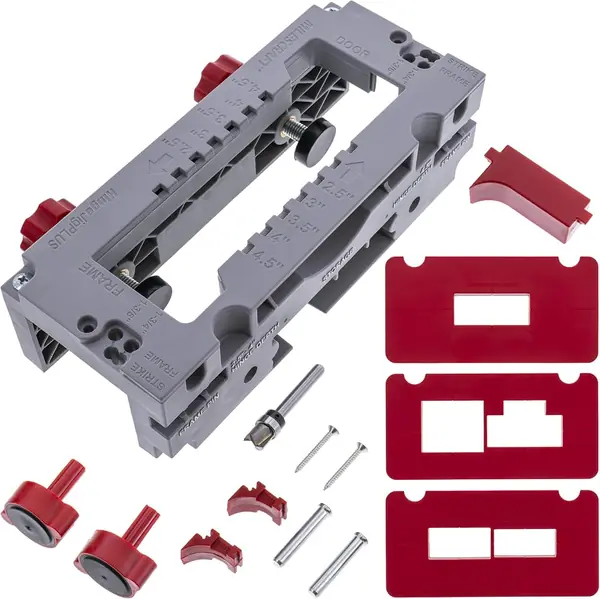
Milescraft HingeJigPLUS gray jig with dual clamps and latch templates

Screw-free mounting

Shop Score 81/100
Hinge Sizes
2-1/2 to 4-1/2 inches
Corner Profiles
1/4-inch radius, 5/8-inch radius, square (chisel)
Mounting
Dual built-in clamps, no screws
Templates
Hinge, latch, and strike plate
View on Amazon

Every other jig here needs something else to hold it: two clamps, or a screw gun, or both. The HingeJigPLUS carries its own dual clamps in the body, so you can set it on a door and cut a pocket without hunting for a clamp that opens wide enough.

It covers 2-1/2- to 4-1/2-inch hinges with 1/4-inch radius, 5/8-inch radius, and square-corner options, mounts on a door or a frame, and ships with latch and strike-plate templates plus a 12 mm bearing-guided bit. The adjustable backset plugs and frame indexing pins are what make jamb work repeatable rather than a guess.

Setup takes a few minutes the first time: the spacer goes into the slot matching your hinge length, the backset plugs go in oriented for a door or a frame, and the corner inserts swap out. The instructions carry you through it, but there is a sequence to learn before the first cut.

Where it earns its place is a first door install, with hinges, latch, and strike from one setup, no clamps to buy, and no screws in the face. The jig asks you to trust its clamp instead of your forearm, and on a flat door that's a fair trade.

Worth Noting

  • Body flexes if the clamps are over-tightened
Our Verdict

The self-clamping pick: it holds itself to the slab, covers hinge, latch, and strike, and ships with its own bit.

Check Latest Price
8.

Gohelper Hinge and Latch Jig Kit Best for Hinge and Latch

Gohelper red aluminum hinge jig and latch jig in one kit

Hinge and latch

Shop Score 80/100
Hinge Sizes
2-1/2 to 5 inches
Corner Profiles
1/4-inch radius, 5/8-inch radius, square
Material
Anodized 6061 aluminum
Latch Plate
1-inch by 2-1/4-inch, door side only
View on Amazon

Hinge pockets get the attention, but a bare door slab also needs a latch mortise on its edge, and that's the second template most kits leave out. This box has both: a hinge jig with the same 2-1/2- to 5-inch range and radius options as our top pick, plus a dedicated latch jig for standard 1-inch by 2-1/4-inch face plates.

Both pieces are 6061 aluminum, and both are door-side: the latch jig cuts the slab edge rather than the strike plate in the jamb, and the hinge template isn't made for jamb mounting. The latch side is sized for 1-3/8- and 1-3/4-inch doors, which covers most residential hardware you'll meet.

At just over two pounds for the pair, it's a heavier box than a hinge-only jig, and it sits at the top of the price range here because you're buying two tools. What that buys is one setup session per door instead of two, and one place to keep both templates.

If the door is already prepped and you're only matching hinge pockets to an existing frame, the hinge-only Gohelper does the same work for less, and the latch jig would sit in the box. Buy this one when the slab arrives bare.

Worth Noting

  • Door side only, not the jamb strike plate
Our Verdict

We keep this one on the list for full slab prep: one aluminum jig, both the hinge and latch mortises.

Check Latest Price

How We Tested Door Hinge Router Jigs

We started by gathering every door hinge jig we could find and reading the specs that actually decide a purchase: hinge length range, which corner profiles the template cuts, whether it mounts to doors only or to jambs as well, how it locks down, and what ships in the box. Jigs limited to 3- and 3-1/2-inch hinges got marked down unless the price made them worth keeping as a second template. That filtering left 12 jigs to test.

Testing ran eight months across three settings: a garage bench where we hung new slab doors, a hallway of original interior doors that got rehung, and a rental rehab where most of the jambs needed rebuilding. For each jig we locked it down, pushed on it with a thumb to see if it budged, then re-checked the clamps before every pass, because a template that shifts under a spinning bit pulls the cut off line. We kept the router base flat on the jig surface and fed clockwise at a steady rate, then dropped the actual hinge into the mortise and measured the gap between door and jamb.

We watched where the template body flexed under the router base, which grips held on dusty pine versus painted oak, and how each jig clamped — separate clamps, screws into the door, or built-in clamps. Depth setting got its own look: jigs with a built-in gauge against ones that leave you counting on the bit. We reset mortise width and backset over and over to see whether the markings stayed true, checked that a 1/4-inch shank bit and a compact router base stayed fully on the template, and ran several jigs through dozens of cuts to see if slots wallowed or screws stripped. Bits, clamps, and self-centering drills in the box counted toward value.

How to Choose a Door Hinge Router Jig

Match the Template to the Hinges You Have

Hinge leaves run 3, 3-1/2, 4, 4-1/2, and 5 inches, with square corners or a 1/4- or 5/8-inch radius, and a jig only cuts what its inserts allow. A template limited to 3 and 3-1/2 inches covers most interior doors but won't touch a 4-inch exterior hinge; an adjustable jig such as the Gohelper spans 2-1/2 to 5 inches and takes the guesswork out of ordering.

Watch the word square. On most of these jigs it means the pocket is routed with square corners that you finish with a chisel, not that the router produces a crisp 90-degree corner on its own. Radius templates leave a rounded pocket that matches a radius leaf and needs no paring at all.

Decide Whether the Jamb Is Part of the Job

Plenty of good jigs clamp to a door face and stop there, including our top pick and the Vorhixa kit. Cutting the frame side as well takes a template that can be fastened flat to the jamb, usually with screws, because a clamp rarely reaches past a door stop. If you're hanging a slab on an existing frame, door-only is all you need.

If the opening is being built from scratch, pay for the jamb capability: the Plumking screws to a frame and adjusts its mortise width to the hinge. Run a straightedge along the jamb first, since no template sits true on a face that is crowned or carrying an applied stop.

Work Out How the Jig Stays Put

There are three methods here: clamps you supply, mounting screws, and clamps built into the jig. Separate clamps move fastest between doors but you need two that open wide enough for a door plus the template. Screws hold flat and don't budge, at the cost of a little speed and a couple of small holes. Built-in clamps, as on the Milescraft HingeJigPLUS, save you buying anything else but depend on the body staying rigid under pressure.

Whichever you choose, the cut is only as good as the grip. A template that creeps mid-pass takes the pocket with it, and no depth setting rescues a mortise that has shifted sideways.

Bits, Bases, and What Isn't in the Box

Most of these templates are built around a 1/4-inch-shank bit, and several include one along with a self-centering bit for the screw holes; the Plumking and the Kreg ship as the jig alone or expect a specific cutter, so factor that in. A compact or trim router is easier to keep flat inside the opening than a full-size router, whose base can overhang a narrow template.

Measure your router base against the jig's bearing surface before the first cut. A base that hangs over the edge tips into the pocket, and that is the moment a clean mortise turns into a repair.

Frequently Asked Questions

Final Verdict

For most people hanging or re-hanging a door, the Gohelper is the jig to buy: aluminum that stays flat under the router, a 2-1/2- to 5-inch range that covers the odd 4-inch exterior hinge, and the router and self-centering bits in the box.

Spend more only when the job asks for it. The Plumking screws flat to a jamb and adjusts mortise width for a new opening, and the Milescraft HingeJigPLUS clamps itself when you don't own a pair of clamps yet.