↑↓ navigate ↵ open Esc close All results →

Best Kreg Pocket Hole Jigs of 2026

Pocket-hole joinery skips dowel alignment and long clamp waits by pairing a stepped drill bit with an angled guide that drives screws tightly from the inside face. A well-built jig turns carcass work and face frames into repeatable drilling: consistent exit angles, calibrated stop depth, and clean holes without tear-out.

Running 12 jigs through eight months of plywood, pine, and scrap maple on both a garage bench and a folding table made two practical realities clear. First, the jig is a one-time buy while proprietary screws and plugs stay an ongoing expense; second, clamping hold-down matters more than dual- or triple-hole capacity, since a body that shifts mid-bore lets the stepped bit wander and chip the surface.

Whether anchored to a bench for batch carcass work or tucked into a tight cabinet corner, each guide below handles 1/2-inch to 1-1/2-inch stock without flexing.

Our Top Picks

The Best Kreg Pocket Hole Jigs

1.

Kreg Pocket-Hole Jig K4 Best Overall
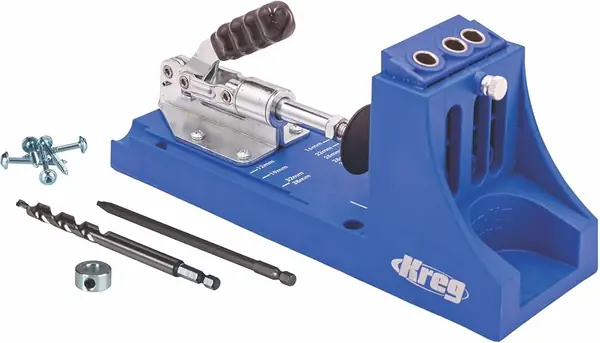
Kreg K4 pocket-hole jig in black and blue with a three-hole drill guide

All-around shop use

Shop Score 97/100
Material Thickness
1/2 to 1 1/2 inches
Weight
1.3 lb
Drill Guides
Three-hole, removable
Clamping
Large clamping recess
View on Amazon

Three drill guides sit side by side in the K4's guide block, so a cabinet side or a face frame takes a full screw pattern in one plunge instead of three separate setups. That single feature is why we recommend it as the default for most shops: one-hole jigs make you re-clamp and re-check for every screw, and across a run of parts the work slows to a crawl. The guide adjusts across 1/2- to 1 1/2-inch stock, which covers nearly everything on a home-center rack.

The guide also lifts out of the base, so the same tool does two jobs. Clamped in the base it's a benchtop fixture for a run of parts; out of the base it's a handheld block for a shelf you can't unbolt or a repair on an assembled carcass. We like that flexibility more than we expected to — the large clamping recess takes a bar or face clamp, and at 1.3 pounds nothing about it strains when you move it.

Setup runs the way Kreg setups do: the stop collar sets bit depth against the material thickness, and the guide slides to match the board. The base is 12 inches long, so give it a clear stretch of bench rather than the corner of a worktable, and check that the workpiece sits flat against the guide before you pull the trigger.

The 720PRO clamps the work for you and collects its own dust. We don't miss either on a one-off project, and this is the one of the two that goes to the job.

Worth Noting

  • Ships without a clamp, bit, or screws
Our Verdict

The K4 is the jig we recommend to most woodworkers: three guides drill a full set in one pass, and the guide lifts out for work away from the bench.

Check Latest Price
2.

Kreg Pocket-Hole Jig 720PRO Best for Batch Work

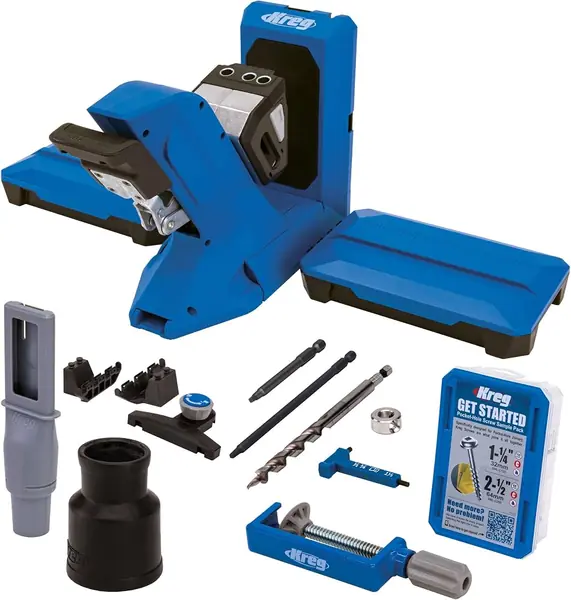
Kreg 720PRO pocket-hole jig with fold-out docking station wings and dust adapter

Batch cabinet work

Shop Score 96/100
Material Thickness
1/2 to 1 1/2 inches
Weight
9.5 lb
Included
Bench clamp, docking station, dust adapter
Clamping
Self-adjusting clamp, anti-slip guide
View on Amazon

Moving up the Kreg line buys automation, and the 720PRO is where that automation starts paying. The guide face is anti-slip and the clamping mechanism adjusts itself to the board, so you set the workpiece in place and the jig closes on it instead of you chasing it with a bar clamp. Across a stack of cabinet parts, that changes the rhythm of the work.

The docking station is the underrated half of the package. Fold-out wings hold the jig at bench height with storage underneath for the bit, collar, and screws, so a batch of holes doesn't turn into a scavenger hunt every time you set the drill down. The dust-collection blade and adapter give the chips somewhere to go other than your shirt.

The 9.5-pound body is the trade: it stays put on a bench and doesn't travel, which is the right deal if your pocket holes all happen in one place. Worth checking before you drill is narrow stock, where the front clamp can take a second look to seat a thin rail squarely against the guide.

Worth Noting

  • Fold-out wings are plastic and flex
Our Verdict

We think the 720PRO is worth its premium for anyone drilling cabinet parts in batches, because the clamp grabs the work and the chips go into the adapter.

Check Latest Price
3.

Kreg Pocket-Hole Jig 320 Best Portable

Kreg 320 pocket-hole jig in blue with two twist-apart drill guides and case

Small shops

Shop Score 95/100
Material Thickness
1/2 to 1 1/2 inches
Weight
1.3 lb
Included
Carrying case, easy-set bit, 40 sample screws
Drill Guides
Two twist-apart guides
View on Amazon

A drawer box clamped to a bench leaves about a square foot of clear space, and that's where the 320 earns its keep. The body is 5 inches on a side and weighs 1.3 pounds, and the two drill guides twist apart so you can set the gap between holes to suit the rail you're joining rather than accepting whatever spacing the jig was built with.

Kreg ships it with a drill guide spacer, an easy-set bit and stop collar, a thickness gauge, and 40 sample screws inside a carrying case, so the first project doesn't stall waiting on an order. The guides carry thickness stops for 1/2- to 1 1/2-inch stock, the same range the bigger jigs cover, and the case keeps the pieces together in a tool bag.

We reach for it when the bench is crowded or the work is small — cabinet boxes, drawers, shop jigs, a shelf in an apartment. It won't set the pace of the 720PRO across a long run of identical parts, but it costs about what the R3 does and drills the same joint in a fraction of the footprint.

Worth Noting

  • Needs a separate clamp to stay put
Our Verdict

For crowded benches and small parts, we reach for the 320: two twist-apart guides set your own hole spacing in a 1.3-pound body.

Check Latest Price
4.

Kreg R3 Pocket-Hole Jig System Best Starter Kit

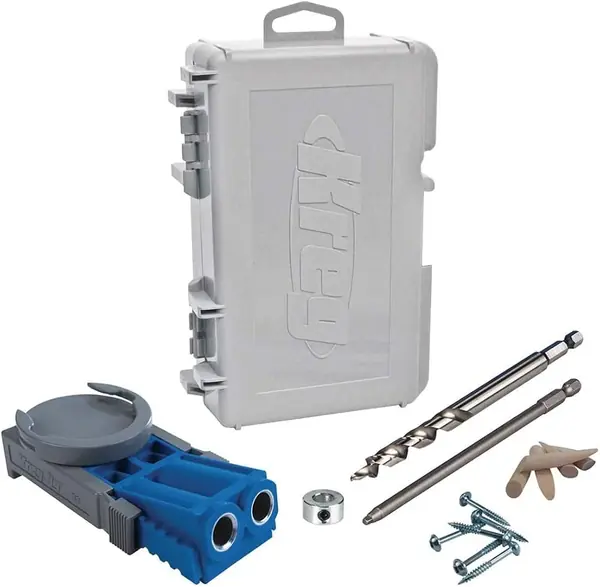
Kreg R3 pocket-hole jig system with clamp pad adapter and compact carrying case

First-time builders

Shop Score 94/100
Material Thickness
1/2 to 1 1/2 inches
Weight
16 oz
Included
Bit, stop collar, plug set, starter screws, case
Depth Settings
Nine positioning-slider settings
View on Amazon

Open the R3's case and you have almost everything a first joint needs: the jig, a stepped drill bit, a depth collar, a 6-inch square-drive bit, a plug set, and a starter set of screws. That's the argument for this pocket-hole jig system — you aren't buying a guide and then discovering you need four more things before the first hole.

Nine depth settings on the positioning sliders are what make it feel less like a beginner tool. You set the slider to the stock thickness instead of counting threads on a collar, and the clamp pad adapter lets the drill guide ride a bar clamp or face clamp you already own rather than demanding a proprietary one. It covers the same 1/2- to 1 1/2-inch range as the rest of the line, and the hardened-steel guides carry a lifetime warranty.

At 16 ounces and 8 inches long it drops into a tool bag, and the case keeps the collar and the plugs together between projects — which matters more than it sounds the first time a stop collar goes missing mid-build.

Worth Noting

  • Plastic body is the long-term wear point
Our Verdict

First-time builders should start with the R3, which arrives with the bit, plugs, and screws, and sets depth with nine sliders instead of a collar.

Check Latest Price
5.

Kreg Mini Jig Kit Best for Tight-Spot Repairs

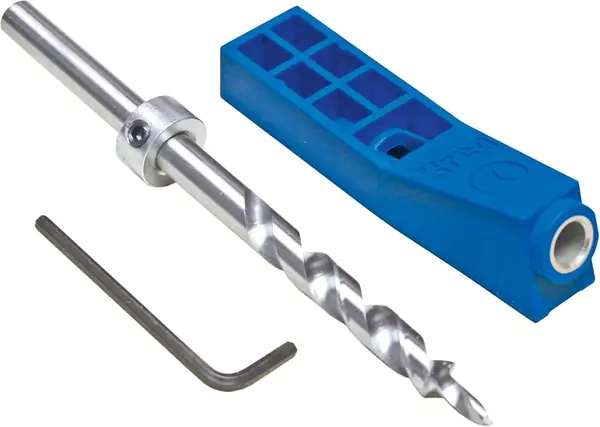
Kreg Mini Jig Kit with a single steel drill guide and stepped drill bit

Tight-spot repairs

Shop Score 93/100
Material Thickness
Any thickness, no fence
Included
Stepped bit, stop collar, hex wrench
Drill Guides
Single steel guide with chip relief
Dimensions
1.5 x 3.25 x 9.25 inches
View on Amazon

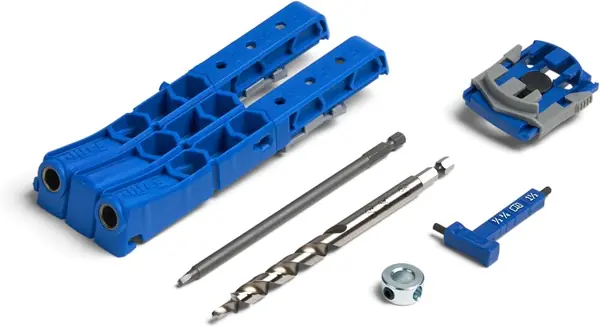
There's no fence on the Mini Jig, just a single steel guide with a relief hole that clears chips as the bit backs out. That's the whole tool: 9 1/4 inches long, 1 1/2 inches tall, light enough to live in a drawer. It ships with a stepped bit, a stop collar, and a hex wrench, and because there's no fence in the way it will take stock of any thickness.

Where it earns its place is work the bench jigs can't reach — a repair inside an assembled cabinet, a joint in a corner, a spot where a 12-inch base won't sit. With no fence you put the guide wherever the hole belongs, clamp it down, and drill.

We treat it as the second jig rather than the only one. It's the least expensive thing here, and as a companion to a bench jig it turns up in exactly the situations the big one can't handle; keep a couple of C-clamps with it and it earns its drawer space.

Worth Noting

  • One hole per setup slows long runs
Our Verdict

We like the Mini for repairs and corners the bench jigs can't reach, since it clamps anywhere on the work and takes any stock thickness.

Check Latest Price

How We Tested the Pocket-Hole Jigs

To build the shortlist, we started with the jigs sold as complete kits and with the bare guides, then filtered by drill-guide format, thickness range, and what actually comes in the box, keeping budget and pro-level options in the same pool. We ended up testing 12 of them over eight months. Most of the drilling happened on a garage bench during a cabinet carcass and a rolling shop cart, with a stretch of face-frame work and a few repairs inside an already-assembled cabinet to cover the awkward jobs.

We counted how many holes each guide bored per setup and whether the spacing could be opened up for wider stock, then bored the same joint over and over to see whether the tenth hole matched the first. We clamped the jig and the workpiece before every bore and wore safety glasses throughout, because that stepped bit throws chips whether or not a dust blade is in the way. On 1/2-inch, 3/4-inch, and 1-1/2-inch stock we set the stop collar to the matching depth and checked the offcut for blowout on the face.

Portability got measured with a scale and a tape: we weighed each jig, noted how much bench it ate, and checked whether the guide detached and whether a case came with it. At the stress points we looked for steel where the bit runs and plastic where it doesn't matter, and we read the warranty before anything went back in the box. Because screws and plugs are the cost that never stops, we also tallied what a project's worth of each added to the total.

How to Choose a Kreg Pocket-Hole Jig

Start With the Drill Guide

Guide count decides your pace. A single guide, like the Mini's, drills one hole at a time — fine for a repair, tedious for a cabinet. Two guides that twist apart, as on the 320, let you set the gap between holes to suit the rail width, which matters when a narrow stile can't take a wide spread. Three guides, as on the K4, put a whole screw pattern in the wood in one plunge. All the fence-based jigs here take 1/2- to 1 1/2-inch stock, so settle the guide count before you compare anything else.

How the Jig Holds the Work

Nothing spoils a pocket hole faster than a jig that creeps mid-drill: the bit deflects, the hole lands off-center, and the joint pulls crooked. The jigs here handle it in three ways — a large recess you clamp through, an anti-slip base or a self-adjusting clamp built into the body, or a bare guide you clamp directly to the workpiece.

The trap is assuming a jig clamps itself. Every jig in this roundup except the 720PRO needs a clamp out of your own toolbox, and a small one at that; if you own none, price one in before you decide.

Footprint and Where It Lives

The K4's base runs 12 inches, which is nothing on a full bench and everything on a folding worktable. The 320 is 5 inches on a side, the R3 is 8 inches long at 16 ounces, and the 720PRO is a 9.5-pound fixture with fold-out wings. We favor a detachable guide for a shop that doubles as a garage: the K4's guide comes out and the base goes on a shelf. Compact in a listing describes the body, not the setup — a 5-inch jig still needs the room your clamp and your board take up.

Budget for the Clamp and the Screws

The jig is the cheap part. Pocket holes want washer-head, self-tapping screws sized to the material; ordinary wood screws won't seat the joint, and screws are a recurring cost for as long as you build. Add a clamp if you don't own one, plus plugs if the holes will show. The R3 and 320 include starter screws, and the 720PRO includes a bench clamp. We think it's worth pricing the clamp and a box of screws into the decision, because that total can change which jig is the better value.

Frequently Asked Questions

Final Verdict

For most woodworkers, the Kreg K4 is the jig to buy. Three drill guides put a full screw pattern in the wood in one plunge, the guide lifts out of the base when the work is on a shelf rather than a bench, and it covers the 1/2- to 1 1/2-inch stock that home-center lumber comes in.

Go to the 720PRO if pocket holes are production work and you want the jig to close on the board and catch its own chips. Go to the 320 or the R3 if bench space or budget is the constraint — both drill the same joint in a smaller package.