↑↓ navigate ↵ open Esc close All results →

Best Cabinet Hardware Jigs of 2026

Drilling a cabinet pull an eighth of an inch off square turns into a permanent eye-catcher on a brand-new door face, since there is no clean second shot once the bit breaks through. A dedicated hardware jig prevents bit wander by registering squarely against the door edge and guiding the drill through hardened bushings at the exact center-to-center spacing.

Across eight months of installing knobs and bar pulls on flat slab and Shaker doors for full kitchens, a bathroom vanity, and laundry built-ins with 12 jigs, frame rigidity proved far more important than the total number of spacing holes on the ruler. A template that flexes or creeps under drill pressure repeats the same misalignment across every door in the bank.

Each of the seven jigs below handles both knobs and pulls, locks firmly enough to resist bit thrust, and resets quickly between doors so a small vanity or full kitchen comes out aligned on the first pass.

Our Top Picks

The Best Cabinet Hardware Jigs

1.

Kreg KHI-Pull Cabinet Hardware Jig Best Overall
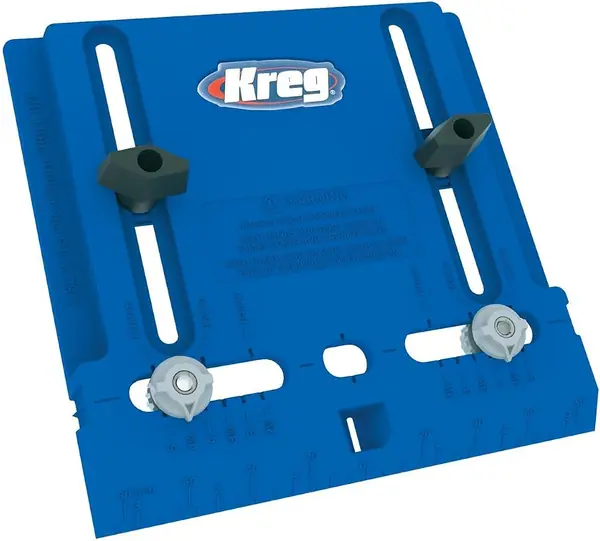
Kreg KHI-Pull blue metal cabinet hardware jig with adjustable drill guides

Standard cabinet pulls

Shop Score 95/100
Material
Metal
Stops
Built-in
Edge Guide
Moveable
Pull Spacing
1 to 5 inches
View on Amazon

The KHI-Pull covers 1- to 5-inch pull spacing, which is the range on most kitchen and bath cabinets. A moveable edge guide and built-in stops hold the spacing once you set it, and the metal drill guides take a standard bit without wallowing. We set it for a run of drawer fronts and door pulls, and the jig stayed registered as we moved from one piece to the next.

That repeatability is why it is our top pick. The Kreg is not the cheapest jig here or the most calibrated, but it strikes the balance we want for a typical kitchen: enough range for standard pulls, a metal guide that feels solid, and a setup we can teach someone in a few minutes. We especially like that the edge guide lets you reference the cabinet edge instead of marking center on every door.

There is no clamp in the box, so on glossy paint we add one rather than trust hand pressure. The included edge guide still gives you a solid reference, and the setup is simple enough to repeat without re-measuring. For a standard kitchen, that is a small habit to build.

Worth Noting

  • Not for pulls longer than 5 inches
Our Verdict

We recommend the Kreg to most DIYers because its metal guides, built-in stops, and 1-to-5-inch range make a full kitchen run feel routine rather than risky.

Check Latest Price
2.

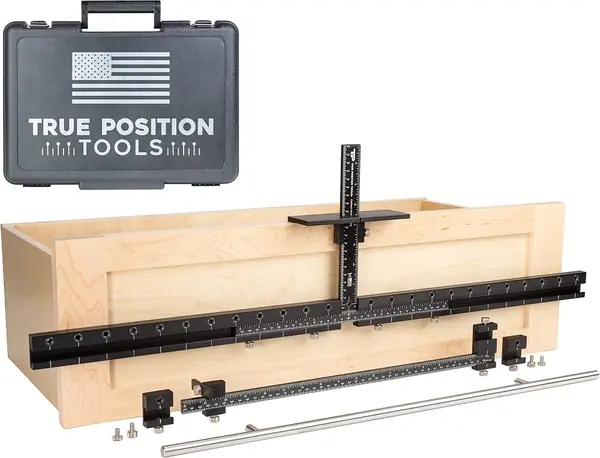
True Position Tools Original Cabinet Hardware Jig Best Premium Jig

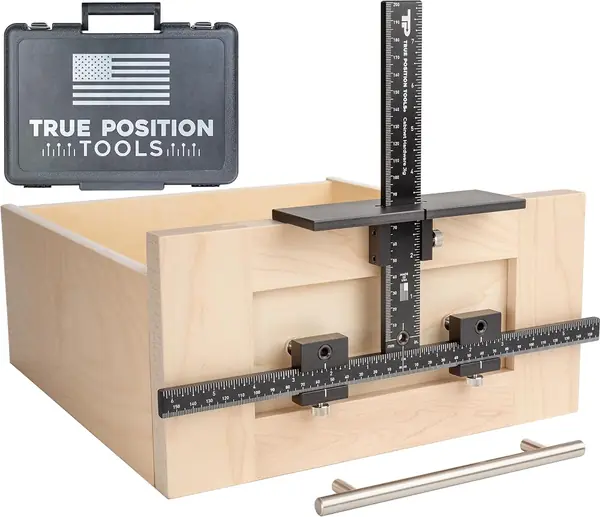
True Position Tools Original black aluminum cabinet hardware jig with hard case

Shaker cabinet installs

Shop Score 94/100
Material
Aluminum
Weight
4.3 lb
Pull Capacity
Up to 12 inches
Shaker Spacers
Included
View on Amazon

The Original is a 4.3-pound slab of machined aluminum with laser-engraved scales, stainless fasteners, and shaker spacers. It arrives in a hard case and feels less like a template than a setup tool that happens to drill holes.

On a Shaker door, the spacers bridge the recessed panel and keep the jig from rocking, which is the failure point on cheaper flat templates. You tighten the thumb screws, hold the jig, and drill; there is no clamp or pencil mark required. The calibration is the reason to pay attention: the scales are meant to be trusted, and the stops repeat from one door to the next.

We think the Original earns its place when the cabinets are the expensive part of the job. It is the jig we choose for a full Shaker kitchen or a contractor's truck, where a single slip is costly. The 4.3-pound body is a lot to hold against an upper door, and we noticed it after a run; that mass is also why it sits so securely on a drawer front.

Worth Noting

  • Premium price for occasional use
Our Verdict

We reach for the True Position Original when cabinet hardware has to be perfect on Shaker doors, and its calibrated aluminum body justifies the premium for pros and meticulous DIYers.

Check Latest Price
3.

TOURACE Cabinet Hardware Jig Best Value Adjustable Jig

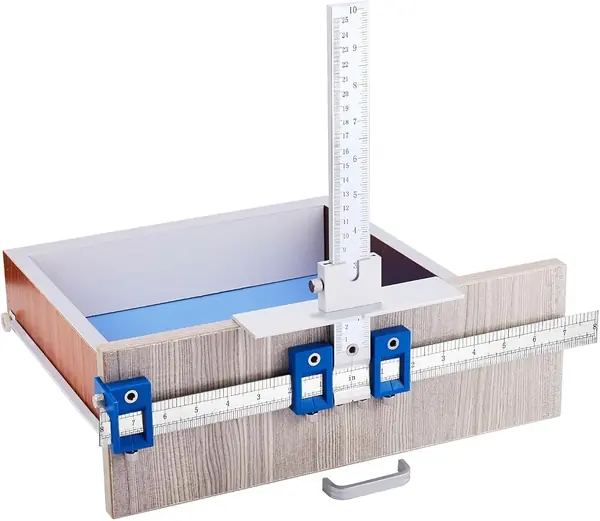
TOURACE silver aluminum and ABS cabinet hardware jig with drill guide sleeves

Mixed pull spacings

Shop Score 93/100
Material
Aluminum and ABS
Weight
1.23 lb
Adjustment
Thumb screws
Drill Guide
Quick-release
View on Amazon

At 1.23 pounds, the TOURACE is light enough to hold one-handed while you line up the drill guide. The quick-release drill guide block and thumb screws do the adjusting, and the aluminum guide sleeves take the wear that a plastic-only jig would not.

We think it is the adjustable jig to buy on a moderate budget. Setting two guides for a drawer pull takes a minute, and the L-bracket and top screws keep the assembly from sliding once tightened. It is not as refined as the Kreg or the True Position jigs, but it has enough adjustment for a mixed kitchen and a scale that is easy to read.

For a kitchen with a mix of 3-inch, 3.75-inch, and 5-inch pulls, that is enough. The setup is self-explanatory, though you need to be deliberate about snugging the screws. If you install cabinets every day, step up to a metal jig; for a weekend remodel, this is the value pick.

Worth Noting

  • ABS frame flexes under hand pressure
Our Verdict

We think the TOURACE is the adjustable jig to buy on a moderate budget, with quick-release guides that make short work of mixed drawer and door hardware.

Check Latest Price
4.

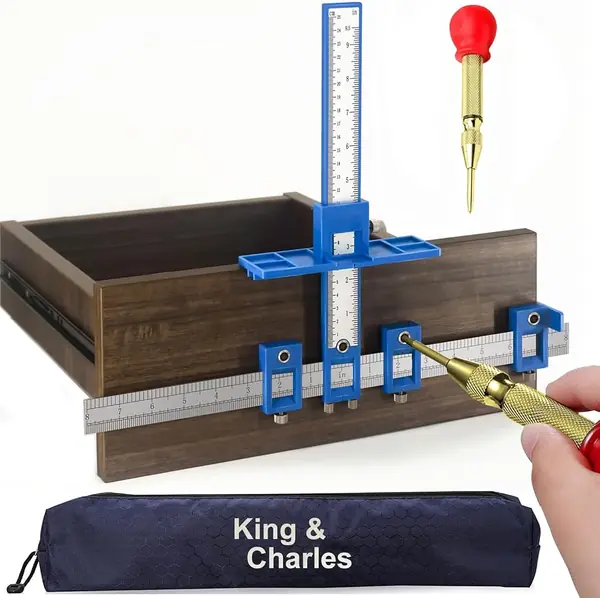
King&Charles Cabinet Hardware Jig Best Budget Jig

King&Charles multicolored ABS cabinet hardware jig with automatic center punch

Budget cabinet refreshes

Shop Score 92/100
Material
ABS
Weight
15.9 oz
Included
Automatic center punch
Length
16 inches
View on Amazon

The kit's automatic center punch is what makes the King&Charles our budget jig: after the jig locates the hole, you press a dimple into the wood, then drill into that dimple instead of fighting a walking bit. The jig itself is a 16-inch ABS body with metric and imperial scales and detachable drill-guide sliders.

We keep it as our budget jig because it handles standard 3- to 5-inch pulls without much fuss. The sliders set quickly, and the punch gives you a second chance to catch a misaligned mark before the drill touches the door. The trade-off is a light plastic feel and thin instructions, so we dry-run the setup on scrap and recheck the sliders against the scale.

The light plastic body is not the most rigid jig here, but it is easy to store and comes with a bag for the loose sliders. For a first kitchen or a rental refresh, that is a lot of useful jig for the money; for a full custom run, the Kreg is the more solid default.

Worth Noting

  • Sliders can shift on long pulls
Our Verdict

We keep the King&Charles around as our low-cost jig for standard pulls, and the included center punch is the detail that makes it worth buying.

Check Latest Price
5.

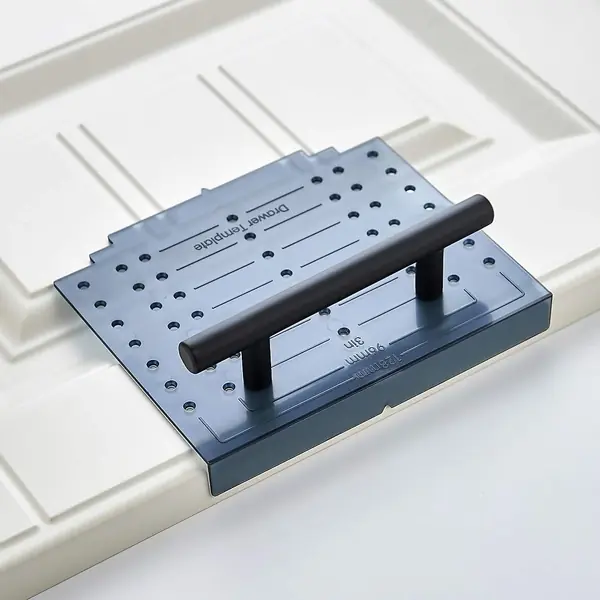
Ravinte Cabinet Hardware Template Kit Best Budget Template

Ravinte clear plastic cabinet door and drawer hardware template kit with drill bit

Standard pull spacing

Shop Score 91/100
Material
Plastic
Weight
4.6 oz
Included
Door template, drawer template, 3/16-inch drill bit
Hole Centers
3" (76mm), 3-3/4" (96mm), 5" (128mm)
View on Amazon

Ravinte's kit is two clear plastic templates, one for doors and one for drawers, plus a 3/16-inch drill bit. The holes are fixed at 3, 3.75, and 5 inches, so this is a template for common hardware, not an adjustable jig.

The see-through plastic is genuinely useful: you can hold the template against the cabinet edge and see the hole marks line up before you commit. For a standard pull, it removes the measure-mark-drill cycle on every door, and the included bit means you can start as soon as you open the package.

We recommend it for a straightforward install where every pull is one of those three spacings. The catch is that the template has to sit flush and square; on a Shaker door it can rock against the recessed panel, so we clamp it and check the edge. For standard pulls, that is a small habit to build.

Worth Noting

  • Only three fixed hole spacings
Our Verdict

The Ravinte kit is our pick for common three-, 3.75-, or five-inch pulls when a simple template is all you need.

Check Latest Price
6.

True Position Tools MAX Cabinet Hardware Jig Best for Long Pulls

True Position Tools MAX black aluminum cabinet hardware jig with long-pull extensions

Long cabinet pulls

Shop Score 90/100
Material
Aluminum
Weight
3.96 lb
Case
Included
Long-pull Extensions
Included
View on Amazon

The MAX adds long-pull extension bars and a rapid center extension to the True Position line, which is what lets it handle pulls that run longer than the compact jigs. It keeps the same aluminum body and calibrated scales as the Original, adds 32mm shelf-pin capability, and comes in a case. The whole assembly weighs 3.96 pounds.

On a bank of wide drawer fronts, the extra stop is the useful part: you set the jig once and move down the row without finding center on every panel. The shaker spacers keep it stable on recessed doors, and the thumb screws lock the guides firmly enough that we did not need a clamp.

It is more jig than a small vanity needs. The shelf-pin feature is outside this guide's focus, but it does not interfere with hardware work, and the long-pull capacity is the reason to consider it. For a whole kitchen with 6-inch or longer pulls, the time saved on setup is the whole argument.

We choose the MAX when the hardware is long and the cabinet count is high; it is the most capable jig here for those jobs. For standard 3- to 5-inch pulls, the Original or Kreg is easier to handle.

Worth Noting

  • Premium price for a single small project
Our Verdict

We choose the MAX when a project includes long pulls or a whole house of Shaker cabinets, because its extension bars and calibrated stops handle what compact jigs cannot.

Check Latest Price
7.

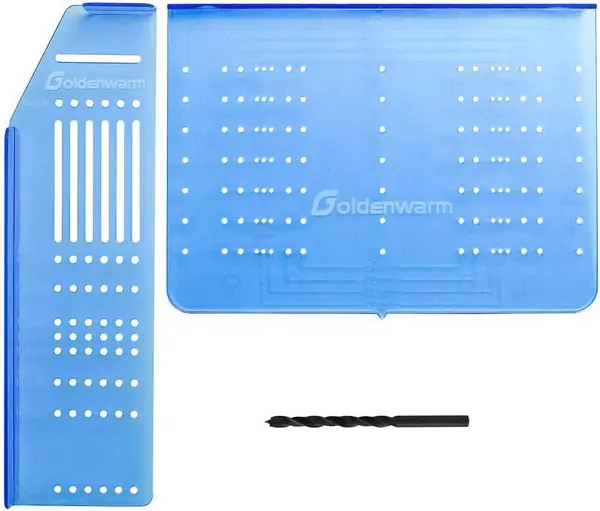
Goldenwarm Cabinet Pull Template Best for Wide Pull Spacings

Goldenwarm blue plastic cabinet pull and knob drilling template with drill bit

Wide pull spacings

Shop Score 89/100
Material
Plastic
Weight
5.64 oz
Included
Pull template, knob template, 3/16-inch drill bit
Hole Centers
2.5, 3, 3.5, 3.75, 4, 4.5, 5, 6.25 inches
View on Amazon

Goldenwarm's template covers eight hole centers from 2.5 to 6.25 inches, including the wider 160mm spacing that many basic kits skip, and we like it for a standard spacing that falls between the usual template sizes. The package includes a pull template, a knob template, and a 3/16-inch drill bit, and the blue plastic is easy to see against light cabinet fronts.

The measurement lines are clear, and the knob template is a useful extra if you are mixing knobs and pulls. For a one-off project, it saves buying an adjustable jig just to match a wider pull.

We dry-fit the template and mark the hole before drilling, especially on trimmed doors where the handle can sit lower than expected. For a straightforward set of wide-spaced pulls, it is a cheap way to repeat the layout; for a full Shaker kitchen, an adjustable jig is the safer choice.

Worth Noting

  • Fixed pattern may not center on every door
Our Verdict

We like the Goldenwarm for pulls with unusual standard spacings, since its eight hole patterns cover widths that simpler templates skip.

Check Latest Price

How We Tested Cabinet Hardware Jigs

We began with spec sheets, comparing each jig's supported hole-center spacings, guide-sleeve material, weight, and what ships in the box, then ruled out anything that couldn't handle both a knob and a bar pull or that gave no way to register against a door edge. Twelve jigs went to the bench, and we used them for eight months.

Each one was used the way it would be on a real install: clamped to 3/4-inch slab doors and to Shaker doors with a recessed center panel, drilling knobs on uppers and pulls on drawer fronts. We timed setup from unboxing to first hole, checked hole-to-hole centers with calipers after every hole, and noted whether the bit rattled in its guide sleeve — slop there is what turns a round hole into an oval one.

For locking stability, we taped each jig's position, drilled a full door at a slight angle the way a hurried installer would, and measured any creep afterward. We switched between a 3-inch and a 5-inch spacing on the adjustable jigs to see what each change cost in setup time, mounted long bar pulls on drawer fronts, and cranked the clamps down hard on the plastic templates to watch for flex. Between sessions, everything sat in a hot garage to see which ones came back warped.

We also counted how many doors each jig got through on a single setup, weighed it, and checked whether the case actually held the bit, punch, and spare bushings. Value came down to cabinets per dollar rather than sticker price — a slower jig with a wide spacing range beat a fast one that only fit one pull. The ones that made the list are the jigs we kept reaching for on our own runs.

How to Choose a Cabinet Hardware Jig

Match the Jig to Your Pull Spacing

The first number to check is center-to-center spacing. A fixed template with 3-, 3.75-, and 5-inch holes is fast and inexpensive, but it cannot shift to a 4-inch pull or a 6.25-inch bar pull. An adjustable jig covers a range, like the Kreg's 1 to 5 inches, and lets you set any spacing in between. Measure your new hardware before ordering, not after the cabinet boxes are open.

Knobs are simpler: a single hole, usually centered on the door or drawer. A pull jig can handle knobs, but a knob-only template cannot handle pulls. If you are mixing both, choose a jig that includes a knob guide or plan to mark knobs separately.

Fixed Templates vs. Adjustable Jigs

A cabinet hardware template is a plate with pre-drilled guide holes. It is fastest for a run of identical doors because there is nothing to adjust, and the clear plastic lets you line up the cabinet edge. The limitation is built in: if the hole pattern does not match your pull, the template is not adjustable. It also has to sit flush, so a warped plate or a recessed panel can throw off the hole.

An adjustable jig uses sliding guides, stops, and a fence to set spacing once and repeat it. Setup takes longer, but the jig can follow the hardware instead of the other way around. We prefer adjustable jigs for mixed drawer and door hardware, Shaker cabinets, and any job where the pulls are not a standard three-hole pattern.

Stability and Setup Matter More Than Features

A jig that shifts while the bit turns will drill a crooked hole no matter how precise its scale is. Look for metal drill guides, thumb screws that stay tight, and a fence or edge guide that registers against the cabinet. On slick painted doors, add a clamp; on recessed Shaker panels, use a jig with spacers or standoffs so the body sits square.

We also pay attention to the setup: clear scales, a repeatable stop, and instructions that match the hardware. A cheap jig with a good center punch can outperform a fancy one you have to re-measure every time. If you are doing one vanity, a simple template is enough. For a kitchen, buy the repeatability.

Plan for the Whole Run

The real cost of installation is the measuring, not the drilling. A jig that stays set across a bank of drawers saves more time than one with extra features you never touch. Check whether the jig handles the longest pull in the house and whether it stores in a case or bag; a loose template is easy to lose between projects.

For a professional or a large remodel, a calibrated jig like the True Position Original or MAX can pay for itself in avoided mistakes. For a standard kitchen, the Kreg's 1-to-5-inch range covers most pulls, while a fixed template like the Ravinte is enough for one common size. Match the tool to the run, not to the brochure.

Frequently Asked Questions

Final Verdict

After testing the set, the Kreg KHI-Pull is the jig we recommend first. It covers the 1-to-5-inch spacing on most kitchen and bath pulls, its metal guides and stops make a long run repeatable, and it is easier to justify than the calibrated premium jigs. If you have Shaker cabinets or pulls beyond 5 inches, the True Position Original or MAX is the upgrade; if every pull is a standard 3-, 3.75-, or 5-inch size and the budget is tight, the Ravinte template does the job.