↑↓ navigate ↵ open Esc close All results →

Best Biscuit Joiners of 2026

Every bad glue-up starts the same way: you flip the carcass and the seam has crept a sixteenth of an inch out of flush. A biscuit joiner exists to prevent that. It cuts a matched crescent slot in both mating edges, and a compressed beech biscuit swells with glue to hold the faces level while the clamps come down.

We cut slots with 11 joiners over nine months — shop cabinets, a bookshelf, face frames on a garage bench — and what separated them rarely showed on the box. The fence is where these tools are won or lost: one that creeps under clamping pressure cuts a slot riding high on one board and low on its neighbor, and glue won't rescue that.

After that it's convenience and control: depth stops you can set without hunting, a bag that catches chips instead of spraying them, and a cord you feel every time you carry the tool to the bench. The five picks below hold their settings, take the full range of biscuit sizes, and leave a seam you can sand flat in one pass.

Our Top Picks

The Best Biscuit Joiners

1.

Makita PJ7000 Plate Joiner Best Overall
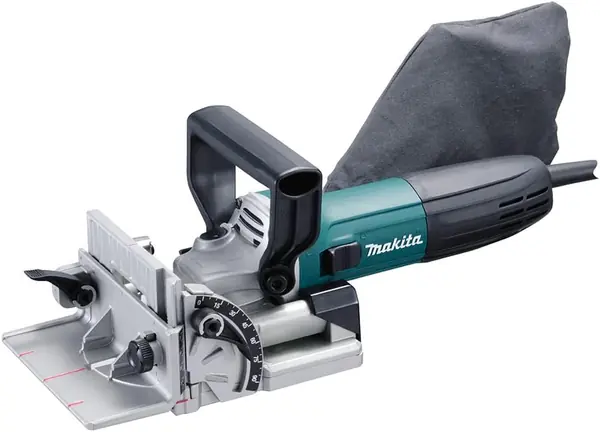
Makita PJ7000 blue biscuit joiner with dust bag and case

Furniture and cabinets

Shop Score 94/100
Amperage
5.6 A
No-load Speed
11,000 rpm
Fence Stops
0°, 45°, and 90°
Depth Settings
6 with one-touch stops
View on Amazon

The PJ7000 earns its place with the parts you adjust between cuts. Its cast-aluminum pivot fence has positive stops at 0, 45, and 90 degrees, and the rack-and-pinion height control moves the fence in a straight, predictable line. Set the depth for a #20 biscuit, lock the large cam levers, and the tool feels planted while the blade goes in. That is the kind of stability that makes a biscuit joint repeatable rather than a one-off success.

The motor is rated at 5.6 amps and 11,000 rpm. That is less amperage than the DEWALT DW682K, but the higher speed and smooth start make the Makita feel quick in the cuts we made. Six one-touch depth settings cover #0, #10, and #20 biscuits, and the depth changes are easy to make without hunting for a detent. We also like the cast fence's heft: it gives you something solid to register against, especially on narrow face frames.

Dust collection is the one place it asks for attention. The bag needs emptying before it packs tight; once it does, suction falls off and chips start looking for the floor. We keep the PJ7000 set up for furniture and cabinet work because the fence and depth controls are the reason it earns the top spot. It is the joiner we trust when an off-angle slot shows.

Worth Noting

  • Dust bag needs frequent emptying
Our Verdict

We recommend the Makita PJ7000 for furniture and cabinet work because its fence and six depth stops make accurate slots repeatable.

Check Latest Price
2.

DEWALT DW682K Biscuit Joiner Best Corded for Hardwoods

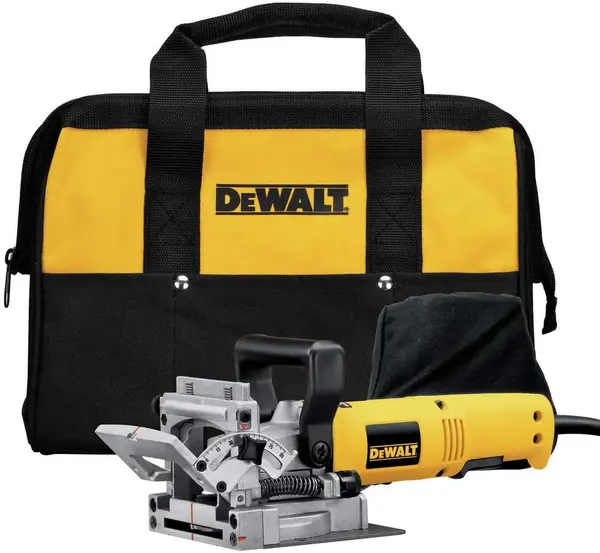
DEWALT DW682K yellow biscuit joiner kit with dust bag and case

Hardwoods and frames

Shop Score 93/100
Amperage
6.5 A
No-load Speed
10,000 rpm
Fence Tilt
0° to 90°
Miter Notch
45°
View on Amazon

Fence drift is the failure that turns a biscuit joint into a repair, and the DW682K is built to resist it. Its dual rack-and-pinion fence is designed to keep the blade and fence parallel as you raise or lower the height, and the one-piece fence tilts from 0 to 90 degrees. A 45-degree locating notch lets you index off the outside face of a mitered joint. Those details matter when you are building face frames or aligning a row of shelf boards.

The 6.5-amp motor and 10,000 rpm blade speed give it more amperage than the Makita PJ7000, and it felt strong in the cuts we made. It is a corded tool with a familiar DEWALT layout, so the controls are easy to read and the fence locks down with a reassuring clamp. Flush cuts at 0 degrees can be made without removing the fence, which saves a step when you are working on the edge of a cabinet.

The caution is slot fit. Some biscuits can run tight in the slot, so test-fit the brand you plan to use before a large glue-up. A vacuum adapter is included, and we use it for longer runs to keep the cut line clear. That is a small extra step on a tool that otherwise makes accurate joinery feel straightforward. The fence and the motor feel matched; neither one is the weak link.

Worth Noting

  • Dust bag can blow chips toward operator
Our Verdict

We think the DW682K is the corded pick for hardwood joinery, with a parallel fence and enough power for face frames.

Check Latest Price
3.

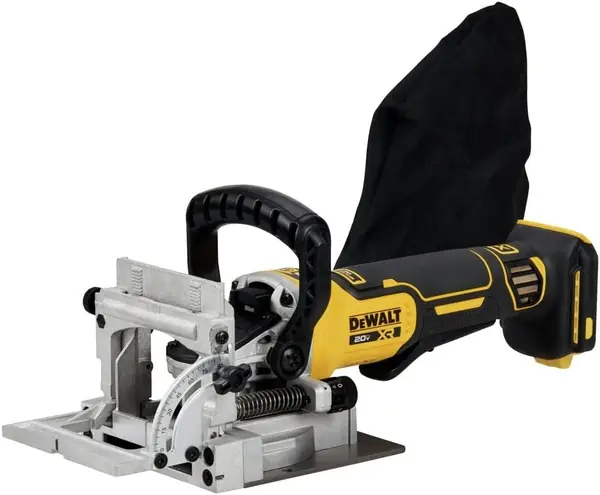
DEWALT DCW682B 20V MAX XR Biscuit Joiner Best Cordless

DEWALT DCW682B cordless biscuit joiner with angled dust port

Cordless jobsite work

Shop Score 92/100
Power Source
20V MAX battery (tool only)
Weight
6 lb (tool only)
Fence Bevel
0° to 90°
Biscuit Sizes
#0, #10, #20
View on Amazon

Cordless freedom is the whole point of the DCW682B. The 20V MAX XR battery platform means no cord to drag across a bench or trip over at a jobsite, and at 6 pounds for the bare tool it is easy to carry to the work instead of bringing the work to an outlet. The paddle switch works from either side, which helps when you change hand position in a tight run.

DEWALT carried over the dual rack-and-pinion fence and added tool-free depth, height, and bevel adjustments. The depth dial clicks through #0, #10, and #20 biscuits, and the fence bevels from 0 to 90 degrees. In our cuts the brushless motor started smoothly and kept the slot clean, with no sense that the cordless format was leaving power on the table. The all-metal fence and positive detents give it a precise feel that matches the corded DEWALT.

The one use boundary is F biscuits: the DCW682B handles #0, #10, and #20, not the tiny F size some restoration and craft work calls for. For cabinet installers who already carry DEWALT batteries, the cordless format is an easy trade-off; for a shop that never leaves the bench, the corded DW682K is the simpler choice.

Worth Noting

  • Battery and charger sold separately
Our Verdict

For installers who already own DEWALT batteries, we like the DCW682B's cordless freedom and tool-free adjustments.

Check Latest Price
4.

WEN JN8504 Biscuit Joiner Best Budget

WEN JN8504 red and black biscuit joiner with hard case

Budget workshops

Shop Score 91/100
Amperage
8.5 A
No-load Speed
10,000 rpm
Included
50 biscuits and hard case
Biscuit Stops
#0, #10, #20
View on Amazon

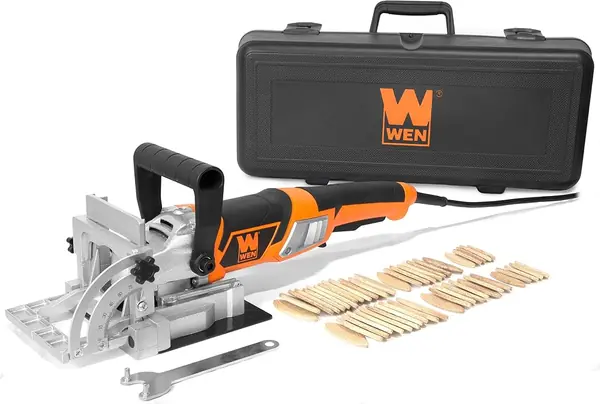
The WEN JN8504 is the kit that makes biscuit joinery easy to try. For a budget tool it arrives complete: an 8.5-amp motor, a 4-inch carbide-tipped blade, pre-set stops for #0, #10, and #20 biscuits, a dust bag, a hard case, and a starter set of 50 biscuits. We like that the fence tilts from 0 to 90 degrees and that the depth stops are labeled for the common biscuit sizes. You can open the case and make a test joint without buying a separate biscuit assortment.

The 8.5-amp motor spins at 10,000 rpm, and in our cuts it had enough power for softwoods and sheet goods. The depth stops are easy to set, and the fence tilts smoothly through its range. We were pleasantly surprised by how complete the kit feels for a budget tool: the case keeps everything together, and the starter biscuits let you make a test joint right away. It does not have the crisp machined feel of the premium picks, but it gets the cut made.

The fence is the part to check. It can arrive slightly out of square with the base, so cut a test slot in scrap and inspect the fit before you commit a project to it. Once squared, the WEN makes solid joints for shelves, repairs, and small cabinet runs. We reach for it when the job does not justify a premium tool, and that is the whole point of a budget joiner.

Worth Noting

  • Height markings are hard to read
Our Verdict

We see the WEN JN8504 as the budget kit to start with, thanks to its 8.5-amp motor and included biscuits and case.

Check Latest Price
5.

RYOBI JM83K Biscuit Joiner

RYOBI JM83K corded biscuit joiner kit with dust collector and bag

Occasional DIY

Shop Score 87/100
Amperage
6 A
Included
Dust collector and bag
Power Source
Corded AC
View on Amazon

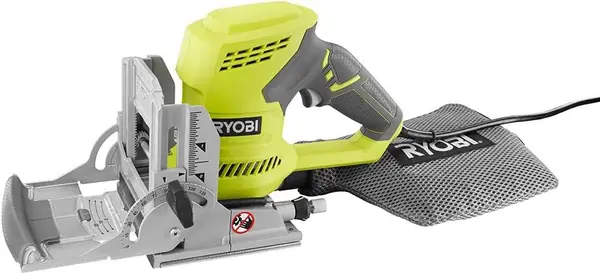
Not every shop needs a fence full of detents. The RYOBI JM83K is a corded 6-amp biscuit joiner kit with a dust collector and bag, and that simple formula has real appeal for occasional shelves, repairs, and small glue-ups. There is no battery to charge and no platform to buy into: you plug it in, set the fence, and cut. We see it as a second joiner or a first joiner for someone who works a few weekends a year.

The 6-amp motor sits in the middle of this group on power, and the dust collector and bag are useful inclusions. Before you buy, confirm that the fence has #0, #10, and #20 depth stops and that it locks square; those are the details that decide whether a simple joiner stays simple. The corded design is the attraction for light work. For furniture and cabinet runs, the Makita and DEWALT picks give you more control.

Worth Noting

  • Offers less control on long furniture and cabinet runs
  • Fence depth stops and square lock need pre-purchase checking
Our Verdict

We consider the RYOBI JM83K a simple corded option for light weekend work, provided you confirm its depth stops.

Check Latest Price

How We Tested Biscuit Joiners

We started with the joiners the major brands actually stock, corded and cordless, and narrowed the shortlist by fence design, the biscuit sizes each one accepts, dust collection, and price before buying 11 of them. Every unit went onto a garage bench for nine months of real work — shop cabinets, a bookshelf, face frames — plus a few hundred test cuts in oak, maple, poplar, and 3/4-inch plywood.

Fence accuracy came first. We cut a slot in one board, mated it to a second, checked the seam with a straightedge and a feeler gauge, then repeated the joint ten times to see whether the fence drifted under clamping pressure. Each fence got checked against a machinist's square at every stop it offered, including the bevel settings and the retractable notch used for mitered frames. We timed setup out of the box, counted how many cuts it took to get a clean slot with no tearout, and fed each tool through hardwood at a steady rate to hear whether the motor bogged or the blade burned the edges.

We also tracked what living with the tool is like: how much dust ended up in the bag versus on the bench after ten plywood cuts, how a cord trailing across the bench compared with swapping batteries on the cordless model, and what came in the box — biscuits, case, bag.

Safety governed every step. Tools were unplugged or had their batteries pulled before a blade change or a deep fence adjustment, every workpiece was clamped with hands clear of the blade path, and we wore eye and hearing protection and ran dust collection on sheet goods. Joint quality and adjustability carried the most weight in the final scoring, with ease of use, dust control, and value deciding the rest.

How to Choose a Biscuit Joiner

Put the Fence First

A biscuit slot has to sit square to the face and parallel to the edge, and that is fence work, not blade work. Look for a rack-and-pinion height adjuster, positive stops at 0, 45, and 90 degrees, and cam locks that hold without flex. We check a new joiner against a square and cut a scrap slot before trusting it on a project. The Makita PJ7000's cast-aluminum fence is the most reassuring example here; the WEN's lower-cost fence is the one we check most carefully.

Count the Depth Stops

Most biscuit work uses #0, #10, and #20 biscuits, so those three settings are the minimum. A dedicated stop for each size is faster and less error-prone than reading a scale, especially when you switch between panel thicknesses. Six settings, as on the Makita, add room for unusual biscuits and fine depth tweaks. If you build cabinets, confirm the depth changes are tool-free or at least easy to lock; fiddling with a wrench between cuts gets old.

Corded or Cordless?

Corded joiners are the simpler shop choice: steady power, no battery platform, and no charging routine. Cordless makes sense when you install cabinets or build on site and do not want a cord across the work. The DEWALT DCW682B is the cordless pick here, and its tool-free depth and bevel changes suit setup work. Remember that a bare tool needs batteries and a charger, so the real cost depends on the platform you already own.

Match Power to the Work

Amperage and rpm tell you only part of the story. A 6.5-amp motor, as on the DEWALT DW682K, gives you headroom in hardwoods and thick panels, while the Makita's 5.6-amp motor turns faster at 11,000 rpm and feels smooth in the cut. Weight matters too: a heavier fence and body can feel planted, but a 12-pound joiner is more tiring to hold against a vertical case side. Pick the balance that matches your work, not the biggest number on the label.

Plan for Chips and Setup

Biscuit joiners make a lot of chips, and a full dust bag cuts suction quickly. A bag is fine for a few cuts; for a long run, a vacuum adapter keeps the cut line visible and the shop cleaner. Empty the bag before it packs tight, and make a test cut in scrap whenever you change biscuit size. A kit with biscuits and a case, like the WEN JN8504, gets you started without a separate shopping trip. Setup time is part of the cost of ownership: the easier the fence and depth controls, the more likely you are to use the tool.

Frequently Asked Questions

Final Verdict

The Makita PJ7000 is our top pick because it solves the part of biscuit joinery that is hardest to fake: a fence that stays where you set it. Its positive stops, six depth settings, and smooth 11,000 rpm cut make repeatable joints easier, and that is worth more than an extra amp on the label. If you work away from an outlet, the DEWALT DCW682B gives you cordless freedom and tool-free changes. For a tight budget, the WEN JN8504 is the kit we recommend for a first set of shelves.