↑↓ navigate ↵ open Esc close All results →

Best Cabinet Face Frame Clamps of 2026

A face frame goes up in a hurry and has to stay lined up for the next twenty years. The trouble is that the moment you let go to pick up the drill, the stile shifts, the seam opens a hair, and the screw lands exactly where you didn't want it. A cabinet face frame clamp pulls the stile flush against the cabinet side and, on most of the models worth owning, holds a drill bushing steady so both your hands stay free.

We tested 12 clamps from eight different sets over eight months — hanging upper frames, building shop cabinets, and resetting drawer fronts — and the number printed biggest on the box, clamping force, mattered less than how smoothly the thread turned once it was loaded. Opening capacity surprised us too: the width in the product name often isn't the stile the jaw will actually swallow. What every pick here gets right is the same thing: it holds a frame flat and steady long enough to drill and drive a screw alone.

Our Top Picks

The Best Cabinet Face Frame Clamps

1.

Pony Jorgensen 8510BP Cabinet Claw 2-Pack Best Overall
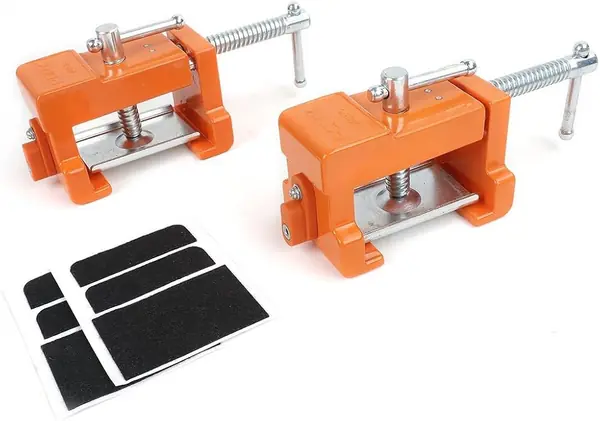
Two orange Pony Jorgensen cabinet claw clamps with side drill guides and protective pads

Hanging face frames

Shop Score 93/100
Opening Capacity
2 to 4 inches
Stile Width
1-1/2 to 2 inches
Included
2 clamps and two pad sets
Max Load
650 lb
View on Amazon

The business end of this clamp is a flat alignment plate that bridges the seam between two cabinets, with a drill guide mounted beside it. You bore through both stiles, swing the guide out of the way, and drive the screw — the clamp never moves, and neither stile does.

That sequence is why we put the Pony first. The plate forces two faces into one plane, and the pilot hole locks that alignment in before the clamp comes off. Doing the same job with a bar clamp means a helper holding a stile while you sight down the seam and hope it stays.

The specifications back up the shape: rated for stiles 1-1/2 to 2 inches wide, opening from 2 to 4 inches so the jaws straddle a stile and its neighbor, and a 650-pound load rating a cabinet seam will never approach. Two sets of protective pads are in the box, and they are the part to check before you crank down — a pad that has slid out of place is how a clamp marks a finished face. Note that it is built for face-frame cabinets; on a Euro-style frameless box there is no stile to straddle.

One clamp per seam holds it while you fasten; a pair means the next joint is already open and set when you move down the run. What we appreciate most is how little attention it asks for once it is tight. Let go, pick up the drill, and the frames are still exactly where you left them.

Worth Noting

  • Not built for Euro-style frameless cabinets
  • Slipped protective pads can mark finished cabinet faces
Our Verdict

We recommend it first because the alignment plate and swing-away drill guide let one person hang a flush face frame — the tool we want on every cabinet run.

Check Latest Price
2.

Manram Cabinet Clamps 4-Pack Best Kit for a Full Kitchen

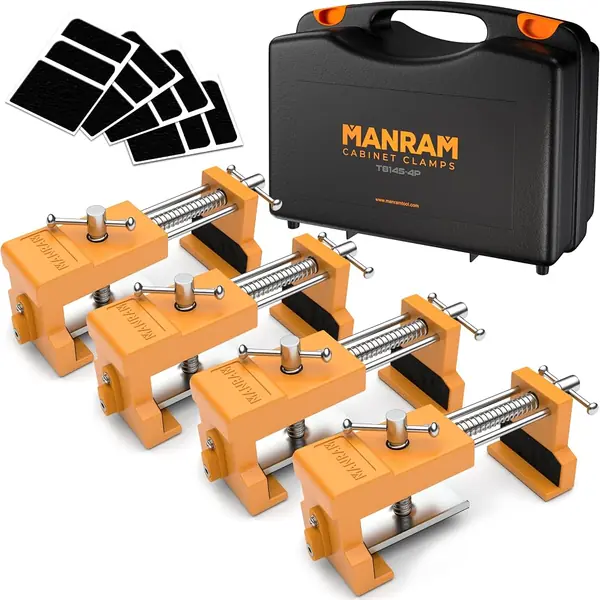
Four orange Manram cabinet clamps with drill guides, felt pads and a carrying case

Full kitchen installs

Shop Score 92/100
Set Includes
4 clamps, felt pads, case
Opening Capacity
4 inches
Clamping Force
300 to 600 lb
Stile Thickness
Up to 1-1/4 inches
View on Amazon

Four clamps in one box is why we point a whole kitchen at this set. Clamp a run of three cabinets, walk down the line, and every joint you set is still there when you come back with the drill — you are not trading one clamp back and forth all afternoon.

The working parts follow the same idea as the Pony's: a plate that rides across the seam, a side drill guide that flips out of the way, and jaws that span a stile. The set opens to 4 inches with a 2-inch jaw and a rated force of 300 to 600 pounds, and each clamp carries felt pads for the faces and the alignment plate.

The screw wants a firm final turn. Stop at snug and a stile can creep before the fastener bites, so tighten the way you tighten a vise rather than a wing nut. The pads are the other thing to mind — press them flat before each cabinet, because a corner that has lifted will leave a mark.

The case is what we did not expect to care about and now do. Four aluminum clamps with drill guides are awkward to store loose, and a set that arrives and leaves in one tray is the difference between using them and forgetting them in a drawer. If you are chasing a single bad seam, two clamps will do it; this set is for the job where a whole run is going up.

Worth Noting

  • Rated for stiles up to 1-1/4 inches thick
Our Verdict

Four clamps in one box is why we point a whole kitchen at this set: you can clamp a run and come back to joints that have not moved.

Check Latest Price
3.

DAYDOOR Cabinet Clamps 4-Pack Best for Wide Stiles

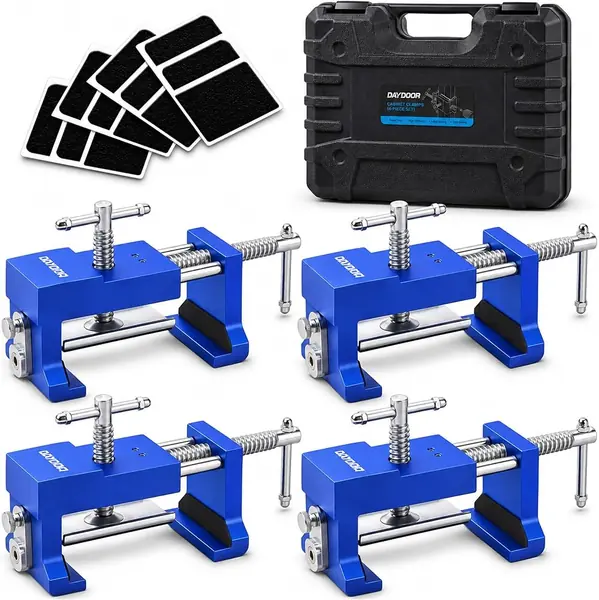
Four blue DAYDOOR cabinet claw clamps with EVA pads and integrated drill guides

Wide custom stiles

Shop Score 91/100
Set Includes
4 clamps with EVA pads
Opening Capacity
2.85 to 5.3 inches
Pads
EVA
Stile Width
1-1/2 to 2-1/2 inches
View on Amazon

Stiles up to 2-1/2 inches wide and an opening that runs from 2.85 to 5.3 inches make this the widest-gripping set in the group. If your frames are shop-made from heavier stock, or the stiles are wider than the 2-inch standard the other clamps are built around, this is the one that closes on them.

The body and side jaw are cast steel, and the pads are dense EVA rather than felt, which holds its shape against a finished face and does not fuzz or shift the way softer pads can. The set comes as four clamps in blue or orange, with a two-pack also sold, and each clamp has an integrated drill guide on the side.

The extra range costs you travel. On a standard 1-1/2-inch overlay stile the jaw starts a long way out and the screw takes noticeably longer to close than the Pony's does. We accept that trade for the reach and reach for this set on custom work rather than production runs — a clamp that fits an odd frame is worth a few extra turns.

Worth Noting

  • No carrying case in the box
Our Verdict

What sold us is the range — jaws that take stiles up to 2-1/2 inches wide and an opening out to 5.3 inches for thick custom frames.

Check Latest Price
4.

Sebupar Cabinet Clamps 4-Pack Best for Heavy-Duty Clamping

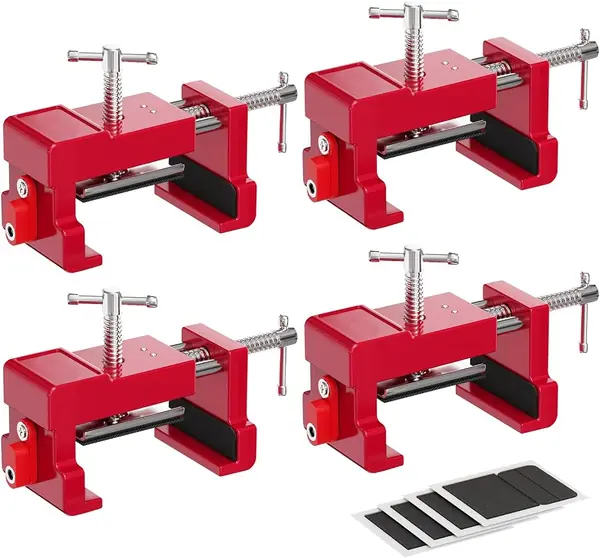
Four red Sebupar cast-steel cabinet clamps with side drill guides and felt pads

Heavy-duty clamping

Shop Score 90/100
Set Includes
4 clamps with felt pads
Opening Capacity
4 inches
Material
Cast steel and aluminum
Stile Capacity
1-1/2 to 2 inches
View on Amazon

Cast steel on the body and side jaw, an aluminum alignment plate on the front, and a 4-inch opening: this set is built like the tools it resembles. Four clamps arrive with a set of felt pads, and each one carries a side drill guide for the pilot hole.

Weight is the first thing we noticed — 6.59 pounds for the set — and it reads as substance on a seam. Set the jaw, turn the screw, and the two faces come level and stay there. The thread is where it falls down: it can drag through the casting, so closing a clamp takes more hand than it should.

Give the drill guide a check before you start. The main hole is tapered, and a standard cabinet screw head may not pass it cleanly, so test your screws in the guide on the bench and have a driver bit on hand that reaches through it.

What you get is four heavy clamps with pads and guides included, enough to set a run without stopping. Hanging a kitchen is well within reach if you are willing to work the screws. We rank the Manram above it because a clamp that turns smoothly is worth more halfway up a ladder than one that does not.

Worth Noting

  • Threads can bind when tightening
  • Screw hole is tapered and fussy about screw size
Our Verdict

We like the cast-steel build and the four-clamp set; the stiff thread is what keeps it behind the Manram for a full kitchen.

Check Latest Price
5.

WEN CL327F 3-Inch Face Clamp

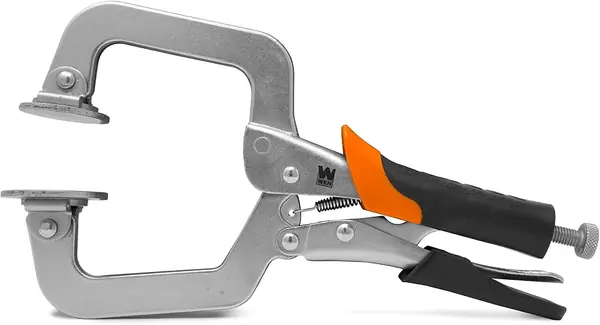
WEN three-inch face clamp with soft-grip handles and non-marring swivel pads

Bench frame assembly

Shop Score 89/100
Pads
Swivel, non-marring
Handle
Soft grip with quick release
Throat Depth
3 inches
Clamping Capacity
2-3/4 inches
View on Amazon

Soft-grip handles, a quick-release lever, and swiveling non-marring pads on both jaws, for the least money in this group. The WEN is a 3-inch face clamp: 3 inches of throat depth, 2-3/4 inches of clamping capacity, a tension knob that closes the gap and a lever that releases the pressure in one squeeze.

On the bench it is the clamp that makes pocket-screw face frames come out flat. The pads are offset so one sits on each side of a stile-and-rail joint, both against the same face: tighten, drive the screws, and the lever lets go without a dozen turns of a screw.

This is not the tool for tying two hung cabinets together — there is no alignment plate to level the faces, no drill guide, and 2-3/4 inches of capacity will not straddle a stile and its neighbor. What it is: the clamp we keep within reach while a frame is still on the bench, and at this price we want one at each corner of the glue-up.

Worth Noting

  • Lacks alignment plate and drill guide for cabinet runs
  • 2-3/4-inch capacity cannot straddle two cabinet stiles
Our Verdict

The least expensive clamp here, and the one we keep on the bench for pocket-screw face frames and glue-ups.

Check Latest Price
6.

Kreg KHC-MICRO Face Clamp Best for Pocket-Hole Joints

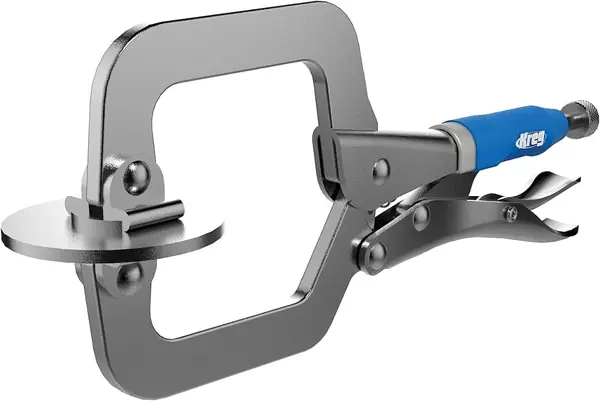
Kreg two-inch face clamp with gray handle and metal jaw for pocket-hole joints

Pocket-hole joints

Shop Score 88/100
Material
Metal
Weight
11.5 oz
Jaw Reach
2 inches
Compatible Jigs
Kreg 300-series and R3 adapter
View on Amazon

Small, light, and shaped to sit in a Kreg jig: at 11.5 ounces this is the clamp that makes a pocket-hole face frame a one-person job. The 2-inch jaw reaches exactly where the jig's clamp adapter expects it, and it stays clear of the drill while you work.

The screw knob spreads pressure evenly across the joint, and the jaw profile keeps the two pieces flush while the screw goes in. It is small enough to ride in the jig's box and light enough to forget it is there until you need it, which is most of why it lives in our tool bag rather than on a shelf.

What it is not is a cabinet claw. Two inches of reach will not pull two stiles together on a hung cabinet or level a seam between boxes, and there is no plate to bridge the gap. For frames built flat on the bench and screwed on afterward it is the right tool; for hanging them, it is not.

Worth Noting

  • Needs a firm turn or the joint can shift
Our Verdict

If the frames go together on a Kreg jig, this is the clamp we want in hand: small, light, and shaped for the jig's clamp adapter.

Check Latest Price
7.

POWERTEC 71181 Drawer Front Clamps

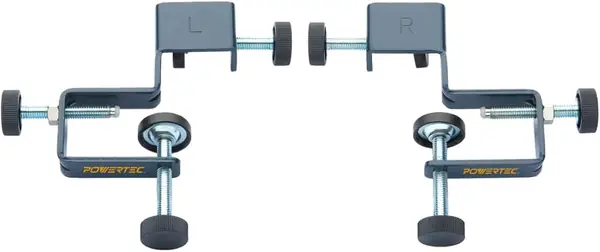
Pair of POWERTEC drawer front installation clamps with micro-adjust bolts and steel bodies

Drawer front alignment

Shop Score 87/100
Set Includes
2 clamps
Material
Alloy steel
Adjustment
Micro-positioning bolt and locking nuts
Cabinet Types
Face-frame and frameless
View on Amazon

This pair does one job: it holds a drawer front against its box while you drive the screws. The frame is thin enough that you can push the drawer shut with the clamps still on, check the reveal against its neighbors, and adjust before anything is fastened.

The hardware is small but thought through — a micro-positioning bolt with locking nuts for the front and rear, and clamp pads low-profile enough to sit inside the drawer opening. Both clamps work on face-frame and frameless cabinets, which covers most kitchens either way.

The steel is lighter than a cabinet clamp's — fine for a drawer front, not what you want to lean on. Set the clamps, push the drawer closed, and check the reveal against the drawer beside it before the bit touches wood, and check again after the first screw is in.

Where it earns its place on a kitchen install is after the frames are up — the last step, where a drawer front sits a hair proud of its neighbor and there is no third hand to hold it while you sight the gap. That is the moment this pair exists for, and it is a good one.

Worth Noting

  • Face-side grip can slip while adjusting
Our Verdict

We use this pair for drawer fronts, not stiles: the thin frame lets you close the drawer and check the reveal before screwing.

Check Latest Price

How We Tested Cabinet Face Frame Clamps

We started by reading through the field of face frame clamps and drawer-front jigs, comparing opening capacity, the stile widths each jaw would accept, whether a drill guide was built in, what the pads were made of, and how many clamps came in a set. Anything whose jaw couldn't open past roughly 2-3/4 inches — not enough to straddle a stile and its neighbor — came off the list, and we priced every remaining set per clamp before ordering.

Twelve clamps from eight sets arrived and went straight to work over eight months: a kitchen run of uppers and lowers, shop cabinet boxes built on sawhorses, and a pantry of drawer fronts that had never sat quite flush. We hung each frame solo, timing how long it took to clamp, drill, and drive screws without a second pair of hands, and noting the bushing size and whether the guide cleared the bit or had to be unclamped for the driver.

We checked flush by running a straightedge and a fingertip across every seam, and counted how many clamps it took to hold a full run straight before the frame crept. Pads went against prefinished faces, then came off to see what they left behind.

Under load, we turned each thread by hand and noted where it bound or ran smooth, and we compared rated clamping force with what a cabinet seam actually needs — a clamp rated far past the job isn't better if the handle fights you. Every clamp stayed inside its stated opening and force rating, and we wore eye protection whenever a bit went through a guide, keeping the shank clear of the clamp body. Sets that stayed in rotation kept their case and pads together through all eight months.

How to Choose Cabinet Face Frame Clamps

Hanging or Building: Two Different Clamps

Clamps sold as cabinet claws, the Pony and the Manram here among them, are built to straddle one stile, bridge the seam to its neighbor, and hold both faces in a single plane while you drill and screw. A pocket-hole face clamp, like the WEN or the Kreg, has offset pads that sit flat on either side of a joint so the pieces stay flush while the screws go in.

The trap is buying the second kind to hang cabinets with. A face clamp will pull two stiles together, but nothing on it levels the faces, so the seam still steps. For installation you want the version with the alignment plate and guide; for building frames on the bench, the offset jaw is the better tool.

Capacity: Read the Jaw, Not the Name

Stiles run 1-1/2 to 2 inches wide on most production cabinets, with shop-made frames going wider. These clamps straddle the stile, so a 4-inch opening is normal and the jaw itself is only about 2 inches across. Two stiles joined at a seam plus the alignment plate is what that opening has to swallow.

The number in a product's name is usually the jaw width, not the capacity — which is why a clamp advertised as 2-inch can be nothing like a clamp with 2 inches of opening. Measure the widest stile in your run, then check the opening range and the stile width the listing states, not the model number.

The Drill Guide Is What Replaces a Helper

What separates these cabinet clamps from a plain face clamp is the guide: a bushing that aims the bit through both stiles at the same height, then swings aside so you can drive the screw without unclamping. That one detail is the difference between one person hanging a run and two people passing a drill back and forth.

Before you start, check that your screw heads pass through the guide's hole and that the guide locks down tight. A guide that shifts under pressure drills an oversized or wandering hole, and a hole in the wrong place in a finished stile is not something you can take back.

Pads, and How Many Clamps You Need

Every clamp here ships with protective pads, and they decide whether a finished face comes out clean. Felt is soft but wears and can slide; the denser EVA on the DAYDOOR set holds its shape better. Press each pad down before you tighten, keep spares, and treat a lifted corner as a mark waiting to happen.

On quantity: two clamps will get you through a repair or a single stubborn seam, but four lets you clamp a run of cabinets, walk away, and come back to joints that have not moved. If a whole kitchen is going up, buy four and a case rather than two and a lot of patience.

Force Ratings Matter Less Than the Thread

Rated clamping force runs from 300 to 650 pounds across these clamps, and every one of those numbers is more than a cabinet seam will ever ask for. What actually decides whether a stile creeps is the screw: a thread that drags in its casting needs real hand pressure to close, and the clamp that turns smoothly is the one you can set one-handed halfway up a ladder.

Turn the screw before you commit if you can, or buy from a maker whose thread has a reputation for being smooth. Judge the thread, not the rating.

Frequently Asked Questions

Final Verdict

We reach for the Pony Jorgensen 8510BP first. The alignment plate and swing-away drill guide are what let one person hang a face frame that comes out flush, and it is rated for the 1-1/2 to 2 inch stiles most cabinets use.

If a whole kitchen is going up, the Manram four-pack is the better buy: the same sequence, four clamps, and a case to keep them in. And if your frames are still on the bench, the WEN does the assembly work for a fraction of what a claw set costs.