↑↓ navigate ↵ open Esc close All results →

Best C-Clamps for Woodworking

A C-clamp that looks solid in retail packaging can bind two inches down the acme screw, walk its swivel pad across a wet glue joint, or flex its frame under torque until a shadow line opens in the seam. Reliable clamps track smoothly down the full thread length and hold pressure exactly where the joint meets.

Over seven months of clamping edge-joined panels, drawer boxes, shelves, and shop jigs, we put 12 C-clamps ranging from 1-inch jaw openings up to 6-inch frames under real shop loads. Buyers often confuse jaw opening with throat depth, and because most glue-ups take three or four clamps at a time, pack count and per-clamp price carry as much weight as raw clamping force.

Ranging from compact 1-inch frames for jigs and small parts to deep-throated castings for panel work, these seven clamps lock joints square while the glue cures.

Our Top Picks

The Best C-Clamps for Woodworking

1.

Pony 2660 6-Inch C-Clamp Set Best Overall
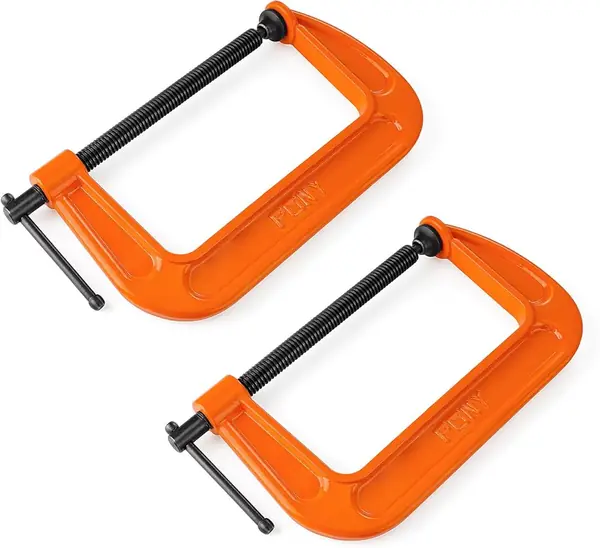
Pony 2660 orange C-clamp two-pack with sliding T-handle

General woodworking

Shop Score 95/100
Throat Depth
3-1/2 inches
Pack Size
2 clamps
Load Limit
1,000 pounds
Opening Capacity
6 inches
View on Amazon

Two 6-inch clamps is a practical starting point for a small shop, and the Pony 2660 set is the pair we keep closest to the bench. The 6-inch opening covers cabinet sides, face frames, and thicker laminations, while the two-clamp pack means you can close a small glue-up without buying a second set.

The 3-1/2-inch throat is the detail we appreciate most. It lets the jaw sit farther in from an edge than the 2- to 3-inch throats on several clamps here, so you can reach past a rail or into a shallow recess without angling the frame. The 1000-pound load limit is the highest stated figure among these picks, and the ductile iron frame feels rigid when you lean on the handle.

The sliding T-handle gives you a few grip positions, and the orange powder coat makes the clamps easy to find when they migrate across the shop. We also like that the swivel pad is zinc plated; it turns without grinding grit into the work.

For general woodworking, this is the set we recommend first. It covers the middle ground that most glue-ups fall into, and the second clamp is genuinely useful rather than filler. If you mostly need to reach into deep cabinet recesses, the Bessey is the better specialist; if you want a single lighter 5-inch clamp, the Tekton is easier to handle.

Worth Noting

  • Threads can feel stiff when new
Our Verdict

For most woodworking glue-ups, the Pony 2660 set gives you two 6-inch clamps with a 3-1/2-inch throat and a 1000-pound rating, so you can handle thicker assemblies without buying a second set.

Check Latest Price
2.

Irwin Quick-Grip 4-Inch C-Clamp Best for Fast Threading

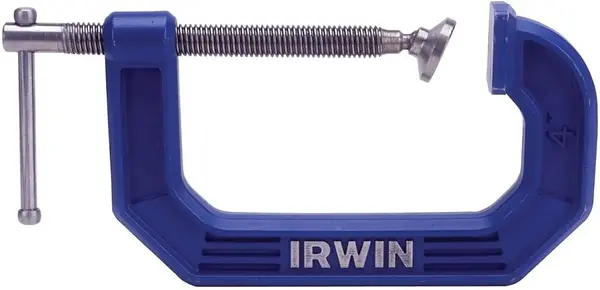
Irwin Quick-Grip blue and gray 4-inch C-clamp with swivel pad

Fast edge clamping

Shop Score 94/100
Throat Depth
3 inches
Screw
Double-rolled thread
Item Weight
2.2 lb
Clamping Capacity
4 inches
View on Amazon

The double-rolled screw is the reason to reach for the Irwin Quick-Grip before a run of repetitive clamping. It moves the jaw quickly, and the larger handle gives you leverage without making your palm sore after a dozen turns. The 4-inch clamping capacity and 3-inch throat put it in the useful middle for edge banding, face frames, and small cabinet parts.

At 2.2 pounds, the Irwin has a planted feel that we like on a bench, though it is heavier than the compact Pony 2630 and less pleasant to hold overhead. The swivel pad is broad enough to spread pressure on softwood, and the alloy steel frame has a reassuring heft. We also noticed that the handle shape encourages a firm grip rather than a fingertip pinch.

Where the Irwin earns its place is speed: the thread is quicker than the Pony 2660's and the 3-inch throat is deeper than the Tekton's. The 4-inch opening runs out before the Pony's 6-inch capacity, so it suits narrower parts better than thick assemblies. For a woodworker who clamps a lot of narrow parts in a row, the faster screw and comfortable handle make it the more pleasant tool. Pair it with a deep-reach clamp when the joint calls for more throat.

Worth Noting

  • Can flex under hard torque
Our Verdict

Choose the Irwin Quick-Grip when you want a 4-inch clamp that threads quickly and gives you a generous 3-inch throat for edge work.

Check Latest Price
3.

Bessey CM34DR Deep-Reach C-Clamp Best Deep Reach

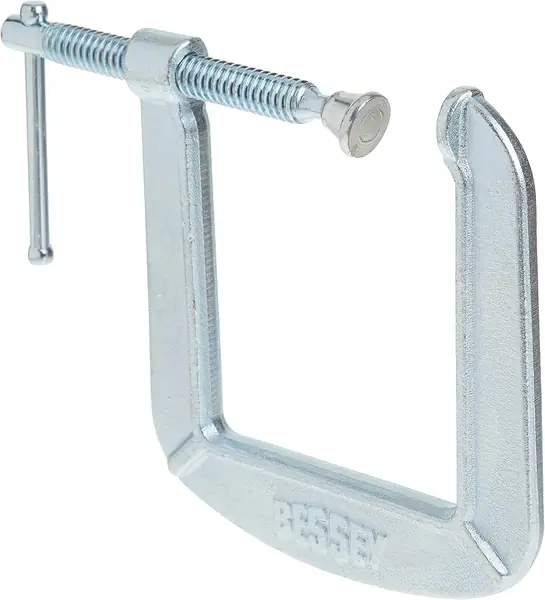
Bessey CM34DR black and red deep-reach C-clamp with steel handle

Deep cabinet work

Shop Score 93/100
Throat Depth
4-1/2 inches
Load Limit
900 lb
Frame
Drop-forged steel
Clamping Capacity
3 inches
View on Amazon

A 4-1/2-inch throat is the reason to own the Bessey CM34DR. It reaches past a cabinet face or into a recessed joint where a standard C-clamp stops at the edge, and the 900-pound rating gives you enough pressure to pull a joint closed without feeling the frame give. The drop-forged steel body and cold-drawn spindle feel precise in hand, and the sliding T-bar lets you find a comfortable grip in a tight spot.

The 3-inch jaw opening is the trade-off: this is a clamp for edges, not for clamping a thick stack of laminations. We like it best as a specialist beside a wider 6-inch clamp, and its 11-ounce weight makes it easy to hold in place while you start the screw. The handle is short enough to stay out of the way in a cabinet, and the galvanized finish shrugs off glue drips. For cabinet assembly and repair work, the deep throat earns its space in the bag. If you need maximum opening and throat together, the Pony 2660 is the better all-rounder.

Worth Noting

  • Swivel pad can come loose
Our Verdict

The Bessey CM34DR is the deep-reach clamp we reach for when a cabinet edge or recessed joint sits beyond a standard throat.

Check Latest Price
4.

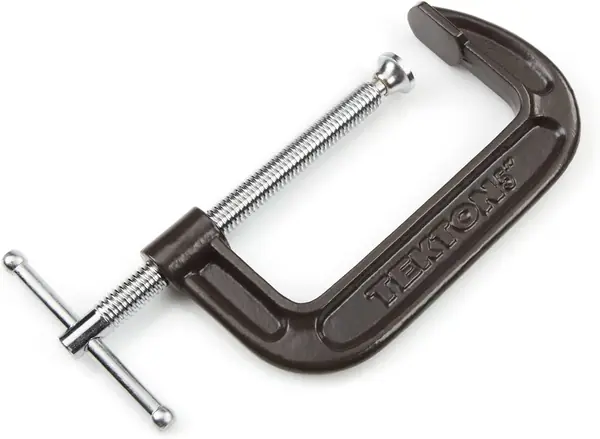
Tekton 4022 5-Inch C-Clamp Best Mid-Size

Tekton 4022 gray malleable iron C-clamp with chrome screw

Mid-size glue-ups

Shop Score 92/100
Throat Depth
2-3/8 inches
Jaw Opening
5 inches
Frame
Malleable iron
Screw
Acme thread
View on Amazon

The 5-inch opening and smooth Acme screw make the Tekton 4022 a natural step up from a 3- or 4-inch clamp. The malleable iron frame has an I-beam shape that feels stiff in the hand, and the swivel pad floats on a ball-and-socket joint so it can sit flat on an angled workpiece. The sliding handle lets you choose a grip position instead of always choking up on a fixed bar.

What we like most is the balance: the screw turns without the gritty feel some budget clamps have, and the 5-inch capacity covers thicker assemblies without the bulk of a 6-inch clamp. The 2-pound frame is substantial enough to stay put on the bench, and the baked enamel finish is easy to wipe clean. We reach for it when we want one clamp that can handle wood, light metalwork, and general repair.

For a woodworker who wants a single mid-size clamp, the Tekton is easy to recommend. It is not as fast as the Irwin, but it is the most balanced all-rounder in this group. If you regularly clamp thick stacks, the Pony 2660's extra opening is worth the step up.

Worth Noting

  • Throat depth trails deep-reach clamps
Our Verdict

The Tekton 4022 is a balanced 5-inch clamp for woodworkers who want one sturdy mid-size clamp for glue-ups, assembly, and occasional metalwork.

Check Latest Price
5.

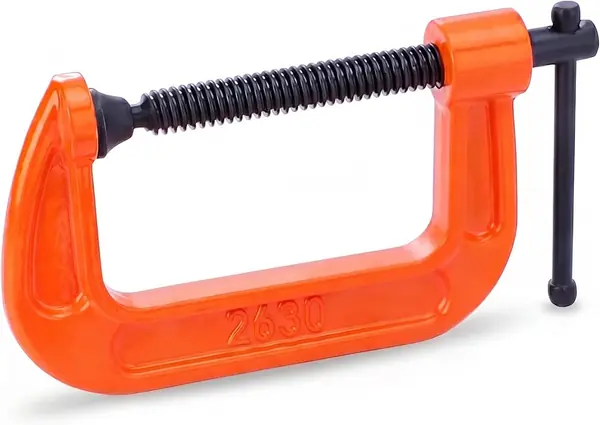
Pony Jorgensen 2630 3-Inch C-Clamp Best for Small Light Work

Pony Jorgensen 2630 orange 3-inch C-clamp with zinc screw

Small light work

Shop Score 91/100
Throat Depth
2 inches
Load Limit
800 lb
Item Weight
11.2 oz
Opening Capacity
3 inches
View on Amazon

The Pony 2630 is the small clamp we grab when a 6-inch frame is too much for the joint. The 3-inch opening and 800-pound rating give it more capacity than the tiny 1- and 2-inch clamps here, and the orange powder coat is easy to spot in a drawer of hand tools. At 11.2 ounces, it is light enough to hold in one hand while you start the screw.

We like it for light glue-ups, small jigs, and tight spots where a bigger clamp will not fit. The zinc-plated screw turns smoothly enough for a clamp at this size, and the swivel pad seats on trim and small parts without needing a caul every time. It is not the clamp we build a whole glue-up around, but it is a useful helper.

Compared with the Tekton and Pony 2660, the 2630 is a specialist: it goes where a larger frame will not. We keep a pair for small repairs and model-scale work; they earn their space beside the larger clamps.

Worth Noting

  • Mixed durability at the 3-inch size
  • Short 2-inch throat limits reach
Our Verdict

The Pony 2630 is a handy small clamp for light glue-ups and tight spots, but we keep it as a helper rather than the only clamp in a busy shop.

Check Latest Price
6.

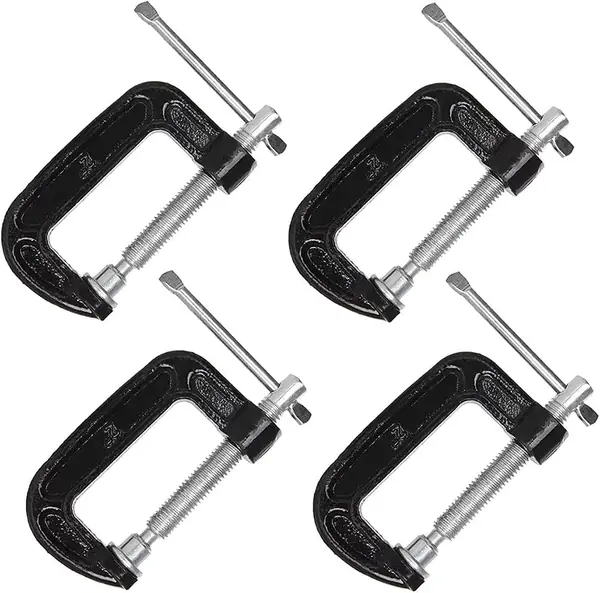
Zeromall 2-Inch C-Clamp Set Best for Craft and Shelves

Zeromall black cast iron C-clamp set of four

Craft and shelves

Shop Score 90/100
Throat Depth
1 inch
Pack Size
4 clamps
Jaw Opening
2 inches
Material
Cast iron
View on Amazon

Four small clamps for the price of a single mid-size one is the appeal of the Zeromall set. The 2-inch jaw opening and cast iron frame make them handy for shelf pins, small boxes, and light assembly, and the swivel pads seat on uneven surfaces without leaving a sharp dent. Each clamp has a T-handle that is easy to turn between fingers, and the compact body slips into a drawer or a tool roll.

We like the set as a supplement rather than a foundation. The clamps are compact enough to keep close at hand, and having four means you can hold a small glue-up while the next one is setting. Four clamps also let you spread pressure across a small frame instead of chasing one clamp around the joint. They are not the clamps we choose for a cabinet glue-up, but for craft work and quick repairs they earn their place.

Worth Noting

  • 1-inch throat limits reach
Our Verdict

The Zeromall set is an affordable way to add four small clamps for crafts, shelf pins, and light assembly, not for drawing heavy joints closed.

Check Latest Price
7.

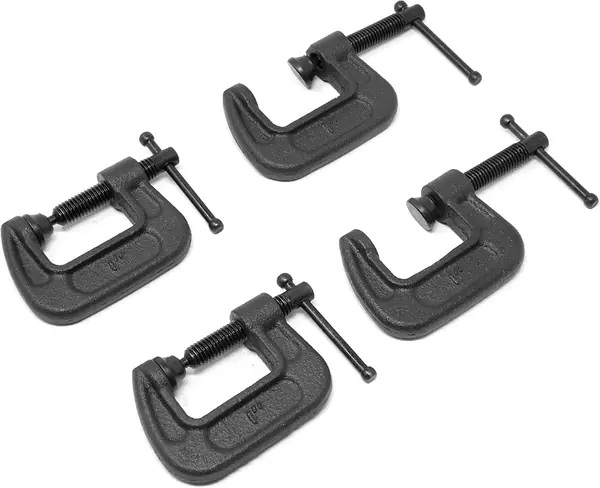
WEN CLC108 1-Inch C-Clamp Set Best for Tiny Parts

WEN CLC108 black cast iron C-clamps in a four-pack

Tiny parts

Shop Score 89/100
Throat Depth
0.8 inch
Pack Size
4 clamps
Jaw Opening
1 inch
Material
Malleable cast iron
View on Amazon

The 1-inch jaw on the WEN CLC108 tells you what this set is for: tiny parts, model work, and jigs where a full-size C-clamp cannot fit. The four clamps have a 0.8-inch throat and a cast iron body that feels denser than the size suggests. The black oxidized finish is plain, but it resists rust in a shop drawer.

The low-resistance screw turns easily between thumb and finger, and the swivel pad adjusts to small angled pieces. We used them for holding thin stock and small assemblies, and they are most useful in multiples: four tiny clamps can hold a jig or a repair while your hands are free. They are not general-purpose woodworking clamps, and a 1-inch opening runs out quickly on anything thicker than trim.

For model makers and anyone working on small parts, the WEN set is a practical buy. We keep them for delicate work and reach for the Pony 2630 or Tekton when the joint gets bigger. If you need clamps for a cabinet or a thick glue-up, this is the wrong size; for tiny work, the four-pack earns its drawer space.

Worth Noting

  • Swivel pads can loosen
Our Verdict

The WEN four-pack is for tiny parts and model-scale work; its 1-inch jaws are too small for general furniture glue-ups.

Check Latest Price

How We Tested and Chose the Best C-Clamps for Woodworking

We started by pulling spec sheets for every C-clamp we could find in stock — jaw opening, throat depth, stated load limit, frame material, and screw type — and set aside anything that looked likely to flex under a hard turn. Pack size and price per clamp went into that first sort too, since a four-pack and a single clamp aren't the same value. From that list we bought 12 clamps, from 1-inch models up to a 6-inch frame, and used them for seven months.

Every clamp went onto a real bench first, measured against the stock it was meant to hold: how far the throat reached past the edge of a cabinet side, whether the jaw opened wide enough for a doubled panel. Then came the work — edge-joined panels, drawer boxes, shelf frames, and a long run of small jigs and model parts where a 1-inch clamp is the only thing that fits.

When tightening, we took each clamp short of its stated load limit, fingers clear of the jaw opening, and watched the frame while feeling for the point where the screw began to bind and the handle dug into a palm. Each swivel pad got checked for whether it turned freely and whether it left a mark on softwood. Before every session we looked the frames and screws over for cracks or bends and retired anything that had taken a set.

By the end, the differences were mostly in the feel: some screws still ran smooth on the twentieth turn, and some handles had us stopping to shake out a hand. We also tallied clamps per pack and what it cost to buy enough of them to glue a full panel.

How to Choose C-Clamps for Woodworking

Jaw Opening and Throat Depth Are Different

Jaw opening is the distance between the jaws; throat depth is how far the frame lets you reach in from the edge. We prioritize throat depth for cabinet work because it decides whether a clamp can reach a cabinet face, a rail, or a recessed joint. A 6-inch clamp with a 3-1/2-inch throat is a good generalist; a 3-inch clamp with a 4-1/2-inch throat is the better choice for deep edges. Measure the stack you need to close and the distance from the edge to the clamp point before you buy. A big opening will not save you if the throat cannot reach the spot.

Match Force to the Frame

Among the clamps here that publish a load limit, the full-size models run from 800 to 1,000 pounds, while the 1- and 2-inch clamps are built for lighter work. We look for a frame that stays rigid when you tighten, because that matters more than the last hundred pounds of rating. Ductile iron, malleable iron, and drop-forged steel all appear in this group, and each feels different in hand. A clamp that flexes or whose screw binds will frustrate you before you reach its limit. For general furniture work, choose a clamp rated around 800 pounds or more and use cauls to spread pressure on softwood.

Screw, Handle, and Swivel Pad

The screw and handle decide how pleasant a clamp is to use. A double-rolled thread moves the jaw faster, which helps when you set a dozen clamps in a row; an Acme or cold-drawn screw usually feels smoother and less likely to bind. We like a sliding T-handle for leverage, though a fixed handle can be easier to spin in tight quarters. The swivel pad should sit flat and turn without wobbling; that contact is what keeps the clamp square and spreads pressure on softwood. If you clamp a lot of trim, pay attention to the pad. If you clamp a lot of parts quickly, pay attention to the thread.

Build a Small Set, Not a Single Clamp

Glue-ups rarely need one clamp. A pair of 6-inch clamps covers cabinet sides and thicker assemblies, while a pair of 3-inch clamps handles small parts and tight corners. We like the Pony 2660 set as a starting point because the two clamps have a deep throat and enough capacity for general work; add a deep-reach clamp if you build cabinets and a few tiny clamps for jigs. Buying in pairs also keeps pressure even across a joint. If you are choosing your first set, spend the budget on two useful sizes rather than one oversized clamp.

Frequently Asked Questions

Final Verdict

For most woodworking glue-ups, we recommend the Pony 2660 6-inch set: two clamps, a 3-1/2-inch throat, and a 1000-pound rating give you room for cabinet parts and thicker assemblies without a second purchase. If your work keeps you at the edge of a cabinet or a recessed joint, the Bessey CM34DR's 4-1/2-inch throat is the better specialist. For faster threading in a 4-inch clamp, choose the Irwin Quick-Grip.