↑↓ navigate ↵ open Esc close All results →

Best Pocket Hole Jigs of 2026

Buying a pocket hole jig purely on its stated thickness range overlooks what actually decides accuracy: whether the clamp locks the drill block dead still and whether the depth collar stays put on the bit. When either one creeps mid-bore, a screw tip punches straight through the face of a drawer front or cabinet rail.

Drilling face frames, drawer boxes, a plywood carcass, and garage shelving across eight months with 12 jigs tested how well each system held from the first hole to the fiftieth. Models covering 1/2-inch to 1-1/2-inch stock handle nearly any shop build, provided indexing between thicknesses takes seconds rather than a fresh round of test cuts.

Spanning compact clamp-on guides for occasional repairs to dedicated benchtop fixtures built for repetitive cabinet work, these four hold a true angle hole after hole.

Our Top Picks

The Best Pocket Hole Jigs

1.

Kreg R3 Pocket-Hole Jig Best Overall
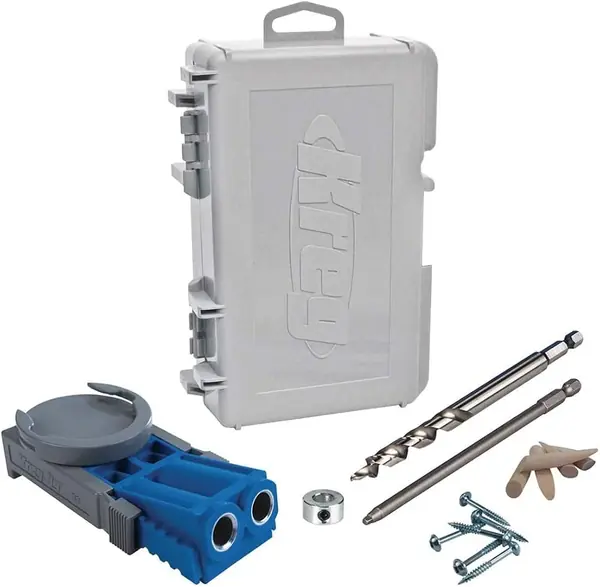
Kreg R3 pocket hole jig in blue plastic with stepped drill bit and compact carrying case

First-time jig buyers

Shop Score 96/100
Weight
16 oz
Material Capacity
1/2" to 1-1/2"
Carrying Case
Included
Depth Settings
9
View on Amazon

The R3 is the jig we point a first-time buyer to, and the reason is in the box: the jig, a stepped drill bit, a depth collar, a driver bit, a plug set, starter screws, and a compact case. At 16 ounces it's light enough to carry to a job or a friend's garage without a second thought, and it sets up in about the time it takes to slide the guides to your board thickness.

Those guides click into nine depth settings covering 1/2-inch plywood through 1-1/2-inch stock, and the hardened-steel insert that holds the bit's angle carries a lifetime warranty — the part that wears is the part the maker stands behind. We're also fond of the clamp pad adapter, which lets the jig ride under most face clamps or F-clamps already hanging in your shop instead of locking you into a proprietary one.

On the bench, what we noticed most is the lack of fuss: set the collar with the included gauge, clamp, drill, drive, move on. The angle holds through a run of shelf parts, and the screws draw joints up tight enough that the pocket is the only thing that shows. The body is plastic, which is the one thing we treat carefully — this is a jig that lives in its case between projects rather than loose in a toolbox, and after a season of weekends that's the only maintenance it asks for.

Worth Noting

  • Clamp is sold separately
Our Verdict

We recommend the R3 to anyone buying a first pocket hole jig: a complete, genuinely portable kit for 1/2- to 1-1/2-inch stock, and the least expensive pick here.

Check Latest Price
2.

Kreg 720PRO Pocket-Hole Jig Best for High-Volume Work

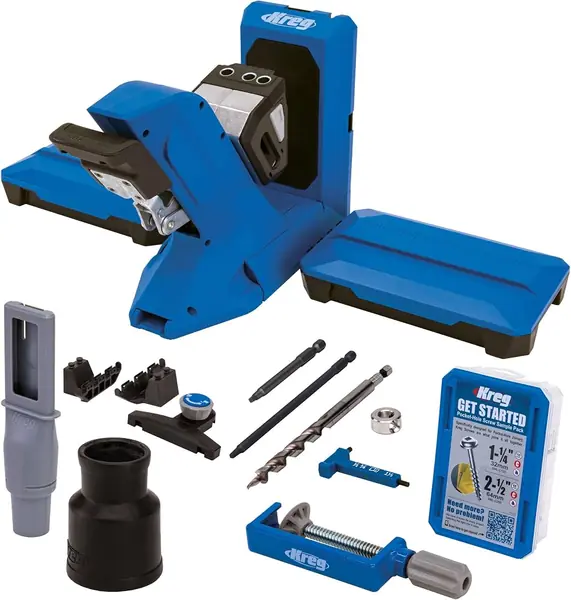
Kreg 720PRO pocket hole jig with bench clamp, dust collection blade, and folding docking station

High-volume shop work

Shop Score 95/100
Weight
9.5 lb
Material Capacity
1/2" to 1-1/2"
Clamping
Automatic thickness setting
Dust Collection
Blade and adapter included
View on Amazon

The 720PRO takes a step out of every board change. Set a piece of stock in the cradle, press the handle, and the clamp finds the material thickness itself anywhere from 1/2 to 1-1/2 inches — no collar to reset, no knob to spin. On a single bookshelf that's a convenience; on a run of cabinet boxes it's the difference between a rhythm and a chore, and it's why this is the jig we keep set up when a batch of parts is on the list.

The dust collection blade and adapter are the other thing you notice the first time you hook up a vacuum: chips go up the hose instead of across the bench and into the guide. Kreg packs in a bench clamp, a docking station with foldable wings, the easy-set bit, a stop collar, a gauging tool, and sample screws. At 9.5 pounds it's built to stay where you clamp it.

We check that the front clamp is seated square before every hole, because a jig that shifts takes the accuracy with it. Set up properly, this is the fastest of the four here on a run of identical parts, and the onboard storage keeps the bit and collar with the tool instead of somewhere on the floor.

Worth Noting

  • Plastic base and folding wings are the weak points
Our Verdict

Buy the 720PRO if pocket holes are a regular part of your week — the self-setting clamp and dust collection turn a fiddly setup into a rhythm.

Check Latest Price
3.

Massca Pro M2 Pocket Hole Jig Best Metal-Body Jig

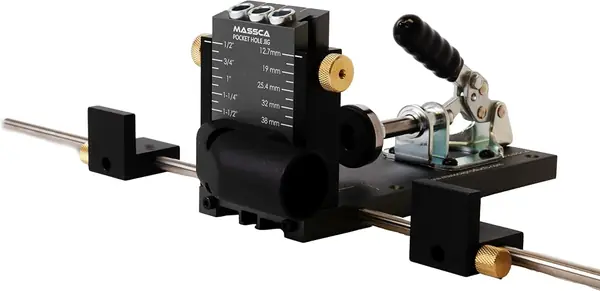
Massca Pro M2 aluminum pocket hole jig with steel support bars and dust port connector

Long-board joinery

Shop Score 92/100
Weight
5.52 lb
Body Material
Aluminum
Dust Port
Included
Support Bars
Two lockable steel bars
View on Amazon

Most of the jigs here are plastic; the M2 isn't. The frame is a machined aluminum body, it weighs 5.52 pounds, and it sits on the bench with enough mass that a bumped board doesn't send it skating. There's a T-track slot down the side so you can clamp it or bolt it down, and the whole thing reads like a small power tool rather than an accessory.

What earns it a place in this guide is the pair of lockable steel support bars and their stop blocks. Slide a long rail or a shelf edge through, set the blocks to your measurement, and every hole in the run repeats without remarking each one. No other jig here gives you that, and it's the reason we keep the M2 set up for shelving and face frames while the lighter jigs stay in their cases.

Depth adjusts with a knob, from 1/2-inch plywood up through thick hardwood, and the dust spout connector takes a vacuum hose so chips leave the surface instead of packing into the guide. It's a bench jig — the bars, the weight, and the hose all want a permanent spot — and that's the trade you're accepting for joints that land in the same place every time.

Worth Noting

  • Supplied drill bit is the weak link
Our Verdict

For long rails and shelves, the aluminum M2's support bars and dust port make it the steadiest jig of the four on stock that wants to slide.

Check Latest Price
4.

Milescraft PocketJig 200XCJ

Milescraft PocketJig 200XCJ bundle with double barrel and single barrel jigs and face clamp

Two-jig starter kit

Shop Score 91/100
Body Material
Plastic
Warranty
3-year limited
Face Clamp
2" face clamp included
Board Settings
1/2", 3/4", 1", 1-1/2"
View on Amazon

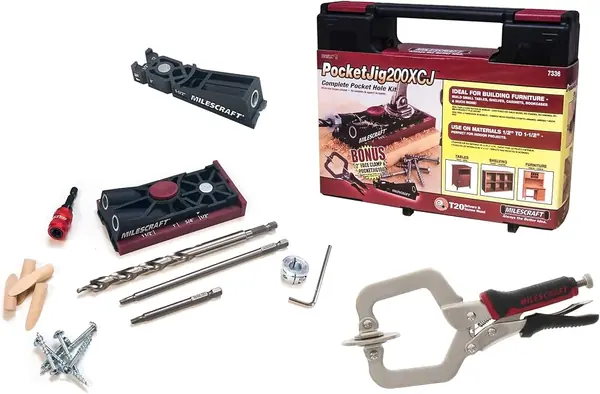
Two drill guides and a 2-inch face clamp come in the one box, which is a different offer from the single-jig kits here that leave the clamp off the invoice. The double-barrel guide drills a matched pair in one plunge; the single-barrel guide twists free and goes where the double won't reach — drawer parts, narrow stiles, repairs against a wall.

Setup is more thoughtful than the price suggests. The sled adjusts on a spring-loaded button, imperial and metric scales are molded alongside it, and four common board thicknesses are marked so you can set to a measured piece instead of guessing between detents. A recessed magnetic pocket holds the clamp where you put it while you work down a board, which saves re-setting the clamp as you move.

The body is plastic and it feels it — this is a bench jig that stays in its case, not something we toss in a truck bed. What it gives you for the money is redundancy: one guide set for 3/4-inch stock and another for 1/2-inch, both clamped and ready, which is genuinely handy on a mixed project. That is the kit we point to when someone wants the clamp in the box and a second guide on the bench.

Worth Noting

  • Three-year warranty instead of a lifetime one
Our Verdict

The 200XCJ gives you two guides and a face clamp in one box — the kit to buy if you want a spare guide and don't want to shop for a clamp.

Check Latest Price

How We Tested Pocket Hole Jigs

We started by gathering every jig we could find with a stated capacity of at least 1/2 inch to 1-1/2 inch, then sorted them by how they're held — built-in clamp, clamp-pad adapter, T-track, or a clamp sold separately — and by what actually ships in the box. Twelve made the cut. We used each one for eight months on face frames, drawer boxes, a plywood carcass, and a set of garage shelves, splitting time between a basement bench and a driveway where boards came straight out of the truck.

Every jig and every workpiece got clamped before the bit turned, and we kept a hex key on the bench to snug the stop collar before each run. We set the clamps as tight as they'd go and watched for any shift or kick mid-hole. A typical session was 30 to 50 holes into 3/4-inch plywood, with a switch down to 1/2-inch and back to see how many adjustments and how many minutes a thickness change cost. We checked the collar after each board to see whether it had crept, looked for tear-out and chips piling up around the guide, and hooked a shop vac to the dust port when a jig had one.

After each session we inspected the guide slots for slop and the bits for dulling or burn marks, weighed the jigs, and packed them into their cases with a driver and spare screws to see whether the lid still closed. We also logged everything we had to buy separately, since a jig that needs a clamp, screws, and a bit added to the cart isn't the bargain it looks like. What separated the leaders from the rest was simple: the guide held its angle over a long run of holes, and nothing moved that wasn't supposed to.

How to Choose a Pocket Hole Jig

Board Thickness Sets the Shortlist

Every jig in this guide handles material from 1/2 inch to 1-1/2 inches, which covers 3/4-inch plywood, 1x stock, and 2x4s used on the flat. Check that range first, because it is not universal: the extra-large jigs built for 2x4 and 4x4 framing start where these stop and cannot drill a 3/4-inch rail at all. Within the range, look at how thickness gets set — a marked gauge and a stop collar are faster and less error-prone than counting turns on a knob.

The Clamp Makes the Hole

An unclamped jig walks, and a jig that walks drills an oval in the wrong place. There are three approaches among these picks: a self-adjusting clamp built into the body, a clamp pad adapter that lets a standard face clamp or F-clamp hold the jig, and a T-track slot for clamping a heavier body down.

The trap is in the box contents. Most kits below the premium tier ship without a clamp, so the clamp is a separate purchase you make before your first project — factor it into the budget rather than discovering it on assembly day.

Bench Fixture or Go-Bag

Weight tells you where a jig lives. At 16 ounces, our top pick goes in a tool bag and drills on a driveway; at 9.5 pounds, the 720PRO wants a bench, a clamp, and a docking station's worth of space. If your work happens in one shop, buy the heavier jig and enjoy the stability. If it happens at a rental, a friend's garage, or a jobsite, a compact jig plus a good clamp beats a bench model you keep leaving behind.

Chips, Bits, and What Wears Out

Two parts do the real work: the hardened guide and the stepped bit. A dust port or a chip relief hole keeps shavings from packing into the guide and dulling the cut, which matters more than the vacuum hookup itself. Bits are consumables, so plan on replacements, and a stop collar that slips ruins holes quietly.

Warranties split here — Kreg backs its hardened guides for life, while the Milescraft carries a three-year limited term. If you drill most weekends, that difference is worth weighing against the price of the kit.

Frequently Asked Questions

Final Verdict

For most shops the Kreg R3 is the jig to buy. It covers the 1/2- to 1-1/2-inch stock nearly every project uses, arrives with the bit, collar, driver, plugs, and screws to start drilling the day it lands, and travels in its own case. Add a face clamp and it will handle a longer project list than most of us get through in a winter.

Two upgrades change the math for specific buyers. Drill cabinet boxes or shelf runs by the dozen and the 720PRO's self-setting clamp and dust port save real time; need a metal body that holds long rails steady through a repeat run, and the Massca M2 is the one to look at.