↑↓ navigate ↵ open Esc close All results →

Best Tenon Cutters for Log Furniture of 2026

Driven over the end grain of a clamped log, a tenon cutter shaves rough bark and sapwood down into a round peg ready for a mortise. When the setup is off, though, the cutter chatters into an oval tenon, scorches the shoulder, and overheats the drill before the first rail is finished.

Running a dozen tenon cutters on sawhorses over nine months showed that clean joints depend on basic shop math more than marketing claims. Tenon diameter has to match an available Forstner bit, and cutters this size demand a slow, high-torque half-inch chuck—which immediately rules out most compact cordless drills.

Individual fixed-size cutters suit builders standardizing on a single joint, while multi-size kits cover varied stock diameters with either a soft radius shoulder or a crisp square profile that holds its blade setting from one log to the next.

Our Top Picks

The Best Tenon Cutters for Log Furniture

1.

Lumberjack Tools Home Beginner's Kit Best Overall
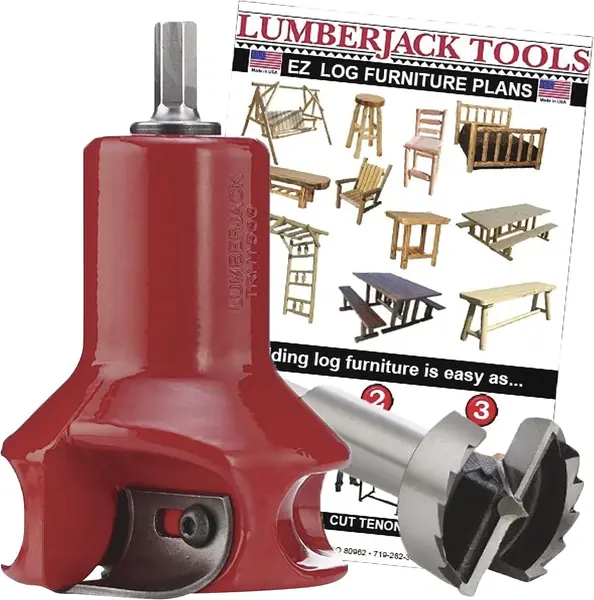
Lumberjack Tools Home tenon cutter kit with 1-1/2-inch cutter, Forstner bit, and plan booklet

Beginner log projects

Shop Score 88/100
Shoulder Profile
Radius (low profile)
Tenon Diameter
1-1/2 inches
Kit Contents
1-1/2-inch cutter, 1-1/2-inch Forstner bit, 20-plan booklet
Drill Requirement
1/2-inch high-torque, 500 RPM or less
View on Amazon

The box is the argument: a 1-1/2-inch tenon cutter, the matching 1-1/2-inch Forstner bit that bores the socket, and a booklet of 20 log furniture plans. Of the kits here, it's the most complete first order you can place, and that pairing matters more than it sounds — the boring bit has to match the tenon diameter exactly, or the joint won't seat. Buying a cutter and then hunting for the right bit is where a lot of first projects stall.

The cutter works like a giant pencil sharpener. The body cups the end of the log, twin blades shave the end down to size, and the aluminum housing sets the shoulder profile — here a radius, which turns from tenon to log face quickly and low instead of blending over a long taper. We like that on furniture, where the joint should read as joinery rather than a carved collar. The threaded shank unscrews for replacement and the cutter carries a lifetime warranty, which tells you how the maker expects it to hold up.

Setup is where beginners get caught, not the cutting. Clamp the log so it can't spin, start the cut square to the end, and let the blades peel rather than pushing the drill. We run test tenons on a scrap branch before touching good stock, and we check the two blades against each other first — matching blade settings are what give you a round tenon at the diameter on the label instead of an oval.

Worth Noting

  • Cuts only a 1-1/2-inch tenon
Our Verdict

We recommend this kit to anyone building a first log project: cutter, matching mortise bit, and plans arrive together, and the radius shoulder leaves a close, clean joint.

Check Latest Price
2.

VEVOR 3-Size Tenon Cutter Kit Best Multi-Size Kit

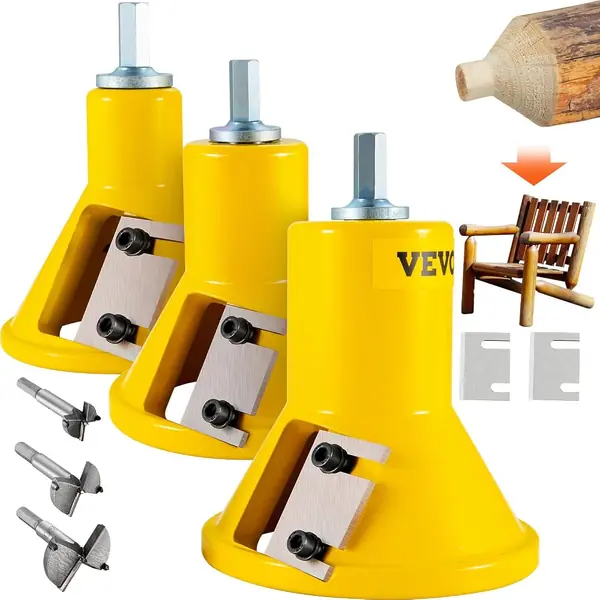
VEVOR tenon cutter set with three aluminum cutters for 1, 1-1/2, and 2 inch tenons

Mixed tenon sizes

Shop Score 87/100
Shoulder Profile
60-degree taper
Set Contents
Three cutters and an accessory set
Tenon Diameters
1, 1-1/2, and 2 inches
Maximum Log Diameter
2-1/2, 3, and 3-1/2 inches
View on Amazon

Three cutters instead of one is the whole pitch. The set covers 1, 1-1/2, and 2 inches, each in its own die-cast aluminum body, so a chair with 2-inch leg tenons and 1-inch spindle tenons doesn't need two purchases and a wait between them. If your plans call for more than one joint size, that's the case for looking past our top pick.

Three cutters for roughly the money of one of the single-size Lumberjack kits is what makes this set worth a second look. The shoulders are cut at a 60-degree taper — the pencil-tip profile that reads as traditional rustic furniture — so the set suits benches, beds, and rail sections where a joint is meant to look hand-built rather than machined.

What you don't get is the rest of the joint. This is a cutter set, so the Forstner bits that bore the matching sockets are yours to source, one per diameter, and no plan booklet comes in the box; budget for that before you compare it against a kit. We also watch the button screws that hold the blades, because on a twin-blade cutter the two edges have to be matched, and that alignment is what gives you a round tenon at the diameter you asked for.

The shipped set weighs 7.3 pounds, and you mount one cutter at a time, so the bulk lives in the case rather than on your wrist. Our advice is to keep that case and label the slots: three bodies that look alike are easy to mix up, and a marked slot saves you resetting blades you already dialed in.

Worth Noting

  • Excludes matching Forstner bits and any project plan booklet
  • Twin blades require careful screw alignment for a round tenon
Our Verdict

Three sizes for about the money of one kit is why we steer anyone with mixed joints here — 1, 1-1/2, and 2 inches in a single purchase.

Check Latest Price
3.

Timber Tuff 1-Inch Tenon Cutter Best for Railings and Spindles

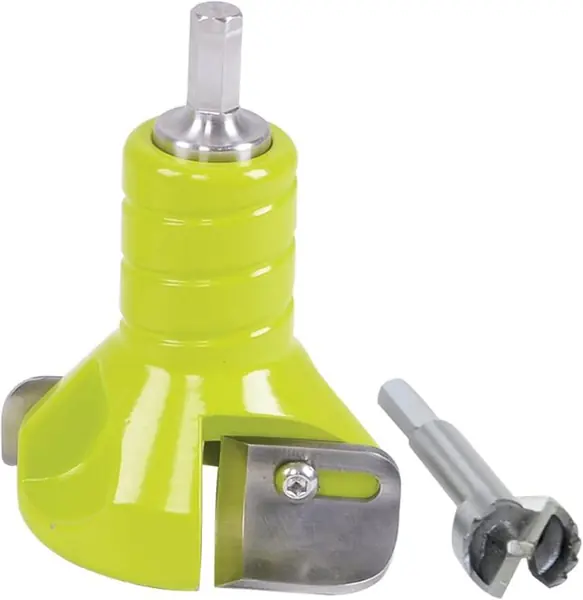
Timber Tuff 1-inch twin blade log tenon cutter with Forstner bit in green

Railings and spindles

Shop Score 86/100
Shoulder Profile
Square 90-degree shoulder
Tenon Diameter
1 inch
Blade Scale
Marks on the body for repeat blade settings
Included Components
Tenon cutter and 1-inch Forstner bit
View on Amazon

Railings, spindles, chair backs, canes: the small end of log furniture runs on 1-inch tenons, and this cutter is built for exactly that. The 1-inch Forstner bit that ships with it bores the socket the tenon fits, so the whole joint arrives in one box.

The shoulder here is square — 90 degrees — which suits a rail or a spindle that pulls up tight against a bored face. There's no taper blending the transition, so the joint reads as a crisp step rather than a carved collar. Marks on the body let you return the blades to a setting you've already proved, which is the difference between twenty matching spindles and twenty almost-matching ones.

What we like most is how little it asks of the drill: it chucks into any 1/2-inch or larger drill, handheld or standing in a press. In a press the cutter comes down square to the end of the rail every time, and square tenons are what let a railing go together without a fight. Handheld works too, provided the log is clamped hard and you keep the cutter level as it starts.

If your build is all rail and spindle work, this is the simplest path to consistent small tenons: the steel blades resharpen rather than retire, and the bit for the other half of the joint is already in the box with it.

Worth Noting

  • Cuts 1-inch tenons only
Our Verdict

Nothing here beats it for small work: a 1-inch cutter with its own Forstner bit, a square shoulder, and a blade scale that repeats.

Check Latest Price
4.

Lumberjack Tools Pro Tenon Cutter Best for Repeat 1-1/2-Inch Tenons

Lumberjack Tools Pro aluminum tenon cutter with dual steel blades and measurement marks

Repeat 1-1/2-inch tenons

Shop Score 85/100
Shoulder Profile
Radius
Tenon Diameter
1-1/2 inches
Weight
1.8 lb
Tenon Length
In-Sight measurement marks
View on Amazon

Machined from a solid billet of aluminum rather than cast, this is the same 1-1/2-inch cut as our top pick in a lighter, more precise body. The extra money goes into the housing, the blades, and a set of marks on the body that change how you cut.

Those marks are the In-Sight measurement system, and they're the reason this cutter earns a place at the premium end. Instead of stopping to measure, you watch the tenon come up to a line on the body and stop the cut there, so a run of tenons comes out at the same length without a caliper in your free hand. We also noticed how little the body weighs in use — 1.8 pounds swinging at the end of a drill is easier to control at the start of a cut than a heavier casting.

Blade setting is where this family of tools lives or dies. The two edges have to be matched, and the spacing between them is what sets your finished diameter, so check them before the first cut and again after a few. Run it on a 1/2-inch corded drill or an 18-volt cordless at minimum, keep the log clamped, and remember that these cutters remove material fast enough that a mistake happens fast too.

Where it doesn't fit is a first build. The precision is worth paying for once you're cutting the same joint over and over; before that, you're buying capability you don't yet have a use for. Give it a few projects and the marks stop being a luxury and start being the reason a set of tenons gets finished in one sitting.

Worth Noting

  • Cutter only, no Forstner bit or plans
Our Verdict

For a builder cutting the same joint all afternoon, the billet body and length marks make this the most precise 1-1/2-inch cutter here.

Check Latest Price

How We Tested Tenon Cutters for Log Furniture

We started with every cutter sold for log furniture and narrowed the field on the specs that decide whether a joint actually works: tenon diameter and whether a matching Forstner bit came in the box, shoulder profile, the chuck size and RPM the maker specifies, and what else ships with the tool, from plans to spare blades to an accessory set. We kept both single-size cutters and multi-size kits in the running, since that choice drives price and how much drawer space the thing claims.

Each cutter spent the nine months in a working rotation, on driveway sawhorses on weekends and a garage bench on weeknights, cutting tenons in pine, cedar, and dry hardwood. We clamped every log down so it couldn't rotate before the drill started, and we ran each cutter only on a drill that met its stated chuck size and low-RPM torque requirement, noting how badly the tool lugged when a drill came up short.

For each pass we timed the cut and measured the finished tenon with calipers, then checked the shoulder against a framing square to see whether it sat flush against the log face. We cut ten tenons in a row on one blade setting to watch for drift, comparing bodies that hold the setting with a machined scale or marks against those that rely on the screws alone. We also logged how fast shavings cleared, how much the cutter shook in hand, and whether it wandered in the first inch of a cut.

After every cutter had run a few hundred tenons, we looked at the edges under a loupe for rounding and blueing, and noted which blades could be resharpened and which had to be replaced outright. We finished by weighing what each one cost against what came in the box, how many diameters a single tool covered, and which cutter we reached for without thinking by the end.

How to Choose a Tenon Cutter for Log Furniture

Start With the Tenon Diameter

Every tenon needs a socket of the same size, so the diameter you pick sets two purchases: the cutter and the boring bit. Read your plans before you order and find the largest joint the piece needs. If every joint in the build is 1-1/2 inches, a single-size kit is the simpler answer and there is nothing to adjust. If the design mixes a 2-inch leg tenon with 1-inch spindles, a three-size set like the VEVOR costs less than buying cutters one at a time.

The trap is ordering by the tool rather than by the joint. A 1-inch cutter cannot make a 1-1/2-inch tenon, and no amount of blade adjustment changes that — the body only opens so wide.

The Drill Behind the Cutter

A tenon maker shaves rather than bores: it wants torque at low speed, which is why the Lumberjack cutters call for a heavy-duty 1/2-inch drill turning 500 RPM or less. A compact drill with a 3/8-inch chuck will bog in end grain, heat the blades, and push you into forcing the tool — the moment tenons go off-center.

Check the chuck and the low-speed range before you order the cutter, not after. The Timber Tuff is the forgiving one here, stated for handheld or drill-press use on any 1/2-inch or larger drill, while the Pro cutter accepts a corded 1/2-inch drill or an 18-volt cordless at minimum — and it means a serious one.

Reading the Shoulder

The shoulder is the ring of transition where the tenon steps down to the log face, and it is the part of the joint people actually see. A radius shoulder turns over quickly and low, giving a crisp, close joint — our preference on furniture, and what both Lumberjack cutters cut. A 60-degree taper blends over more length, like a pencil tip, and reads as traditional rustic work; that is the VEVOR set. A square 90-degree shoulder, as on the Timber Tuff, seats flat against a bored face.

Choose by the look of the finished piece and by how the shoulder will meet the mortised member, not by which profile sounds more advanced.

What's Actually in the Box

A kit doesn't always mean the whole joint. The Lumberjack kits ship a cutter, a matching Forstner bit, and a booklet of 20 plans; the Timber Tuff pairs its 1-inch cutter with a 1-inch bit; the VEVOR set is three cutters and an accessory set, leaving the boring bits and the plans to you. Budget for one Forstner bit per diameter if yours doesn't include it, because the socket has to match the tenon exactly.

The other line worth reading closely is the shank. The Lumberjack cutters use a threaded shank that unscrews for replacement, so a damaged shank doesn't retire the tool.

Clamping and Cutting a Straight Tenon

The cutter centers itself on the end of the log, which makes the log's shape part of the setup. An out-of-round or ragged end fights the mouth of the cutter; trim it closer to round, or pick a straighter section from the pile. Then clamp the log so it cannot spin — a log turning against a half-inch drill is the part of this hobby that hurts — and start the cut square, letting the blades peel rather than pushing the tool.

Square start and a clamped log do most of the work. The rest is letting the cutter run at its own pace instead of leaning on the drill to speed it up.

Frequently Asked Questions

Final Verdict

Start with the Lumberjack Tools Home Beginner's Kit. It is the most complete first order here, pairing the cutter with the mortise bit that has to match it and a book of plans, and its radius shoulder leaves a low, tidy joint line.

If your plans call for more than one tenon diameter, the VEVOR set covers three sizes for about the money of one kit. And for railings, spindles, and branch work, the 1-inch Timber Tuff with its own bit is the simpler tool.