↑↓ navigate ↵ open Esc close All results →

Best Stair Tread Jigs of 2026

Cutting a stair tread strictly from tape-measure numbers leaves a glaring gap against the skirt board whenever a wall sits out of plumb or a stringer runs off square. A stair tread template jig transfers the exact angles and width of the opening directly onto the stock so the board drops in tight on the first cut.

Using 12 jigs across nine months on full stair runs, tight winders, and odd-angled shelving exposed the details that spec photos hide. Usable width is shorter than advertised span because the pivoting ends eat a couple of inches, and thin aluminum plates flex right at the locking point where a true reference line matters most.

Some kits arrive ready to span a staircase out of the box while others expect a shop-cut center board, so matching rigidity and locking hardware to the staircase layout prevents mid-layout slip.

Our Top Picks

The Best Stair Tread Jigs

1.

Eleon Staircision XL Stair Tread Template Best Overall
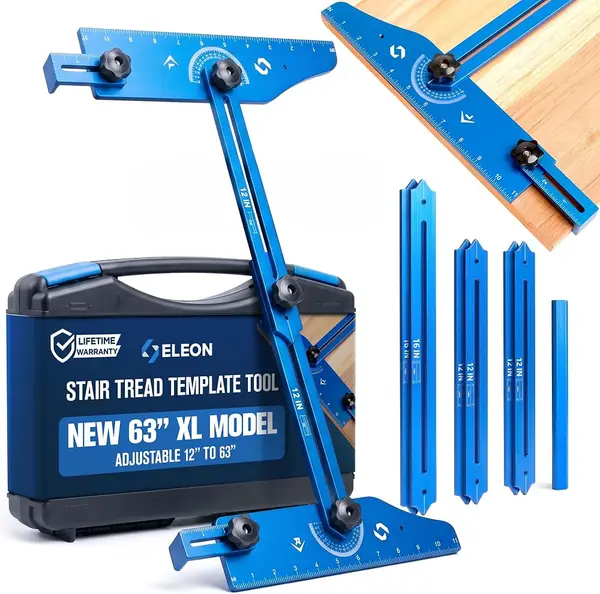
Blue aluminum Eleon Staircision XL stair tread template with ruler markings and fitted storage case

Full staircases

Shop Score 91/100
Adjustable Span
12" to 63" inches
Material
Aluminum alloy
Storage
Molded storage case
Plate Thickness
0.25 inches
View on Amazon

A quarter inch of aluminum is the number that settled this one for us. The aluminum kits in this group mostly run 0.16-inch plate, and the Staircision XL is half again as thick, which is exactly the difference you feel when you lift a set angle off a tread and carry it across the shop to a piece of oak. It spans 12 to 63 inches and folds down to roughly 11 inches for storage.

Markings run along the edge of the bars, and the knobs travel in slots rather than fixed holes, so a setting can be locked anywhere in the range instead of at the next detent. We liked the case more than we expected to: it is molded with a home for every piece, which is what keeps a 63-inch tool from becoming a box of loose bars between jobs.

The catch is the difference between span and usable width. That 63 inches counts the whole tool, and the pivoting ends turn inward to meet the walls of the opening, so the widest tread you can actually mark is several inches narrower than the number on the box. Measure your widest step, including the bottom tread that usually runs wide, before you order the XL.

Twelve treads in an old house, where no two share a width or an angle, is the job this was built for, and the setup cost disappears after the third step. For a single closet shelf, one of the two-piece sets below does the same work for a fraction of the money and takes up less room in a drawer.

Worth Noting

  • First setup takes trial and error
Our Verdict

This is the jig we hand someone doing a whole staircase: a quarter-inch plate, a 63-inch reach, and a case that keeps the pieces together.

Check Latest Price
2.

NAACOO Stair Tread Template Tool Best Budget

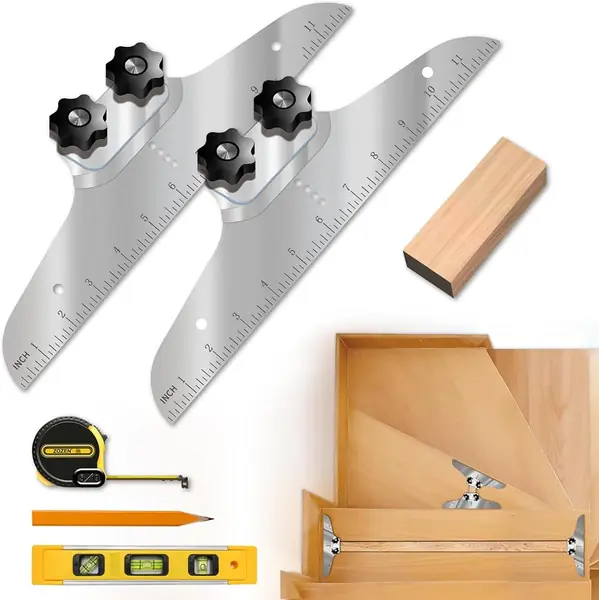
NAACOO stair tread template set with two marked end plates, nylon knobs, and tape measure

Tight budgets

Shop Score 90/100
Item Weight
1.87 lb
Locking
Four nylon knobs
Included
Two marked end templates, four knobs, tape measure
Center Board
User-supplied 1x2 or wider
View on Amazon

Cheapest of the jigs here, and it gets there by leaving out the middle. You get two end templates with ruler markings, four nylon knobs, a pair of gaskets, and a tape measure; the straight board that spans them is yours to supply. Cut that board about two inches shorter than your widest tread and you have room to swing the jig into the opening.

We're impressed by how much of the job that handles. The knobs tighten by hand, the marked ends let you read a width straight off the tool, and the whole set drops into a box the size of a paperback. It doesn't feel like a machined instrument the way the aluminum kits here do, but on a flight of worn treads in an old house, the accuracy is there.

The gaskets are the quiet win: they sit between the template and the tread, so you're not sliding bare metal across a finish you just applied. Between jobs everything goes back in the box, and the tape measure living in there means you're not hunting for one when the jig comes out.

Worth Noting

  • A bowed center board throws off the layout
Our Verdict

For one flight on a tight budget, this is the set we point people to, provided you're willing to cut the center board yourself.

Check Latest Price
3.

PUIOCO Stair Tread Template Tool Best for Wide Stairs

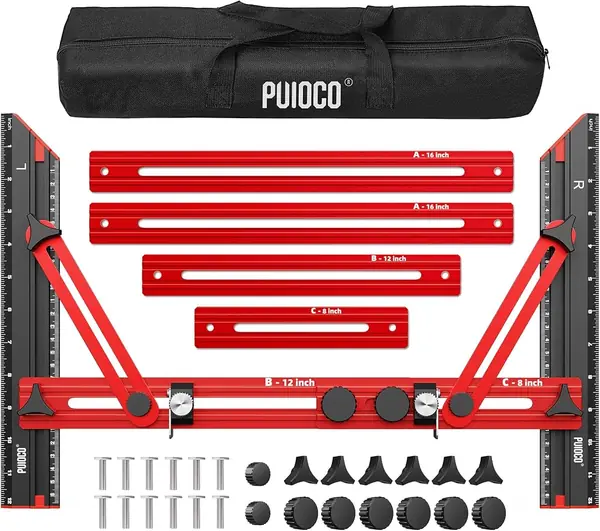
Red and black PUIOCO aluminum stair tread template with triangular brace and edge flip stops

Wide landings

Shop Score 89/100
Adjustable Span
12 to 67 inches
Material
Aluminum alloy
Locking
Triangular brace with nut-fixed pivots
Pivot End Depth
12 inches
View on Amazon

At 67 inches fully extended, this reaches further than anything else in the group, nearly three inches past the next longest and well beyond the 36-inch flight that counts as standard. That's the number that matters on an open-riser stair, a room-width shelf, or a landing that runs wall to wall.

The triangular brace between the two halves is the other thing we noticed. If you've used a stair tread template before, you know the weak point: the pivots want to rotate while you carry the setting to your stock, and you end up marking a tread that's a degree off. Here the brace shares that load with a pair of edge flip stops, and the stops also register squarely against the tread edge when you lay one out.

The 12-inch pivot ends are the compromise. They cover a standard tread depth with an inch to spare, but on a deep bullnose or a doubled tread you'll finish the layout with a square. We're comfortable with that trade, because width is what fails first on a landing, and this tool is built for width.

Everything is aluminum with laser marking that stays legible, and the bars break down into a bundle for storage. There's no case or bag in the box, so give the pieces a zip bag if they're riding in a truck between jobs.

Worth Noting

  • 12-inch pivot ends stop short on deep treads
Our Verdict

When the staircase runs wider than a standard flight, we reach for this one: the longest reach here and a brace that stops the ends twisting.

Check Latest Price
4.

Gohelper Stair Tread Template Tool Best for Deep Treads

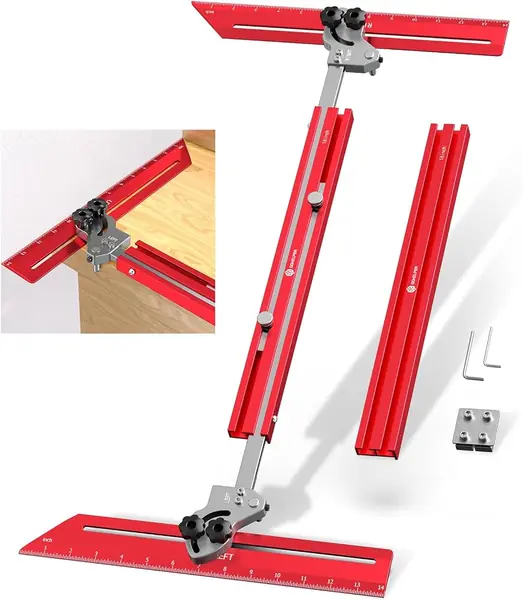
Red Gohelper aluminum stair tread template with two pivoting scale ends and dual knobs

Deep treads

Shop Score 88/100
Material
6061 aluminum alloy
Item Weight
3.47 lb
Adjustable Length
23" to 64.2"
Pivoting End Depth
14 inches
View on Amazon

Fourteen inches of pivoting end is the reason to look at this one. The common figure on these kits is 12 inches, enough to cover an 11-inch tread with an inch to spare. The Gohelper gives you two more, and that is the difference on a deep bullnose tread or a bottom step that runs out past the riser.

The ends also swing through 127 degrees on curved slots rather than turning on a single bolt, so a splayed corner or an out-of-square landing doesn't run the frame out of travel. Assembly is a couple of minutes with the connector and a hex wrench, and after that it folds into a straight bundle about the length of a level.

Weight is the trade: at 3.47 pounds this is a heavy jig, and we read that as the price of the stiffness rather than a fault. Set it on a tread and it stays where you put it while you reach for a pencil, which is not true of the lighter frames here.

Snug the knobs unevenly and a pivot can bind, which is a two-second fix: back both off, square the ends, tighten together. That quirk aside, this is the one we reach for when a tread is deep or a corner is odd, because the extra swing covers shapes the fixed-angle kits simply can't follow.

Worth Noting

  • Extension bar carries no ruler markings
Our Verdict

We keep this one in mind for deep treads and odd corners: 14-inch pivoting ends and 127 degrees of swing, locked by a pair of knobs.

Check Latest Price
5.

SUNLFPROD Stair Tread Template Tool Best for Finished Stairs

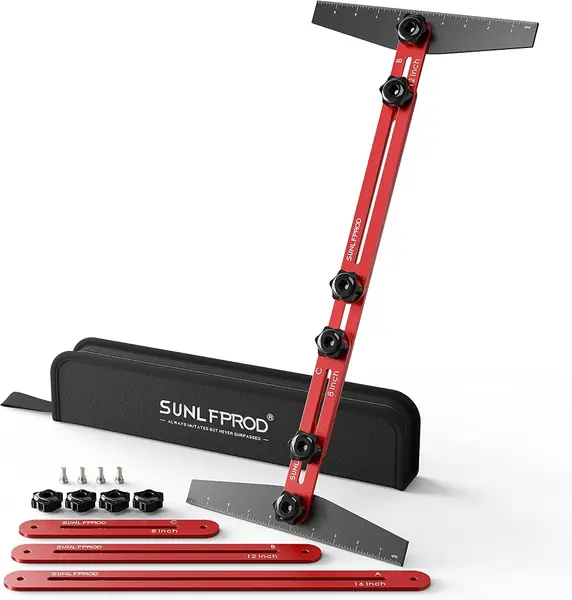
Red-gray SUNLFPROD aluminum stair tread template with extension sections and cloth storage bag

Finished treads

Shop Score 87/100
Adjustable Span
10.5" to 60.5"
Storage
Oxford cloth storage bag
Plate Thickness
0.16 inch (4 mm)
Hardware
Rubber and nylon washers
View on Amazon

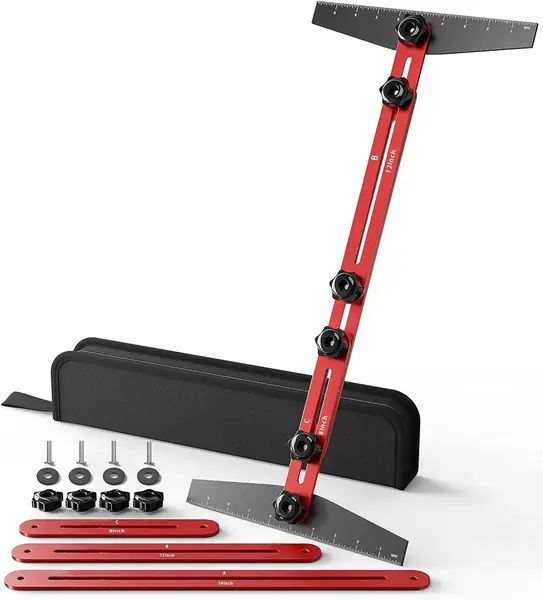
Two kinds of washers ship with this kit, and that's the detail that sold us. The rubber ones sit between the aluminum and the workpiece, so the template can lie across a finished tread or a painted shelf without leaving a scribe line; the nylon ones go under the knobs, where you want friction instead of cushioning. Most kits here give you one kind and leave you to sort it out.

The rest is a straightforward aluminum kit: 0.16-inch plate, extension sections of 16, 12, and 8 inches that combine to cover 10.5 to 60.5 inches, and laser-etched markings that don't wear off the way printed scales do. Assembly takes a minute with the connector and the hex wrench.

It travels in an Oxford cloth bag rather than a molded case, which is right for a truck and wrong for a shelf where things get stacked on top. Nothing rattles loose inside, and the sections nest without a puzzle to solve when you're packing up at the end of a job.

Worth Noting

  • Ships in a cloth bag rather than a hard molded case
Our Verdict

Our pick for finished work: rubber washers that sit between aluminum and oak, plus 10.5 to 60.5 inches of reach in a cloth bag.

Check Latest Price
6.

WONDERFUL.LIGHT Stair Tread Gauge Template Tool Best for One-Staircase Remodels

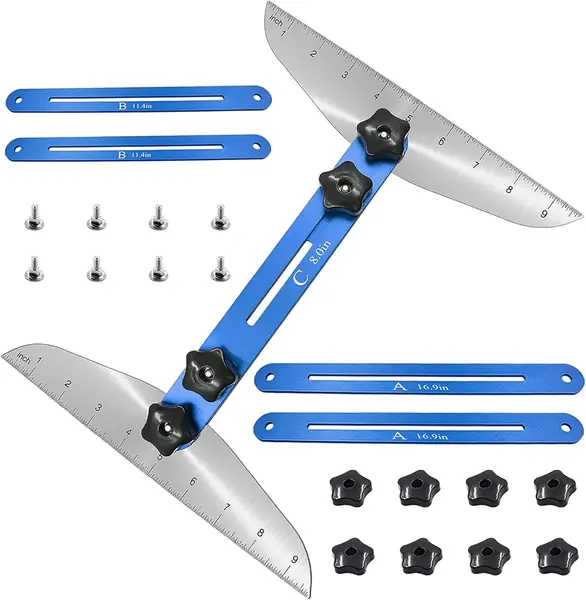
Blue WONDERFUL.LIGHT aluminum and stainless stair tread template with knobs and fitted case

One-staircase remodels

Shop Score 86/100
Adjustable Span
11.4 to 60.7 inches
Material
Stainless steel and aluminum alloy
Locking
Four knob locks
Storage
Fitted storage case
View on Amazon

A fitted case is what you notice first: molded with a slot for each piece, which is more organization than most kits here offer at this price. The tool runs from 11.4 to 60.7 inches and is built from stainless steel and anodized aluminum, so a damp basement or a cold garage isn't a worry.

Setup is four knobs and a slide. The angle range covers corner and curved stairs, the length handles everything short of a room-width landing, and the bars are marked, so you can read a width without reaching for a tape.

Our read is that it sits in the sensible middle of this group: more tool than the budget sets, less money than the braced aluminum kits, and organized well enough that you'll find every knob when you need it. For one staircase and a closet of shelves, that's plenty.

Worth Noting

  • End pieces can slip under marking pressure
Our Verdict

A capable 11.4- to 60.7-inch kit with a case we like, though the end pieces need a firm hand on the knobs before you trust a setting.

Check Latest Price
7.

TANYO Stair Tread Template Tool

Red TANYO aluminum stair tread template with laser scale and damping gaskets

Light travel kit

Shop Score 85/100
Adjustable Span
8" to 60"
Item Weight
1.32 lb
Plate Thickness
0.16 inches
Angle Range
0° to 360°
View on Amazon

At 1.32 pounds, this is the lightest full-length kit in the group, and it still stretches from 8 to 60 inches, a wider range than several kits that weigh twice as much. The 360-degree pivot is the widest angle adjustment here, which is what you want on a curved or corner stair.

We think it's the right buy for a homeowner with one staircase and no plans to build a second. Everything you need is in the box, the 16-, 12-, and 8-inch sections combine to whatever length the job needs, and it goes together in a couple of minutes once you've read the directions through.

The gaskets are the detail we didn't expect to matter: they damp the pivots so the ends don't flop while you line the jig up with one hand and hold a pencil with the other. It breaks down to a bundle you can hang on a peg, which is where it will live between projects.

Worth Noting

  • Plate flexes if you lean on it
Our Verdict

It's the cheapest full-length aluminum kit we tested, and it measures fine, just don't expect it to shrug off a drop the way the heavier frames do.

Check Latest Price
8.

AXIUM Stair Tread Template Tool

Red AXIUM aluminum stair tread template with rounded edges and rubber damping pads

First stair project

Shop Score 80/100
Adjustable Span
10.5" to 60.5"
Material
Aluminum
Item Weight
1.69 lb
Edges
Rounded and smoothed
View on Amazon

Think of this as the aluminum kit for someone who isn't sure they need one. It covers 10.5 to 60.5 inches, within a couple of inches of the top pick at both ends, and it's the least expensive way here to get a full set of sliding aluminum bars rather than a two-piece end kit.

The details are aimed at occasional use. Every edge is rounded and smoothed, which matters more than it sounds when you're steering a three-foot bar around finished trim, and rubber pads damp the pivots so the ends stay where you set them. The scale is black on white and easy to read at arm's length.

Assembly is a matter of sliding the sections together and running the connector through, and the whole thing breaks down into a bundle that stows in a toolbox drawer rather than on a wall. At 1.69 pounds it's one of the lightest aluminum kits here, so it's the one that goes up the ladder with you instead of staying on the bench.

For a first staircase, we think that's the right trade. The 10.5-inch minimum closes down tighter than the big kits, which is what you want on a narrow basement flight or a winder, and the price leaves room for a better blade. Start here if the tool has to earn a permanent spot before you spend more on one.

Worth Noting

  • Built for occasional use rather than heavy daily work
Our Verdict

We like this one for a first jig: 10.5 to 60.5 inches of aluminum with rounded edges, at the low end of the aluminum-kit prices.

Check Latest Price

How We Tested Stair Tread Jigs

Stair tread jigs look like the same two pieces of aluminum in product photos, so we built our shortlist from the specs that actually change a cut: adjustable span, plate thickness, how the ends pivot, what hardware locks a setting, and whether the kit arrives with a case or expects you to supply the center board. We rounded up 12 jigs across price bands and used them for nine months, through a full staircase replacement in a 1920s house, a basement remodel, and a stretch of shelf and partition scribes that had nothing to do with stairs.

Each test started with the jig set to a real opening and marking a scrap of tread stock, then carrying it, locked, across the shop to the saw and re-checking the setting against our original measurement to see if anything slipped in transit — which is where knob-only kits and brace-backed ones part company. We checked advertised span against usable width by laying each end on a board and marking to the inside stop, then ran calipers over the plates and pressed on the middle of every bar to feel how much it bowed.

Readability had its own pass: we read each stamped ruler and laser-etched scale in a dim stairwell under a work light, then timed a first-time user from opening the box to the first accurate mark. The pivoting ends went through deep treads and winders, with the marking depth each one covered measured on stock. At the end we packed every jig back into its case or bag and weighed what it cost against the rest of the field.

How to Choose a Stair Tread Jig

Span Is Not the Same as Usable Width

Every kit quotes a range, and almost every one counts the whole tool at full extension. Because the pivoting ends turn inward to meet the walls of the opening, the widest tread you can mark is several inches narrower than the headline number, and on the long kits the gap runs to five or nine inches. Measure your widest step — the bottom tread usually runs wider than the flight above it — and buy real margin above it.

A standard residential flight is 36 inches, so a 60-inch kit gives comfortable room on almost anything indoors. The XL kits that reach past 60 are for landings, open stairs, and room-width shelving. If your widest step tapes at 44 inches, you don't need one.

Two-Piece End Sets vs. Full Sliding Kits

A two-piece set is two marked ends that clamp onto a straight board you supply. Cut that board about two inches shorter than the widest tread so you can swing the jig into the opening, use something straight, and you have a tool that costs very little and lives in a drawer. A full kit replaces your board with aluminum sections that slide and lock, which is where the rigidity and the ruler markings on the bars come from.

For one flight every few years, the two-piece set is genuinely enough. If the tool will pay for itself across several jobs, the sliding kit is worth the money.

Rigidity and Locking: Where Cheap Kits Show It

The failure that ruins a tread is a template that moves between the opening and the saw. Plate thickness is the number to look for: 4 mm, or 0.16 inch, is common and adequate, and a quarter-inch plate is noticeably stiffer. Bracing matters as much — a triangular brace or a second nut at each pivot keeps the ends from rotating when you lift the tool.

A stair tread template is only as good as the lock that holds it. None of these kits is fragile, but the lighter ones will flex if you lean on them, so set the jig, snug the knobs, and mark with a light hand.

Pivot Ends and Tread Depth

The pivoting ends are what actually touch your stair, so their length sets the deepest tread you can lay out in one pass. Twelve inches is the common figure and covers an 11-inch tread; fourteen inches handles a deep bullnose or a doubled tread without a second measurement.

If your stairs turn or splay, check the angle range too. Most of these swing wide enough for a corner, and a few use curved slots instead of a single pivot bolt, which holds an angle better while you tighten.

Markings, Cases, and the Small Stuff

Ruler markings on the bars save a step, and laser-etched scales stay readable much longer than painted ones. A molded case is worth having if the tool lives on a shelf between projects; a cloth bag packs better in a truck and less well under a stack of clamps.

Then look at the washers. Rubber washers between the aluminum and a prefinished tread are the difference between a clean layout and a scratch you can't sand out.

Frequently Asked Questions

Final Verdict

Start with the Eleon Staircision XL unless something specific about your stairs says otherwise. It has the stiffest plate here, it spans a full residential flight with room to spare, and the case means the pieces are still together when the next tread needs replacing.

Two exceptions are worth naming. If the staircase runs wide — a landing, an open-riser run — the PUIOCO's extra reach past 63 inches is the difference between one setup and two. And if you're replacing four treads once and never touching stairs again, the NAACOO set does the same job for a fraction of the money.