↑↓ navigate ↵ open Esc close All results →

Best Contact Cements for Laminate Countertops of 2026

Contact cement allows zero second chances: once laminate touches the glued substrate, peeling back a quarter inch of misalignment usually snaps or ruins the sheet. Achieving a flat countertop without seam bubbles depends on predictable open time, uniform tack, and a coat that spreads cleanly without clumping.

Brushing and spraying 14 formulas across plywood and particleboard over six months—covering countertop runs, cabinet faces, vertical panels, and decorative overlays—proved that ventilation and odor matter nearly as much as bond strength. Water-based low-odor cements make winter basement work practical when solvent fumes would force the project outdoors until spring.

First-time users also need to budget for double coverage, since both the substrate and the laminate back require a full coat—whether working from a small repair can, a gallon bucket for long counters, or aerosol sprays for vertical work.

Our Top Picks

The Best Contact Cements for Laminate Countertops

1.

3M Fastbond 30NF Contact Adhesive Best Overall
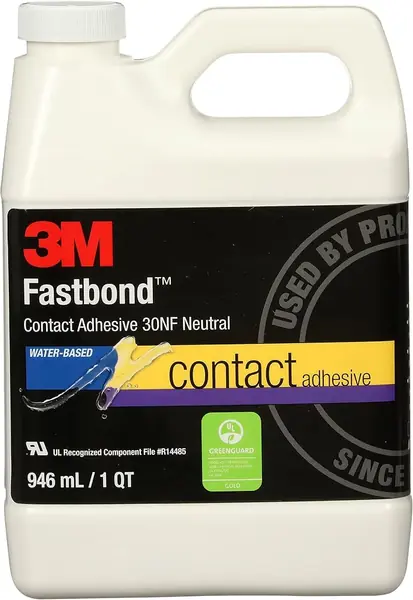
3M Fastbond 30NF contact adhesive in a one-quart neutral can

Indoor countertop projects

Shop Score 89/100
Laminate Use
Plastic laminate
Volume
1 quart
Formula
Water-based low-odor
Bonding Range
4 hours
View on Amazon

The four-hour bonding range is the reason this 3M adhesive earns the top spot. Contact cement grabs as soon as the two coated surfaces meet, so a long window to position a sheet of plastic laminate is not a small convenience; it is the difference between a controlled layup and a one-shot gamble. The water-based formula is also low-odor and non-flammable while wet, which we appreciate in a kitchen or basement shop.

The quart is a sensible size for a typical countertop or a run of cabinet panels, and it brushes or rolls into a uniform film. After cure, the bond is rated for high heat and moisture, so it stands up around sinks and appliances. The tack can feel gentler than a solvent cement, and rushing the open time can leave you with a weak grab; follow the label and test a scrap piece first. That is the trade-off we accept for the cleaner indoor experience.

For a full kitchen, buy enough to coat both surfaces and keep a little extra on hand. We still choose this one first for laminate countertops because it is explicitly made for plastic laminate, gives us room to work, and does not turn the house into a solvent zone.

Worth Noting

  • Premium price for occasional use
Our Verdict

For indoor laminate work, we choose this low-odor water-based contact cement because its four-hour bonding range gives you time to align countertops and cabinet panels.

Check Latest Price
2.

DAP Weldwood Original Contact Cement Best Small Can for Repairs

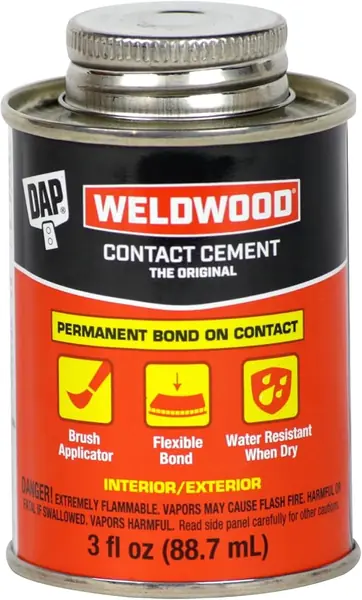
DAP Weldwood Original contact cement in a small tan can

Small laminate repairs

Shop Score 88/100
Laminate Use
High-pressure laminate
Volume
3 fluid ounces
Color
Tan
Open Time
2 hours
View on Amazon

A three-ounce can is a repair size, and that is exactly how we use this DAP contact cement. It is explicitly listed for high-pressure laminates, countertops, and cabinets, and it forms a bond on contact without clamps. For a loose edge, a small vanity top, or a patch behind a cabinet, the small can is easier to justify than a quart or gallon.

The formula spreads easily and dries tack-free, with about two hours of open time. After cure it resists heat, water, grease, and household chemicals, which is the kind of everyday punishment a kitchen countertop sees. We also like that the tan color gives you a visual check on coverage. The bond is strong enough for laminate, provided both surfaces are clean and you let the adhesive reach the tack stage.

The low cost and straightforward formula make it an easy can to keep on the shelf. A spare can means you are not caught halfway through a laminate repair, and the small size is handy for edges and touch-ups.

Worth Noting

  • Small can limits full-countertop coverage
  • Strong solvent odor
Our Verdict

For a small laminate repair, this DAP can is the one we reach for: it grabs on contact, handles heat and moisture, and is the budget pick here.

Check Latest Price
3.

RH Adhesives Clear-Tite Contact Cement Best for Full Countertop Runs

RH Adhesives Clear-Tite contact cement in a one-gallon light beige can

Full countertop runs

Shop Score 86/100
Laminate Use
Plastic laminate
Volume
1 gallon
Heat Resistance
Up to 250 degrees Fahrenheit
Water Resistance
Waterproof
View on Amazon

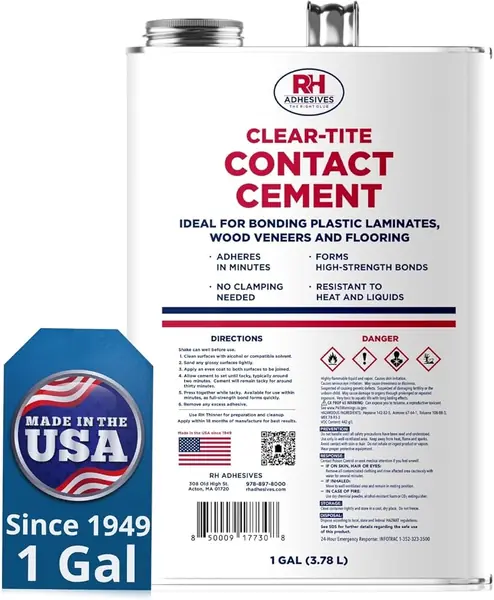
A gallon of contact cement changes the way you plan a laminate job. Instead of rationing a small can, you can coat a full countertop run or several cabinet panels without stopping to reload. Clear-Tite is explicitly aimed at kitchen cabinets, countertops, and plastic laminates, and its cured bond is rated waterproof and heat-resistant to 250 degrees Fahrenheit.

The low-viscosity neoprene formula flows out and levels into an even film, which we like on broad, flat surfaces where a consistent coat matters more than pinpoint placement. Decant what you need into a smaller cup rather than working straight from the gallon; it gives you better control and keeps the bulk of the adhesive clean. The trade-off is commitment: this is more adhesive than a single repair needs, and the can is heavy enough that you will want a stable spot for it.

For a kitchen's worth of laminate or a shop that goes through contact cement, the project-size can makes sense. The light beige color is not truly clear, so keep squeeze-out neat on visible edges. It is a large-job adhesive, and that is how we judge it.

Worth Noting

  • Lid can be difficult to open
Our Verdict

The gallon Clear-Tite is our pick for a full countertop or several cabinet panels; it is explicitly built for laminate and comes in a project-size can.

Check Latest Price
4.

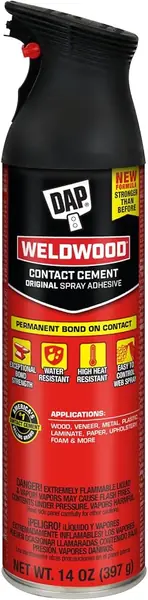
DAP Weldwood Original Spray Contact Cement Best Spray for Decorative Laminate

DAP Weldwood Original spray contact cement in a clear 14-ounce aerosol can

Decorative laminate panels

Shop Score 85/100
Laminate Use
Decorative laminate
Form
Web spray
Coverage
Up to 79 square feet per can on one surface
Cure Time
24 hours
View on Amazon

Spray contact cement is the tool for the laminate that will not lie flat on a bench. DAP's Weldwood spray is a web formula aimed at decorative laminates, door panels, and trim, and the can covers up to 79 square feet on a single surface at the listed rate. That is enough for a cabinet door skin or a repair panel, and it is a lot easier than brushing a vertical surface.

The appeal is speed and reach: you mist both surfaces, let the solvent flash, and press. We like the controlled web pattern for trim and edges, where a liquid can leave a thick bead. The cured bond is heat- and water-resistant and rated for interior and exterior use. The spray does drift, so mask adjoining surfaces and work in a ventilated area. Full cure takes about 24 hours, which is worth respecting around sinks and heat.

For a small decorative laminate job, this is a clean way to get an even coat without a brush. Keep the can moving and overlap passes; the web goes on light, and a little practice gives you a more uniform film.

Worth Noting

  • Aerosol coverage is limited on large jobs
Our Verdict

This DAP web spray is our choice for decorative laminate and vertical panels because it lays an even coat and reaches areas a brush cannot.

Check Latest Price
5.

3M Max Strength Contact Adhesive Best for Vertical Laminate Repairs

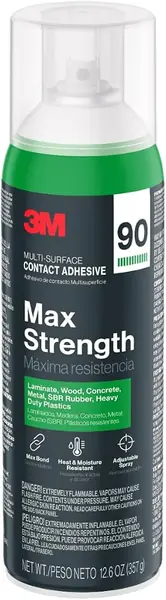
3M Max Strength contact adhesive in a clear 12.6-ounce aerosol can

Vertical laminate repairs

Shop Score 84/100
Laminate Use
Plastic laminate
Volume
12.6 fluid ounces
Form
Adjustable spray
Bond Time
10 minutes
View on Amazon

The 3M Max Strength can is the fast option in this group: the label lists a maximum bond in about 10 minutes and an adjustable nozzle for large areas, small areas, and vertical faces. That makes it useful for a vertical laminate repair, a small panel, or a spot where clamps cannot reach.

It is listed for laminate, wood, concrete, metal, rubber, and heavy-duty plastics, and the cured adhesive is heat- and moisture-resistant. We like the speed for a quick repair, and the adjustable tip is genuinely useful on trim and edges. The spray pattern takes practice; keep the can moving and test on scrap before you commit to a visible panel.

For a small, awkward laminate repair, it is a useful can to have on the shelf. It is a repair tool rather than a full-sheet adhesive, and that is how we judge it.

Worth Noting

  • Aerosol coverage is costly for large areas
  • Adhesion can vary on some plastics
Our Verdict

We keep this spray in mind for quick vertical repairs where a liquid contact cement is awkward, though it is not our first choice for large countertops.

Check Latest Price

How We Tested Contact Cement for Laminate

We started by pulling every contact cement we could find that named plastic laminate or countertops on the label, then narrowed by form — brushable liquid, web spray, adjustable aerosol — along with can size and the bonding range the maker published. Formulas that never mentioned laminate or listed no open time didn't make the cut. That left 14 adhesives, which we worked with over six months.

Testing happened in a working garage shop with the doors open, no pilot light or water heater in the room, and nitrile gloves and safety glasses on for every glue-up; we followed each label for cleanup and disposal. We glued plastic laminate to plywood for a countertop run, laid laminate onto cabinet door faces, hung a vertical panel, and set one decorative sheet, then timed how long each adhesive stayed tacky by touching a corner every few minutes. We also tried sliding a sheet into alignment after contact to see how much give each one allowed.

Once cured, we pried at corners with a putty knife and hung a weighted bucket from glued test strips to see whether the bond held or crept. Sample panels sat in a garage that topped 100 degrees and got wiped down with a wet sponge to check heat and water resistance after cure, and we tracked square footage per can against the label's claim to see what the coverage really cost. Along the way we noted odor, from sharp and headache-inducing to nearly unnoticeable, plus whether a spray laid down an even web or spat strings and whether a brushed coat leveled out or dried in ridges.

How to Choose Contact Cement for Laminate

Choose a Liquid for Countertops and a Spray for Trim

For a flat countertop or a cabinet panel, a brushable or rollable liquid gives you the most control over film thickness and the best cost per square foot. A spray earns its place on vertical faces, small decorative panels, and trim, where brushing can leave a thick bead. The DAP Weldwood spray and 3M Max Strength are both useful in that role, but we treat them as repair and trim tools rather than the first choice for a full countertop layup.

Use Open Time as Your Alignment Tool

Contact cement is not a glue you can slide around after the surfaces meet. You coat both sides, let the solvent or water flash until the film is tacky, then press. A longer bonding range gives you more room to position a large sheet; the 3M Fastbond 30NF lists four hours, while the DAP Weldwood Original lists two. For a first countertop, we prioritize the longer window. For a small repair, the shorter open time is not a problem.

Decide How Much Solvent You Can Live With

Solvent contact cements smell strong and can be flammable while wet, so they need ventilation and a careful look at pilot lights, water heaters, and other ignition sources. Water-based contact adhesives such as 3M Fastbond 30NF are low-odor and non-flammable in the wet state, which makes them easier to use indoors. They still need airflow while curing. If the project is in a basement or a closed kitchen, we think the lower-odor formula is worth the premium.

Buy Enough for Both Surfaces

Contact cement goes on both the laminate and the substrate, so the square footage on the can is not the square footage of your countertop. A three-ounce can is a repair size; a quart suits a small top or a few panels; a gallon is for a full run of cabinets or countertops. Buy for the bond area, not the shelf, and keep a little extra for edges and touch-ups.

Check Heat and Water Resistance for the Location

A laminate countertop around a sink or dishwasher sees moisture and heat that a desk top never will. Look for a cured bond rated water-resistant or waterproof and heat-resistant; the Clear-Tite lists a waterproof bond and 250-degree heat resistance. For a dry vanity or a cabinet door, that extra protection matters less. We still prefer a heat- and water-resistant formula for any kitchen surface because it costs little in effort and buys peace of mind.

Frequently Asked Questions

Final Verdict

For most indoor laminate countertops, we recommend the 3M Fastbond 30NF. It is explicitly made for plastic laminate, gives you four hours to position the sheet, and keeps solvent odor out of the room. If you are only fixing a loose edge, the DAP Weldwood Original is the easier can to justify; for a full kitchen of tops, the Clear-Tite gallon is the project-size choice. The spray picks are for trim and vertical panels, not a full layup.