↑↓ navigate ↵ open Esc close All results →

Best Epoxies for Filling Wood Cracks of 2026

Once a split in a porch post or window sill opens wide enough to take a dime, conventional wood filler crumbles, yet gravity turns epoxy selection into a viscosity problem. Pourable resin disappears straight out of a vertical crack, whereas a troweled paste holds its shape on upright trim and a kneadable putty stick handles small fastener holes cleanly.

Preparing sound wood and measuring accurately mattered across all three forms when 12 epoxies—pastes, putty sticks, and deep-pour resins—were tested over eight months on rotted sill ends, split balusters, and deep slab voids: punky fiber has to be pared back, and eyeballed ratios leave repairs gummy for days. Matched to vertical fills, deep pours, and quick spot repairs, each formulation cures hard enough to sand flush and take paint.

Our Top Picks

The Best Epoxies for Filling Wood Cracks

1.

Abatron WoodEpox Kit Best Overall
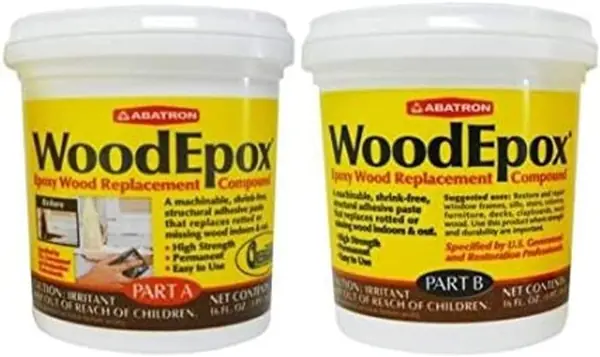
Abatron WoodEpox two-part epoxy putty kit in beige, two pint containers

Rotted trim and sills

Shop Score 93/100
Kit Size
2 pints
Mix Ratio
1:1
Tensile Strength
2500 psi
Working Time
20 to 30 minutes
View on Amazon

A crack that runs the full depth of a window sill is the test that separates these products. WoodEpox goes into the void as deep as the void goes, in one pass, and it is built to be used in any thickness or shape with no shrinkage as it sets. That matters more than it sounds. A filler that pulls back while curing leaves a shallow trench along both sides of the repair, and you see every bit of it the moment the primer goes on.

What we appreciate most is how it behaves under a tool. It mixes one-to-one to a stiff, clay-like consistency, gives you 20 to 30 minutes to work, and cures hard enough to be carved, chiseled, and sanded to a profile, which is what makes it a restoration filler rather than a gap plugger. We worked it into chipped edges and molded trim and got fills that took paint without telegraphing where the damage had been. At 2500 psi it carries the highest tensile rating among the putties here, so it is also the one we trust to hold a hinge screw in rebuilt wood.

Finishing is where a filler either disappears or it doesn't. It is beige out of the can, takes paint well, and sands to a fine, smooth surface. Stain is a test-first job: tint a scrap of cured filler in the color you plan to use and hold it against the wood before you commit. It is rated for interior and exterior use, and the near-zero-VOC, low-odor formulation means a small indoor repair doesn't require emptying the room.

Mixing is by hand and by eye, equal parts with no scale, and that is the one place to slow down. Work the two components until the color is completely uniform, because a lazy mix shows up later as a soft spot that will not sand flush with the rest of the repair.

Worth Noting

  • Larger kit than a few small cracks need
  • Can fail to bond on pressure-treated wood
Our Verdict

We recommend WoodEpox for anyone repairing a crack or missing section that has to look and behave like wood again, because it fills to full depth without shrinking and finishes under a tool.

Check Latest Price
2.

PC-Woody Epoxy Paste Best for Vertical and Overhead Work

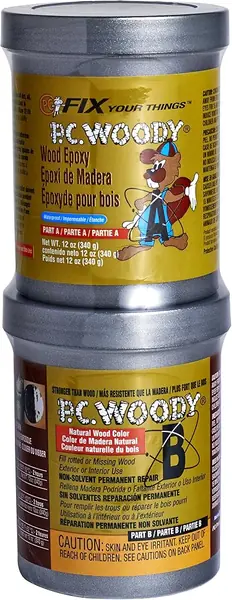
PC-Woody two-part wood repair epoxy paste, tan, in two cans

Vertical and overhead fills

Shop Score 92/100
Full Cure
24 hours
Mix Ratio
1:1 by volume
Tensile Strength
850 psi
Can Size
12 oz
View on Amazon

Overhead and vertical work is where fillers embarrass you: you press a blob into a crack in a door frame and watch it let go and drop. PC-Woody's high tack is the reason we reach for it. The paste grabs the wood where you put it and holds, which turns a two-handed juggling act into a one-handed job on a sill nose or the underside of a porch rail.

It mixes one-to-one by volume, and the maker's directions call for working it on a flat board with a stiff putty knife rather than in a cup. You get 20 to 30 minutes of open time, long enough to reposition a repair or mix a second batch for a bigger area. It is made with real wood and cures to something you can sand, prime, and paint, with a listed 24-hour full cure and 850 psi tensile strength.

That 850 psi is the figure to read carefully. It is rated well below the structural putties here, so we do not use it where the repair has to carry a hinge screw or a fastener under load; that is WoodEpox territory. For rebuilding a rotted sill corner, packing a check in a post, or closing a split in a deck rail it is more than enough, and it is rated for exterior service from 35 to 115 degrees Fahrenheit with a cured range of -20 to 200.

The payoff for the slower mix is a filler that behaves well outdoors: it is listed as resistant to UV, fresh and salt water, and the chemicals present in pressure-treated lumber. Give it its 24 hours and it powders under sandpaper instead of gumming the paper, which saves you from going through half a pack of sheets on one repair.

Worth Noting

  • Sticky paste is messy to spread
  • Light-colored stain can look washed out
Our Verdict

We point anyone filling a vertical or overhead crack toward PC-Woody, because the paste grabs and stays exactly where you press it, and it holds up outdoors for years of weather.

Check Latest Price
3.

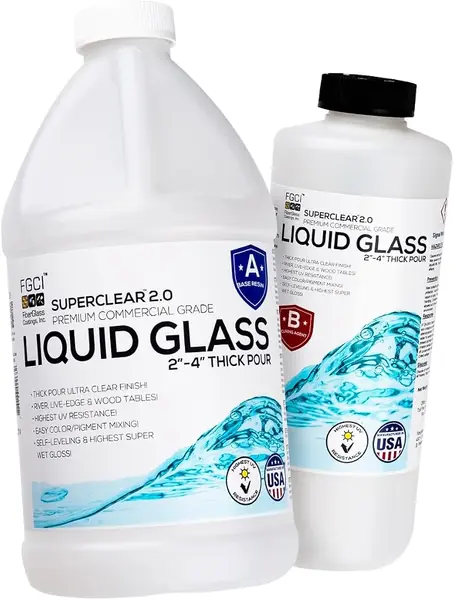
Superclear Deep Pour Epoxy Best for Large Voids

Superclear Deep Pour clear two-part casting resin kit in a boxed package

Deep clear voids

Shop Score 91/100
Kit Size
0.75 gallon
Finish
Clear
VOC Level
Zero VOC
Maximum Pour Depth
2 to 4 inches
View on Amazon

Two to four inches in a single lift is the number that matters when a slab has a knot void the size of your fist or a bark inclusion running down its edge. Pour once and you get a clear window through the wood instead of a stack of thin layers with visible lines between them.

The resin is thin, close to water, and that is exactly what lets it travel to the bottom of a narrow void and release trapped air on its own. We got very little torching out of it and very few bubbles left in the casting, and mixing the two parts does not whip much air in either. The one habit worth building is checking your setup before you pour: tape the underside, dam the open ends, and look over every joint in the form.

Clarity is where this one separates from everything else on the list. Cured, it reads as glass, which is the point when the void is a feature: a live-edge tabletop, a river-table channel, a knot you want to show off rather than hide. Nothing else here pours, and nothing else gives you a see-through repair. It is also the only pick sold as a bulk kit, which changes the math, so buy it for a slab project and not for one crack in a table apron.

Worth Noting

  • Slow cure ties up the workpiece
  • Runs out of open vertical cracks
Our Verdict

We keep Superclear Deep Pour for slab work, where a wide void can be filled clear in a single pour and left as a feature of the wood rather than hidden with an opaque patch.

Check Latest Price
4.

J-B Weld KwikWood Best for Small Repairs

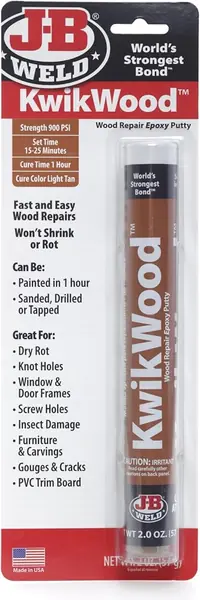
J-B Weld KwikWood epoxy putty stick in beige, seven inches long

Quick small repairs

Shop Score 90/100
Full Cure
60 minutes
Tensile Strength
2450 psi
Net Weight
2 oz
Stick Length
7 inches
View on Amazon

A seven-inch stick of kneadable putty solves a different problem than a can of paste. Cut off a slice, work it between your fingers until the color is uniform, press it into the crack or the rotted pocket, and you have mixed exactly what you need. No cup, no measuring, nothing left over curing in the trash.

It reaches full cure in about an hour and sands and paints like a hard filler, which makes it the fastest turnaround here. It is beige, so paint covers it cleanly on trim, frames, and sills. The 2450 psi tensile rating puts it close to our top pick, and it handles the small structural jobs it is good at: stripped screw holes in cabinet doors, rotted corners on window frames, a chunk missing from a door edge.

For a fast repair on painted wood, this is the one we grab first. It is the least expensive way into the category, and for someone fixing three or four small defects rather than restoring a whole window, that is the right amount of product to buy.

Plan around cure depth rather than the headline number. The stick lists 60 minutes to full cure and that holds for a thin fill, but a deep pocket needs a full day before sanding or you will clog paper on material still soft underneath. It also cures hard, often harder than the softwood beside it, so sand with a block and a light hand or you will dish the grain around the repair.

Worth Noting

  • Two ounces goes fast on large voids
  • Tacky on fingers while mixing
Our Verdict

We hand KwikWood to anyone with a handful of small painted repairs, since the stick kneads by hand, sets fast, and sands and paints within an afternoon.

Check Latest Price
5.

Endhokn Epoxy Putty Best for Small Painted Fixes

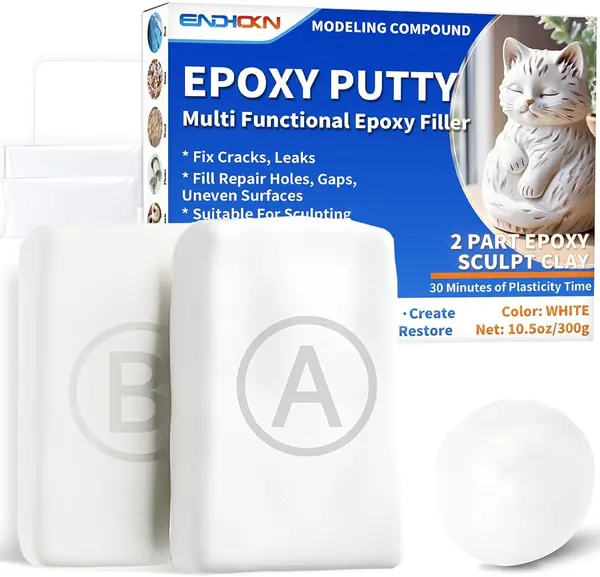
Endhokn white two-part epoxy putty kit with gloves and scraper included

Small painted fixes

Shop Score 89/100
Kit Size
10.5 oz
Full Cure
24 hours
Mix Ratio
1:1
Color
White
View on Amazon

White is the first thing to know about this one. It is a general-purpose epoxy putty that happens to work on wood rather than a filler formulated for it, so the repair is something you paint over rather than stain to match. That is fine on a shutter or a painted chair leg and wrong on a walnut tabletop.

Where it earns shelf space in our shop is the small mixed-material job: a carved detail that needs to be built back up, a split in a painted exterior board, a broken ornament that has to hold its shape while it sets. The kit arrives with gloves and a scraper, the 1:1 mix is forgiving, and the putty can be shaped and pressed into place rather than troweled flat, which suits repairs that are not flat to begin with.

Give it the full 24 hours it asks for and it cures to a hard, sandable surface that takes paint. On wood specifically we treat it as a small-repair putty, not the filler we reach for when a crack has to disappear under a clear finish or match grain. Its real strength is breadth: wood, metal, ceramic, tile, and plastic all take it, so one box covers the odd jobs around a house that a wood-only filler cannot.

Worth Noting

  • Hard to smooth to a flat finish
Our Verdict

We keep this white putty for small painted repairs across wood and ceramic, where a sculptable patch that gets covered by paint is all the job needs.

Check Latest Price

How We Tested Epoxy for Filling Wood Cracks

We started by gathering every epoxy filler we could find that's actually sold for wood — troweled pastes, kneadable putty sticks, and clear deep-pour resins — then cut the shelf down to 12 based on form, mix ratio, stated cure time, and whether the kit size matched the repair it was meant for. A 2-ounce stick is the right buy for a sill end; a gallon kit isn't, unless you're pouring a table.

Testing ran eight months, mostly in a garage with the door up. We cut punky wood back to sound fiber with a chisel, then filled rotted sill ends, split porch balusters, stripped screw holes, and a slab with a deep void. We watched whether each product held its position on vertical faces and overhead, how long it stayed workable before it stopped accepting a trowel, and whether the surface shrank away from the crack edges overnight.

We mixed by volume and then deliberately by eye to see how forgiving each one was, and rated stickiness by how hard the material pulled at nitrile gloves and whether it slid off a putty knife. Cured hardness we checked with a thumbnail and a screwdriver tip, then sanded each patch with 120- and 220-grit, primed and painted a section to see whether the cured color ghosted through, and drove screws into the structural repairs. Spare patches sat outdoors through rain and a week of hard sun, and we noted how far each kit actually went against what it cost.

How to Choose Epoxy for Filling Wood Cracks

Putty, Paste, or Pour

Three forms cover almost every repair. A kneadable putty stick such as KwikWood is mixed in your fingers and pressed into small defects; it is the fastest option and the easiest to control in a tight spot. A two-part paste such as PC-Woody or WoodEpox is mixed on a board and troweled in, with enough body to stay put on a vertical face and enough working time to shape a larger repair. A deep-pour resin like Superclear is a liquid you cast into a horizontal void.

The trap is using one form for the other's job. A pourable resin in an open vertical crack runs straight out the bottom, and a stiff putty pressed into a wide shallow void will not level itself, so you end up sanding flat what you could have poured level.

How Deep a Fill It Will Make

Thickness is where cheap fillers fail. One that shrinks as it cures pulls away from the sides of a crack and leaves a hairline seam that shows through paint; one that can only be used thin has to go in layers with a cure between each. WoodEpox is listed as shrink-free and usable in any thickness or shape, and Superclear's deep-pour resin is rated for 2 to 4 inches per lift. Those are the two that suit a genuinely deep void.

For anything shallower than a pencil, a putty is fine, and the small stick formats are made to be pressed in and left alone. Match the size of the container to the number of cracks you actually have; a two-pint kit for one tabletop split means most of it cures in the can.

Working Time and Cure Time

Pot life tells you how long you have before the mix stops behaving. The 20 to 30 minutes listed by PC-Woody and WoodEpox is enough to fill a sill and shape the edges, while a putty stick with a 60-minute full cure lets you sand the same afternoon. A deep-pour resin sits at the opposite end of the scale: it stays workable for a long stretch and then cures over days, so plan bench space accordingly.

Treat every stated cure time as a thin-bead number. A thick fill in a cold shop takes longer, and sanding too early smears the surface instead of cutting it. Mix in a ventilated space and keep uncured epoxy off your skin.

Color, Finish, and Exterior Repairs

Every pick here cures to a color, beige, tan, or white, and paint covers all of them. Stain is the harder finish, because epoxy does not absorb pigment the way wood does: darker and solid-pigment stains read better than thin light ones, so test on a cured scrap before you commit to a whole repair.

Outdoors, the same rules apply plus weather. A filler rated for exterior service handles wet and freezing cycles, and any soft or punky area should be cut back to sound fiber or hardened before anything gets packed in. On pressure-treated lumber, glue up an offcut first, because some epoxies will not grip it.

Frequently Asked Questions

Final Verdict

Most wood cracks never need a specialist. A two-part paste, mixed one-to-one, troweled in, and sanded flat will handle them, and we recommend Abatron WoodEpox first because it fills as deep as the damage goes, does not shrink back, and carves and sands to a profile that disappears under paint. It is the closest thing here to putting wood back.

If you are working overhead or on a face where gravity is against you, PC-Woody's high tack holds where a wetter paste slides, and it is the can we keep for exterior trim. When the void is wide enough to look into on a slab, Superclear Deep Pour fills it clear in one lift.