↑↓ navigate ↵ open Esc close All results →

Best Epoxy for Wood of 2026

Shopping for "wood epoxy" as a single category leads straight to failed repairs, because the label covers three distinct tools: a thin adhesive for tight joinery, a moldable paste that replaces missing wood, and a low-viscosity penetrant that hardens spongy fibers. Using the wrong form leaves a joint starved or a patch impossible to sand smooth.

Cure speed is a workflow trade-off rather than a quality score—a five-minute formula can kick off in the cup on a hot July afternoon before clamps ever snug down, a reality seen across eight months of gluing chair rungs, rebuilding a rotted sill, and saturating a soft porch railing with 12 epoxies. Judging each formula on mixing ease, cure hardness, and sandability sorts adhesives, structural pastes, and consolidants by the repair at hand.

Our Top Picks

The Best Epoxy for Wood

1.

Gorilla 2 Part Epoxy Best Overall
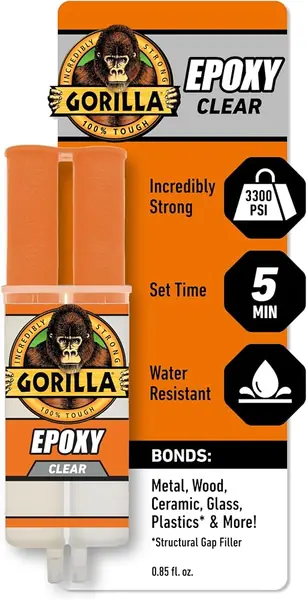
Gorilla 2 Part Epoxy clear adhesive in a dual-barrel syringe

General wood bonding

Shop Score 93/100
Full Cure
24 hours
Set Time
5 minutes
Syringe Size
0.85 oz
Tensile Strength
3300 psi
View on Amazon

The Gorilla 2 Part Epoxy comes in a single syringe with resin and hardener in separate barrels, and that packaging is why it stays within reach in our shop. The five-minute set lets you hold a small trim repair or a loose chair rung by hand and move on, while the clear cure keeps the fix from announcing itself on finished wood. The 0.85-ounce syringe goes further than you might expect on tight joints and small fills.

What makes it our top pick is range. It bonds wood, metal, ceramic, glass, and most plastics, and the medium-viscosity formula fills small gaps without running down a vertical face. The listed tensile strength is 3300 psi, high for a hardware-store epoxy, and the water resistance covers damp basements and exterior trim that gets splashed. We also like that the cap lets us reuse an opened syringe instead of mixing a fresh batch for every little repair.

Five minutes is not much time for a complicated glue-up. You need to dry-fit first, have clamps within reach, and mix only what you can place before the epoxy starts to stiffen. For a larger assembly, a slower paste or a longer-open epoxy gives you more breathing room. But for quick, visible repairs where clear and strong matter more than a long open time, this is the one we keep coming back to.

Worth Noting

  • Small syringe runs out on larger jobs
Our Verdict

We recommend Gorilla's clear syringe as the default for small wood bonds and quick fills; it is fast, strong, and easy to keep on hand.

Check Latest Price
2.

PC-Woody Wood Repair Epoxy Paste Best for Rotted Wood

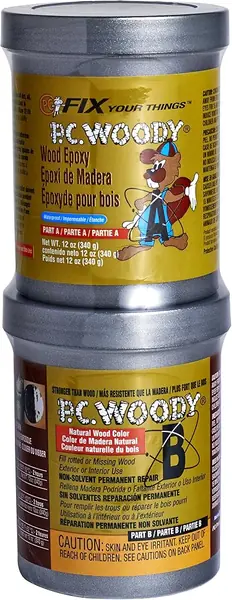
PC-Woody tan two-part epoxy paste in two cans

Rotted wood repair

Shop Score 92/100
Volume
12 oz
Mix Ratio
1:1
Cure Time
24 hours
Tensile Strength
850 psi
View on Amazon

When a windowsill or porch post goes soft, PC-Woody is the paste we reach for. It mixes 1:1 into a thick, peanut-butter consistency that stays where you put it, even on a vertical face, and cures to a tan material you can sand, drill, and paint. The 12-ounce kit gives you enough for several repairs, and the high tack means it does not sag while you shape an edge.

What sold us is how much like wood it behaves after curing. The listed tensile strength is 850 psi, lower than a thin structural adhesive, but this is a wood filler and rebuild compound rather than a close-joint glue. It bonds to wood, resists weather and UV, and takes screws without crumbling. We also appreciate the extended working time; you can mix a batch, fill a cavity, and still carve it into a profile before it sets.

Mixing takes a little discipline. The maker wants equal parts by volume on a flat surface with a stiff putty knife, and the paste is sticky enough that gloves can become a mess; the instructions actually warn against mixing with gloves. Keep the batch small, press it firmly into the cavity, and overfill slightly so you can sand back to a flush surface. For painted exterior repairs, this is one of the most forgiving products here.

For a structural joint that needs a thin glue line, choose a clear adhesive instead. For replacing wood that has rotted away, PC-Woody is our first choice.

Worth Noting

  • Tan cure can show under pale stains
Our Verdict

We reach for PC-Woody when rot has eaten away wood and you need a sandable, structural patch that stays put.

Check Latest Price
3.

Abatron Wood Restoration Kit Best Restoration System

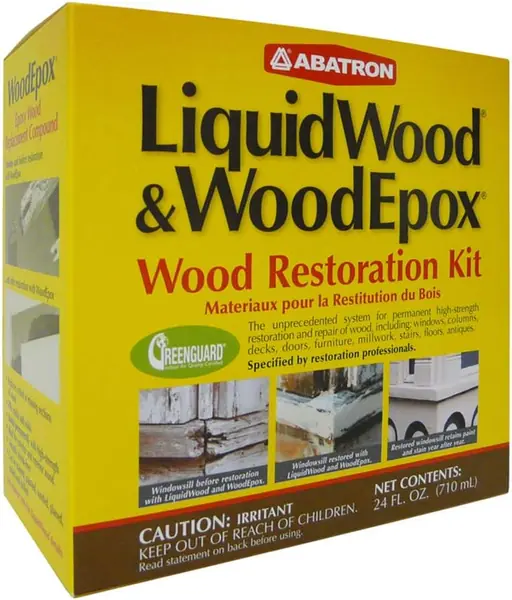
Abatron Wood Restoration Kit with LiquidWood bottle and WoodEpox cans

Full restoration

Shop Score 91/100
Full Cure
8 hours
Kit Size
24 oz
Kit Contents
LiquidWood and WoodEpox
LiquidWood Pot Life
30 to 45 minutes
View on Amazon

The Abatron Wood Restoration Kit is not a single epoxy but a two-step repair. LiquidWood is a penetrating resin that hardens soft fibers, and WoodEpox is a moldable putty that fills the void after the hardener cures. That sequence is the point: you saturate the damaged wood first, then rebuild the missing profile with a filler that will not shrink or pull away.

We like this kit for exterior trim and architectural repairs because it treats the cause and the symptom. LiquidWood has a 30-to-45-minute pot life and soaks in like a thin primer, while WoodEpox can be shaped by hand and sanded, drilled, or painted once cured. The 24-ounce kit is a sensible size for a few window sills or a damaged column, and the low-VOC formula keeps the work comfortable indoors.

The learning curve is in the mixing and the clock. LiquidWood needs several coats on thirsty wood, and WoodEpox is tacky enough that you want nitrile gloves and a clean work surface. Work in small batches, especially in warm weather, because the putty stiffens faster than you expect. The reward is a repair that looks and behaves like wood rather than a patch sitting on top of it.

For a large restoration, the 2-gallon WoodEpox pail makes more sense than buying several kits; for a single rotted sill, this kit is the better entry point. If you only need to harden soft wood and do not have a void to fill, a standalone penetrating epoxy is simpler.

Worth Noting

  • WoodEpox runs short on large voids
Our Verdict

Choose this kit for rotted exterior trim where you need to harden the fibers and rebuild the profile in one go.

Check Latest Price
4.

TotalBoat Penetrating Epoxy Best Wood Hardener

TotalBoat clear penetrating epoxy kit with resin and hardener

Soft wood hardening

Shop Score 90/100
Full Cure
2 days
Volume
1.5 quart
Mix Ratio
2 parts resin to 1 part hardener
Viscosity
Low
View on Amazon

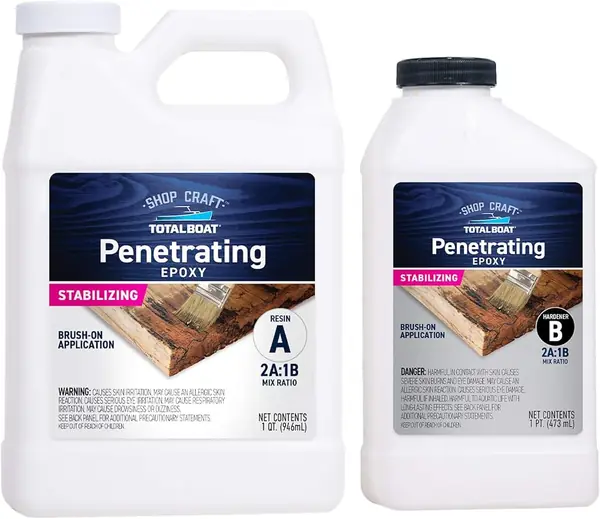
TotalBoat's penetrating epoxy is the thinnest product in this group, and that is exactly why it earns a place. It is not a gap filler or a clamp-time adhesive; it is a low-viscosity wood hardener designed to soak into soft, spongy fibers and cure them solid. The 2:1 mix gives you a watery resin that can be brushed, rolled, or injected into a check or crack.

We used it as a consolidant before filling, which is the sequence that makes sense. On a rotted sill or a soft boat part, the epoxy needs to reach the damaged cells rather than sit on the surface. TotalBoat's long cure, listed at two days, gives it time to penetrate, and the cured film is waterproof. The 1.5-quart kit is enough for several small restoration jobs if you measure carefully.

What impressed us is the balance of low viscosity and strength. It is thin enough to wick into end grain and cracks, but it does not leave the wood feeling brittle or hollow. You can thin it further with acetone according to the maker, though we prefer to start with the as-shipped consistency and add only if the wood is refusing to drink. The clear finish also lets you paint or varnish over it without a color mismatch.

This is not a product for filling a missing chunk of trim. It will run out of a vertical void, and it needs a filler like WoodEpox or PC-Woody on top. It also cures slowly, so plan on leaving the repair alone. For stabilizing soft wood before a structural patch, though, it is the best penetrant here.

Worth Noting

  • Runs out of vertical voids and needs a separate filler
  • Slow two-day full cure delays follow-up filling
Our Verdict

We keep TotalBoat on hand for soft, spongy wood that needs hardening before a filler; it penetrates where thicker epoxies cannot.

Check Latest Price
5.

J-B Weld WoodWeld Best Fast-Set

J-B Weld WoodWeld light tan epoxy in a dual syringe

Fast clamp-free repairs

Shop Score 89/100
Full Cure
1 to 3 hours
Mix Ratio
1:1
Set Time
6 minutes
Syringe Size
25 ml
View on Amazon

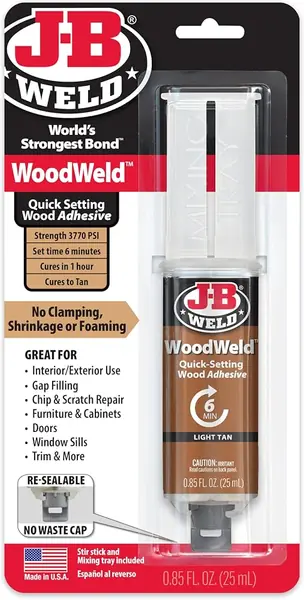
Six minutes is the whole pitch for J-B WoodWeld. The syringe combines resin and hardener at a 1:1 ratio, and once mixed it sets fast enough that many small repairs do not need a clamp. For a cracked chair rail or a loose dowel, that can be the difference between a repair you finish today and one you keep meaning to get to.

The dual barrel takes the guesswork out of the ratio, and the 25-milliliter syringe is easy to control on a small repair. The cured epoxy is a light tan solid that can be sanded and drilled, so it works under paint or in a hidden location. It is not a structural adhesive for a heavily loaded joint, but for filling a split or reattaching a small trim piece, the size and speed make sense.

What we like most is how little setup it demands: no mixing cup, no ratio to eyeball, and a set fast enough to finish a small repair in one pass. The fast clock is also the catch. Mix only what you can place in a couple of minutes, and have your clamp or tape ready before you squeeze the plunger. In warm weather the working time feels even shorter.

For a multi-piece glue-up, choose a slower epoxy or a traditional wood glue. For a quick repair where the clock matters, WoodWeld is the syringe we grab.

Worth Noting

  • Light tan cure can show on visible wood
Our Verdict

We use WoodWeld for small wood repairs that need to be done fast; its six-minute set is the reason it earns a spot.

Check Latest Price
6.

J-B Weld Wood Restore Epoxy Putty Best for Large Putty Fills

J-B Weld Wood Restore brown epoxy putty in a 32-ounce can

Large putty fills

Shop Score 88/100
Volume
32 oz
Form
Putty
Color
Brown
Cure Time
60 minutes
View on Amazon

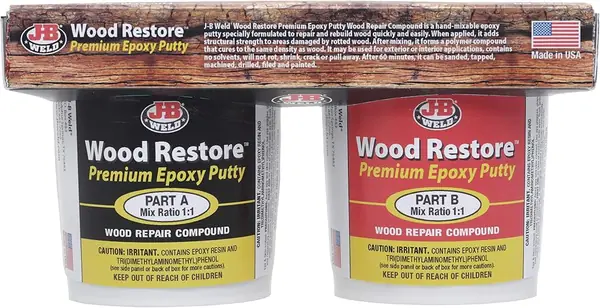
The J-B Wood Restore tub is the bulk option here: 32 ounces of hand-mix epoxy putty for filling large rot pockets, cracks, and missing chunks rather than a few syringe-sized repairs. We like it when a repair is too big for a small tube but does not justify a two-gallon pail. It mixes to a brown, clay-like consistency that you can press into a void and shape before it hardens.

The putty cures hard enough to sand, drill, and paint, and the brown color blends better under stain than a light tan filler. It is also useful for building up a worn edge or filling carpenter-bee holes in exterior trim. The 60-minute cure is quick enough to keep a morning repair moving, though cool weather will slow it down.

Consistency is the part to watch. This is a stiff putty, and it needs thorough mixing until the color is uniform; otherwise you can end up with soft spots. Press it firmly into the wood so it keys into the surface, and work in smaller batches in warm weather. A rough shape is fine because you can sand it back once it hardens.

For a large, ugly void that will be painted, this is a practical bulk filler. For a small, visible repair where you want a smooth, stainable patch, PC-Woody is easier to control and more predictable.

Worth Noting

  • Stiff putty requires thorough hand mixing to avoid soft spots
  • Harder to control on small, visible stainable repairs
Our Verdict

We reach for this bulk putty when a repair is too large for a syringe and the finished patch will be painted.

Check Latest Price
7.

Abatron WoodEpox 2-Gallon Kit Best for Big Restoration Jobs

Abatron WoodEpox brown two-part epoxy putty in a large pail

Big restoration jobs

Shop Score 87/100
Volume
2 gallons
Form
Putty
Color
Brown
Components
Two-part kit
View on Amazon

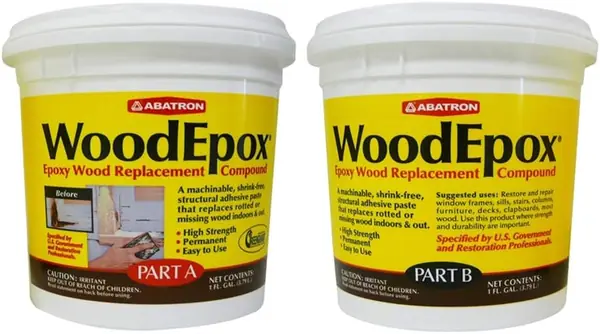
Two gallons of WoodEpox is a commitment. This is the same moldable, shrink-free wood replacement compound as the smaller Abatron kit, packaged for a restoration that will consume a lot of filler: a porch, a set of columns, or a building's worth of window trim.

The putty can be applied in thick lifts, shaped by hand, and sanded or drilled once cured. It bonds to wood and does not shrink or crack, which is why restoration crews use it on exterior details that need to mimic a profile. The 2-gallon pail is 8.3 pounds, so it is manageable to move but not something you want to open for a single repair.

The practical downside is the commitment. Once mixed, a batch has a working window, and a two-gallon pail rewards a steady pace and a clean mixing area. For a homeowner with one rotted sill, the 24-ounce kit is far more sensible; for a contractor or a serious restoration, the bulk pail avoids running out mid-project.

We recommend this pail only for large restoration work where a smaller kit would run out before the job is done. It is not the starting point for a first repair, but it is the right size when the whole facade needs attention.

Worth Noting

  • Two-gallon pail is oversized for single small repairs
  • Mixed batches have a limited working window
Our Verdict

Save the two-gallon WoodEpox for large restoration work where a smaller kit would run out before the job is done.

Check Latest Price

How We Tested the Best Epoxy for Wood

Research came first. We read through listings and maker instructions for dozens of epoxies and sorted them by form — thin adhesives, moldable pastes and putties, and low-viscosity penetrants — then set aside anything that couldn't be sanded, stained, or used outdoors where the label promised it. That left 12 we bought ourselves and used for eight months.

Most of the work happened in a garage with the door up and nitrile gloves on. We mixed each one in small batches at the stated ratio, timing with a stopwatch from the first stir to the moment it stopped spreading and started to string, and noted whether the ratio was easy to hit by eye or needed a scale.

Syringes went head to head with cans on a vertical joint, where we watched for drips and how much squeeze-out ran down the wood. Thin penetrants got dribbled into punky spots on a porch railing until the wood stopped drinking; pastes got pressed into a rotted windowsill with a putty knife to see whether they held their shape or slumped.

After curing, we twisted the glued rungs and leaned on the repaired rail to see if the bond held, then sanded patches with 120- and 220-grit to check whether the paper clogged. An awl pressed into each filler told us whether the center had gone hard, and stain brushed over cured joints showed how far the color drifted. Sample blocks sat outside through rain and a hard freeze to test water resistance and lifting. We also tracked how much volume each repair actually ate, since a big kit only saves money if you don't waste half of it.

How to Choose an Epoxy for Wood

Start With the Form: Adhesive, Paste, or Penetrant

A two-part epoxy for wood comes in three useful forms, and they are not interchangeable. A clear syringe adhesive like Gorilla is for close-fitting bonds and small gap fills; a moldable paste like PC-Woody or WoodEpox is for rebuilding missing wood; a low-viscosity penetrant like TotalBoat is for hardening soft fibers before you fill. Choose the form first, then compare brands. If you are gluing a tight joint, a paste may be too thick to wet the surfaces; if you are filling a rotted cavity, a thin adhesive will run out and leave a hollow repair.

Working Time Is a Design Choice

Fast epoxy is convenient, but five or six minutes is not much time to spread, assemble, and clamp a multi-part repair. Slow epoxy gives you room to position pieces, yet it can take a day or more before you sand. We match the pot life to the job: a quick syringe for a small trim repair, a 20-to-30-minute paste for shaping a patch, and a 30-to-45-minute system for a larger restoration. Mix small batches even with slow products; a wide, shallow cup gives you more working time than a deep pot.

Strength, Gap Fill, and Wood Movement

Tensile strength is useful, but it does not tell you whether an epoxy is right for a loose chair joint. A high-strength adhesive needs thin glue lines and good clamp pressure; a gap-filling paste can bridge a void but may be weaker in a tight joint. Epoxy also cures rigid, so it is a poor match for a joint that needs to flex. Use it where the repair is rigid and protected from movement, and choose a paste when the gap is too wide for a conventional glue.

Finish, Color, and Stain Testing

Clear epoxy disappears under a film finish, which makes it the safer choice for visible furniture repairs. Tan and brown paste fillers are easier to sand and shape but can telegraph through a pale stain. The maker of PC-Woody recommends darker or solid-pigment stains for best results, and that is good advice for any pigmented epoxy: test the stain on a cured scrap before you commit. Paint hides more than stain, so a painted exterior repair gives you more freedom in color.

Match Water Resistance and Coverage to the Job

For exterior trim, a windowsill, or a boat part, check that the cured epoxy is water resistant or waterproof and that the working temperature fits your shop. Coverage matters as much as chemistry: a small syringe is plenty for a few joints, while a rotted post can swallow a 12-ounce kit faster than you expect. Buy enough for the whole repair before you mix the first batch, and keep a slower backup product on hand for the sections that need shaping rather than clamping.

Frequently Asked Questions

Final Verdict

Gorilla's clear syringe is the epoxy we recommend first for most wood repairs: it bonds tight joints, fills small gaps, and sets fast enough to keep a project moving. When the wood is soft or hollow, switch to PC-Woody, whose tan paste rebuilds a missing profile and sands flush. For a full exterior restoration, the Abatron kit gives you the hardener and filler in one box. Choose by job: bonding sound wood, rebuilding rotted wood, or hardening soft fibers.