↑↓ navigate ↵ open Esc close All results →

Best Epoxy for Wood Turning of 2026

A void opening across the rim of a promising bowl blank does not have to scrap the piece, provided the repair resin cuts cleanly under a gouge instead of gumming up sandpaper or yellowing against figured grain. What separates turning-friendly epoxies from frustrating ones is predictable cure hardness, low bubble entrapment, and a viscosity that settles into checks without overheating.

Working time, indoor odor, and cost per ounce diverged sharply across a dozen kits tested over nine months on the lathe and at the bench—filling cracks, casting offcuts, and coating bowls and platters while respecting maximum pour depths with gloves and active ventilation. Clarity only goes so far if a cured pour chatters or smears when the tool rest comes up to the rim.

Our Top Picks

The Best Epoxy for Wood Turning

1.

Art 'N Glow Crystal Clear Epoxy Resin Kit Best Overall
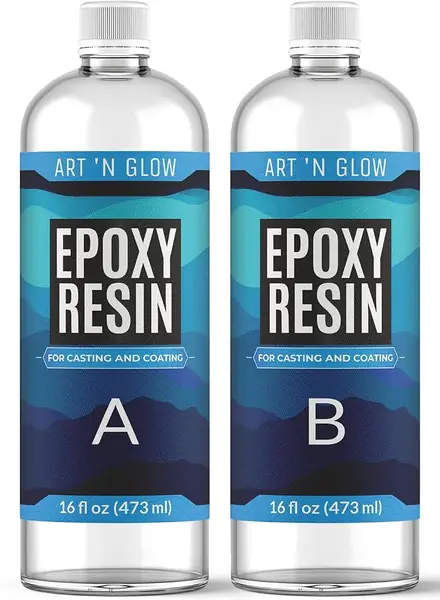
Art 'N Glow two-part crystal clear epoxy resin kit with 32-ounce resin and hardener bottles

Bowls, platters, stoppers

Shop Score 95/100
Kit Size
32 fl oz
Full Cure
72 hours
UV Protection
UV stabilizers and HALS additives
Max Pour
6 oz per casting
View on Amazon

Casting and coating in one bottle is what sold us on this kit. The stated ceiling is about 6 ounces per casting, and the same resin levels out into a gloss coat, so one bottle fills a check in a bowl blank and then seals the outside of the finished bowl. For a turner who does a bit of everything, that range is the whole point.

We keep reaching for it because a clear fill lives or dies on whether you can see it. This one stays glass-clear over grain, and a quick pass with a heat gun takes care of the bubbles that do rise to the surface. It's also food safe once fully cured, which is why we're comfortable recommending it for salad bowls, platters, and spoons rather than only for display work. UV stabilizers and HALS additives are in the formula to hold that clarity.

The bottle is small, and the pour limit means a hollow gets built up in stages rather than in one lift. Plan on the full 72 hours before you sand, and buy two kits if you're casting whole blanks instead of filling cracks. The maker lists wood among compatible materials, the formula is mixed in Dallas, and the smell stays low enough to work indoors.

Worth Noting

  • Pour limit of 6 ounces per casting
  • Costs more per ounce than bulk kits
Our Verdict

We recommend it as the best all-around kit here: it casts small blanks, fills cracks, and top-coats bowls in a clear, food-safe resin.

Check Latest Price
2.

Superclear Deep Pour Epoxy Resin Best for Deep Voids

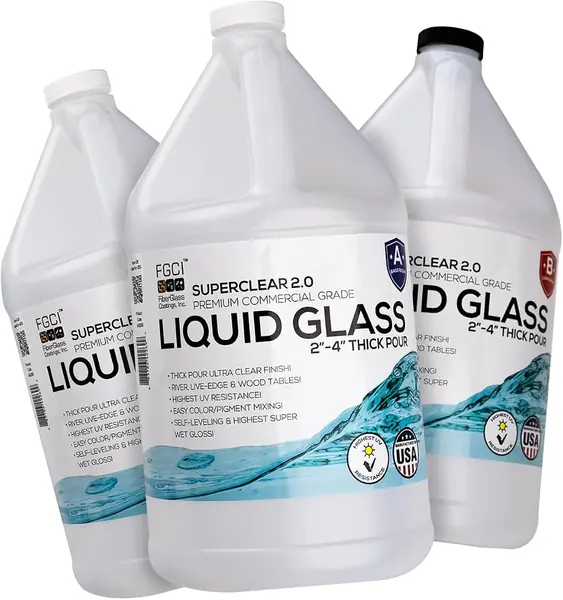
Superclear Deep Pour epoxy resin 3-gallon kit with two pails for deep casting pours

Deep voids and caps

Shop Score 94/100
Kit Size
3 gallons
VOC Level
Zero VOC
Item Weight
27 lb
Max Pour Depth
2 to 4 inches
View on Amazon

Two to four inches in a single lift is the number that separates this kit from everything else on the list. Most of the resins here go down a quarter inch at a time, which is fine for a seam but means stacking pours in a hollowed blank or a rotted pocket in a burl, and stacked pours show as lines through the fill.

The low viscosity does the rest. It runs into the bottom of a void and lets trapped air climb out, and the cure runs slow and cool rather than hot, which is exactly what lets a thick casting set without cracking. A long working time comes with that, so there's no scramble to get a big blank filled.

It's food safe and zero VOC after full cure, made in Florida, and heavy: the three-gallon kit ships at 27 pounds and carries the highest price on this page. The same formula comes in smaller kits if three gallons is more resin than you'll use in a year.

We keep this one in reserve for the piece that has to come out right, like a burl cap with a soft core or a blank with a bark inclusion worth saving. For a hairline check it's more resin and more waiting than the job needs, and that's when we reach for a coating kit instead.

Worth Noting

  • Cure runs several days
  • Three-gallon kit outpaces hobby work
Our Verdict

Buy this when one pour has to fill inches of void; it casts 2 to 4 inches deep and stays clear in live edge wood.

Check Latest Price
3.

Superclear Table Top Epoxy Resin Best for Coating

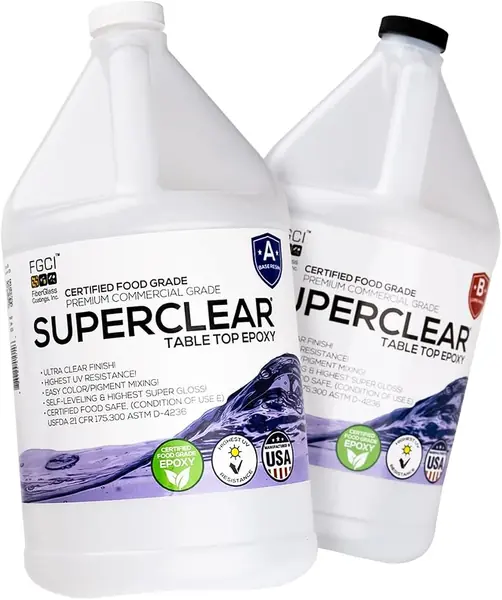
Superclear Table Top epoxy resin 2-gallon kit with resin and hardener containers

Coating finished bowls

Shop Score 93/100
Kit Size
2 gallons
Mix Ratio
1:1 by volume
Food Contact
Food safe after full cure
UV Protection
Anti-yellowing UV stabilizers
View on Amazon

“Table top” undersells what this does for a turner. It's a coating resin: thin, self-leveling, and mixed 1:1 by volume, so it flows out flat across a curved surface and leaves a gloss you can't build as easily with oil.

It's the coating half of the Superclear lineup, and the chemistry is aimed at staying clear: UV stabilizers against yellowing, a food-safe surface after full cure, and a film that brings out figure instead of masking it. Two gallons goes a long way when you're sealing bowls and platters rather than pouring slabs, and it's the least expensive resin per ounce in this group.

We reach for it when a piece is turned and needs a durable, glassy skin: a display bowl, a platter headed for the dinner table, a hollow form that will be handled. The catch is that it's a coating, not a deep-pour casting resin, so it isn't the one to pour two inches into a hollow. Buy it alongside the Deep Pour kit and you've covered both halves of the work.

Worth Noting

  • Bubbles need a heat gun each coat
Our Verdict

The coating resin we reach for on finished work: it levels to a glass gloss, resists yellowing, and is food safe once cured.

Check Latest Price
4.

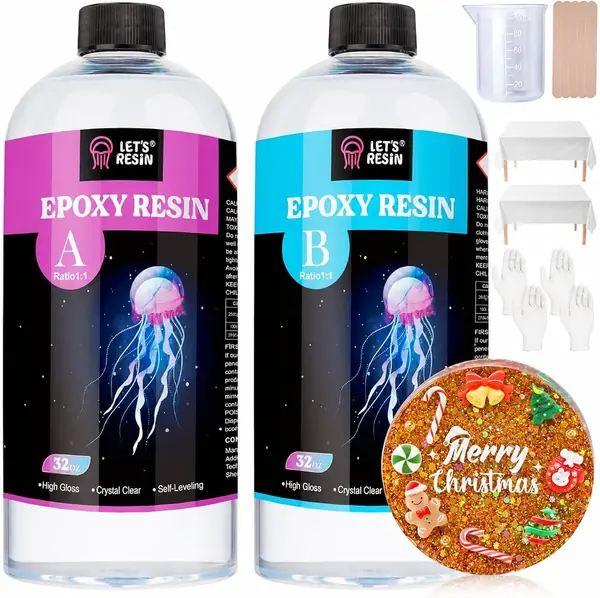
LET'S RESIN Crystal Clear Epoxy Kit Best Mid-Size Kit

LET'S RESIN crystal clear epoxy kit with 64-ounce resin and hardener bottles for casting

Small casting work

Shop Score 92/100
Kit Size
64 fl oz
Mix Ratio
1:1 by volume
Shelf Life
1 year
Cure Temperature
75 to 85 °F
View on Amazon

Watch it come out of the cup and you can see why this one is easy to like: it runs thin, spreads on its own, and the anti-foaming additives have most of the bubbles gone before you pick up the heat gun. For pen blanks, small casts, and a gloss coat on a little turning, that behavior saves a step every time.

Clarity is where this kit earns its place, with castings that come out clean and stay that way, and the 1:1 mix is forgiving for a first-timer. Two things to know before you buy. The maker puts the ideal cure temperature at 75 to 85 °F, so a cold shop will leave you with a tacky surface, and the shelf life is one year, which makes it a poor kit to stockpile. It's also sold as a craft casting resin rather than a woodworking product, so try it on an offcut before committing a special blank.

Worth Noting

  • One-year shelf life limits stockpiling
Our Verdict

A forgiving half-gallon for pen blanks, small casts, and gloss coats, with some of the cleanest clarity in this group.

Check Latest Price
5.

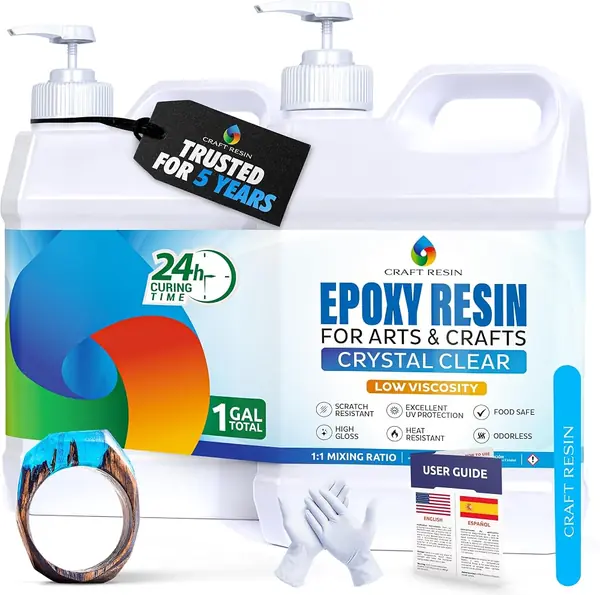
Craft Resin Crystal Clear Epoxy Kit Best for Indoor Shops

Craft Resin crystal clear epoxy resin kit, one-gallon set with mixing stick and gloves

Indoor shop casting

Shop Score 91/100
Kit Size
1 gallon
Mix Ratio
1:1 by volume
Full Cure
24 hours
Food Contact
Certified food safe
View on Amazon

Low odor is the reason this kit made the list. If your lathe lives in a basement or a spare room, a resin that doesn't run you out of the shop matters more than a marginal difference in gloss, and this one is formulated for indoor work.

It's a 1:1, self-leveling casting and coating resin with a stated 24-hour cure, food-safe certification, and enough heat resistance for pieces that see hot food. Clarity is one of its strengths: castings come out glass-clear and the surface is glossy without polishing. The kit includes a mixing stick and gloves.

What it doesn't do is forgive a sloppy mix. Measure the 1:1 by volume rather than by eye, stir slowly, and keep the room warm, or you'll be the one scraping a tacky layer off a coaster.

Our take: for an indoor shop and a mix of small casting and coating, this is a comfortable gallon to keep on hand, and it's the one we point to when ventilation is the constraint. Where it sits out is the deep-void job, since a burl cap with a hollow core still wants the deep pour.

Worth Noting

  • Bubbles need a heat gun pass
Our Verdict

Our pick for a shop where fumes matter: it casts and coats clearly, cures in a day, and is certified food safe.

Check Latest Price
6.

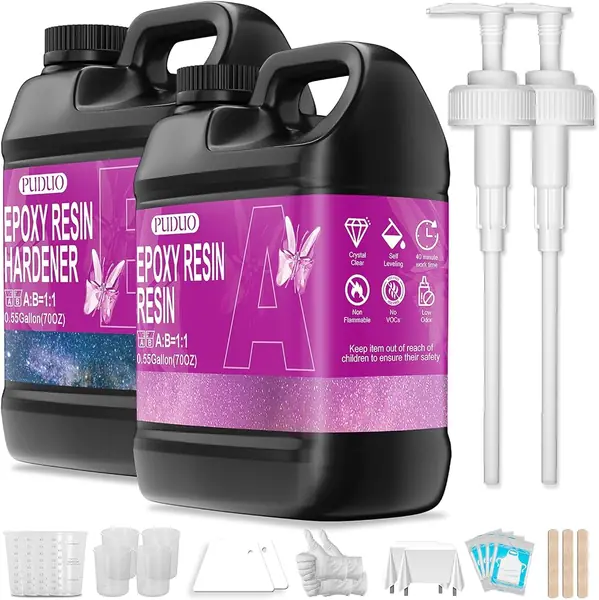
Puduo Epoxy Resin Kit Best for Bulk Crack Filling

Puduo epoxy resin kit with two half-gallon bottles, pumps, measuring cups, and gloves

Bulk crack filling

Shop Score 90/100
Kit Size
1.1 gallons
Mix Ratio
1:1 by volume
Full Cure
24 hours
Viscosity
Medium
View on Amazon

A gallon and a bit, split across two bottles, makes this the biggest kit here outside the deep-pour pail. Pumps, measuring cups, spatulas, and gloves come in the box, and the kit turns up in a lot of shops for exactly that reason: everything you need to start pouring is in the carton.

The mix is a straightforward 1:1, the resin is medium viscosity, thick enough to stay where you put it in a crack and thin enough to level, and the brand states food-grade standards with a 24-hour cure. For filling a lot of voids in a lot of practice blanks, that combination is hard to argue with on cost, and it's one of the lowest prices per ounce on this list.

Our reservation is cure reliability. Whether a batch hardens on schedule seems to hinge on measuring exactly by volume and keeping the shop warm, and either mistake leaves you with a soft pour. We treat it as the bulk kit for utility work, crack repairs in practice blanks and quick shop casts, rather than for the piece you're entering in a show.

Worth Noting

  • Cure depends on exact measuring and warmth
Our Verdict

A big, economical kit for utility crack fills and quick casts, as long as you measure carefully and keep the shop warm.

Check Latest Price
7.

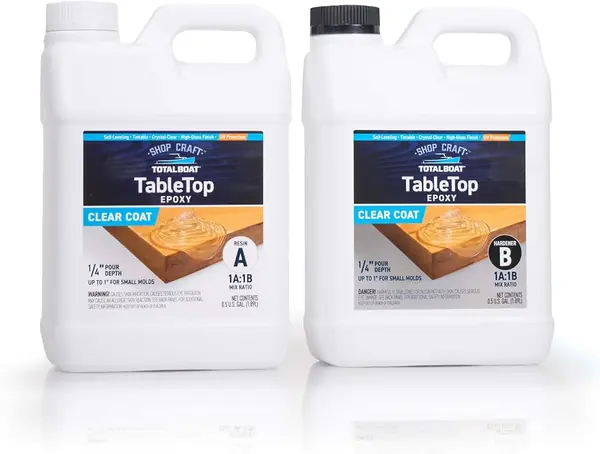
TotalBoat Table Top Epoxy Resin Best for Platters and Flatwork

TotalBoat table top epoxy resin one-gallon kit with half-gallon resin and hardener bottles

Platters and flatwork

Shop Score 89/100
Kit Size
1 gallon
Work Time
40 minutes
Coverage
12.8 sq ft at 1/8 inch
Pour Depth
1/4 inch on flat work
View on Amazon

Where the Superclear coating kit gives you two gallons and a food-safe claim, this one gives you numbers to plan around: a quarter inch per coat on flat work, up to an inch in a mold, and coverage of 12.8 square feet at an eighth of an inch per gallon. We like a stated coverage figure, because it's the difference between buying once and guessing twice.

The 40-minute working time at 70 to 80 °F is generous enough to coat a platter and touch up its edges, and the film is UV resistant and waterproof, which matters on a garden bowl or a porch piece that lives in the sun. Layers go on over one another, so building depth is a matter of patience rather than a different product.

The trade-off is temperature. This is a 70-to-80-degree product, and a cold shop gives you slow leveling and a duller surface, so warm the room or save it for summer work. It's built for flat and gently curved surfaces, and for hollow forms the casting kits are the better tool.

Worth Noting

  • Needs a shop at 70 to 80 °F
Our Verdict

When you want to know how far a gallon goes before you buy, this coating kit states its coverage, depth, and working time.

Check Latest Price
8.

Shabebe Crystal Clear Epoxy Resin Best for Vertical Crack Fills

Shabebe crystal clear epoxy resin kit with 16-ounce resin and hardener bottles and gloves

Vertical crack fills

Shop Score 88/100
Kit Size
32 fl oz
Mix Ratio
1:1 by volume
Viscosity
Medium to high
Work Time
40 minutes
View on Amazon

Most clear epoxies here are thin enough to run out of a vertical crack before they set. This one is medium-to-high viscosity, which means it sits where you put it, a real advantage when you're filling a check on the side of a mounted blank and don't want a puddle on the lathe bed.

The rest of the package aims at the same job: 40 minutes of working time to work resin into a crack, wood listed among compatible materials, and river-table casting named in the marketing. It ships with stirring sticks, gloves, and instructions, the 1:1 mix is simple, and pieces cure clear and glossy. The outlay is small, and the bottle is small with it, so it fills checks all season but won't cast a large blank.

Worth Noting

  • Cure can stay tacky in a cool shop
Our Verdict

For filling a check on the side of a mounted blank, its thicker body stays where you put it instead of running.

Check Latest Price

How We Tested Epoxy for Wood Turning

We started by reading spec sheets and instruction sheets for casting and coating resins sold for wood, then narrowed to kits with enough volume for real turning work, clear mixing directions, and a cure schedule we could plan around. Over nine months, we tested a dozen kits in a working shop, not on a lab bench. We filled cracks in turning blanks, cast small offcuts, coated platters and bowls, and tried vertical crack fills where a runny resin would sag.

Each kit was mixed by volume following its own ratio, and we noted how easily the two parts combined, how strong the odor was in a ventilated indoor shop, and how many bubbles appeared at pour and after cure. We watched whether the resin seeped into narrow voids or stayed put on a vertical face, then respected each maker's maximum pour depth per lift rather than forcing a thick pour. We timed working time, checked the surface for tack at the stated intervals, and sanded or turned cured samples to see whether the fill cut cleanly or clogged abrasives.

Clarity got judged over actual wood grain, not in a cup, and we kept clear castings on a windowsill to watch for yellowing. We compared kit volume against cost per ounce, noted whether food-contact claims were made and waited out the full cure before considering them, and checked that every cured fill reached a hard, sandable solid. The kits that stayed in rotation were the ones that made the job easier from mixing through final sanding, not just the ones that looked good on day one.

How to Choose an Epoxy for Woodturning

Start With the Depth of the Pour

Woodturning epoxy splits into coating resins and casting resins, and the labels matter less than the depth each one is built for. A coating resin goes on a quarter inch or less at a time and cures hard and glossy. A deep-pour casting resin goes two, three, four inches in one lift and cures slowly, so a thick block doesn't overheat and crack.

Pour a coating resin two inches deep in a hollow blank and you risk a cracked block and a web of bubbles; use a deep pour as a thin finish and you'll wait days for a film that dents. Measure your deepest void and buy for it.

Match Viscosity to Where the Resin Has to Go

Thin resin finds the bottom of a void and lets air escape on its own. Thick resin stays on a vertical face instead of running down onto the lathe bed. Neither is better on its own; it depends on whether you're filling a check on the side of a mounted bowl or casting a block in a mold.

For mostly vertical crack repairs, look for a medium-to-high viscosity like Shabebe's. For casting, thin is what you want.

Buy Clarity You Can Trust Over Grain

You're pouring clear so the wood shows through, and two things spoil it: bubbles and yellowing. Look for anti-yellowing UV stabilizers and a formula that releases air, then plan to pass a heat gun over every pour, because no kit here clears itself entirely.

On pale woods like maple, a hazy or amber fill is obvious next to the grain, so keep a test pour on an offcut if you're matching a finish you already use.

Mix by Volume and Watch Your Shop Temperature

Most failures start here. These kits are 1:1 by volume, not by weight; the two components have different densities, so a scale set to the same number gives you the wrong chemistry and a tacky surface. Stir slowly for the full time the label gives, scraping the sides and bottom of the cup.

Work at 70 to 85 degrees. A cold shop is the other common cause of a fill that never hardens, so warm the room before you mix rather than after.

Decide Whether the Piece Needs a Food-Safe Cure

Salad bowls, platters, and spoons meet a different standard than a display piece. Several kits here state food-safe contact after a full cure, and the operative words are fully cured: give the label's full cure time, 24 to 72 hours depending on the resin, before the bowl meets a salad.

Choose a resin that carries the claim rather than assuming any clear coat is inert.

Frequently Asked Questions

Final Verdict

Art 'N Glow's 32-ounce kit is the one we point most turners to first: it casts small blanks, fills checks, and top-coats a bowl in the same clear, food-safe resin, and it doesn't punish a beginner's mixing.

If your work runs to hollow forms, burl caps, or anything with a void deeper than a half inch, spend the money on Superclear Deep Pour instead. The difference is a fill you can pour in one go and then turn without hunting for layer lines.