↑↓ navigate ↵ open Esc close All results →

Best Wood Fillers of 2026

Good wood filler disappears into a board; poor filler leaves a pale, sunken scar that turns worse once stain hits it. Whether a repair blends in depends on how evenly the compound packs into the wood, sands at the edges, and holds its grip through seasonal humidity swings.

Half a year of patching an old dresser, cabinet doors, window trim, and scraped floorboards with 14 pastes, tubes, epoxies, putty sticks, and powders underscored an unavoidable trade-off: the easiest formulas to sand smooth are rarely the toughest under impact, while hard-curing epoxies demand extra elbow grease with the sanding block. Any "stainable" claim also calls for a scrap test before committing to a visible panel.

Clean feathering and lasting adhesion anchor all eight formats, spanning quick squeeze-tube fills, rotted exterior trim repairs, putty-stick touch-ups, and economical powder mixes.

Our Top Picks

The Best Wood Fillers

1.

FamoWood Water-Based Wood Filler Best Overall
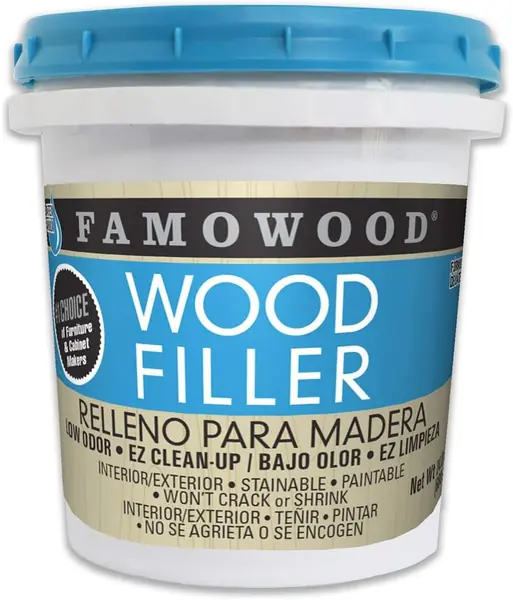
FamoWood natural water-based latex wood filler in a one-pint tub

General furniture repairs

Shop Score 94/100
Container Size
1 pint
Use
Interior and exterior
Dry Time
15 minutes
Cleanup
Water
View on Amazon

Fifteen minutes is the number on the label, and on a run of nail holes along a length of casing it holds close enough: by the time we worked our way down the board, the first holes were ready for paper. A filler that sets that fast changes how a job runs, because you sand and finish in one session instead of taping over the work overnight.

What we like best is how it behaves under sandpaper. It powders off cleanly, feathers into the surrounding grain instead of tearing, and does not leave the raised ring that comes from a filler which shrank as it cured. On a repair headed for paint, that is the whole game.

Water cleanup sounds like a minor feature until a batch goes on too thick and you are scraping it back off. A rinse of the knife and the tub edge and you are moving again. The pint goes further than it looks, too: trim, a small furniture repair, and a couple of window frames without running dry.

The label lists interior and exterior use, and on vertical trim outside it holds. Horizontal surfaces that stay wet, like a deck board, a sill, or the bottom edge of a door, are where a latex filler gives up first, and those jobs belong to the epoxies below.

Worth Noting

  • Stain can dry lighter than the surrounding wood
Our Verdict

We reach for this one first: it dries in about 15 minutes, sands smooth without tearing, and cleans up with water, which covers most trim and furniture repairs in a shop or a house.

Check Latest Price
2.

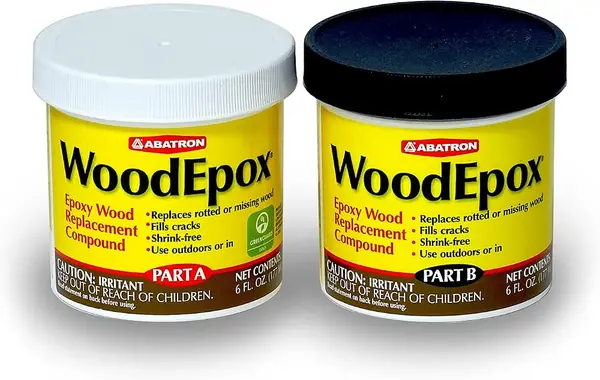
Abatron WoodEpox Kit Best for Rotted or Missing Wood

Abatron WoodEpox two-part epoxy wood filler kit in brown, 12-ounce containers

Rotted exterior trim

Shop Score 93/100
Container Size
12 oz
Color
Brown
Full Cure
120 minutes
Working Time
20 minutes
View on Amazon

Missing wood is a different problem from a dent, and this kit is built for it: sill ends, porch posts, door edges, and the bases of columns where weather has taken a section away and paint will no longer hide the loss.

It arrives as two cans of paste that you mix in equal volumes on a flat board with a putty knife, then press into the void. Because it does not shrink, a missing corner comes back in one pass rather than three, and after about two hours it can be sawn, planed, carved, and sanded like the wood around it. There are no measuring cups in the kit, so equal parts are by eye unless you keep two spoons or a small scale with it.

We think it is worth the premium on an old house, where the alternative is a carpenter. It is also the easiest two-part product here to live with: low odor, almost no VOCs, and no solvent bite in a closed room. On pressure-treated lumber the bond is the weak point, so rough the surface and let the wood dry before you commit.

Worth Noting

  • Premium price for a 12-ounce kit
Our Verdict

Our choice when wood is missing rather than dented: this two-part epoxy rebuilds rotted trim and sands, carves, and paints like the wood around it, at a premium price.

Check Latest Price
3.

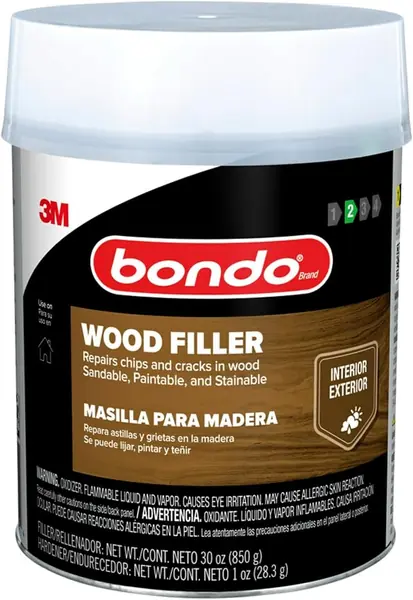
Bondo Wood Filler Best Fast-Setting Two-Part

Bondo light brown two-part wood filler bottle with a cream hardener tube

Fast structural patches

Shop Score 92/100
Use
Interior and exterior
Color
Light brown
Volume
30 oz
Sandable In
15 minutes
View on Amazon

Nothing else here sets as fast. Pressed into a rotted window frame, Bondo is firm enough to sand in about 15 minutes and ready for paint shortly after, which makes it the filler we reach for when a repair has to be finished the same afternoon.

It is a two-part polyester with a cream hardener, and it handles like body filler because that is what it is: creamy on the knife, spreadable, and rock hard once it goes off. Mix small batches. The working window is short and shorter in a warm room, so a lump the size of a walnut is about right for a sill, and paring the excess off with a chisel a couple of minutes after it goes on saves most of the sanding.

Ventilation is not optional. The unmixed resin is sharp enough that we keep the container closed and work with a fan or an open door behind us. Deep voids go better in two passes than one, since the mix stiffens before you can shape a large patch, and a second application over cured filler bonds fine.

Worth Noting

  • Not stainable so the repair needs paint
  • Sharp solvent smell while mixing
Our Verdict

Buy it for hard, fast patches on rotted or gouged wood that will be painted, and skip it for anything headed for stain.

Check Latest Price
4.

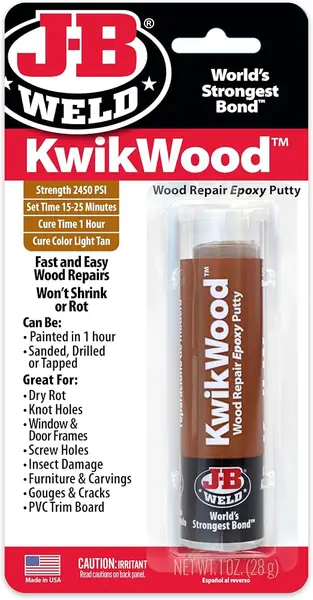
J-B Weld KwikWood Best Putty Stick for Small Repairs

J-B Weld KwikWood tan epoxy putty stick in a one-ounce size

Small hole repairs

Shop Score 91/100
Cure Time
1 hour
Work Life
15 to 25 minutes
Stick Size
1 oz
Lap Shear Strength
900 psi
View on Amazon

KwikWood is a stick, not a paste. You slice off a coin, knead it between your fingers until the two colors become one, and press it into the hole, which takes less time than finding a putty knife and a stirring stick.

For a stripped hinge-screw hole, nothing else here comes close. It cures to a light tan that drills and holds a screw after about an hour, so a cabinet door goes back on with its hardware sitting in solid material rather than in a wad of soft filler.

The catch is on your hands. Freshly mixed, the putty is aggressively tacky and clings to a finger instead of the hole, so we keep a cup of water nearby and wet our hands before kneading. Press it in with a thumb, leave it slightly proud, and sand it back once it has gone off.

Cure is where it asks for some care. A stick that was not kneaded all the way through, or one worked in a cold garage, can still be soft well past the hour on the label, and soft epoxy will not hold a screw. The one-ounce stick goes a long way on holes and not very far on a rebuilt corner, so size the job before you start slicing.

Worth Noting

  • One-ounce stick is small for larger rebuilds
Our Verdict

A stick we keep in the toolbox for stripped screw holes and chewed trim: knead, press, and drill it about an hour later.

Check Latest Price
5.

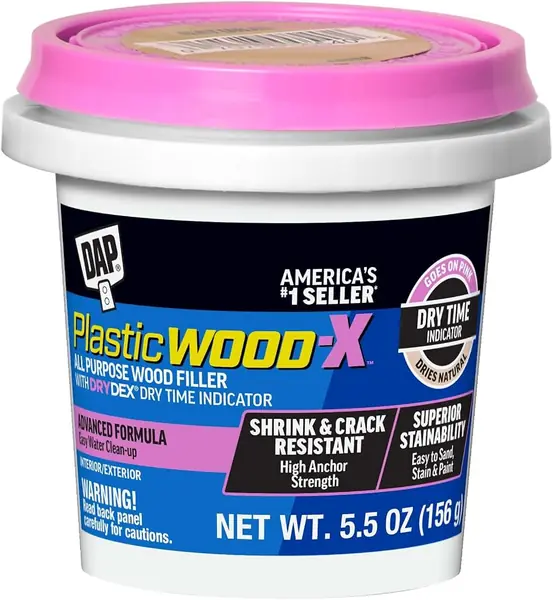
DAP Plastic Wood-X with DryDex Best for Beginners

DAP Plastic Wood-X natural wood filler in a small 5.5-ounce tub

Beginner hole filling

Shop Score 90/100
Container Size
5.5 oz
Use
Interior or exterior
Color
Natural
Dry Time
3 to 36 hours depending on depth
View on Amazon

The paste comes out pink and dries to a natural tan, which is the most useful thing about it: you sand when the color goes, not when you think enough time has passed. For nail holes, brad holes, and small gouges in casing, we think that takes most of the risk out of a first repair.

It goes on thick and knife-grade, so it stays where you put it on a vertical face instead of sagging, and it sands to a smooth surface without much pressure. Shallow fills of an eighth of an inch or so dry in a few hours; deeper ones take considerably longer, and the color is a more honest guide than the clock.

The tub is small, and 5.5 ounces disappears once you move past nail holes into a whole room of trim. It is also not the filler for a deep gouge or anything that has to carry a screw. Inside, on painted casing, cabinet faces, and door edges, it does not need to be: it is tidy, low-odor, and easy enough for a beginner to leave a clean finish.

Worth Noting

  • Small tub runs out on a full room
Our Verdict

If you have never filled a nail hole, start here: the pink paste turns tan when it is ready to sand, so you cannot jump the gun.

Check Latest Price
6.

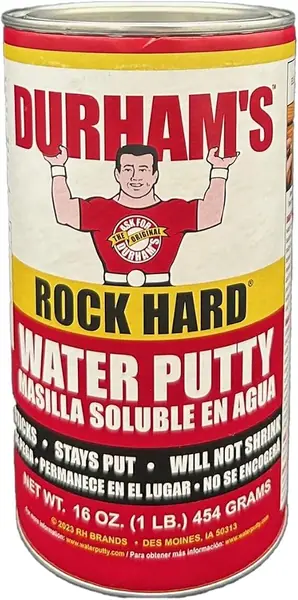
Durham's Rockhard Water Putty Best Budget

Durham's Rockhard water putty can holding one pound of cream powder

Budget patching jobs

Shop Score 89/100
Container Size
1 lb
Use
Wood, plaster, stone, and concrete
Color
Cream
Form
Powder
View on Amazon

A pound of powder looks like nothing in the can until you add water, and then it becomes a tub of putty you can mix as thin as a wash or as stiff as peanut butter. For the size of the can, nothing else here stretches further.

It cures hard, genuinely hard, harder than pine, and it does not shrink back out of a hole the way a soft latex filler can, so a patch in a door frame or a stair tread stays where you put it.

The same can fills plaster cracks and anchors into stone and concrete, and it takes paint beautifully once it has set. Cream is the color, and paint is the plan; there is no grain match to chase.

Mixing is the skill it asks for. Too much water and the patch is weak and chalky, so aim for the consistency of stiff cake batter and add water in dribbles rather than starting over. It also stiffens in the pot as you work, which is the argument for small batches. We keep a can on the shelf for exactly that reason: it handles the odd jobs that the tubes and epoxies are too expensive to waste.

Worth Noting

  • Dries harder than softwood and needs careful sanding
Our Verdict

A pound of powder fills a lot for very little, mixing to whatever consistency the repair needs and curing hard enough to paint over.

Check Latest Price
7.

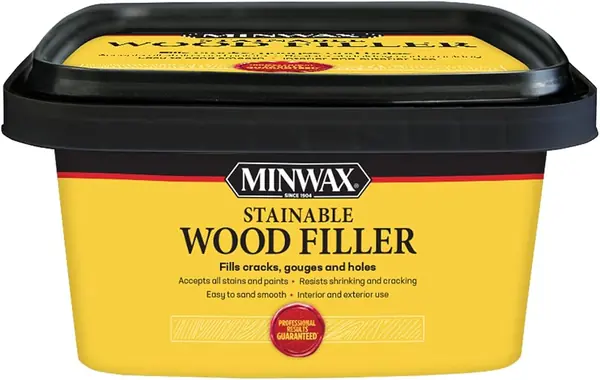
Minwax Stainable Wood Filler Best for Large Interior Repairs

Minwax stainable wood filler in a natural-colored 32-ounce tub

Large interior repairs

Shop Score 88/100
Container Size
32 oz
Use
Indoor and outdoor
Dry Time
2 to 6 hours
Stainable
Yes, oil and water-based
View on Amazon

Thirty-two ounces is a serious tub of filler, and Minwax aims it at people filling a whole room's worth of trim before a finish goes on. It is formulated to accept the company's oil- and water-based stains, which is the reason to choose it over a plain paint-grade putty.

Shallow repairs dry in a couple of hours and deeper ones take longer, so trim filled in the morning is usually sandable by afternoon. It spreads smoothly, sands flush without pulling away from the edges of a hole, and takes paint without flashing through.

Keep the lid pressed down. A tub this size will skin over between projects, and a splash of water worked in with a knife brings it back if it has only stiffened; a tub left open in a dry shop will not come back at all.

Where it earns its keep is quantity on painted interior work: a run of baseboard, a door slab, a set of cabinet boxes that will all be sprayed the same color. Having one tub open beats opening four tubes, and at that scale the filler's limits stop mattering. For a single patch on stained furniture, we reach for something else.

Worth Noting

  • Stain dries a shade off from the wood
Our Verdict

We recommend it when a whole room of painted trim needs filling and you want one tub rather than four tubes.

Check Latest Price
8.

Boncart Wood Filler

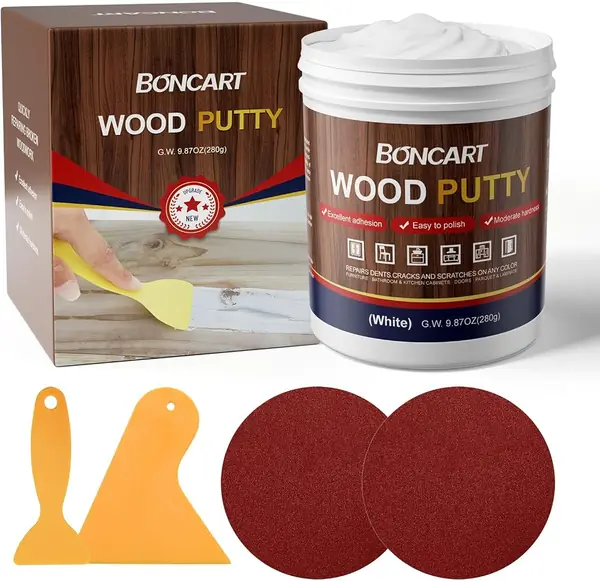
Boncart white wood putty can with two scrapers and two sandpaper sheets

Painted white trim

Shop Score 87/100
Container Size
9.87 oz
Color
White
Included
Two scrapers and two sandpaper sheets
Water Resistance
Not water resistant
View on Amazon

The can comes with two scrapers and two sheets of sandpaper, which sounds like filler swag until you are touching up cabinet fronts and the putty knife is out in the truck. White is the other half of the pitch: this is a filler for painted wood, not for show grain.

It spreads like soft icing, smooth and with no smell, and it dries white and hard enough to sand into a feathered edge that disappears under paint. On shallow work it behaves well: nail holes, dents in a door face, chipped corners on a cabinet frame, screw holes behind a hinge plate.

We keep it for painted trim and cabinet boxes because the white takes the guesswork out of a paint-grade repair. Deep fills are where it needs patience, since a dent filled in one thick pass can crack across the middle as it cures, so build it in two thin layers and let each one go off before the next.

Worth Noting

  • Not water resistant so keep it indoors
Our Verdict

We like it for painted cabinet fronts and trim, scrapers included, as long as you keep the fills shallow.

Check Latest Price

How We Tested Wood Fillers

We began by comparing formats—ready-mixed paste, squeeze tubes, two-part epoxy, putty sticks, and powders—then filtered by intended use, container size, and price so the shortlist included budget, furniture-grade, and exterior-rated options. Over six months, we tested 14 fillers on an old dresser, cabinet doors, window trim, a painted doorframe, and scraped floorboards. We applied each one with a putty knife or by hand, mixing two-part products at the maker's stated ratio in a ventilated workspace with gloves on, and tracked how much coverage each container gave on small versus larger patches.

We noted how each filler spread and whether it clung to the edge of a chip or pulled away, then timed how long it stayed workable and how long it took to dry before sanding. We also tried each on a vertical doorframe to see whether it sagged before it set. We sanded every cured patch by hand and looked for a feathered edge that blended into the surrounding grain instead of a ridge. After a week, we checked again for shrinkage, cracking, and hardness; we also drove a small nail or screw into cured patches on scrap boards to see whether the filler crumbled or held.

For stain and paint acceptance, we finished half of each patch with an oil-based stain and half with paint, watching for blotchiness, uneven stain resistance, or a color that sat on top. We checked wood moisture with a meter before applying anything, left opened containers on a shelf for a month to see whether they thickened or skinned over, and placed exterior samples on sound, dry trim to check them after rain. We did not use fillers on damp wood, load-bearing members, or any repair meant to restore structural strength.

How to Choose Wood Fillers

Start With the Format

Ready-mixed paste in a tub or tube is the default for holes, dents, and gouges, and it is what most interior trim work needs. A squeeze tube or small tub suits a handful of nail holes; a pint or larger suits a room. Two-part epoxies, whether a paste you mix or a stick you knead, are for repairs that have to be strong, weatherproof, or built out past the surface: rot, missing sections, stripped screw holes. Powder putties are the cheapest way to cover a lot of patching, at the cost of mixing a fresh batch every time.

The wood putty on the same shelf is often the same family of product under a different word, so read the format and the dry time rather than the name.

Sandability and Shrink Decide Whether the Patch Shows

A filler that powders under paper and feathers at the edges disappears beneath a finish; one that balls up or tears leaves a ridge you chase with paper until the surrounding wood is dished. Shrink matters just as much, because a filler that pulls back as it cures leaves a shallow depression that telegraphs through paint.

Hard-setting fillers such as epoxy and water putty sand flat but resist paper, so work them with 120-grit and finish by hand. Paints and finishes hide almost anything; stain hides nothing.

Stainable Is a Claim, Not a Promise

Nearly every filler labeled stainable will take some stain, and almost none takes it the way wood does, because there is no grain to absorb it. That is why a repair on a visible stained surface often ends up a shade off no matter which product you buy, and why the smarter move is to plan the color before you fill rather than after.

If the piece will be painted, choose for sandability and forget color. If it will be stained, keep the repair small, test the filler on a scrap of the same species, and expect to touch up with a matching pigment rather than relying on the filler alone.

Interior, Exterior, and Wet Wood

Latex fillers are fine on vertical exterior trim that sheds water. Horizontal surfaces that stay damp, like deck boards, sills, and the bottom edge of a door, are where they fail first, and where a two-part epoxy or a polyester filler earns its price.

Rotted wood needs more than filling. Dig out the soft material until you reach sound wood, let it dry, and harden or consolidate what is left before you fill, or the patch sits on mush and comes away with the next freeze.

Will It Hold a Screw?

Fillers marketed for anchoring nails and screws hold in light work: a cabinet hinge screw, a trim nail, a drawer glide. A door hinge carrying real weight is a different ask. For a stripped hole, a kneadable epoxy putty is the safer choice because it cures dense enough to drill and tap like wood, and a pilot hole keeps the screw from splitting the patch.

Anything load-bearing should be repaired with wood, not filler. A filler restores the surface, not the strength of the member underneath.

Frequently Asked Questions

Final Verdict

For most of the filling in a shop or a house, we point people to FamoWood: it dries in about the time it takes to work along a piece of casing, sands without tearing, and cleans up with water, so a mistake costs minutes rather than an evening.

Buy Abatron WoodEpox instead when the repair is missing wood rather than a hole, such as a rotted sill end, a porch post, or a corner broken off a door, where the patch has to be structural and survive weather. And if the job is paint-only and has to be done this afternoon, Bondo sets faster than anything else here.