↑↓ navigate ↵ open Esc close All results →

Best Stainable Wood Fillers of 2026

Patch a nail hole in oak, sand it flush, wipe on stain, and a poor wood filler announces itself as a muddy bullseye or shrinks into a shallow dimple. A good stainable filler takes pigment close to the surrounding grain, feathers flat under sandpaper, and holds its volume as it cures.

Hand-sanding 14 fillers over four months across pine shelves, white oak floor gaps, painted casings, and an exterior door frame—then top-staining half with oil and half with water-based color—exposed two common traps. A fast dry time hurts rather than helps if the paste skins over before you press it level, and an oversized tub is false economy if the rest hardens on the shelf.

From bare indoor trim headed for stain to weather-exposed exterior repairs that require a two-part bond, the seven options below match the container size and chemistry to the actual patch.

Our Top Picks

The Best Stainable Wood Fillers

1.

Famowood Water-Based Wood Filler Best Overall
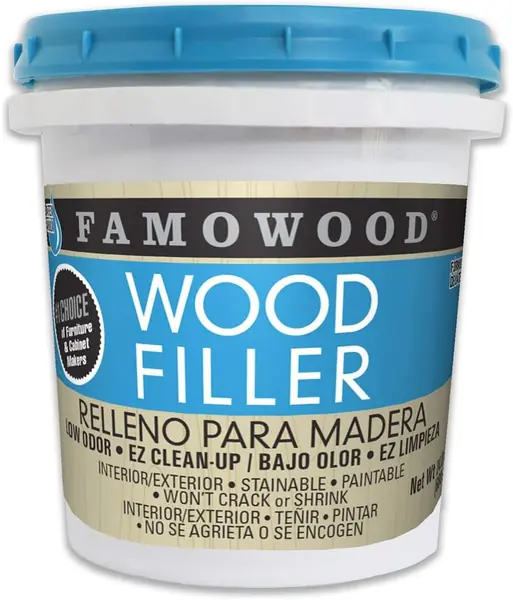
Famowood water-based wood filler in a natural-color one-pint tub

Bare-wood repairs

Shop Score 94/100
Container Size
1 pint
Use
Interior and exterior
Dry Time
15 minutes
Finish
Stainable and paintable
View on Amazon

Fifteen minutes is the number that shapes a repair with Famowood: it sands and takes finish quickly, so a row of nail holes or a torn door edge does not stall the rest of the project. We like that pace for trim and furniture, where you want to fill, sand, and get on with the finish. It is also one of the few water-based fillers here that is rated for interior and exterior use, and the low odor and water cleanup make it easy to live with in a small shop.

What sold us is how it handles under sandpaper. It knifes into cracks and feathers out without the gummy drag that makes you reach for coarser grit than you wanted. It also drills and planes, so a patch in a jamb or a table edge does not have to be a purely cosmetic island. The catch is the working time: fifteen minutes is great when you are moving, less so when you are filling a long, deep run. Scoop only what you can place and shape in one pass, and work in sections.

The natural shade is not a universal match. On pale wood it can read a little pink before it is topcoated, and stain can dry lighter or darker than the surrounding grain, so test a scrap and tint if the repair sits in a visible field. In a painted or inconspicuous spot, that is a nonissue. For a stain-grade repair, the sanding and adhesion are what keep us coming back.

Worth Noting

  • Short working time for large fills
Our Verdict

We recommend Famowood as the default for bare-wood repairs: it spreads and sands smoothly, dries fast enough to keep moving, and accepts stain with a little testing.

Check Latest Price
2.

Minwax Stainable Wood Filler Best for Large Projects

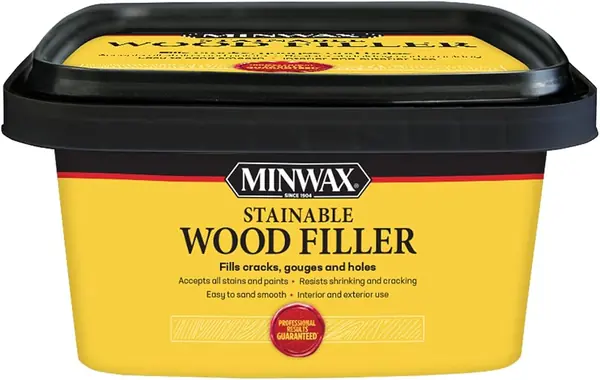
Minwax stainable wood filler in a 32-ounce natural-color tub

Large trim projects

Shop Score 93/100
Container Size
32 oz
Use
Indoor and outdoor
Dry Time
2 to 6 hours
Stain Compatibility
Minwax oil and water stains
View on Amazon

A 32-ounce tub changes the economics of a repair: you can scoop without rationing and still have enough for the next trim run or furniture patch. That is the main reason this Minwax tub earns a place here. It is a natural-color latex filler for cracks, nail holes, and knot holes, and the label is unusually direct about stain compatibility: it is formulated to accept Minwax oil- and water-based penetrating stains.

The texture is thick enough to press into a gouge and hold on a vertical casing, and it sands to a flush surface without a lot of fuss. We like that it can be painted too, so one tub can cover both stain-grade and painted repairs. The working window is generous compared with a fast-setting filler, which makes it easier to fill a long run of trim in one pass.

Our reservation is freshness. The tub can arrive stiff or dry out after the first opening, and once that happens you are fighting crumbs instead of spreading a paste. Buy from a store with turnover, press the lid down hard, and add only enough water to bring it back if it thickens. Those are real caveats, but for volume work, this is the tub we keep around.

Worth Noting

  • Stain can take unevenly on dense patches
Our Verdict

We reach for the big Minwax tub when a project has more than a few holes to fill; it sands flush and is made for Minwax stains, provided the tub arrives soft.

Check Latest Price
3.

DAP Premium Wood Filler Best for Color Matching

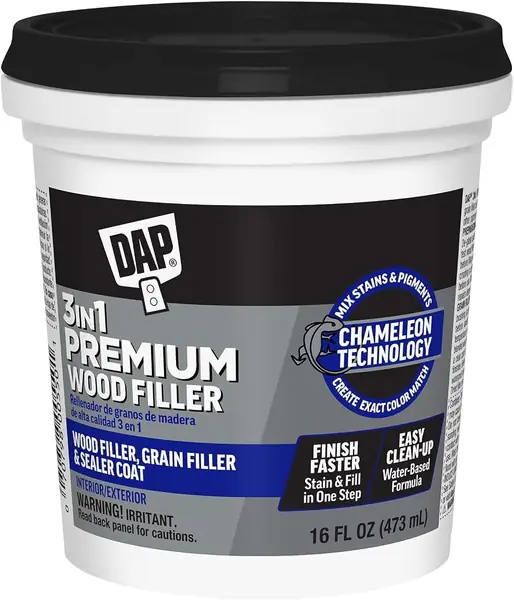
DAP Premium Wood Filler in a white 16-ounce tub

Color-matched repairs

Shop Score 92/100
Container Size
16 fluid ounces
Use
Interior and exterior
Dry Time
2 to 4 hours
Color
White
View on Amazon

The reason to pick this DAP tub over a natural-color filler is control: you can mix a little stain, dye, or pigment into the wet paste and tune the patch before it dries. We like that for a repaired tabletop or a cabinet face where a generic tan blob would announce itself. The 3-in-1 label is real: it works as a filler, a grain filler, and a sealer, so it can smooth open grain and seal the patch in one step.

It goes on as a thick, knife-grade paste and stays where you put it on a vertical surface, which matters on door stiles and cabinet frames. The 16-ounce tub gives you enough to mix a batch for several repairs, and the two-to-four-hour dry time leaves room to work without waiting until tomorrow. It sands to a smooth surface and accepts paint, so it is not a one-trick stain product.

The white base is the trade-off. On bare wood you have to tint it; straight from the tub it is not a match, and a half-hearted mix will show. Make a test batch, let it dry, and compare it under the finish you plan to use. For a painted repair, the white base is an advantage, but for stain-grade work, buy it for the color control, not for convenience.

Worth Noting

  • White base needs tinting on bare wood
Our Verdict

We choose DAP Premium when the repair has to disappear under stain, because you can tint the wet filler before it ever touches the wood.

Check Latest Price
4.

DAP Plastic Wood-X Wood Filler Best Dry-Time Indicator

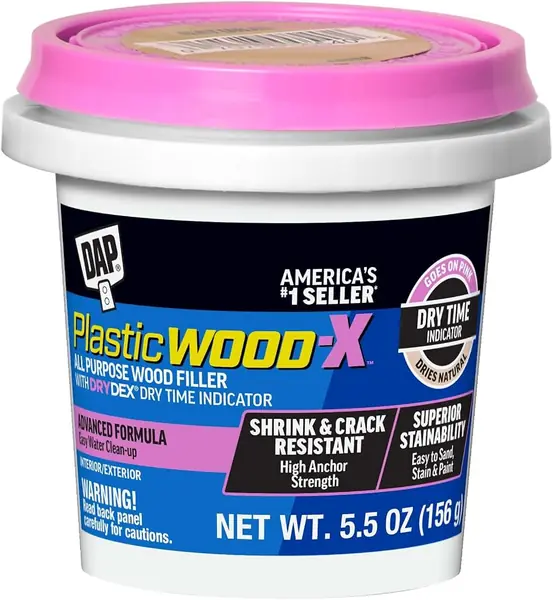
DAP Plastic Wood-X natural wood filler in a small tub

Small touch-ups

Shop Score 91/100
Container Size
5.5 oz
Use
Interior and exterior
Dry Time
3 to 6 hours
Color
Natural
View on Amazon

The pink color is not a gimmick. It tells you the filler is still wet, then fades to a natural wood tone when it is ready to sand, which is genuinely useful on a casing with a dozen nail holes and no patience for the touch test. The paste is thick enough to press into a vertical surface without sagging, and it dries to a color that is close enough for paint or a light stain.

The catch is the size: 5.5 ounces is a touch-up tub, not a project tub. We found it best for punch lists, door casings, and small furniture repairs, where the indicator saves time and the small container is easy to keep in a drawer. For a floor or a large built-in, step up to a bigger filler. It sands easily and takes paint well, but like any natural filler, it still needs a test under stain.

Worth Noting

  • Small tub runs out on big repairs
Our Verdict

We like this small tub for trim and furniture touch-ups because the pink-to-natural color takes the guesswork out of when to sand.

Check Latest Price
5.

GoodFilla Wood and Grain Filler Best for Floor Repairs

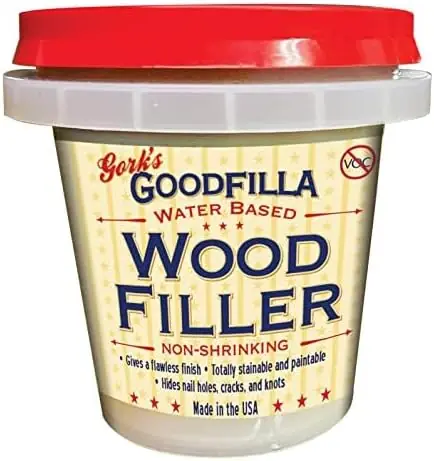
GoodFilla White Oak wood and grain filler in an 8-ounce can

Floor repairs

Shop Score 90/100
Container Size
8 oz
Color
White Oak
Finish
Stainable tintable sandable
Repair Type
Floor gaps and knot holes
View on Amazon

A floor with gaps and knot holes is a different kind of repair: the filler has to move with the boards, sand flat enough not to catch a sock, and look close enough that you stop noticing it. GoodFilla's White Oak color is aimed at that job, and the eight-ounce can is easy to work from when you are kneeling over a few square feet.

The paste spreads smoothly and sands without blinding the grain, which is the part that matters when the repair sits in a traffic lane. It accepts stain, tint, and dye, so you can nudge the color instead of accepting the can's version. We also appreciate that it reconstitutes with water; a can that stiffens between projects is not automatically a loss, which is more than we can say for many tubs.

The limit is the size. Eight ounces covers a small floor repair or a piece of furniture, not an entire room of gaps. And because it is a pre-colored White Oak, it is not a universal natural filler for dark walnut or painted trim. On a floor, test in a closet or under a rug first; on a visible field, tint a small batch and let it dry before committing.

Worth Noting

  • Eight-ounce can is small for whole rooms
Our Verdict

We keep GoodFilla White Oak on the floor-repair list because the pre-colored fill blends with light oak and can be brought back to life with water.

Check Latest Price
6.

Elmer's Carpenter's Wood Filler Best for Painted Nail Holes

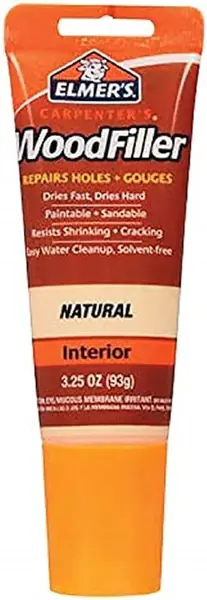
Elmer's Carpenter's Wood Filler in a natural-color 3.25-ounce tube

Painted nail holes

Shop Score 89/100
Container Size
3.25 oz
Use
Interior only
Dry Time
12 to 24 hours
Color
Natural
View on Amazon

The little tube is the appeal: it fits in a drawer, costs little, and puts a thick paste exactly where a nail hole or a molding dent needs it. It dries hard enough to sand and takes paint without a lot of ceremony, which makes it a reasonable pick for a punch list before the painter arrives. The pointed tip helps on trim, though the paste can be stiff to squeeze.

Where we part company is stain-grade work. The natural color is not a match for bare wood, and the filler can dry crumbly or flake when it is worked too thin, so it is not the one we trust under a clear finish on a visible surface. For painted trim, a quick nail-hole repair, or a rental-grade fix, that is an acceptable trade; for a tabletop or floor, choose one of the better-blending fillers above.

Worth Noting

  • Can dry crumbly in the tube
Our Verdict

Save Elmer's for painted nail holes and small trim dents, not for a stain-grade repair that has to disappear in oak.

Check Latest Price
7.

Bondo Wood Filler Best for Painted Exterior Repairs

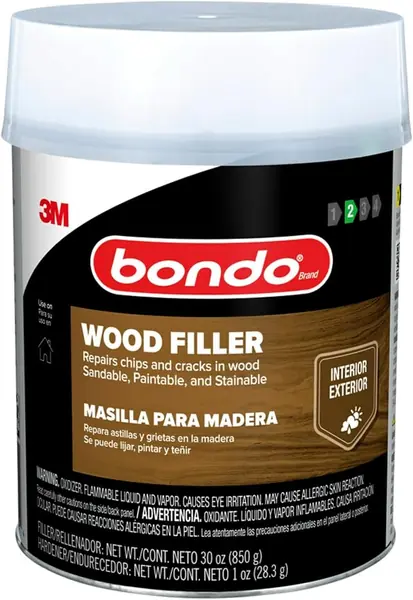
Bondo two-part wood filler with cream hardener in a 30-ounce container

Painted exterior repairs

Shop Score 88/100
Container Size
30 oz
Use
Interior and exterior wood
Dry Time
15 minutes
Formula
Two-part resin with hardener
View on Amazon

The two-part mix is the whole story with Bondo: a cream hardener turns the paste into a dense, fast-curing repair that can be sanded in about fifteen minutes and shaped with a chisel before it sets completely. We like it for a rotted sill, a window frame, or a chunk missing from a painted exterior door, where the repair needs to be hard and weather-resistant rather than invisible under clear finish. It is the only product here that is explicitly built for permanent, non-shrinking repairs.

Mixing is not difficult, but it is less forgiving than scooping from a tub. Measure the hardener, fold it through thoroughly, and place only what you can shape before the paste stiffens. A putty knife and a scrap of cardboard for mixing are enough; the cream hardener is potent, so work in a ventilated spot and keep the container closed.

Once cured, it sands and holds up like a hard patch. That density is why it suits exterior trim and rotted wood, and why it can be a poor match for a delicate furniture repair: it does not feather like a soft latex filler, and it can be harder than the wood around it. Use a light touch with the sander, especially on thin trim.

Our reservation is the finish. On a visible stain-grade patch, this is not the filler we reach for; it can read as a hard, resinous spot and does not take stain like the wood around it. Use it where paint will cover the repair, and reserve the stainable fillers above for furniture and interior trim. For exterior rot under paint, the density and speed are worth the fuss.

Worth Noting

  • Not for visible stain-grade patches
Our Verdict

Reach for Bondo on painted exterior rot and hard repairs, not on a stain-grade patch where the filler has to blend into visible grain.

Check Latest Price

How We Tested Stainable Wood Fillers

We started with the label claims and spec sheets, then filtered for the things that actually predict behavior: whether a filler is stainable or paint-only, water-based or two-part, rated for interior or exterior exposure, and whether the container size lines up with the size of the repair. Paste tubs, squeeze tubes, and two-part formulas went into the same pile; anything that only promised a paintable finish got dropped early. Fourteen fillers went on the bench for four months.

The work happened where repairs actually happen — nail holes in a painted pine bookcase, gaps in a white oak floor, knot holes in a stair tread, a deep crack in an exterior door frame, and a vertical jamb where gravity works against you. We packed each filler into the hole with a putty knife, timed how long it stayed workable, and noted whether it went on creamy or stiff and whether it pulled away from the hole's edges as it dried. On a damp scrap of pine, we checked whether it still set hard.

After curing, we hand-sanded every patch with 120- then 220-grit and watched for edges that feathered flat versus ones that tore and needed a second pass. Half the patches got an oil stain, half a water-based stain, and we compared each result against the bare wood beside it. We measured shrinkage at the edge of the hole at two weeks and again at a month, along with any hairline cracks.

We also resealed every container and reopened it weeks later to see whether the surface had skinned over — the difference between a filler you finish and a filler you throw away. Two-part formulas were mixed in a ventilated area, with the hardener container kept closed between batches.

How to Choose a Stainable Wood Filler

Start With the Finish, Not the Filler

A stainable filler is not a universal color match. On bare wood, the patch has no grain, so it can dry lighter, darker, or flatter than the board around it even when it accepts stain. That is why we start with the finish: a repair under paint only needs a smooth, paintable surface, while a repair under clear stain needs a filler you can tint or a pre-colored product close to the wood. If the patch will sit in a visible field, test a scrap before you commit.

Our picks split along that line. DAP Premium lets you mix stain into the wet filler for control; GoodFilla White Oak starts close on light floors; Elmer's is a paint-grade touch-up tube, not a stain-grade answer. The label's stainable claim is the starting point, not proof of an invisible repair.

Balance Working Time Against Sanding

Fast-drying filler feels efficient until you are trying to shape a long run of trim with a paste that has already begun to set. Fifteen-minute products like Famowood are excellent for small sections, while a two-to-four-hour window gives you room to fill, tool, and check your work. We care more about a controlled working time than the shortest possible dry time.

Sanding behavior matters just as much. A filler that clogs paper or tears at the edge of a patch costs more time than it saves. Use a sanding block, let the filler cure fully, and start with the finest grit that will flatten the repair. If a product dries rock hard, expect to work more carefully around adjacent veneer.

Buy for the Container You Will Actually Finish

A big tub is a false economy if it stiffens before the next project. Water-based fillers can dry out after the lid comes off; some, like GoodFilla, can be brought back with water, while others turn crumbly and stay that way. Buy from a store with turnover, press the lid down, and keep the rim clean.

Match the format to the job. A small tube is right for a punch list; a 16- or 32-ounce tub is right for trim, cabinets, or a floor repair. Do not buy a gallon for three nail holes, and do not try to stretch a 5.5-ounce tub across a whole room.

Respect the Repair's Depth and Exposure

Stainable filler is cosmetic. It can fill a gouge, a nail hole, or a crack, but it is not a structural repair for a loose joint, a rotted sill, or a load-bearing screw hole. Remove loose material, fill in lifts no deeper than the label allows, and let each layer dry. Deep fills can shrink or crack even when the product says it will not.

For exterior work, choose a product rated for indoor and outdoor use, and seal or paint it as the label directs. Famowood, Minwax, DAP, and Bondo are rated for exterior use; Elmer's is interior only. If water can stand on the repair, plan on a finish coat.

Frequently Asked Questions

Final Verdict

Famowood is the stainable filler we reach for first because it sands cleanly, dries fast enough to keep a repair moving, and handles both interior and exterior work. Its short working time and slightly pink natural shade are the trade-offs; work in small sections and test the color under your finish.

If color matching is the hard part, choose DAP Premium and tint a batch. If you are filling a long run of trim, Minwax's large tub is the volume play, provided it arrives soft. For painted exterior rot, Bondo is the hard-curing exception.