↑↓ navigate ↵ open Esc close All results →

Best Wood Fillers for Hardwood Floors of 2026

Hardwood floors record every mishap—skidding chair legs, worn thresholds, and winter shrinkage gaps that snag socks and trap grit with every mopping. Filling those voids restores a continuous, cleanable plane without sanding an entire room back to raw oak.

Over three months, 16 water-based, acrylic, two-part, and pre-colored fillers went into gouges, nail holes, and board seams on scrap oak strip flooring before being sanded flush and topcoated. Failures followed predictable patterns: patches that cured proud, shrank into shallow craters overnight, or sanded into chalky halos no stain could hide—making a quick thumb check across the cured repair essential before finishing.

Because two jars labeled "natural" can dry to completely different tones, sanding behavior, foot-traffic durability, and container coverage weighed heaviest—ranging from deep structural gap fillers to small touch-up tubes for a stray nail hole.

Our Top Picks

The Best Wood Fillers for Hardwood Floors

1.

FamoWood Water-Based Latex Wood Filler Best Overall
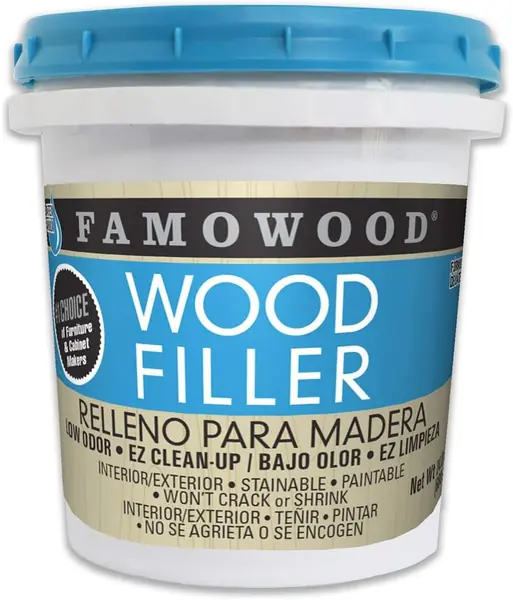
FamoWood natural water-based latex wood filler in a one-pint tub

Interior floor repairs

Shop Score 93/100
Container Size
1 pint
Formula
Water-based latex
Dry Time
15 minutes
Finish
Stainable and paintable
View on Amazon

Fifteen minutes is the number that makes this our pick. The FamoWood tub dries fast enough that you can work your way along a row of dents, come back to the first one, and start sanding while the rest of the room is still taped off. On a floor that matters more than it does on a picture frame: you are usually working around furniture in a room you want back, and every extra hour of cure time is an hour the patch is soft underfoot. The pint tub is the right size for the job, too — enough for a whole room's worth of defects instead of a few test dabs.

Sanding is where we noticed the difference. It powders under the paper rather than balling up, so you can feather the edge into the surrounding boards instead of leaving a ridge you will see every time the light rakes across the floor. Thin coats help: a thick dollop skins over while the middle is still soft, and that is the one way to make this filler fight you. Cleanup is soap and water, and the low odor means you are not opening every window in the house.

Stainable, yes; invisible, no. The cured patch takes stain, but it drinks it differently than the oak around it — lighter on some boards, darker on others, and a few finishes barely move it at all. We test on a doorway or under the sofa before committing to the middle of the room, and on a clear-coated floor we plan on a little color work rather than a perfect match straight out of the tub.

Outdoors is the boundary. The label says interior and exterior, but a water-based filler is a poor bet on a wet, sun-baked deck, and the exterior claim is one we treat as a formality. Indoors, where the floor stays dry and the temperature is yours to control, this is the filler that does the most work for the least fuss.

Worth Noting

  • Stain color rarely matches the floor exactly
Our Verdict

We reach for this one for most interior floor repairs: it dries fast, sands easily, and the pint covers a room's worth of dents and seams.

Check Latest Price
2.

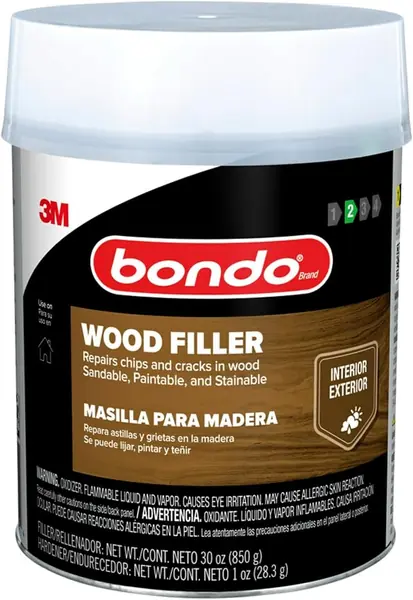
Bondo Two-Part Wood Filler Best for Tough, Deep Repairs

Bondo two-part wood filler 30-ounce bottle with cream hardener tube

Deep structural repairs

Shop Score 92/100
Formula
Two-part with cream hardener
Water Resistance
Water resistant
Volume
30 oz
Full Cure Time
15 minutes
View on Amazon

The tube of cream hardener is the first thing to understand about Bondo: this is a two-part filler, not a tub you open and spread. You scoop the base, squeeze in hardener, mix, and get one window to work before it starts to stiffen. What the fuss buys is a patch that cures hard, stays in the hole, and does not shrink back out of a gap the way a soft latex filler can.

On a floor, that makes it the choice for damage that has gone past cosmetic — the gouge at a threshold that collects grit, the board under a door that has gone soft, the rotted section where paint has been failing for years. It is not the filler for a hairline seam you intend to hide under clear finish; it is the one for a hole that has to survive a footstep.

Work in small batches. The set is quick enough that a big mix stiffens before you get to the second crack, and the hardener ratio is not a place to improvise — too much and the patch turns glassy and miserable to sand. Spread it slightly proud of the surface, let it cure, then knock it back with a block.

We keep coming back to it for the repairs the delicate fillers cannot hold. Buy the 30-ounce only when you have real work for it — it is a great deal of filler for a few holes, and once it is mixed, the clock is running whether you are ready or not.

Worth Noting

  • Not stainable; plan on paint instead
  • Pungent solvent smell until cured
Our Verdict

When a floor defect is deep, soft, or rotted rather than cosmetic, we want this two-part filler: it cures hard and takes paint, though it will not pass for stained wood.

Check Latest Price
3.

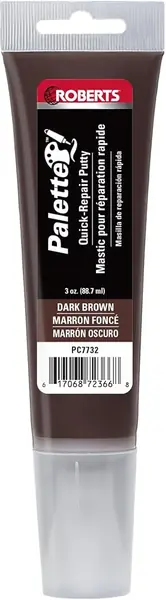
Roberts Palette Quick-Repair Floor Putty Best for Seams and Nail Holes

Roberts dark brown quick-repair putty for wood laminate and vinyl floors

Narrow seam touch-ups

Shop Score 91/100
Color
Dark brown
Formula
Acrylic-based
Shelf Life
Two years
Flooring Types
Wood, laminate, and vinyl
View on Amazon

Roberts sells this as flooring putty and it shows. The colors are named for floor tones rather than wood species, the acrylic formula is built to be walked on rather than carved, and the job it is aimed at is the narrow stuff — the seam between two boards, the nail hole left by a face-nailed strip, the nick a chair leg took out of a finished floor.

Color is the whole decision. This listing is dark brown and the same putty comes in nine other shades, so pick against the finished floor, not the raw wood — a floor that has aged under finish no longer looks like a fresh board. Low VOC is another thing we appreciate, since you are working indoors, and the two-year shelf life means what is left in the container is still usable the next time a board takes a hit.

It dries fast, sands easily, and does not shrink, which is exactly what a narrow seam needs. What it will not do is rebuild a crushed edge or fill a gouge with any depth to it — for that, step up to a real filler and plan on finishing over the patch. This one is for the hairline work you want to be over with.

Worth Noting

  • Cannot rebuild crushed edges or fill deep gouges
  • Must match the aged floor shade rather than raw wood
Our Verdict

Hairline seams and nail holes in a finished floor are where this putty earns its place, as long as the defect is shallow and the shade is right.

Check Latest Price
4.

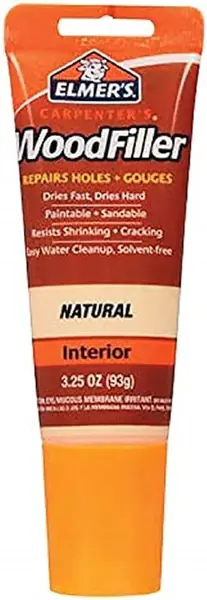
Elmer's Carpenter's Wood Filler Best for Small Touch-Ups

Elmer's Carpenter's Wood Filler natural 3.25-ounce tube for interior wood repair

Small gouge touch-ups

Shop Score 90/100
Container Size
3.25 oz
Color
Natural
Dry Time
12-24 hours
Use
Interior only
View on Amazon

The smallest, least expensive container here is also the least intimidating: a 3.25-ounce tube with a pointed tip that lays filler straight into a gouge without a putty knife. Elmer's names hardwood floor gouges on the label, and that is the job it does best — it is the one we hand to someone who has never repaired a floor.

It goes on as a stiff paste, fills a shallow gouge in one pass, and sands smooth in a few strokes. The stated dry time is 12 to 24 hours, longer than the fast latex fillers here, so this is a fill-it-tonight, sand-it-tomorrow product. Stain is where it lets you down: color sits on the surface instead of soaking in, and under clear finish the patch reads pale. On a floor you plan to paint or recoat, that hardly matters.

Cheap, simple, and good enough is exactly right for a couple of dents by the door, and a tube lives in our toolbox for that. Where it stops being the answer is a deep gouge or the whole perimeter of a room: the fill wants a full day to cure and the tube will not stretch far. Buy two if the hallway is worse than it looks.

Worth Noting

  • Tube skins over between uses
Our Verdict

A few shallow gouges on a floor you plan to paint or recoat are exactly this tube's job — cheap, simple, and not a candidate for a stain match.

Check Latest Price
5.

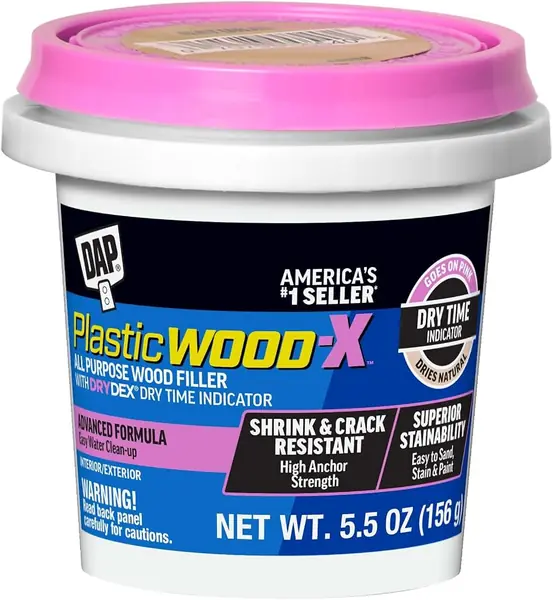
DAP Plastic Wood-X with DryDex Best Dry-Time Indicator

DAP Plastic Wood-X natural latex wood filler in a 5.5-ounce tub

Beginner spot repairs

Shop Score 89/100
Container Size
5.5 oz
Dry Time
3-36 hours depending on depth
Finish
Stainable and paintable
Indicator
Pink that dries natural
View on Amazon

The pink is the whole idea: this filler goes on the color of bubblegum and fades to a natural tan as it cures, so you can see at a glance which patches are ready for paper and which are still soft. That sounds like a gimmick until you are on your knees with six repairs in a row and no way to tell a dry patch from a damp one. Sanding too early is the mistake that ruins most filler jobs — it balls the filler up and drags it back out of the crack — and this takes the guess away.

It spreads as a thick, knife-grade paste that stays where you put it, including on the vertical face of a stair riser or a baseboard, and it sands evenly when the color says go. We like it for nail holes, surface gouges, and scratches rather than anything structural; it is not the filler for a soft board or a hole that has to hold a screw. Stain takes reasonably well for a latex, though the tan is a starting point rather than a match.

Worth Noting

  • Small tub covers only a few repairs
Our Verdict

If you have ever sanded a patch too early, this is the filler we hand over: pink turns tan when it is ready, and it spreads without sagging.

Check Latest Price
6.

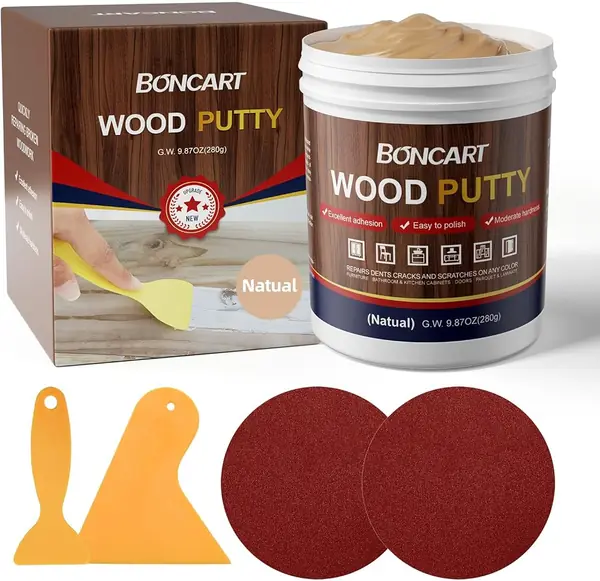
Boncart Wood Filler Putty Kit Best for First-Time Floor Repairs

Boncart natural wood filler putty tub with two scrapers and sandpaper

First-time floor repairs

Shop Score 88/100
Container Size
9.87 oz
Color
Natural
Water Resistance
Not water resistant
Included
Two scrapers and two sandpaper sheets
View on Amazon

Two scrapers, two sheets of sandpaper, and a 9.87-ounce tub arrive together, which makes this the one kit here you can open and use without a trip to the hardware store. For a first repair — a rental deposit on the line, a chair that has been chewing the same spot on the floor — that is worth something.

The putty is a smooth, medium-bodied paste that spreads easily and sands without much fight, and the odd-shaped plastic scrapers actually work. Stain is the weak spot: it takes color unevenly on raw wood and dries lighter than most finished floors, so we treat this as a paint-grade filler rather than a stain match. The tub reseals well enough to keep the rest soft between repairs.

What we keep coming back to is the completeness of it. Someone who owns no putty knife and no sandpaper can fix a room's worth of small dents without buying anything else, and that is a real recommendation for a first attempt. Keep it out of wet areas, though — this is not a water-resistant filler, and a spot by the shower is the wrong place to learn that.

Worth Noting

  • Can crack when used in deep fills
Our Verdict

A complete starter kit — putty, scrapers, and sandpaper — that suits a first repair on a painted floor, though the fill stays soft for anything deep.

Check Latest Price
7.

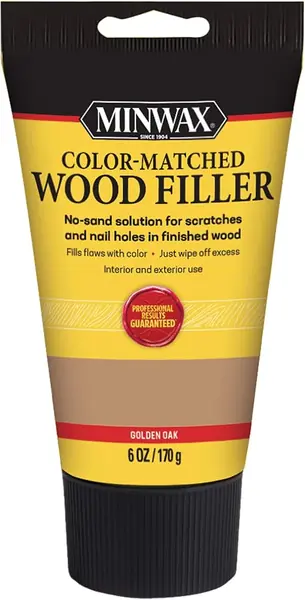
Minwax Color-Matched Wood Filler Best for No-Sand Color Touch-Ups

Minwax color-matched wood filler tube in Golden Oak for finished floors

No-sand color touch-ups

Shop Score 87/100
Container Size
6 oz
Color
Golden Oak
Sanding
Not required
Application
Ready-to-use paste
View on Amazon

Where the Roberts putty is a shade you pick off a color chart, Minwax's color-matched filler arrives already tinted to a named finish — Golden Oak here — and needs no sanding at all. Press it into a defect, wipe the excess with a damp cloth, and let the color do the blending. On a floor that is already coated, that is a very different proposition from a raw-wood filler you have to sand and then stain to match.

When the shade is right, we found the repair simply disappears, and you can fill a nail hole and keep going without a sanding step in between. When the shade is wrong there is no fixing it, and Golden Oak is the shade that draws the most disagreement — on some floors it blends, on others it dries several steps darker than the oak around it. That is the risk with anything premixed, so test it under a piece of furniture or in a doorway before you commit to the middle of the room.

It is a putty, not a structural filler — it fills a defect, it does not rebuild a soft board — and it is meant for finished wood, which is exactly the state your floor is in. For a repair that has to disappear today, nothing else here comes as close.

Worth Noting

  • Cap seal lets the putty harden in storage
Our Verdict

On a finished floor that needs a spot repair today, this premixed Golden Oak putty is the fastest fix here — so long as the shade matches, which you test first.

Check Latest Price

How We Tested Wood Fillers for Hardwood Floors

We started with the damage instead of the label, because a filler that's wrong for a hairline seam is often right for a deep gouge. We gathered water-based, two-part, acrylic, and pre-colored fillers in a range of container sizes and cut the field to 16, tested side by side for three months. Half the work happened in the workshop, on scrap oak strip flooring scored with a set number of gouges, nail holes, and seams; the rest happened in two lived-in homes, on nail holes down a hallway, a worn patch at a kitchen doorway, and a stair tread chewed at the nose.

We timed how long each filler stayed workable before it skinned over, and noted whether it spread with a putty knife or dragged and crumbled at the edges. Once cured, we laid a straightedge across the patch to see whether it sat flush, dried proud, or sank into a crater, then sanded by hand with a block, watching for filler that powdered off evenly and feathered into the boards versus filler that balled up and pulled out of the hole. Cured patches were stained and topcoated to see whether the color took evenly or left a pale halo.

Deep fills went in layers no thicker than the container allowed, with a full cure between passes; two-part products were mixed by an open window, and we wore safety glasses and a dust mask for every sanding session. Patches in the doorway and on the stair nose got walked on for the rest of the test and rechecked weekly for lifting, cracking, or crumbling, and we wiped them with a wet cloth to see whether they swelled or discolored. We also counted how many nail holes one container covered.

How to Choose a Wood Filler for Hardwood Floors

Start With the Damage, Not the Product

Run a fingernail or a screwdriver tip across the defect. A nick, a nail hole, a hairline seam, or a shallow gouge in sound wood calls for a wood putty or a light latex filler that sands easily and disappears under paint or a color match. If the tip sinks, the wood is soft; if the hole has real depth, or the board has rotted, you want a two-part filler that cures hard and can carry a load.

Getting this backwards is the most common mistake we see. A structural filler on a cosmetic nick means fighting it during sanding, and a soft putty in a soft board means doing the repair twice.

Sandability Matters More Than Anything on the Label

You will notice sanding before you notice anything else about a filler. A floor is viewed at a low angle, and a patch that sands harder than the wood around it will dish the boards and leave a hollow you can spot from across the room. Look for fillers described as sanding easily or sanding to a powder, and try a scrap first if you are unsure.

Use a sanding block rather than a loose sheet so the surface stays flat, keep the paper moving, and stop as soon as the patch is flush. Filler that is softer than the wood is far easier to live with than filler that is harder.

Stain Matching Is a Gamble — Plan for It

Here is the trap in this category: stainable on a label means the filler accepts stain, not that the repair will match. Latex fillers take color unevenly and often dry lighter than the surrounding wood, and two-part fillers generally take no stain at all and are strictly paint-grade.

On a clear-finished floor we test on a hidden spot or an offcut before committing, and if the match does not come, a color-matched putty for the touch-up is the better tool than a sandable filler that fights the stain.

Dry Time Sets the Shape of Your Day

Fillers here range from about fifteen minutes to a full day before sanding. A fast filler lets you fill and sand a room in one afternoon, but it also gives you a short working window — scoop or mix small amounts and keep the lid on the rest. Slow latex fillers are more forgiving to apply but turn a deep repair into an overnight job.

Neither is better in the abstract. Match the dry time to whether you are working around furniture for an hour or emptying the room for a weekend.

Buy for the Number of Defects, Not the Worst One

Containers run from a 3.25-ounce tube to a 30-ounce tub, and the right size is the one that matches the job in front of you. A tube handles a handful of nicks; a pint or a tub handles a room, and it is the cheaper way to buy filler by volume.

There is no bargain in a big tub if you have three holes to fill, and no sense in a tube if you are working the whole perimeter of a room.

Frequently Asked Questions

Final Verdict

The FamoWood tub is the one we keep on the shelf: fast enough to finish a room's repairs in an afternoon, soft enough to sand flush without scarring the boards around the patch, and large enough that you are not rationing it.

Go to Bondo when the damage has gone structural — a soft board, rot under a door, a hole that has to hold a screw — and to a color-matched putty for a seam on a floor you do not intend to refinish. Everything else here is a version of those three jobs.