↑↓ navigate ↵ open Esc close All results →

Best Wood Fillers for Large Holes of 2026

Deep voids expose weak wood filler fast: pack a rotted window sill or stripped hinge bore with the wrong paste and the patch shrinks into a crater overnight, splits around the rim, or crumbles the moment a screw bites. Filling a large hole cleanly requires a compound that cures tight to the walls and sands flush without tearing out at the feathered edge.

Chemistry divides large-hole fillers far more sharply than brand name, which became clear over six months of working through 14 formulas. Two-part epoxies and cream-hardener systems rebuild missing wood when strength matters, whereas one-part water-based tubs suit large indoor cosmetic fills—and because formulas soft enough to sand smoothly rarely absorb stain evenly, deciding between paint and clear finish comes first.

From kneadable putty sticks for deep, narrow bores to bulk tubs for wide indoor repairs and weatherproof exterior epoxies, each option holds firm under real shop stress.

Our Top Picks

The Best Wood Fillers for Large Holes

1.

PC-Woody Epoxy Paste Best Overall
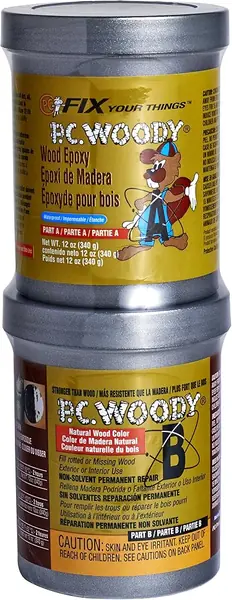
PC-Woody two-part wood repair epoxy paste in two tan cans

Exterior rot repair

Shop Score 94/100
Container Size
12 fl oz
Full Cure
24 hours
Tensile Strength
850 psi
Mix Ratio
1:1 by volume
View on Amazon

A deep cavity is a one-shot problem: you have to get material to the bottom of the hole, shape the top, and keep it from sliding off a vertical face, all before it starts to set. PC-Woody makes that part easier. The two parts mix 1:1 into a thick paste with a working window long enough to pack a rotted sill, reposition a piece that went in crooked, and pare the edges before the surface firms up.

We reach for it first when the repair is structural. Cured, it takes a drill, a nail, and a screw, and it's rated for outdoor service, which is what you want on a sill, a jamb, or a porch column where the wood has rotted through. The high tack keeps it where you press it instead of drooping down the face of a door edge, which is the failure that ruins most vertical repairs.

Staining is the one place it asks for planning. The tan paste doesn't absorb a light stain the way wood does, so use a dark or solid-body pigment over it, or paint it. It also costs more per ounce than everything here except the KwikWood stick, and that premium is what buys the working time and the strength. On a painted exterior repair that's an easy trade; on a pale oak floor it's the wrong tool.

Worth Noting

  • Sticky paste is messy to mix
  • Full cure takes 24 hours
Our Verdict

Our default for a deep repair: it gives us the working time to place the paste properly and the strength to hold a screw once cured.

Check Latest Price
2.

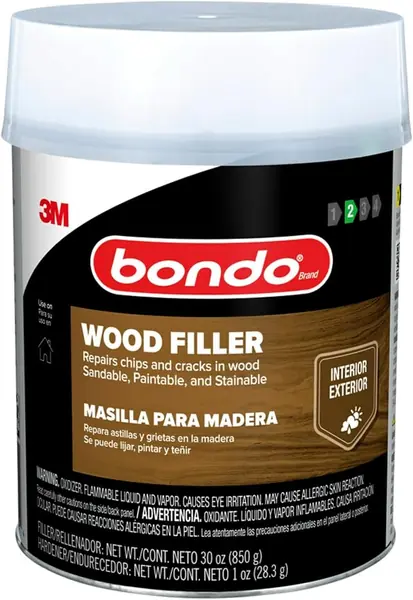
Bondo Wood Filler Best Value for Big Painted Repairs

Bondo two-part wood filler quart bottle with cream hardener tube

Large painted patches

Shop Score 93/100
Container Size
1 qt (30 oz)
Hardener
0.5 oz cream hardener
Sandable In
15 minutes
Water Resistance
Water resistant
View on Amazon

A full quart, plus a tube of cream hardener, is a lot of repair material, and the epoxy pastes in this guide come in cans a third that size. If the job is a set of rotted step treads or a door frame with a chunk knocked out of it, that volume is the whole argument: mix what the repair needs and there is still filler in the bottle for the next one.

It's an auto-body material at heart and behaves like one. We found it goes from spreadable to firm quickly, so mix small batches one at a time and stop fiddling once it starts to kick. The payoff arrives fast: it can be sanded by hand or with a power sander in about 15 minutes, and it cures hard without shrinking back into the hole.

Exterior trim, porch rails, garage door edges, anything headed for primer and paint is where this one earns its keep. Prep the surface, pack the filler in slightly proud of the wood, sand it flush, and coat it. If you are filling a lot of cubic inches and the topcoat will hide the repair anyway, this is the sensible buy.

Worth Noting

  • Patch will not take stain evenly
Our Verdict

Buy this one when the hole is huge and the finish is paint: a quart of fast-sanding filler that cures hard and stays put.

Check Latest Price
3.

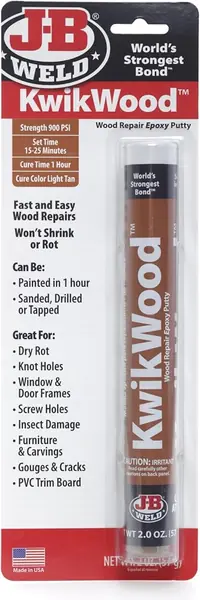
J-B Weld KwikWood Best for Deep Narrow Holes

J-B Weld KwikWood beige epoxy putty stick for wood repair

Stripped screw holes

Shop Score 92/100
Full Cure
60 minutes
Tensile Strength
2,450 psi
Net Weight
2 oz
Stick Size
7 inch
View on Amazon

Slice off a length, knead it between your fingers until the core and the outer layer are one color, and press it into the hole. That's the whole process. For a deep, narrow repair such as a stripped hinge screw, a knot hole, or a splintered cabinet edge, it is far less fuss than mixing a can of paste and scraping the leftovers out of a lid.

We liked it most where a filler has to hold a shape by itself. It stays where it's pushed on a vertical edge, cures to something you can drill, and its stated tensile strength of 2,450 psi is the highest in this group. A repair that used to mean drilling out and gluing in a dowel becomes a simple job, and the beige color is easy to cover with paint.

Judge the size of the repair before you cut: 2 ounces goes a long way in a screw hole and nowhere in a fist-sized cavity, where a can of paste is the better buy. On a deep plug, give it overnight before you sand rather than trusting the hour on the label.

Worth Noting

  • Beige putty does not match bare wood
Our Verdict

For a deep, narrow hole, we reach for this stick before any can: knead, press it in, and the repair is done.

Check Latest Price
4.

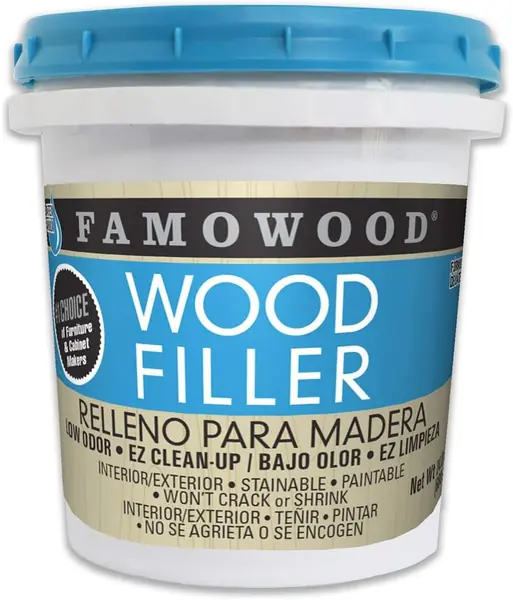
Famowood Water-Based Wood Filler Best for Furniture and Interior Trim

Famowood natural water-based wood filler in a one-pint tub

Furniture and trim

Shop Score 91/100
Container Size
1 pint
Dry Time
15 minutes
Cleanup
Water
Use
Interior and exterior
View on Amazon

The texture is what makes this one easy to love. It comes out of the tub creamy, spreads with a putty knife like soft frosting, and feathers to nothing at the edges, which is exactly what a patch on a table apron or a door casing needs if the repair is going to vanish under a finish.

We keep a pint on the shelf for furniture and interior trim. It's water-based, so cleanup is a rinse under the tap, and the 15-minute dry time means a repair can be sanded and recoated the same afternoon. Deep gouges go in as layers rather than one heavy pack, and each pass stays workable, sands flat, and can be drilled or planed once cured.

The label lists interior and exterior use; we treat it as an indoor product. On a sill or a deck board, a two-part epoxy is the better bet, because this filler's strength is in how it finishes, not in how it stands up to weather.

Worth Noting

  • Natural shade has a pink cast
  • Stain can dry lighter than wood
Our Verdict

We keep this one for indoor furniture and trim, where its creamy spread and 15-minute dry time matter more than brute strength.

Check Latest Price
5.

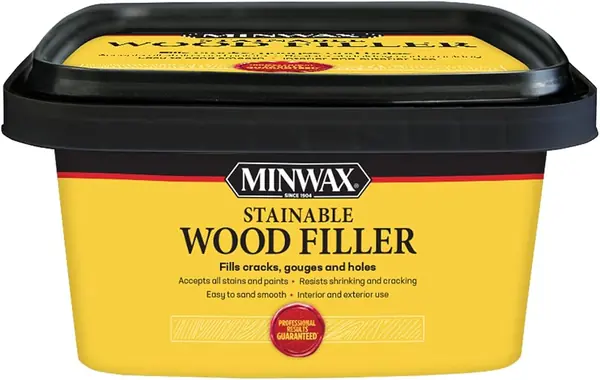
Minwax Stainable Wood Filler Best Bulk Tub for Indoor and Outdoor Work

Minwax stainable wood filler in a 32-ounce natural-color tub

Whole-project filling

Shop Score 90/100
Container Size
32 oz
Dry Time
2 to 6 hours
Color
Natural
Cleanup
Soap and water
View on Amazon

Thirty-two ounces is a lot of filler, and it is the right amount when the repair is really a project: a door frame with a dozen holes where hardware used to be, a trim run you are repainting, a sill with several soft spots. It is also one of the least expensive ways here to buy filler by volume.

We treat it as a paint-grade workhorse. The latex formula spreads easily, sands flush without tearing at the edges, and cleans up with soap and water. Deep fills need patience, so build them in layers and let each one go off before adding the next, because a thick single pack skins over while the middle is still soft.

For a single gouge, a small tube is the better buy; for a whole house's worth of trim, this is the size that makes sense. It is a filler to keep on the shelf for the jobs you find as you work through a room, not one to buy for a single nail hole.

Worth Noting

  • Tub dries out between sessions
  • Stain rarely matches surrounding wood
Our Verdict

The tub we buy when a project has more holes than patience, as long as the finish is paint or a forgiving stain.

Check Latest Price
6.

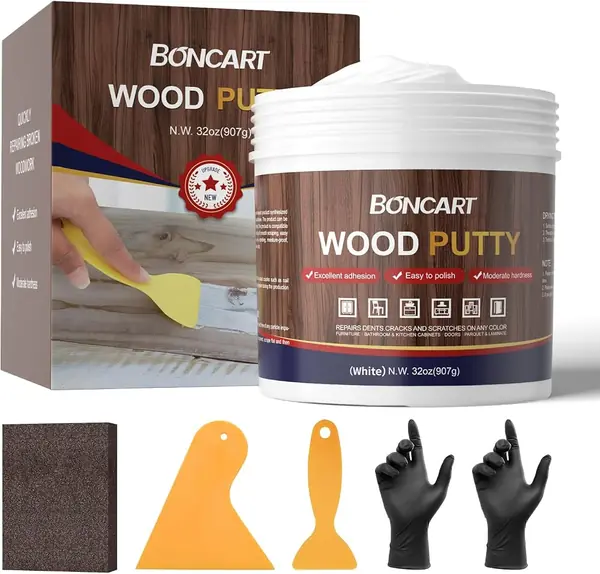
Boncart Wood Filler

Boncart white wood putty tub with scrapers, sanding block, and gloves

Painted white trim

Shop Score 89/100
Container Size
32 oz
Color
White
Included
2 scrapers, sanding block, gloves
View on Amazon

The box includes two scrapers, a sanding block, and a pair of gloves, which is more than most fillers here give you beyond the tub itself. For a first furniture repair or a set of painted cabinet doors, having the tools in the box removes an errand.

The filler is a thick white paste that spreads smoothly and sands to a flat surface, and we found it forgiving to work with: it holds where you put it and does not drag as it skins over. Thirty-two ounces is enough to work through a room's worth of trim without rationing.

Build deep spots in two passes rather than one heavy dollop, and let it cure fully before sanding. That approach also keeps a thick patch from cracking later, which is the usual way a budget paste lets you down.

Worth Noting

  • White shade only suits painted surfaces
Our Verdict

A sensible buy for painted white trim: a big tub, a smooth paste, and the scrapers included.

Check Latest Price
7.

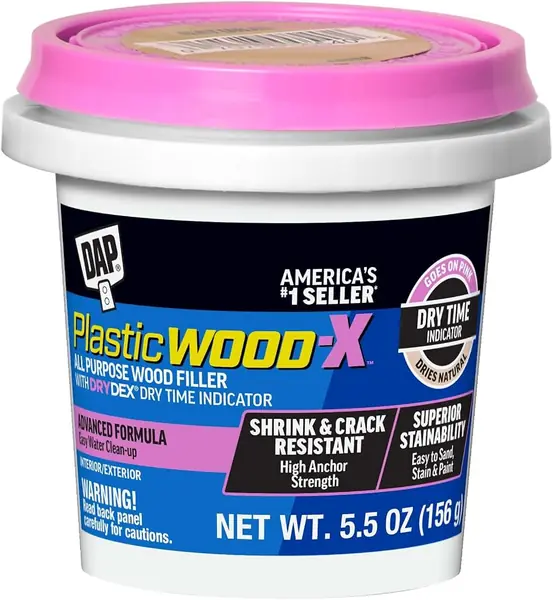
DAP Plastic Wood-X Best for Nail Holes and Cracks

DAP Plastic Wood-X natural latex wood filler in a small tub

Nail holes and cracks

Shop Score 88/100
Container Size
5.5 oz
Dry Time
3 to 6 hours
Dry Indicator
Pink to natural
View on Amazon

It goes on pink and fades to a natural tan as it cures. That sounds like a gimmick until you are filling something deeper than a nail hole, where the surface can feel hard while the middle is still soft. The color tells you when to pick up sandpaper.

The material itself is a thick, knife-grade latex that stays put on a vertical casing and takes paint well, and we like that it removes the guesswork from a repair you are going to paint anyway. Spread it, watch it fade, sand it, coat it.

Buy it for trim, casings, and the small stuff. A genuinely large cavity would take several tubs, which makes it an expensive way to buy volume, and the deep-fill cure time is long enough that a thick patch becomes a two-day project.

Worth Noting

  • Small tub runs out on big fills
  • Deep fills need 36 hours before sanding
Our Verdict

We like it for trim and casings, where the pink-to-tan change takes the guesswork out of when to sand.

Check Latest Price

How We Tested Wood Fillers for Large Holes

We started by sorting every filler we could find by what it is actually built to do: one-part water-based tubs, two-part epoxies and cream hardeners, and kneadable putty sticks. From there we narrowed to 14 that covered the container sizes, exposure ratings, and price-per-ounce spread shoppers actually choose between, and dropped the single-use tubes too small to fill anything beyond a nail hole.

Testing ran six months across a handful of houses and one very tired garage. We packed fillers into a rotted porch sill, a chunk missing from a garage door frame, stripped hinge-screw holes in a cabinet door, nail holes in white painted trim, and a chewed furniture leg. Two-part products were measured at the stated ratio — both parts, on a scale, never eyeballed — and mixed and sanded in a ventilated garage with a fan running.

We timed how long each stayed workable in the pot, and on vertical faces we watched whether it held where we put it or sagged out of the hole before it set. After full cure we came back to see if the patch had pulled below the surface or cracked at the rim, then drove screws into the cured hinge holes to see whether they held. Each patch was block-sanded flush, with notes on clogged paper, torn edges, or a clean cut. Sample patches got stain and paint side by side, exterior patches stayed out through rain and two freezes, and reopened containers sat a month to see if they skinned over.

How to Choose a Wood Filler for Large Holes

Match the Material to the Size of the Hole

Treat anything deeper than about a quarter inch as a structural repair rather than a cosmetic one. Two-part epoxies and epoxy putty sticks cure hard enough to drill, sand, and hold a screw; latex and acrylic fillers are easier to spread and sand but do their best work in gouges, cracks, and shallow holes that will be painted. Squeeze tubes of lightweight putty are for nail holes and surface dents, and a deep cavity will show you how little material they actually contain.

Working Time Matters More Than Fast Drying

A big fill takes minutes of packing, topping off, and trimming, and a product that firms up while you are still working turns a repair into a race. We weight working time heavily for large holes: PC-Woody stays spreadable long enough to fill a deep cavity properly, and that is a large part of why it leads this list. When a filler does kick fast, as Bondo does with its 15-minute sanding time, the answer is small batches mixed one at a time rather than one heroic batch.

Plan for Paint, Not Stain

Almost nothing here takes stain like wood does. Two-part epoxies are essentially plastic and absorb pigment unevenly, and latex fillers that advertise stainability often dry lighter or darker than the grain around them. On a repair that will be clear-finished, test the filler on an offcut first, lean toward a dark or solid-body stain, or fill after the finish is on with a color-matched putty. If the patch is getting painted, buy on strength and stop worrying about color.

Rebuilding Rotted or Missing Wood

Cut back to sound wood before you fill. Filler bonded to soft, crumbly fiber lifts out with the next season, and no product will consolidate punky wood, so a wood hardener is a separate step that comes first. For a missing corner or a wide opening, pack epoxy paste against a backer or a taped form so it cures roughly to shape, then sand it to the profile. If the repair carries load, sister in a new piece of wood instead of trusting filler alone.

Buy for the Shelf Life You Will Use Up

A 32-ounce tub is the cheapest way to buy filler and a false economy if you fill three holes a year, because tubs firm up around the rim long before they are empty. If you do buy bulk, press the lid down flat and store it indoors, off a cold garage floor. Small tubes and sticks cost more per repair, but they never leave you chiseling dried material out of a can.

Frequently Asked Questions

Final Verdict

PC-Woody is our pick for a hole big enough to need rebuilding rather than hiding. The extended working time lets you place it properly, the cured patch takes a screw, and it holds up outdoors where the rot started, which is the combination most products here cannot offer at once.

If the repair will be painted and the cavity is enormous, Bondo's quart covers more area for less money per ounce, and for a stripped hinge screw the KwikWood stick is faster than mixing anything. Those two cover the jobs the top pick is overqualified for.