↑↓ navigate ↵ open Esc close All results →

Best Wood Fillers for Cabinets

Cabinet work leaves nowhere for a sloppy patch to hide: a ring of old pull holes or a hairline face-frame crack shows up immediately once gloss or satin paint hits the door. Any filler that shrinks, gums up under paper, or dries a shade off forces a second round of sanding and repainting.

Matching chemistry to the repair matters far more than brand names, a lesson reinforced across five months of testing 14 fillers. Soft water-based paste handles nail holes and shallow seams, two-part resin rebuilds a rotted sink corner, and kneadable epoxy putty locks a screw back into a stripped hinge mortise—provided sanding waits until the patch cures firm enough not to drag out or tear surrounding paint.

Covering white paint-grade doors and stained face frames alike, these eight formulas span quick cosmetic tubes through structural two-part repairs that sand dead flush.

Our Top Picks

The Best Wood Fillers for Cabinets

1.

DAP Premium Wood Filler Best Overall
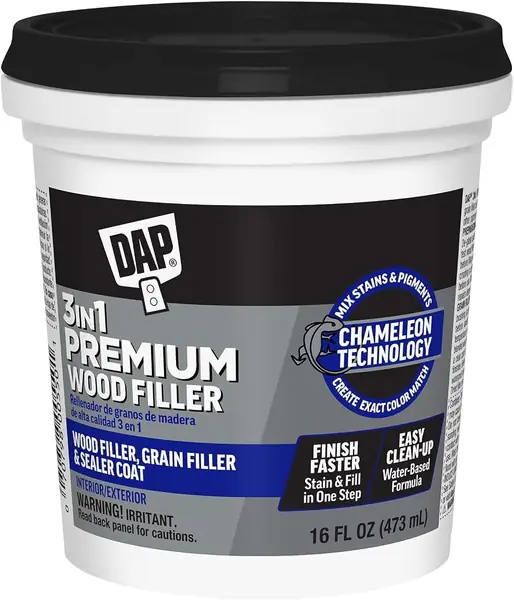
White DAP Premium Wood Filler acrylic latex paste in a 16-ounce tub

Most cabinet repairs

Shop Score 92/100
Color
White
Container Size
16 fluid ounces
Dry Time
2 to 4 hours
Base
Water-based acrylic latex
View on Amazon

Color is where cabinet repairs give themselves away. You fill a nail hole, sand it flush, and the patch reads as a pale dot the moment stain or paint lands on it. DAP's Chameleon Color Blend goes at that directly: you can stir stain, paint, or pigment into the filler while it's still wet, so the plug in a cabinet stile starts close to the surrounding finish instead of fighting it. The base is a thick, water-based acrylic that holds its shape on a vertical face and dries in 2 to 4 hours.

It does more than holes. The same tub works as a grain filler and a sealer, which matters on oak or ash cabinets headed for paint, where a couple of passes across the open pores gives you the flat surface a topcoat needs. It sands to powder rather than gumming up the paper, and once cured it takes a screw, a saw, and a router bit without chipping out. We also appreciate that it cleans up with water, because most cabinet work happens in a kitchen you're still cooking in.

We reach for this tub first on a cabinet project because it covers the whole job, a run of nail holes, a chipped stile, and the grain on a painted door, without switching products. Sixteen ounces handles a full set of cabinets with some left for touch-ups, and the range of repairs it takes on is hard to argue with at this price.

Worth Noting

  • White base needs tinting for dark cabinets
Our Verdict

Our default for cabinet work: one tub fills holes and open grain, and lets us tint the patch toward the cabinet's own finish.

Check Latest Price
2.

Bondo Wood Filler Best for Large or Rotted Repairs

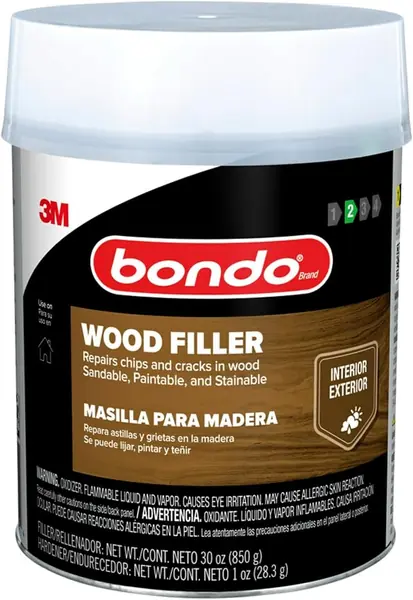
Bondo two-part wood filler in a 30-ounce can with cream hardener tube

Large damaged areas

Shop Score 91/100
Container Size
30 oz
Formula
Two-part resin with cream hardener
Sandable In
15 minutes
Paintable In
25 minutes
View on Amazon

Fifteen minutes after you mix it, Bondo's two-part filler is ready for sandpaper. That number tells you most of what this product is for: a cabinet with a real problem, a rotted bottom rail, a corner chewed by a dog, a gouge deep enough to catch a fingernail, and not a leisurely afternoon of chasing nail holes around a kitchen.

Mixed with the cream hardener, it goes off hard and stays that way. It doesn't sink back out of a deep fill the way soft paste fillers can, and it feathers under sandpaper without tearing, which puts it near the top of this group on sandability. On a cabinet side or a face frame with structural damage, that hardness is the entire point.

Two things to plan around. The unmixed resin is potent, so mix it by an open window or outdoors rather than in a closed kitchen. And because it sets so fast, a batch mixed for a long run of holes starts to stiffen in the pot; mix small, work quickly, and pare the excess off with a chisel a couple of minutes after it goes on to save yourself most of the sanding.

We rate it the strongest choice here for damage you can see from across the room, and the finish is the limit: this is a paint-grade repair rather than a stain-grade one. Under paint the patch disappears. On a cabinet you intend to keep natural, use the DAP tub instead.

Worth Noting

  • Short working window leaves no room for error
  • Strong solvent odor before the hardener goes in
Our Verdict

We reach for Bondo when a cabinet has real damage, a rotted corner or a deep gouge, and the repair has to be hard, flat, and paintable.

Check Latest Price
3.

J-B Weld KwikWood Best for Stripped Hardware Holes

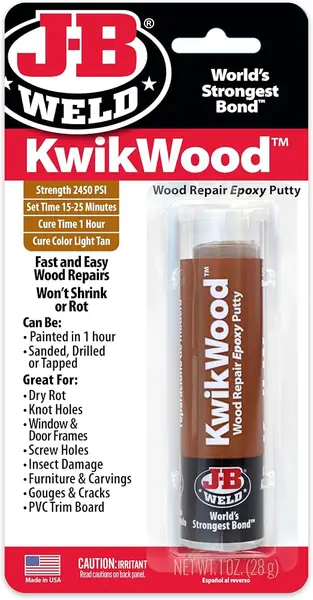
J-B Weld KwikWood tan two-part epoxy putty stick for wood repair

Stripped screw holes

Shop Score 90/100
Size
1-ounce stick
Full Cure
1 hour
Work Life
15 to 25 minutes
Lap Shear Strength
900 PSI
View on Amazon

Sooner or later a cabinet hinge screw spins in its hole and the door sags. Paste filler can't fix that, because the screw needs something to bite into. KwikWood is the product we keep on hand for it: a two-part epoxy putty you knead by hand, press into the wallowed-out hole, and drill once it cures. We've used it on hinge plates, drawer-slide screws, and knobs pulled clean out of a door, and the repair takes a screw again.

It handles like stiff clay rather than paste, which is why it stays exactly where you put it. You get a work life of 15 to 25 minutes; after about an hour it can be drilled, tapped, sanded, and painted. Cured, it's light tan and rated at 900 PSI lap shear, the figure that separates it from every paste filler here, and it doesn't shrink or pull away from the sides of a hole.

The mixing is the whole ballgame. If the outer layer and the core aren't kneaded to one uniform color, you get soft spots that never harden properly, and a stick that has sat in a drawer for a couple of years can dry out before you open it. Check that both parts are still workable, knead thoroughly, and the hour of cure is the easy part.

Worth Noting

  • Small stick covers a single hardware repair
Our Verdict

We keep a stick of KwikWood for repairs that must hold a screw again, like a stripped hinge or a drawer-slide hole.

Check Latest Price
4.

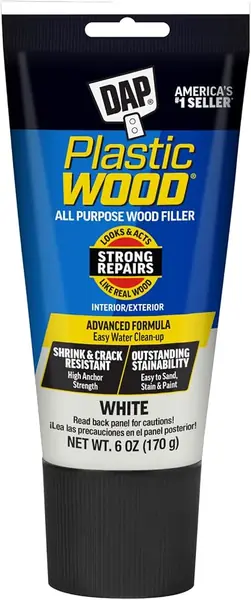
DAP Plastic Wood Best for White Painted Cabinets

DAP Plastic Wood white latex wood filler in a 6-ounce tube

White painted cabinets

Shop Score 89/100
Color
White
Container Size
6 oz
Dry Time
3 to 6 hours shallow; 36 hours deep
Formula
Latex paste
View on Amazon

A white filler on a white cabinet does quiet work: you fill the nail hole, wipe the edges clean, and often skip a separate priming step because there's no tan patch telegraphing through the topcoat. DAP's Plastic Wood is a thick latex paste in a six-ounce tube, and on painted cabinets it's the sensible default.

What we like most is the body. It's knife-grade, so it stays where you put it on a vertical stile instead of sliding down, and it shrinks little enough that a nail hole is usually a one-and-done fill. It sands to a smooth edge and takes latex and oil paint both, drying in 3 to 6 hours for shallow fills and much longer for deep ones. The limit is depth: built up too thick in one pass, this filler can crack and work loose, so layer anything deeper than a shallow ding.

One cabinet-specific trick: pack a wallowed-out screw hole with toothpicks and filler, let it cure, and the screw has something to bite while you decide whether the job calls for epoxy. For ordinary nail holes, wipe the surrounding surface with a damp cloth while the filler is still soft and you can skip most of the sanding.

Worth Noting

  • Dries closer to light gray than white
Our Verdict

On white cabinets we want a filler that disappears under paint, and this latex paste does that with minimal priming.

Check Latest Price
5.

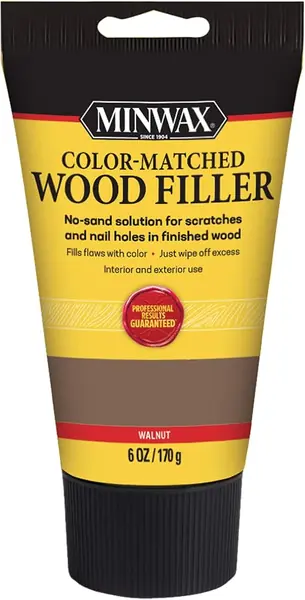
Minwax Color-Matched Wood Filler Best for Finished Wood Touch-Ups

Minwax color-matched wood filler in walnut, 6-ounce container

Finished cabinet touch-ups

Shop Score 88/100
Color
Walnut
Container Size
6 oz
Use
Interior and exterior
Sanding
None needed
View on Amazon

Every other filler on this page ends with sandpaper and a topcoat. Minwax's color-matched filler is built for the opposite situation: a finished cabinet with a ding in the face, where you press in a walnut-toned paste, wipe the surrounding surface clean, and walk away. We keep it for exactly that, repairs on cabinets we aren't refinishing.

It behaves like a stiff putty, and the no-sand claim holds for shallow marks on a sealed surface. Two things to know. The dried patch runs lighter than the tub suggests, so test it somewhere hidden, inside a drawer box or on the back of a door, before you touch a face frame. And this is a touch-up product rather than a whole-kitchen filler; a deep gouge or an open pore needs one of the sandable pastes.

Worth Noting

  • Limited to five stock wood tones
Our Verdict

We use this one when a cabinet is already finished: it fills a ding without sanding, and the patch takes a topcoat.

Check Latest Price
6.

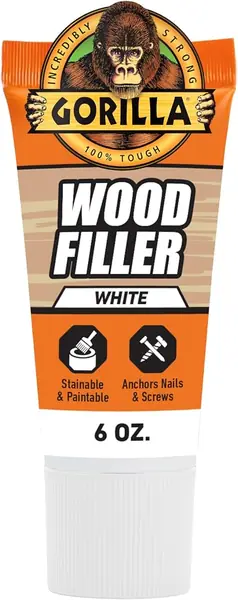
Gorilla White Wood Filler Best for Hairline Cracks

Gorilla white wood filler in a 6-ounce squeeze tube

Hairline cracks

Shop Score 87/100
Color
White
Container Size
6 oz
Dry Time
About 60 minutes shallow; 2 to 6 hours deep
Water Resistance
Water resistant
View on Amazon

A six-ounce squeeze tube is an underrated format for cabinet work. There's no tub to skin over between projects, and the nozzle puts filler directly into a crack in a stile instead of building it up on the surface to sand back down. Gorilla's white version is aimed at painted wood, which is where most cabinet touch-up happens.

We rate it second among the white fillers here, and the gap is about control rather than chemistry. The acrylic formula is water resistant, so it's fine on a cabinet beside a sink or a dishwasher, and it dries to the touch in about an hour for shallow fills, with deep holes taking 2 to 6 hours. What holds it back is body: it comes out of the tube softer than DAP's paste, so you work in thinner passes on a vertical face.

Worth Noting

  • Soft consistency requires thinner passes on vertical cabinet faces
  • Deep fills take 2 to 6 hours to dry
Our Verdict

A squeeze tube of water-resistant white filler we like for hairline cracks and quick touch-ups near a sink.

Check Latest Price
7.

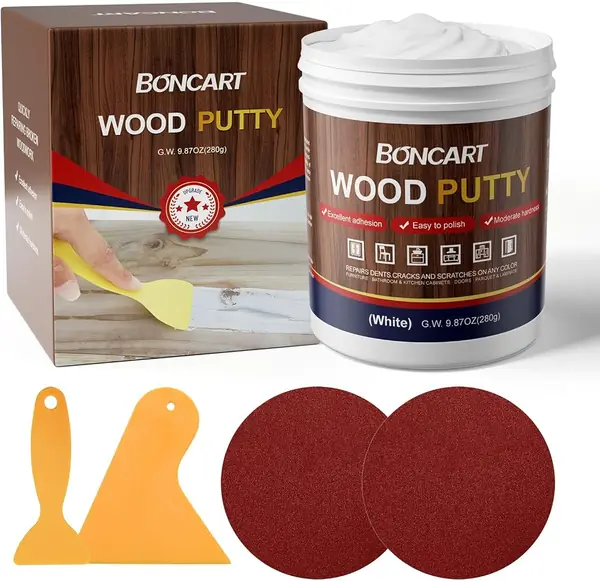
Boncart Wood Filler

Boncart white wood filler tub with two scrapers and sandpaper sheets

Starter repair kit

Shop Score 86/100
Color
White
Size
9.87 oz
Finish
Sandable and paintable
Kit Contents
Two scrapers and two sandpaper sheets
View on Amazon

Open the box and you get more than filler: a tub of white wood putty, two plastic scrapers, and two sheets of sandpaper. For someone whose toolbox amounts to a single screwdriver, that's the difference between starting the repair tonight and making a hardware run first.

The filler itself is a thick white paste that sands and paints, and the line runs to nine tones, ebony, walnut, natural, mahogany, white oak, black, and white among them, which is more color choice than most fillers this size offer. The white version is the one for painted cabinets, doors, and trim.

We rate it the easiest entry point here for a small painted-cabinet repair, mostly because everything you need is in the box, and 9.87 ounces stretches across a rental's worth of nail holes and dings. If you already own a putty knife and a sanding block, the DAP tube is the better filler.

Worth Noting

  • Outperformed as a filler if you already own putty tools
Our Verdict

We like it as a first kit: white filler with scrapers and sandpaper, enough for cabinet holes without buying tools.

Check Latest Price
8.

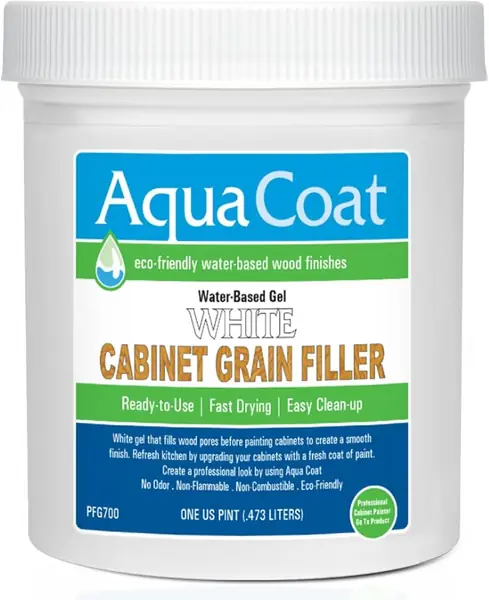
AquaCoat White Cabinet Grain Filler

AquaCoat white cabinet wood grain filler gel in a 16-ounce bottle

Open oak grain

Shop Score 85/100
Color
White
Container Size
16 fluid ounces
Dry Time
30 to 60 minutes
Formula
Water-based gel
View on Amazon

Open oak grain is a different problem from a hole. Paint bridges the pores, then sinks as it cures, leaving a print of the wood under a finish that was supposed to be smooth. AquaCoat's white gel is made for that job: a water-based grain filler you work across the grain to pack the pores before primer.

Application is quick and a little messy. You spread it against the grain with a squeegee, an old credit card, or your fingers, let it dry for roughly 30 to 60 minutes, and sand back lightly. It's low-odor and water-based, which matters in an occupied kitchen where the cabinets are staying put.

The sanding is what makes or breaks the result. Work in one direction, use fine paper, and check the surface under a raking light before primer, because a pore that looks filled in flat light shows up the moment paint lands on it. Budget an evening for a run of oak doors rather than a half hour.

We recommend it for exactly one job: flattening open grain on cabinets that are about to be painted. It is not a hole filler. A gouge, a cracked stile, or a stripped hinge screw needs one of the pastes or the epoxy above, and thin gel will simply shrink back out of them.

Worth Noting

  • Needs several coats to close open oak grain
Our Verdict

We recommend it for one job only: flattening open oak grain before paint, not filling holes.

Check Latest Price

How We Tested Wood Fillers for Cabinets

We built the shortlist by sorting the category by the repair each product is built for — cosmetic nail-hole fills, two-part structural repairs, epoxy putty for stripped hardware holes, and gel fillers meant to close open grain before paint — then narrowed by formula, color, container size, and cure time. Fourteen fillers made the cut: water-based pastes, hardening resins, and ready-to-use putties.

Testing ran five months across two kitchens: a 1950s house with painted-over oak cabinets and a newer one with a damp patch in the sink base. We filled nail holes and hairline cracks in door stiles, packed out stripped hinge-screw holes and drove the screws back in to see whether they held, and built up a soft corner under the sink in layers.

Each patch was sanded flush by hand with a block; we noted whether it came off as powder or smeared and clogged the paper, and timed how long each needed before that sanding. Then we painted or stained over the repair and checked for flashing or a color mismatch. Gel fillers went across bare oak door faces to see whether the pores still showed under paint, and cured fills got a thumbnail press to judge hardness, with deep fills watched for shrinkage and cracking over the following weeks.

Consistency was checked straight out of the container: whether the paste spread easily or arrived dry at the edges, and whether it held on a vertical door face. Water-based products were used indoors with windows open; the two-part resin and the epoxy were mixed outdoors as their labels direct, and we noted the odor and cleanup each left in a working kitchen. We also counted how many hinge holes a small tube covered before it dried out, and dabbed water on patches near the sink to see how well they sealed once topcoated.

How to Choose a Wood Filler for Cabinets

Start With the Repair, Not the Product

Four cabinet problems want four different products. Nail holes and hairline cracks in painted wood want a latex paste you can spread thin and sand flush. A stripped hinge or drawer-slide screw wants a two-part epoxy putty that hardens hard enough to drill and re-tap. A rotted corner or a gouge as deep as your fingernail wants a two-part resin. And an oak or ash cabinet headed for paint wants a grain filler gel, which is a different product again.

Buying one tub to cover all four is how a hinge screw keeps spinning. Decide which of these you actually have before you shop, and accept that a kitchen with mixed damage may need two products.

Decide Paint or Stain Before You Buy

If the cabinets are getting painted, color barely matters, since white and natural fillers both disappear under a couple of coats, though a white filler saves a priming step on white cabinets. If you're keeping the wood natural, color is the whole decision: a tintable filler lets you stir stain into the wet paste, while a color-matched putty gets you close straight out of the tub.

Either way, test on scrap or inside a drawer box first. Many fillers dry lighter than they look in the container, and a patch that reads right when wet can dry two shades pale.

Match Working Time to the Job

A fast two-part filler buys speed, since Bondo is sandable in about fifteen minutes, but it also starts to stiffen while you're still working, so you mix small batches and keep moving. A latex paste gives you hours of open time, which is what you want when you're filling nail holes around a kitchen at your own pace.

Depth matters as much as chemistry. A shallow latex fill dries in a few hours; a quarter-inch-deep hole can take a day and a half, and anything that deep goes in two layers.

Work Clean Indoors

Cabinet work happens in a room you're still living in, so smell and cleanup are real criteria. Water-based pastes wipe off a putty knife and your hands with a damp rag and won't run you out of the kitchen. Two-part resins are the exception, because the unmixed component is strong, so mix outdoors or by an open window.

Whichever you choose, keep a damp cloth at hand while the filler is still soft. Wiping the surrounding surface before it sets saves most of the sanding.

Buy the Right Amount

A six-ounce tube handles a few dozen nail holes with some to spare, while a sixteen-ounce tub covers a full run of cabinets, holes and grain together. Grain filler is the one that catches people out: it goes across whole door faces rather than into a single hole, and several passes burn through a bottle quickly.

If you're refinishing a kitchen, buy for the square footage of door front, not the hole count.

Frequently Asked Questions

Final Verdict

For most cabinet repairs we reach for one tub: DAP Premium Wood Filler fills the holes, seals open grain before paint, and lets you tint the patch toward the finish instead of painting over a white dot. It is the one product here that handles a whole run of cabinets, including the defects you only notice once the primer is on.

Step away from it in two situations. When a screw has to hold again, use J-B Weld KwikWood. When the cabinet has damage rather than a defect, a rotted corner or a deep gouge, use Bondo and plan on paint.