↑↓ navigate ↵ open Esc close All results →

Best Wood Filler Sticks of 2026

A scratch on a wood table is a small thing that becomes a big one — you notice it every time you sit down. Wood filler sticks are the low-effort fix: rub colored wax or putty into the mark, scrape it level, and it fades back into the finish. No sanding the whole top, no refinishing.

We tested 16 filler sticks and repair kits over six months, pressing them into real damage at home and work: a gouged oak side table, a floor plank by the door, painted baseboards, a chair rung that gets handled daily. Firmness matters far more than piece count — a soft crayon wax wipes into a surface scratch beautifully, then slides back out of anything your hands touch. One aside from my kitchen: cap colors are a rumor, so test a shade on an underside first.

The picks below run from everyday wax to epoxy putty and from six shades to a dozen, so there's a filler for a nail hole and one for a rotted sill. What they share: a repair that stops catching your eye.

Our Top Picks

The Best Wood Filler Sticks

1.

Mohawk Finishing Products Fil-Stik 12 Pack Best Overall
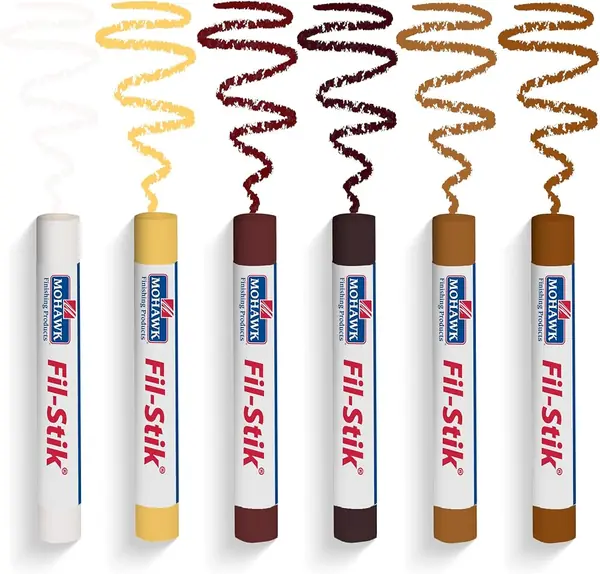
Mohawk Fil-Stik wax filler sticks in twelve assorted wood tones with round crayon-style bodies

Furniture touch-ups

Shop Score 91/100
Colors
12 assorted wood tones
Filler Type
Semi-hard wax
How To Apply
Rub in and scrape level, no heat
Sticks Per Pack
12
View on Amazon

Open the box and there is almost nothing in it: twelve wax sticks in an assortment, and no markers, brushes, or sharpener. That is the point. The Fil-Stik pack is a set of filler sticks for someone who wants the stick itself to do the work, not a drawer of accessories that dry out before you need them.

The wax is semi-hard, and that one property is why we put this set above the cheaper kits. A soft crayon smears across the grain and drags back out of the nick you are trying to fill; a firm stick holds its shape under your thumb, so you can press it into the damage, rub along the grain, and scrape the excess level with a credit card. We got a flush repair on a finished surface without touching a heat source, which is exactly how this stick is meant to be used.

Then there is the color. A dozen assorted tones run from pale natural through maple and nutmeg to walnut, ebony, and dark mahogany, and because they are wax they blend — work a little of one into another and you can push a shade warmer or darker instead of settling for the nearest cap. It is the widest single-brand spread on this page, and the color is permanent rather than a film that wipes off with the next dusting.

Two limits are worth accepting up front. This is an indoor, low-traffic product — furniture, trim, picture frames, paneling — not a hallway floor that takes shoes every day, and a wax stick fills the finish rather than rebuilding the wood, so a gouge through the veneer needs an epoxy putty instead. What is left is the repair we keep coming back for: a nick that takes two minutes and then disappears.

Worth Noting

  • Best on indoor low-traffic surfaces only
  • Wax fills the finish rather than the wood
Our Verdict

For nicks and scratches on finished furniture, this is the set we recommend: twelve firm wax sticks that scrape flush without heat or special tools.

Check Latest Price
2.

J-B Weld 8258 KwikWood Epoxy Putty Stick Best for Gouges and Rotted Wood

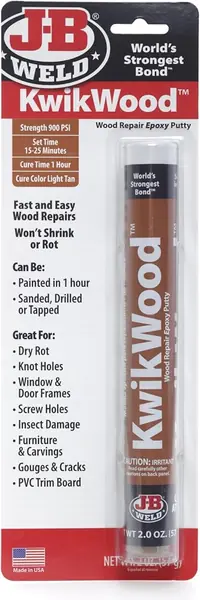
J-B Weld KwikWood beige two-part epoxy putty stick in a seven-inch roll

Structural wood repairs

Shop Score 90/100
Color
Beige
Stick Length
7 inches
Full Cure Time
60 minutes
Tensile Strength
2,450 psi
View on Amazon

A wax stick colors a scratch; it cannot rebuild a window sill a dog chewed or a door frame gone soft at the bottom. That is the repair this one is for. KwikWood is a 7-inch two-part epoxy putty stick — knead the outer wrap into the core until it is uniform, press the putty into the void, and let it cure into something you can sand into shape and paint.

The listed full cure is 60 minutes, and a shallow fill will take sandpaper around then. A deep one keeps hardening well past that, so leave a thick patch overnight before you touch it with paper. Mix it with gloves on: we found the uncured putty aggressively tacky, and once it is on your fingers it is on everything else too.

Beige is the only color, so this is a filler you cover with paint rather than blend into a stain — right for trim, sills, and structural patches, wrong for a hairline scratch on a cherry table where a wax stick finishes the job in seconds. It is also the one pick here that adds strength instead of color, which is why a stick lives in the shop and not in the touch-up drawer.

Worth Noting

  • Single beige color needs paint over it
  • Tacky to mix and slow to cure deeply
Our Verdict

When the damage runs deeper than the finish, this two-part putty stick is our pick: it cures hard, sands smooth, and takes paint.

Check Latest Price
3.

DAIXISM Furniture Repair Kit 13-Piece Best Budget Kit

DAIXISM furniture repair kit with six wax sticks six markers and a sharpener

First touch-up kits

Shop Score 88/100
Colors
Maple, oak, cherry, walnut, mahogany, black
Kit Contents
6 markers, 6 paper-wrapped wax sticks, 1 sharpener
Fade Resistance
Fade resistant
View on Amazon

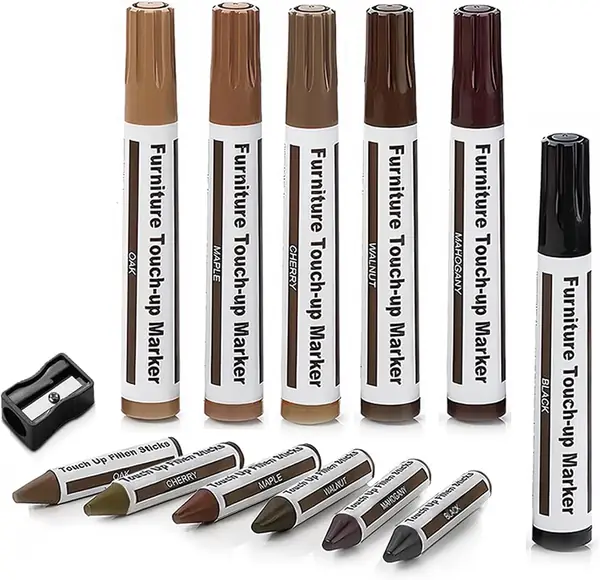
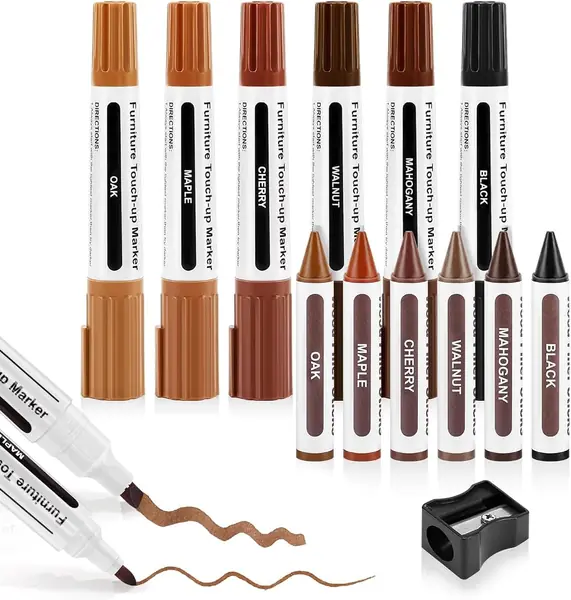
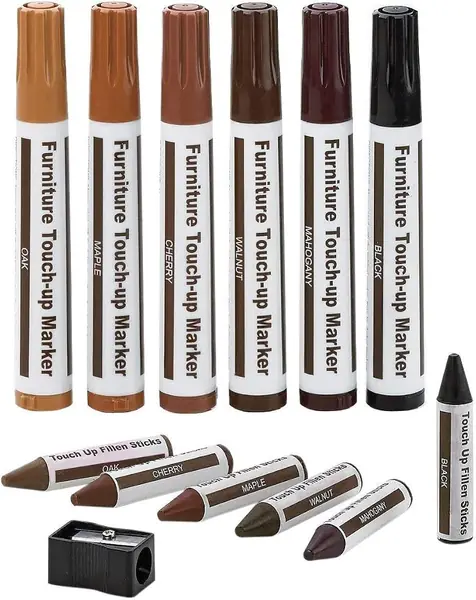
Six wax sticks, six matching markers, and a sharpener in one blister pack — this is the shape most people picture when they go looking for wood filler sticks, and it is the kit we hand to someone doing a first touch-up.

What we like is the division of labor. The marker handles a scratch that is only through the color; the wax stick, sharpened to a point, fills the chip or nail hole underneath it. The six colors are the workhorses — maple, oak, cherry, walnut, mahogany, and black — and because each shade exists in both forms, you tint and fill with the same tone instead of hunting for a second stick.

The markers can arrive dry, which is worth checking the day the pack lands rather than the day you need one; set the kit aside and return it if the tips are stiff. The wax sticks have been the reliable half of every set we have opened. For light furniture, cabinets, and baseboards in those six tones, there is not much this leaves undone.

Worth Noting

  • Colors read darker on wood than the caps
Our Verdict

The kit most shoppers land on: six wax sticks and six matching markers for a budget price, and a sharpener to keep the stick pointed.

Check Latest Price
4.

SEISSO Furniture Repair Kit 42-Piece Best All-In-One Kit

SEISSO 42-piece wood repair kit with wax filler sticks crayons markers and brushes

Mixed-tone households

Shop Score 87/100
Pieces
42
Wax Prep
Warm briefly before deep fills
Also Included
8 markers, 8 wax crayons, 12 brushes
Filler Colors
12
View on Amazon

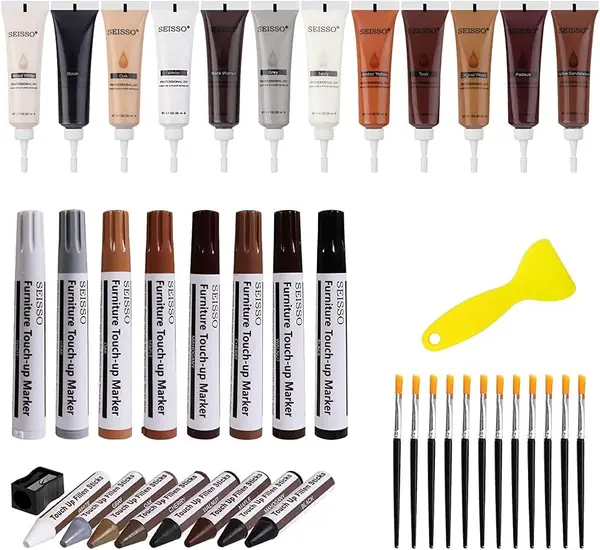
Forty-two pieces sounds like padding until you sort the box: twelve wax filler sticks, eight wax crayons, eight markers, a dozen brushes, and a sharpener, nested in a tray. It is the only kit here built around blending rather than matching.

The twelve filler colors run from white and ivory through oak, amber yellow, teak, padauk, gray, and black walnut to black, and they soften enough to mix. Warm two sticks together and you can walk a color toward the piece in front of you instead of settling for the nearest shade — that is what a big kit buys you, and it is why this one can cover a white door frame, an oak floor, and a walnut table without a second purchase.

The instructions are honest that these want heat. A few seconds with a hair dryer or heat gun softens the stick enough to press it into a crack instead of dragging it across the top, and for anything deeper than a surface scratch that is the difference between a fill and a smudge. Most of the wax kits on this page skip that step entirely.

What it is not is a professional-grade stick. The wax runs softer than the Mohawk Fil-Stiks, so a deep chip takes a second pass and a little patience. We treat this as the household kit — the one that stays in the utility drawer and gets used on everything — rather than the stick we reach for on a piece that matters.

Worth Noting

  • Colors lean darker than the labeled caps
Our Verdict

One box that covers a whole house of wood tones: twelve blendable filler sticks, eight crayons, and matching markers.

Check Latest Price
5.

DAIXISM Furniture Repair Kit 25-Piece Most Colors for the Money

DAIXISM 25-piece kit with twelve wax sticks twelve markers and a sharpener

Mixed wood tones

Shop Score 86/100
Colors
12
Pieces
25
Kit Contents
12 markers, 12 paper-wrapped wax sticks, 1 sharpener
View on Amazon

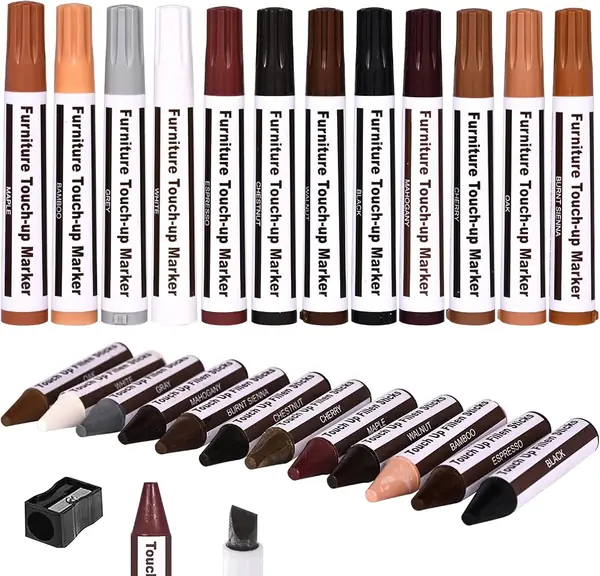
Same brand, same idea, nearly double the contents. Where the 13-piece DAIXISM kit gives you six sticks and six markers, this one doubles both and adds six more colors — white, gray, chestnut, burnt sienna, bamboo, and espresso alongside the maple-through-black basics.

The extra shades are the reason to pick it. White covers painted shelving and door casing, gray reaches the gray-washed cabinet or gray-toned floor, and espresso and burnt sienna sit between a too-warm walnut and a too-harsh black — the range where most color matches actually fail.

The markers are the weak half. Their tips are broad enough that a narrow scratch becomes a stripe, and a pen can arrive dry, so we open all twelve before we need them. The wax sticks do not share that problem, and they are the reason to buy the set.

Twelve tones in one tray is the argument. Keep one kit for a rental, a flip, or a house full of mismatched furniture and the extra shades save you from buying a second set the first time you meet a gray piece. That is a different job from what the Fil-Stiks do, and the price is low enough that owning both makes sense.

Worth Noting

  • Broad marker tips smear fine scratches
Our Verdict

Twelve colors and twelve wax sticks in one budget kit — the version of the cheap set to buy if you own a lot of different wood tones.

Check Latest Price
6.

Lifreer Furniture Markers Touch Up Kit 21-Piece Best for Painted Trim Touch-Ups

Lifreer 21-piece touch-up kit with ten wax filler sticks and ten markers

Painted trim touch-ups

Shop Score 85/100
Colors
10
Pieces
21
Kit Contents
10 markers, 10 wax filler sticks, 1 sharpener
View on Amazon

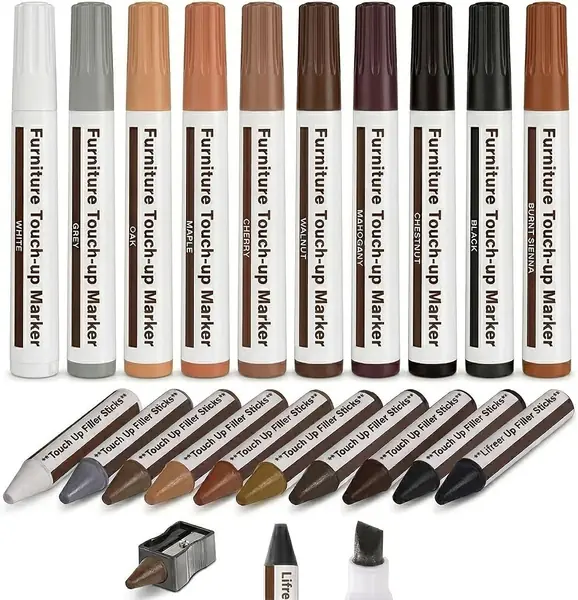
Ten colors is the number to notice, and the list goes past the usual six: oak, cherry, walnut, black, gray, white, maple, and mahogany among them. White and gray are the two the entry-level kits leave out, and they are the two that decide whether you can touch up painted trim or a gray-washed cabinet.

The kit pairs ten markers with ten paper-wrapped sticks and a sharpener, so one product fills and the other tints. The sticks behave like the rest of the budget class — firm enough to press into a nail hole, soft enough to level with a card — and the markers take the lighter cosmetic work.

The marker half is what holds it back. A pen can arrive dry, so open the set the day it arrives and work the tip on scrap before you go near a visible face. Buy it for ten wax sticks at a mid-size price and treat the markers as a bonus — that is how we have used it, and it is a fair step up from a six-color kit.

Worth Noting

  • Markers, not sticks, make up half the kit
Our Verdict

Ten wax sticks, ten markers, and a sharpener in one tray — a sensible mid-size kit if the six-color sets feel limiting.

Check Latest Price
7.

FlyBunny Wood Scratch Repair Kit 13-Piece

FlyBunny 13-piece wood scratch repair kit with six wax sticks and markers

Mid-tone furniture

Shop Score 84/100
Colors
6
Pieces
13
Kit Contents
6 markers, 6 wax sticks, 1 sharpener
View on Amazon

Six colors is the whole story — maple, oak, cherry, walnut, mahogany, and black — the same basics every entry-level kit ships, in a blister pack with a sharpener and nothing else.

Covering a scratch is the job, and it does that job: the markers blend well enough on mid-toned furniture that a repair reads as a shadow rather than a line, and the wax sticks take the chips a marker cannot fill. The sharpener earns its place too, since a blunt stick drags color outside the scratch and makes a small repair bigger.

Our read is that this is a good kit for ordinary furniture and nothing more. It does not have the color range of the 25-piece DAIXISM set or the firm wax of the Mohawk sticks, and it does not pretend to. If six mid-tones cover what is in your house, this will do everything you ask; if you own painted or gray-washed pieces, the bigger kits here are the better buy.

Worth Noting

  • Six colors miss white and gray finishes
Our Verdict

A plain six-color set that handles the same everyday nicks as our budget pick, with nothing extra in the box.

Check Latest Price
8.

Zalirium Dual Tip Furniture Marker Kit 13-Piece Best for Fine Scratch Work

Zalirium dual-tip furniture markers with wax putty sticks and a sharpener

Fine scratch work

Shop Score 83/100
Colors
6
Pieces
13
Tip Sizes
6 mm chisel and 1 mm fine
View on Amazon

A 6 mm chisel on one end and a 1 mm point on the other is the one idea here the other kits do not have, and we like it: the fine end follows a hairline scratch along a table edge where a broad felt tip just lays down a stripe. The wax stick does the filling, the wide end handles a quick cover-up, and the point gets into the detail.

Color is the catch, and it is why this stays an also-consider. Six tones is a workable range, but test on the underside of a table before you touch a visible face, and do not expect blending to rescue a shade that is wrong. As the cheapest kit in this group it earns a drawer, but it is not the one we reach for when the piece matters.

Worth Noting

  • Colors run darker and redder than caps
Our Verdict

Buy it for the fine tip, not the color: the 1 mm point reaches thin scratches the broad markers in other kits cannot.

Check Latest Price

How We Tested Wood Filler Sticks

We started with the filler sticks and marker-and-stick kits selling fastest across major retailers, then filtered by filler type, color count, and price so the list covered semi-hard wax, soft crayon wax, and two-part epoxy putty rather than eight versions of the same thing. Anything that only worked as part of a full refinish was out. Sixteen kits made it into testing, and each one stayed in rotation for six months.

Testing happened on furniture, not sample blocks: a gouged oak side table, a floor plank by the door, painted baseboards and trim, kitchen cabinet doors, bedposts, and a chair rung that takes daily handling. We worked every stick into scratches of known depth, scraped the excess level with a plastic card, buffed with a cloth, then looked at the repair in daylight and under a lamp, checking each cap color against the actual shade on an underside first. We timed how long a stick took to warm and spread, ran the crayons through the included sharpeners, and noted mess, grit, and whether a fill sank overnight.

Then we lived with the repairs. Handled surfaces got a thumb rub and a denim rub twice a day for a week, plus a damp cloth wipe; low-traffic spots were left alone and checked for shrinkage and fading, with sample boards parked on a sunny windowsill for a month. For the epoxy putty, we filled nail holes and a cracked sill, checked hardness at 15, 30, and 60 minutes, then sanded to see whether it clogged the paper. Kits were judged on how many of their colors we actually reached for, and whether the extras earned their place in the box.

How to Choose Wood Filler Sticks

Wax, Crayon, or Epoxy Putty

A wax stick is a finish repair. It sits in the scratch or nail hole, takes the color of the surrounding wood, and disappears; it does nothing structural. An epoxy putty stick is a wood repair: it cures hard, sands, and takes paint, which is what you want for a rotted sill, a chewed corner, or a gouge through the veneer.

The trap is buying one and expecting the other. A wax stick pressed into a soft, punky door frame will fall out within a season, and an epoxy repair on a hairline scratch leaves a visible patch you have to paint. Most households end up wanting both, and no single product on this list does both jobs well.

Firmness Matters More Than Piece Count

Soft crayon wax smears across the grain and pulls back out of the nick; a semi-hard stick holds its edge, presses into the damage, and levels flush when you scrape it with a credit card. That firmness is why a twelve-stick pro set outranks kits with twice the pieces.

If a stick is too hard to press in cold, warm it for a few seconds with a hair dryer or heat gun — never so hot that it turns liquid. Keep the sharpener handy as well: a narrow tip is what lets you push wax into a nail hole instead of coloring the wood around it.

How Many Colors You Actually Need

Six shades — maple, oak, cherry, walnut, mahogany, black — cover most factory furniture finishes, but they miss white, gray, and the pale-mid tones where light oak lives. Ten or twelve colors, plus wax soft enough to blend two sticks together, is what lets you match a piece instead of approximating it.

Never trust the cap. These waxes land darker on the wood than the label suggests, so apply to a hidden edge — the underside of a table, the back of a leg — and adjust from there. A kit you can blend beats a kit with more colors you cannot mix.

Where the Repair Has to Hold

Wax sticks belong on surfaces that do not get scrubbed or walked on: table aprons, headboards, cabinet faces, trim, picture frames. Semi-hard wax is rated for low-traffic use, and on a floor that takes daily shoes a wax fill can pick up dirt and wear away.

If the damage is on a floor or anywhere a hand rests constantly, plan on a thin clear topcoat over the repair, or step up to epoxy where the wood itself is compromised. Neither stick replaces refinishing a whole surface, and neither is a long-term fix for a failing finish.

What Else Is in the Box

Most of these kits are sold by piece count, and half the pieces are markers — thin paint pens that tint a scratch but fill nothing. Count the wax sticks, not the total, and treat the markers as a bonus that may arrive dry.

A sharpener is genuinely useful, since it keeps the stick pointed for nail holes. Brushes and spatulas are the pieces we use least; buy the kit for its filler sticks and let the extras be extras.

Frequently Asked Questions

Final Verdict

Buy the Mohawk Fil-Stik 12 Pack if your repairs are cosmetic: scratches, nicks, and nail holes on finished furniture, trim, and frames, where a firm stick and a dozen blendable tones make the damage disappear. It costs more than the kits with markers and brushes, and it is the one we keep within reach.

If the damage runs deeper than the finish — a rotted sill, a chewed corner, a gouge through the veneer — start with J-B Weld KwikWood and keep a wax kit for the color work afterward. Those two cover almost everything a stick can fix.