↑↓ navigate ↵ open Esc close All results →

Best Wood Glue Applicators of 2026

A crusty bottle nozzle or a shedding bristle can derail a panel glue-up in seconds, leaving puddles on the bench or debris trapped inside a tight seam. When open time is already ticking down, getting adhesive cleanly into the joint—and nowhere else—matters far more than moving fast.

Three months of panel glue-ups, dowel and biscuit joinery, and awkward overhead chair-rail repairs with 14 silicone brushes, trays, two-chamber squeeze bottles, and syringes showed silicone beating natural bristles almost every time—a loose bristle trapped in a glue line leaves a flaw sandpaper cannot fix. Controlled suck-back also mattered far more than reservoir size when squeezing upward under a seat.

Wide flat films, controlled edge beads, and needle-tight blind joints are all covered across seven reusable tools that peel clean once dry.

Our Top Picks

The Best Wood Glue Applicators

1.

Sili Silicone Glue Brush & Tray Kit Best Overall
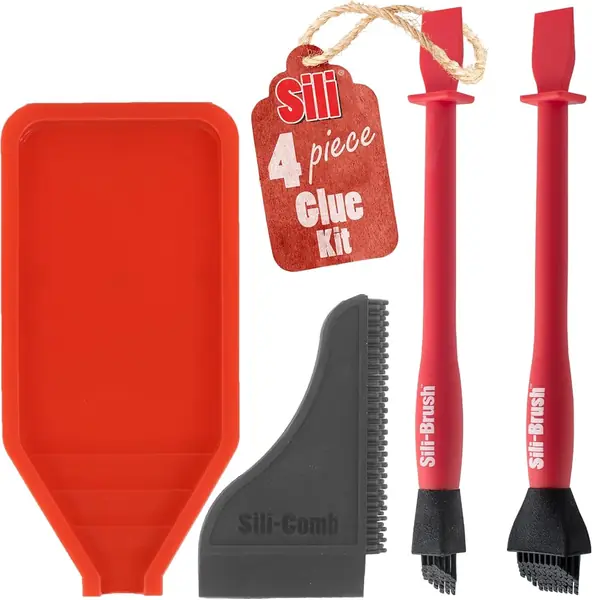
Red Sili silicone glue brush kit with two brushes, comb spreader and glue tray

Joints and panels

Shop Score 96/100
Cleaning
Dried glue peels off; rinses with water
Pieces
4
Material
Silicone rubber
Kit Contents
1/2-inch brush, 1-inch brush, comb/squeegee, glue tray
View on Amazon

A glue-up usually asks an applicator to do two different jobs: lay a bead inside a mortise or a dovetail, then cover a rail face or a panel with an even film. This kit is the one pick here that handles both without a change of tool. The half-inch brush works into joinery, the one-inch brush covers a face, and the comb pulls a bead out into a thin, even coat.

Silicone is the whole trick. Nothing water-based bonds to it, so cleanup is not a scrubbing job — glue left on the tray cures into a sheet you can lift off with a fingernail, and the brushes rinse under warm water. We stopped babying the tray after the first week, and it still comes back ready to use.

What it does not do is dispense. There is no reservoir, so a bottle or a syringe still has to put glue within reach of the brush, and the tray is a small one — enough for a pair of boards, not a whole countertop lamination. That shallow tray is also why it sits comfortably on a crowded bench and rinses in seconds, so it is a fair trade.

Against the rest of this group, the pairing is what earns it first place: two brush widths, a comb for panels, and a tray that catches the drip, with no bristles to shed. If your work is almost all joinery, the Rockler brush alone is the cheaper way in; if it is almost all panels, a roller earns its bench space.

Worth Noting

  • Fine brush takes longer to clean than the tray
Our Verdict

For a shop that builds both joinery and panels, this is the kit we recommend first: two brush widths, a comb, and a tray that gives up dried glue with a peel.

Check Latest Price
2.

FastCap Glu-Bot Glue Bottle Best for High-Volume Glue-Ups

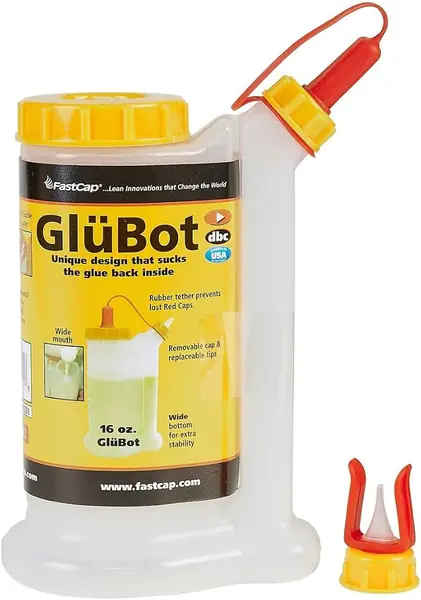
FastCap Glu-Bot 16-ounce yellow and white two-chamber glue bottle with tips

High-volume glue-ups

Shop Score 94/100
Design
Two-chamber with glue suck-back
Capacity
16 fluid ounces
Included Tips
One Yorker and one blade-style tip
Filling
Wide-mouth opening
View on Amazon

Sixteen ounces is the argument here: this is the largest bottle in the group, it refills from a gallon jug instead of a squeeze tube, and the wide mouth takes a pour without glue running down the threads. If you build enough that you buy wood glue in bulk, the savings come from the refill, not from the bottle.

The two-chamber body is the part we ended up relying on. It feeds from the bottom, so the flow stays steady as the level drops, and the vacuum that stops the drip pulls the glue back inside when you let go — no trail of glue between the bottle and the joint. The Yorker tip lays a fine line, the blade tip lays a wider bead, and we reach for the bottle on any glue-up with more than a few joints because we are not stopping to refill.

One quirk: after the bottle sits for a day, the first squeeze goes nowhere, because the chamber has to refill before glue reaches the tip. We squeeze once over a scrap before touching the joint — a second of waste that buys a clean start. The other cost is size: a full bottle is heavy enough that long glue-ups go easier with it resting on the bench rather than held in the air.

Worth Noting

  • Bottle can crack around the lid over time
Our Verdict

We recommend the Glu-Bot to anyone who buys PVA by the gallon: 16 ounces, refillable from the jug, and a suck-back valve that keeps the bench drip-free.

Check Latest Price
3.

Rockler 7-Inch Silicone Glue Brush Best Single Brush for Joinery

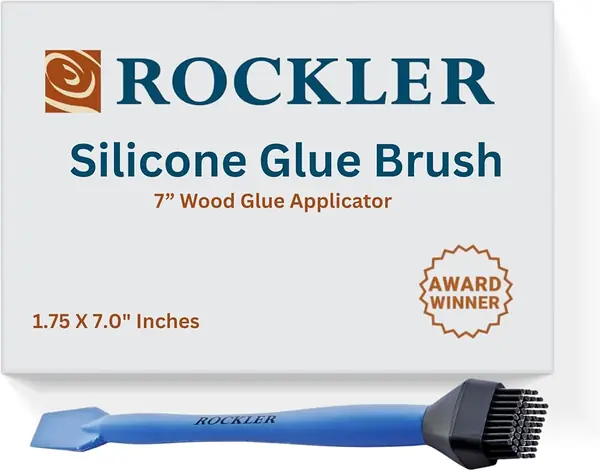
Rockler 7-inch silicone glue brush with blue handle and flat paddle end

Narrow joints

Shop Score 93/100
Cleaning
Dried glue peels off; rinses with water
Length
7 inches
Bristles
Silicone, waterproof
Handle End
Flat paddle for spreading and putty
View on Amazon

Turn this brush around and you get the tool we use most: a flat paddle that spreads a bead across a rail face or presses putty into a knot hole. The bristle end is silicone, seven inches of handle reaches into a drawer box, and nothing sheds into the glue line — which is the failure that ruins a joint, because a boar bristle laminated under a veneer is there for good.

The silicone takes abuse. Dried glue cracks and peels off the tips, a rinse handles the rest, and no solvent is involved. What it will not do is cover ground: it is one brush at one width, and spreading glue across a wide panel with it is slow work compared with a comb or a roller.

Think of it as the single-tool version of the Sili kit: same silicone idea, one width, no tray to catch the drip. If you already own a spreading tray, this is the brush to put beside it, and if you carry tools to a job site, it is the one that survives the trip.

Worth Noting

  • Single width is slow across wide panels
  • Brush head can work loose from the handle
Our Verdict

We keep this one in the apron: the paddle spreads and fills, and the silicone bristles put glue exactly where a joint needs it without shedding.

Check Latest Price
4.

Milescraft Glue Mate 450 Best for Angled and Vertical Gluing

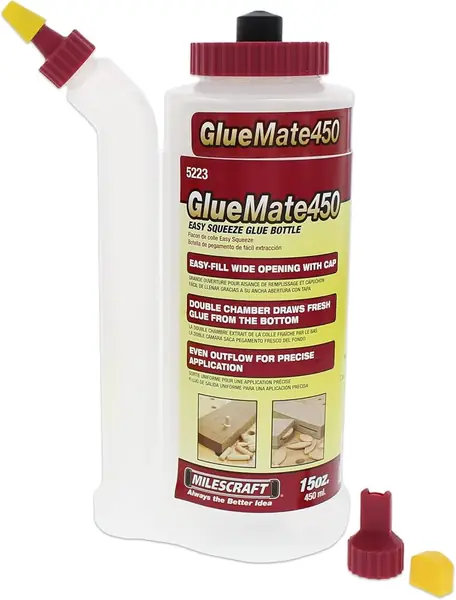
Milescraft Glue Mate 450 clear 15-ounce glue bottle with two applicator tips

Angled glue-ups

Shop Score 92/100
Design
Two-chamber, dispenses at any angle
Capacity
15 fluid ounces
Included Tips
Precision doweling tip and flat biscuit tip
Caps
Anti-drip tip caps included
View on Amazon

Doweling the middle of a cabinet side is the test: the bottle has to work sideways, or pointing down, and a standard squeeze bottle just runs glue out the back of the tip. This one sends glue up from the bottom of the reservoir through a smaller chamber, so the angle barely matters, and it ships with a narrow doweling tip and a flat biscuit tip that shape the bead for you.

Fifteen ounces is enough that a kitchen's worth of biscuits does not empty it, and the caps keep the tips from skinning over between sessions. The cap is also the part to check: if the fill cap or a tip cap does not seat cleanly, the bottle cannot build pressure and the glue comes out in a dribble instead of a line. Press the cap down firmly and keep the bottle upright between uses, and it behaves.

Between this and the Glu-Bot, we take the Milescraft for doweling jigs and biscuit joiners, where the two shaped tips do the work, and the FastCap for plain edge and face glue-ups where nothing but a straight line is needed.

Worth Noting

  • Spout can crack if the bottle is dropped
Our Verdict

Buy the Glue Mate 450 if you glue dowels and biscuits at awkward angles; the shaped tips and two-chamber body do work a plain squeeze bottle can't.

Check Latest Price
5.

FJNATINH Glue Applicator Syringe Kit Best for Tight Joints and Repairs

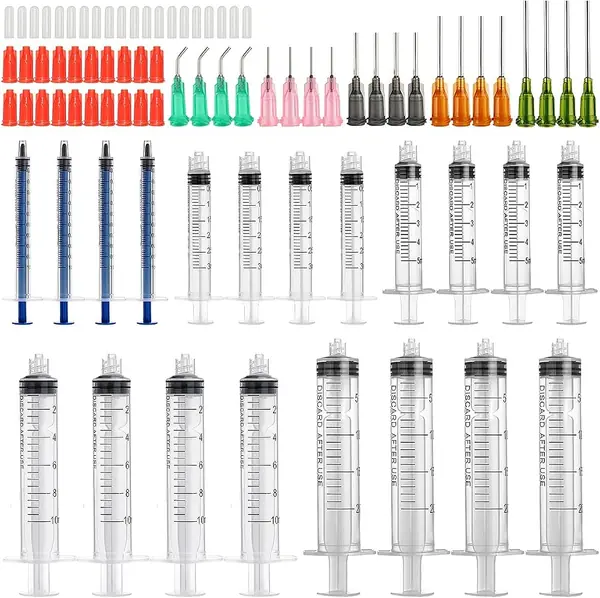
FJNATINH glue syringe kit with blunt needles, luer lock caps and curved tips

Tight joint repairs

Shop Score 91/100
Caps
20 luer lock storage caps and 20 needle caps
Connection
Luer lock
Needle Sizes
14 ga to 20 ga, 1/2 to 2 inch
Syringe Sizes
1, 3, 5, 10 and 20 ml
View on Amazon

Lifted veneer, a loose chair rung, a crack that has closed up but not glued: these are jobs where no bottle reaches. This kit brings twenty syringes in five sizes, blunt luer-lock needles in four gauges from 14 to 20, curved 20-gauge tips, and caps for both the needle and the barrel. They are not sterile and they are not for injection — the blunt tips place liquid, nothing else.

The pairing we keep coming back to is the 10 ml barrel with an 18-gauge needle: enough glue to load a joint without fighting the plunger, and a needle that still slides under a veneer edge. What surprised us is how much control the luer lock gives, since the needle stays put while you work glue into a gap with a clamp waiting behind it.

The limit is the glue itself. PVA sets in the barrel, so a syringe used with wood glue is usually a one-time tool, and the fine gauges clog with anything thicker than a slow trickle. The smallest needles also bend if you push them sideways into a gap, so start the hole with a knife and let the needle follow it.

Worth Noting

  • Syringes used with wood glue are usually single-use
  • Smallest needles bend and clog with thicker glue
Our Verdict

When the joint is already closed, this is the kit we reach for — twenty syringes and blunt needles that carry glue under veneer and into cracks.

Check Latest Price
6.

FastCap BabeBot Glue Bottle Best for Detail Work

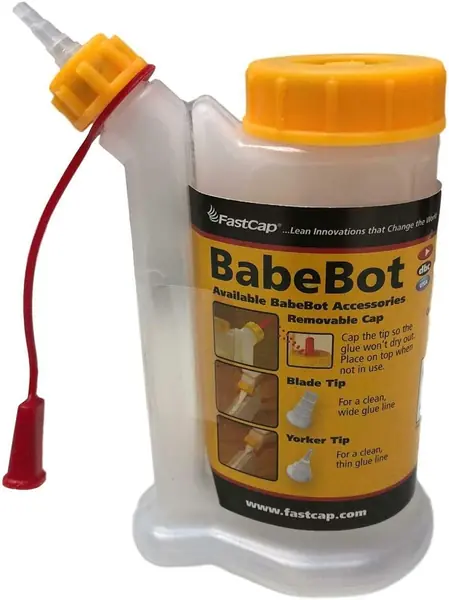
FastCap BabeBot 4-ounce red wide-mouth glue bottle with two tips

Detail work

Shop Score 88/100
Design
Two-chamber, no-drip suck-back
Capacity
4 fluid ounces
Included Tips
Yorker and blade-style tips
Opening
Wide mouth
View on Amazon

The bottle you actually reach for during small glue-ups is usually the one that fits in your hand, and this is that bottle. It carries the same two-chamber, suck-back design as the big Glu-Bot, with a Yorker tip and a blade tip, a wide mouth for filling, and a base wide enough to stand on its own when you set it down mid-glue-up. We like it best in the hand for exactly that reason: it turns between the fingers and lays a short line in a tight corner without an arm's worth of bottle swinging around.

What it costs you is capacity and cap life. You will refill it often if the work is bigger than a drawer box, and the cap and its little tether are the parts that fail first — a cracked cap means a skinned tip, and a bottle that will not seal means a squeeze that does nothing. Buy it as the small-job companion to a larger bottle rather than as your only one.

Worth Noting

  • Cap and cap tether are the first parts to break
  • Small body needs frequent refills
Our Verdict

We like the BabeBot for short lines and small frames: a four-ounce bottle that turns in the fingers and stands up between clamps.

Check Latest Price
7.

Ehoycq Needle-Tip Glue Applicator Bottles Best for Fine Glue Lines

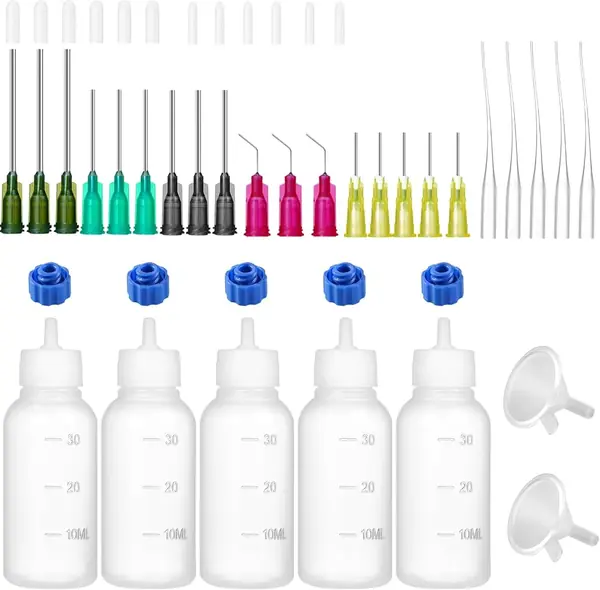
Ehoycq clear 30 ml needle-tip squeeze bottles with blunt needles and funnels

Fine glue lines

Shop Score 87/100
Extras
Two mini funnels and five applicator tubes
Needle Gauges
14, 16, 18, 20 and 25 ga
Bottle Capacity
30 ml
Bottles Per Pack
5
View on Amazon

Five 30 ml bottles, five gauges of blunt needle from 14 down to 25, a soft applicator tube for each, two mini funnels and caps for the tips. The 14-gauge lays a bead about as fine as a bottle tip will, the 25-gauge puts down a line thin enough for a hairline crack or a locating mark, and the soft tube bends around a corner where a rigid needle cannot follow.

The caps are what keep a water-based glue from skinning between sessions, and the seals are also the weak point: a bottle squeezed hard can leak around the collar, and the plastic can deform if it lives in a hot shop. Keep them for PVA and other water-based glue — cyanoacrylate bonds the tip shut and turns the whole bottle into a one-shot.

Detail work is where this set earns its shelf space: gluing a spline into a groove, running a thin line along a stopped dado, or getting a drop into a dowel hole a bottle cannot reach. For a fine line in a tight spot these are the most precise thing here short of a syringe, and unlike a syringe they hold enough to finish a whole drawer.

Worth Noting

  • Can leak around the cap collar when squeezed hard
  • Not for cyanoacrylate, which bonds the tip shut
Our Verdict

For fine lines in tight spots, these needle-tip bottles give you five gauges and a soft tube that reaches where a brush cannot.

Check Latest Price

How We Tested Wood Glue Applicators

We built the shortlist from workshop forums and years of customer reviews, then cut anything that needed a proprietary refill, arrived without a cap, or couldn't be cleaned out. That left 14 applicators — silicone brushes, trays, squeeze bottles, and syringes — which we used for three months.

Testing happened where glue actually gets used: a garage bench on weekend glue-ups, panel and lamination work that wanted a thin, even film, dowel and biscuit joints that wanted a narrow bead, and a chair repair and a cabinet carcass that had us dispensing at an angle and overhead. Every bottle was filled with standard yellow wood glue, and we kept cyanoacrylate out of all of them, since CA can deform plastic bottles and syringe barrels.

Session by session we noted how the glue came out and where it landed: whether a bottle left on its side leaked onto the bench, whether a tip clogged between one weekend and the next, whether a cap still sealed after a dozen openings, and how many glue-ups each bottle got through between refills. We tried to open, dispense, and recap one-handed while the other hand held a joint closed, then let glue cure on every tool for two days to see whether it peeled off in one piece or had to be soaked and picked out, and whether anything shed into the glue line.

For reach, we pushed the needle tips into dowel holes and the back of closed joints to see whether glue arrived where we aimed it or backed up in the barrel, and recapped and reused the same tips for three months to see which bent, clogged, or stopped seating. The blunt syringe needles are non-sterile dispensing tips, and we treated them as glue tools, nothing else.

How to Choose a Wood Glue Applicator

Match the Tool to the Joint

Two shapes of glue-up cover most furniture work: a bead inside a joint, and a film across a face. A bottle or a syringe lays the bead; a brush, comb or roller turns it into an even film. Buying only a bottle leaves you spreading glue with a fingertip, and buying only a brush leaves you pouring straight from the gallon jug.

Plan on one of each unless your work is entirely narrow joinery or entirely panels. For joinery, thin beats broad — the half-inch brush in the Sili kit reaches a mortise that the one-inch brush cannot, and a needle-tip bottle reaches a dowel hole neither will touch.

Silicone Pays for Itself; Bristles Don't

Silicone does not bond to water-based glue, so a cured bead lifts off a tray or a bristle tip with a fingernail, and warm water finishes the job. Natural-bristle and foam brushes cost less per tool, but they shed, and a single bristle laminated under a veneer or left inside a mortise is a permanent defect in a piece you cannot take apart.

If you keep disposable brushes for messy jobs, treat them as one-use and look over the joint before clamping. Silicone is not the answer for solvent glues or two-part epoxy, which can attack it or bond to it.

Bottles: Capacity, Suck-Back and Sealing

A glue dispenser with two chambers feeds from the bottom, so flow stays even as the bottle empties, and the vacuum pulls the glue back when you release the squeeze — that is what stops the drip trail between bottle and joint. The cap matters as much as the valve: one that does not seat cannot build pressure, and the bottle dribbles instead of dispensing.

Press the cap down flat, store the bottle upright, and match capacity to habit. A large bottle such as the Glu-Bot saves refills if you buy glue by the gallon; a small one is easier to control on short lines.

Syringes and Needle Tips Are for Reaching, Not Spreading

Syringes and needle-tip bottles come into their own where a bottle cannot go: under lifted veneer, into a dowel hole, along a crack that has closed. Gauge decides what will pass — 18-gauge or larger, or a soft plastic tube, handles PVA, while 25-gauge is for thin cyanoacrylate and oils.

Wood glue sets inside a barrel, so expect a syringe to be a one-time tool once glue is in it. Keep cyanoacrylate out of plastic squeeze bottles entirely; it bonds the tip shut and can deform the body.

Frequently Asked Questions

Final Verdict

For most woodworkers the Sili silicone brush and tray kit is the answer: it covers joinery and panel work, and it survives being forgotten with glue on it. Add the FastCap Glu-Bot if you buy glue by the gallon and want a bottle that lays a line without dripping.

If your work is mostly repairs and joints that are already closed, the syringe kit reaches places neither of those can, and that is the decision that matters.