↑↓ navigate ↵ open Esc close All results →

Best Wood Glue Syringes of 2026

A loose chair rung stays loose when bottle glue never reaches past the mouth of the socket, leaving a hardened ring on the outside while the tenon remains dry inside. Delivering adhesive an inch or more past the collar turns a surface smear into a tight structural bond.

High tip counts on syringe packaging often pad the box with hair-thin 25-gauge needles too narrow for viscous wood glue, a limitation exposed across four months of testing 14 kits on loose rungs, cabinet doors, lifted veneer, and tight joinery. Long, wider-bore needles move PVA reliably without constant clogging, while luer-lock fittings keep tips from popping off under thumb pressure.

Multi-barrel shop packs, extra-long needles for blind joints, and high-pressure injectors for tight seams all share reliable storage caps that let a loaded barrel wait between repairs.

Our Top Picks

The Best Wood Glue Syringes

1.

FJNATINH Glue Applicator Syringe Kit Best Overall
FJNATINH glue applicator syringe kit with clear barrels, blunt needles, and orange caps

All-purpose glue work

Shop Score 93/100
Storage
Luer lock and needle caps
Needle Lengths
1/2 inch to 2 inches
Needles Included
20 blunt tips, 14 to 20 gauge
Syringe Capacities
1, 3, 5, 10, and 20 ml
View on Amazon

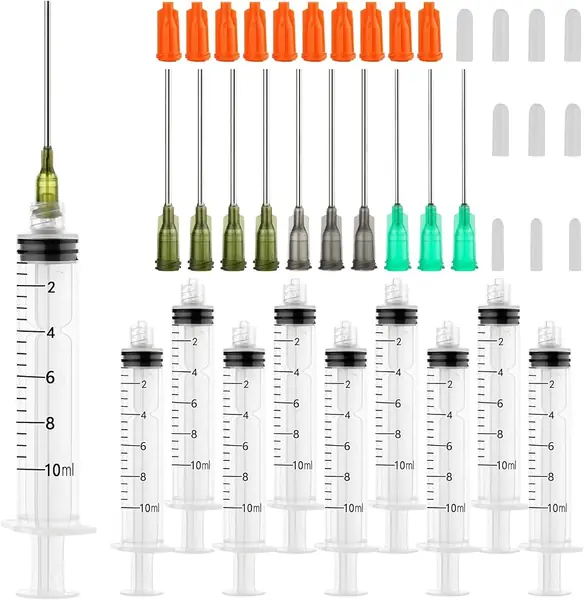
Wood glue is the test that separates these kits, because PVA is thick enough to clog anything narrow. What settled it for us is the needle range: the widest here is a 2-inch 14 gauge, and the assortment runs down to a curved 20 gauge for working around a corner. We filled a barrel with standard yellow glue, and it drew up without fighting the plunger and went into a hairline joint rather than sitting on top of it.

The five barrel sizes do the rest of the work. A 1 ml barrel is the right amount for a dab of CA glue on a splintered edge, while the 20 ml barrel is the one we fill for a chair with four loose rungs, so there's no refilling halfway through the job. The luer lock holds each needle firmly, and the caps let you park a loaded syringe on the bench between sessions instead of emptying it back into the bottle.

Two limits are worth knowing. Most of the twenty needles run 1 1/2 inches or shorter, so this kit reaches surface cracks and open glue lines more easily than it reaches deep under veneer. And the thinnest tips are the ones that fail first — we treat the curved 20 gauge as a one-use part and keep the wide ones for glue with some body to it.

Worth Noting

  • Longest needle reaches only 2 inches
Our Verdict

The kit we reach for first: five barrel sizes and twenty blunt needles from 14 to 20 gauge handle wood glue and everything thinner.

Check Latest Price
2.

DCT Wood Glue Syringe Best for Tight Joints

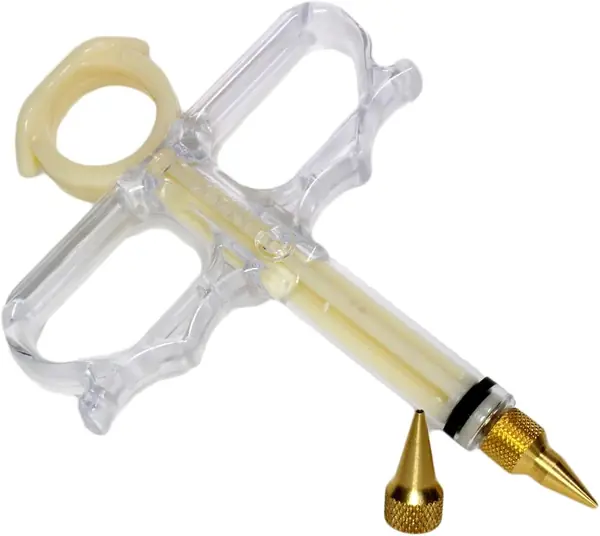
DCT wood glue syringe with a clear barrel, threaded cap, and two brass tips

Closed joint repair

Shop Score 91/100
Nozzles
1/16 and 1/32 inch brass
Capacity
20 ml (0.7 fl oz)
Warranty
One year
Application Pressure
Up to 550 psi
View on Amazon

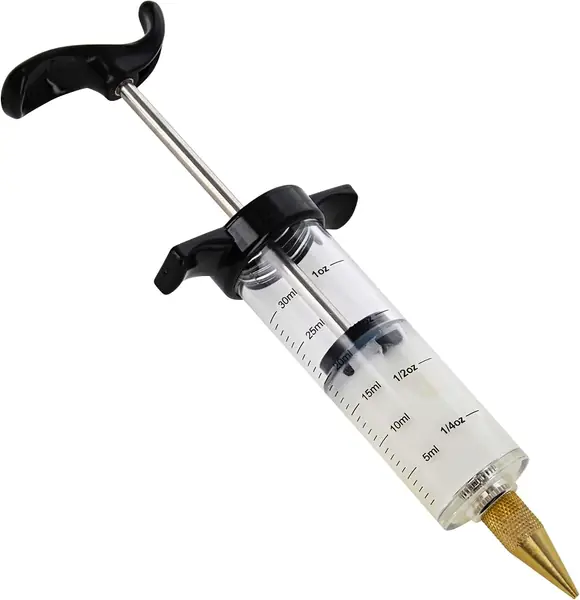
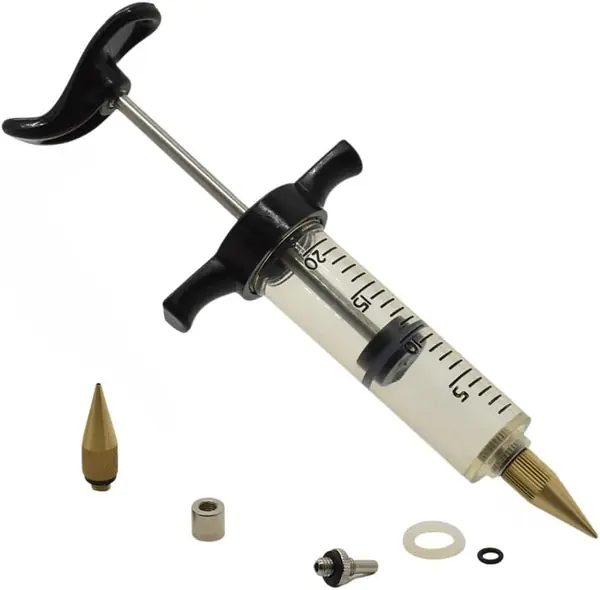
Pressure is the whole idea here. The DCT is a sealed 20 ml barrel that you load through the top or by pulling the plunger, then drive with a plunger that builds up to 550 psi behind the glue. That makes it a different tool from a thumb-powered syringe: with the tip seated in a split, the glue is forced along the crack instead of pooling at the mouth of it.

Two brass tips come with it, 1/16 and 1/32 inch, and both screw into the barrel over an O-ring. Brass is the right call for this job — it doesn't flare or snap when you press it into a tight seam, which is exactly where the thin plastic needles on cheap kits give out. The barrel is clear enough to see how much glue is left, and the whole thing comes apart for cleaning.

Our reservation is maintenance. The maker's own note is to wet the O-ring and keep glue from drying in the barrel, and that is real: leave PVA to set in a brass tip and you'll be soaking it out. A cup of water on the bench between joints solves it, and glue left in the barrel stays workable for days as long as it stays wet. For veneer, laminate, and rungs that won't come out, this is the one we want in hand.

Worth Noting

  • Single barrel with no spare in the box
Our Verdict

Buy it for joints you can't open: 550 psi and brass tips drive glue into a closed crack where a plastic needle just bends.

Check Latest Price
3.

Big Horn 19408 Glue Injector Best Value Injector

Big Horn 19408 high pressure glue injector with two brass nozzle tips

Furniture joint repair

Shop Score 90/100
Nozzles
1/16 and 1/32 inch brass
Application Pressure
Up to 550 psi
Glue Type
Water-based glues
View on Amazon

Two picks here work on the same principle — a sealed barrel, a plunger that builds pressure, and screw-in brass nozzles — and the Big Horn is the less expensive of them. It's rated to 550 psi with 1/16 and 1/32 inch brass tips, and it's built for water-based glues, which covers the yellow PVA sitting in most shops. The plunger holds pressure without glue creeping back around the seal, and the assembly comes apart for a warm-water rinse.

The screw-on cap is the part to watch: its threads are the weak link, and a cap that won't seat lets glue skin over in the barrel between sessions. Start it by hand, don't crank it down, and it seals fine. Otherwise this is the injector we hand to someone who wants real pressure into a rung socket or a laminate edge without paying for a premium body — it does the same work, with a nozzle that won't bend.

Worth Noting

  • Water-based glues only
Our Verdict

The cheaper way into pressure injection: the same 550 psi idea and two brass tips, happiest with the water-based glue already in your shop.

Check Latest Price
4.

CIETER 30-Pack Glue Dispenser Kit Best Assortment

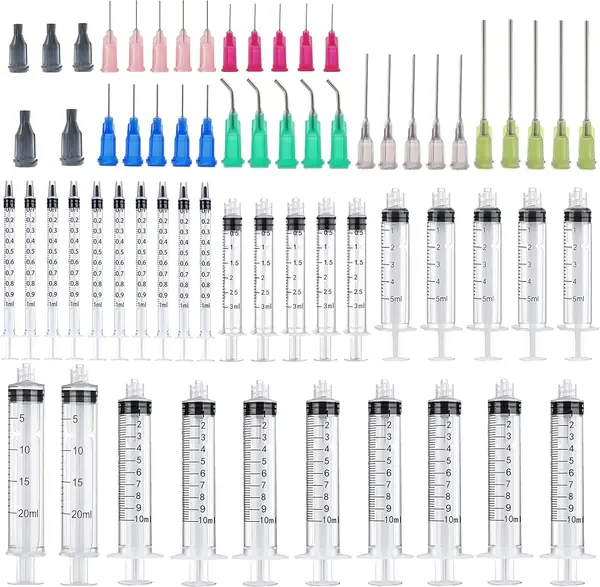
CIETER glue dispenser kit with thirty clear syringes in five sizes and blunt needles

Stocking a workshop

Shop Score 89/100
Needles
30 blunt tips, 14 to 25 gauge
Syringes
30 barrels in five sizes, 1 to 20 ml
Curved Tips
Five 18 gauge curved needles
View on Amazon

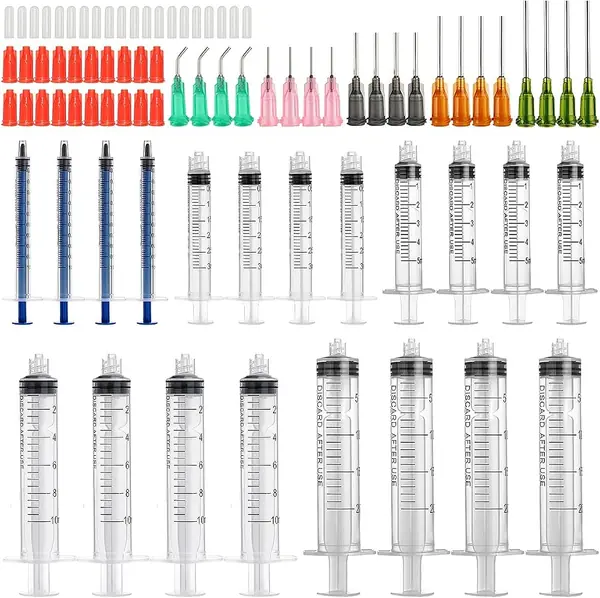
Thirty pieces in one box reads like overkill until you start sorting them. There are ten 1 ml barrels, five each of 3 and 5 ml, eight 10 ml, and two 20 ml, plus thirty needles across six styles from 14 down to 25 gauge, including a curved 18 gauge for working around a corner. That is a shop's supply rather than a single-project kit.

What the volume buys you is the freedom to match the barrel to the job instead of rationing. The 1 ml barrels are for a single drop of CA in a splinter; the 20 ml barrels are for a dowel hole that needs a real bead. We like having enough barrels to leave one charged with PVA and another with thin CA without cleaning either one out first.

The trap with a big assortment is assuming every gauge is usable with wood glue. It isn't: 22 and 25 gauge belong to thin CA, ink, and lubricants. PVA will draw up a 14 or 16 gauge with a firm pull and fight you the whole way through anything finer. Sort the tips once, keep the wide ones with the PVA barrels, and the rest stops being clutter.

Our verdict is that this is the box to buy if you want to stop shopping for syringes. You give up nothing in quality — the barrels are clear with readable graduations and the luer locks hold — but you do buy a lot of barrels you may never fill. For one chair repair a year, a smaller kit is the smarter spend; for a bench that runs through them, this is the obvious one.

Worth Noting

  • Only two 20 ml barrels included
Our Verdict

If you would rather buy once, this is the assortment: thirty barrels, six gauges, and a curved tip, at a price that treats them as disposable.

Check Latest Price
5.

HaBeuniver Glue Syringe Set Best for Fine Work

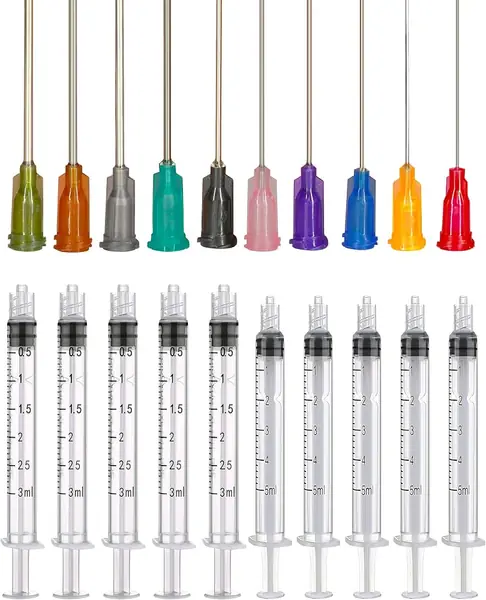
HaBeuniver glue syringe set with small clear barrels and ten blunt needles

Fine crack repair

Shop Score 88/100
Needles
10 gauges, 14 through 25
Syringes
10 total, 3 ml and 5 ml
Needle Length
1 1/2 inches
View on Amazon

Small work is where this kit makes sense. The barrels are 3 and 5 ml — small enough to steer one-handed into a hairline crack in a guitar top or a picture frame — and they come with ten needles, one each from 14 down to 25 gauge, all 1 1/2 inches. If your repairs are delicate rather than structural, this is a better fit than the big-barrel kits.

The gauge range cuts both ways. A 14 gauge pulls PVA up without complaint and lays it into a tight seam; the fine end, 20 gauge and below, struggles to draw thick glue at all, and forcing it just bends the needle. We keep the wide tips on the wood glue barrels and save the small ones for CA, which is thin enough to flow through them.

Cleaning is quick because the barrels are small: a warm-water flush right after the joint is closed and they're ready for the next session. The trade-off is capacity — a 3 ml barrel empties fast, and you'll be refilling it more than once on a chair leg. Keep a 20 ml kit for the bigger jobs and let this one handle the delicate ones.

Worth Noting

  • All needles are 1 1/2 inches, limiting reach
Our Verdict

For hairline cracks and small parts, the 3 and 5 ml barrels here are easier to steer than a 20 ml syringe, and ten gauges let you pick.

Check Latest Price
6.

otwooi 30 ml Glue Syringe Kit Best for Deep Reach

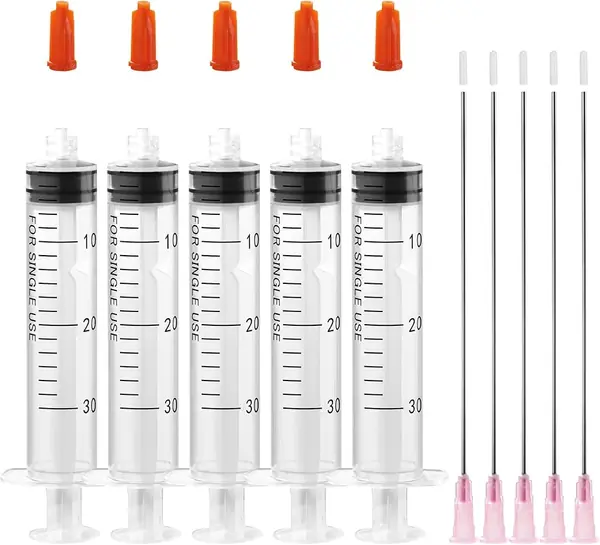
otwooi 30 ml glue syringes with four-inch blunt needles and orange storage caps

Deep hidden joints

Shop Score 87/100
Capacity
30 ml per barrel
Caps
Needle caps and luer lock caps
Count
Five barrels and five needles
Needle
18 gauge, 4 inches
View on Amazon

A four-inch needle changes which joints are reachable. The otwooi kit pairs five 30 ml barrels with 18 gauge needles that long, so you can feed glue down through a dowel hole, along the bottom of a deep crack, or into a rung socket without pulling the joint apart first.

The 30 ml barrel is the largest in this guide, and it earns its place on repairs that eat glue: a loose rung, a split plank, a run of veneer lifting along an edge. Five barrels with luer lock storage caps means you can fill two or three at once and work through a set of chairs without stopping to reload.

Cleanup matters more with a big barrel. A 30 ml syringe holds enough glue that a lazy rinse leaves a skin on the wall, so flush with warm water while the glue is still wet, pull the plunger, and let both parts dry separately before you reassemble them.

Our verdict: buy this when the joint is deep and the access is bad. If your work is mostly open glue lines and quick dabs, a wider assortment with 14 gauge tips will feel easier in the hand, because 18 gauge asks for a firm, steady push. This one is a specialist, and it's good at what it does.

Worth Noting

  • Single 18 gauge needle, slower with thick glue
Our Verdict

Depth is the reason to buy it: a four-inch needle reaches dowel holes and glue lines that a stubby tip simply can't touch.

Check Latest Price
7.

Max Glue Injector MX500 Best for Frequent Heavy Use

Max MX500 glue injector with white polycarbonate body and two brass nozzles

Frequent heavy use

Shop Score 86/100
Nozzles
CNC machined brass, 1/16 and 1/32 inch
Warranty
Lifetime
Body
High-impact polycarbonate and P6 nylon
Viscosity
Medium to high
View on Amazon

The Max is built like a tool rather than a disposable. The body is high-impact polycarbonate and P6 nylon, the two nozzles are CNC machined brass in 1/16 and 1/32 inch, and it's rated for medium to high viscosity material — another way of saying it's meant for glue with body to it, not ink. It's designed and assembled in the U.S. and carries a lifetime warranty.

In the hand the difference shows up as stiffness. A thin plastic barrel flexes when you push hard, and that flex is where a seam opens and glue starts creeping past the plunger; this one doesn't give. The brass nozzles seat cleanly and stay straight when you press one into a closed joint, and warm water runs through the whole assembly when the job is done.

Whether it's worth it depends on how often you do this. For a restorer who reaches for an injector every week, the warranty and the machined nozzles earn their keep. For the twice-a-year chair repair, the DCT does the same pressurized work for a good deal less, and the brass tips on either will outlast the plastic needles on cheap kits.

Worth Noting

  • Sold as one injector with no spare barrel
Our Verdict

For weekly use it justifies the premium: machined brass nozzles, a body that doesn't flex, and a lifetime warranty behind it.

Check Latest Price
8.

Beicok 10 ml Glue Syringe Set

Beicok 10 ml glue syringes with blunt needles and orange storage caps

Keeping glue loaded

Shop Score 85/100
Capacity
10 ml per barrel
Caps
Silicone needle caps and luer lock caps
Count
Ten syringes with ten needles
Needle Sizes
14, 16, and 18 gauge
View on Amazon

Ten barrels, ten needles, and caps for both ends: the Beicok kit is the least interesting box here and, for a lot of benches, the most practical. Every barrel is 10 ml, and the needles are 14, 16, and 18 gauge at 1 1/2 inches, which covers wood glue comfortably without asking you to sort through a dozen sizes you'll never fit.

Here's what ten identical barrels actually buy: one syringe per bottle. Fill one with yellow glue, one with CA, one with epoxy, cap them, and mark the barrels with a marker. You never flush a barrel between glues or wonder what's in the one on the shelf, and that arrangement beats a single premium syringe you have to clean every time.

In use they're ordinary in the way you want — the plungers move smoothly, the luer locks hold, and the caps seal well enough to park a loaded barrel between sessions. We treat them as semi-disposable: if one clogs past saving, replacing it costs less than the solvent and patience it takes to clean it out.

Worth Noting

  • Needles are short at 1 1/2 inches
Our Verdict

Ten small barrels at a price that makes them semi-disposable, which is exactly right if you want a loaded syringe beside every bottle.

Check Latest Price

How We Tested Wood Glue Syringes

We built the shortlist from specs, not marketing copy: the widest needle gauge each kit offered, how long those needles were, barrel capacity, how many barrels came in the box, whether caps were included, and whether the tip sealed with a luer lock or a press fit. That narrowed the field to 14 kits, which we bought ourselves.

Testing ran four months, mostly in a garage shop and a few times at the kitchen table with a chair turned upside down. We used them on loose rungs and table aprons, a splitting cabinet door, chipped veneer, and delaminated plywood edges, and after each repair checked how far back into the joint the glue had traveled. With thick wood glue in the barrel, we timed how long a full squeeze took to move a set volume through each needle.

We pressed needles against joints harder than normal use to see which bent and which sprang back, and left loaded, capped barrels on their sides on newspaper overnight to catch leaks at the plunger and the luer lock, along with any blowback. Cleaning got its own pass: a warm water flush, then a look inside for residue, and a second round with epoxy that did not flush out as cleanly as wood glue. To judge absorption, we glued end grain to face grain and split the blocks after curing.

Caps got tested by leaving a loaded barrel capped for a week between sessions to see whether the tip was still usable. The pressurized brass-tip injectors ran only water-based glue, per the makers' specs; every plastic barrel stayed on water-based glue and CA, with no solvents, and all of these were treated strictly as shop dispensers.

How to Choose a Wood Glue Syringe

Start With the Widest Needle, Not the Count

A glue applicator syringe is only as useful as the biggest tip in the box. PVA is thick, and it draws up a 14 or 16 gauge needle with a firm pull, then fights a 20 gauge and stops a 25 gauge cold. Kits built for ink refilling often top out around 18 gauge and pad the count with sizes no woodworker needs.

Read the range rather than the total: eight needles starting at 14 gauge will do more for you than thirty that start at 20. Both the FJNATINH kit and the CIETER assortment include 14 gauge tips, and that single fact does more for their wood glue performance than anything else on the label.

Match the Barrel to the Joint

A 20 or 30 ml barrel is the efficient choice for a chair, an apron, or a long run of veneer, because you aren't reloading halfway through. A 3 or 5 ml barrel gives finer control in a hairline crack, where the smaller plunger moves less glue per push and you can feel the joint fill.

The number that matters after that is how many barrels you get. Two or three let you dedicate one to yellow glue and one to CA and stop cleaning between jobs, which is the whole argument for the Beicok ten-pack and the CIETER assortment.

Plunger Syringe or Pressurized Injector?

Almost everything here is a hand syringe: fill the barrel, push the plunger, wipe the tip. A pressurized injector is a different animal — a sealed barrel with screw-in brass nozzles that builds up to 550 psi, so glue is driven along a closed crack instead of pooling at the mouth of it.

Buy one when the joint can't come apart: lifting veneer, a separated laminate edge, a rung that won't budge. For open glue lines a plain syringe is faster to load, easier to clean, and cheaper to own. The DCT and the Big Horn are the two injectors in this guide, and both are specified for water-based glue.

Cleaning, Caps, and Needle Care

Glue that sets in a needle ends that needle's life; glue that sets in a barrel ends the barrel's. A warm-water flush before the glue skins over is the whole routine, and a cup on the bench between joints is worth more than any cleaning kit. Storage caps handle the other half, letting a loaded syringe sit between sessions without the tip drying shut.

The thin needles are the fragile part on every kit here: keep a 14 or 16 gauge for wood glue, save the sizes 20 and under for CA and thin liquids, and never lever a needle sideways in a tight joint. And treat these as what they are — non-sterile industrial dispensers with blunt tips, for glue rather than anything that goes into a person.

Frequently Asked Questions

Final Verdict

The FJNATINH kit is what we hand most people, because five barrel sizes and twenty blunt needles from 14 to 20 gauge cover wood glue, CA, and everything between, with no size in the box you'll never use.

If your problem is a joint you can't open, step up to the DCT: 550 psi behind a brass nozzle drives glue into places a plastic needle can't reach, and that's a different job from laying a bead on an open glue line.